
If you’re traveling domestically in the U.S. and trying to save money, deciding whether to drive or fly can be an important decision.

You may assume a road trip is always cheaper for those traveling on a budget, but as fuel prices surge due to the ongoing conflict in the Middle East, that’s not necessarily true. As of April 14, 2026, AAA pegged the national average fuel price at $4.12 per gallon for regular gasoline, up from $3.18 from this time last year.

It goes without saying that flying is almost always faster than driving, but, as with calculating the cost of driving to your destination, airfare prices are similarly volatile right now. Domestic airfare for summer 2026 is trending nearly 15% higher than last year, and that goes for cash fares and points pricing alike.

In 2026, the cheapest option isn’t always what you might think, especially when you factor in credit cards, points and miles and rewards programs that can help you save.

Here’s how to determine which transport mode is best for you and your budget.

How to calculate the cost of driving vs. flying

THOMAS BARWICK/GETTY IMAGES

It’s best to start by breaking out some good ol’ pen and paper (and ideally a calculator, unless you still remember everything you learned in high school) to do the math. Let’s examine the numbers of a hypothetical trip between Chicago and Denver.

A June 2026 flight between Chicago’s O’Hare International Airport (ORD) and Denver International Airport (DEN) costs as little as $271 round-trip with United Airlines if you choose a Main Cabin economy ticket.

If you make the same trip in your car, you’ll drive about 2,000 miles round-trip. Assuming gas costs $4.12 per gallon, and you’d make the drive in a vehicle with a gas tank capacity of 14 gallons and a fuel economy of 25 miles per gallon, you would need to fill your car with fuel 5.71 times to get from Chicago to Denver, totaling $329.35.

Related: Fuel surcharges and higher fares hit travelers’ wallets: How you can prepare

Reward your inbox with the TPG Daily newsletter

Join over 700,000 readers for breaking news, in-depth guides and exclusive deals from TPG’s experts

For a solo trip, flying between Chicago and Denver is cheaper than driving. However, if you’re traveling as a family or with more than one person, driving is a far cheaper option per head.

delta-wing-airplane-view-mountains-window-landscape
DARREN MURPH/THE POINTS GUY

Of course, you may want to get a hotel room to break up the drive, and you’ll have to stop for meals along the way. Both of those add to the trip’s cost, and you’ll need to factor them into your calculations.

Consider how many people are in your travel party

If you find a great flight deal or book with a low-cost airline, you can score one-way flights for under $100. However, that cost goes up when you throw in a spouse and kids. If you travel with a large group, flying may be more expensive than driving — even if you add the cost of gas, meals and an overnight hotel room.

Use a calculator to help compare costs

How do you determine whether flying or driving is the more affordable trip for you? The best way is to crunch the numbers, as shown in the example above.

Consider how much it costs to fill up your car’s gas tank and how many times you’d need to do so for the trip. Then, add estimates for food stops along the way as well as any accommodations you’ll need if it’s a multiday journey.

Tools like AAA’s easy-to-use gas cost calculator do most of the work for you. Plug in your point of origin, your destination, and the make and model of your car to find out how much you’ll pay in gas to get where you are going.
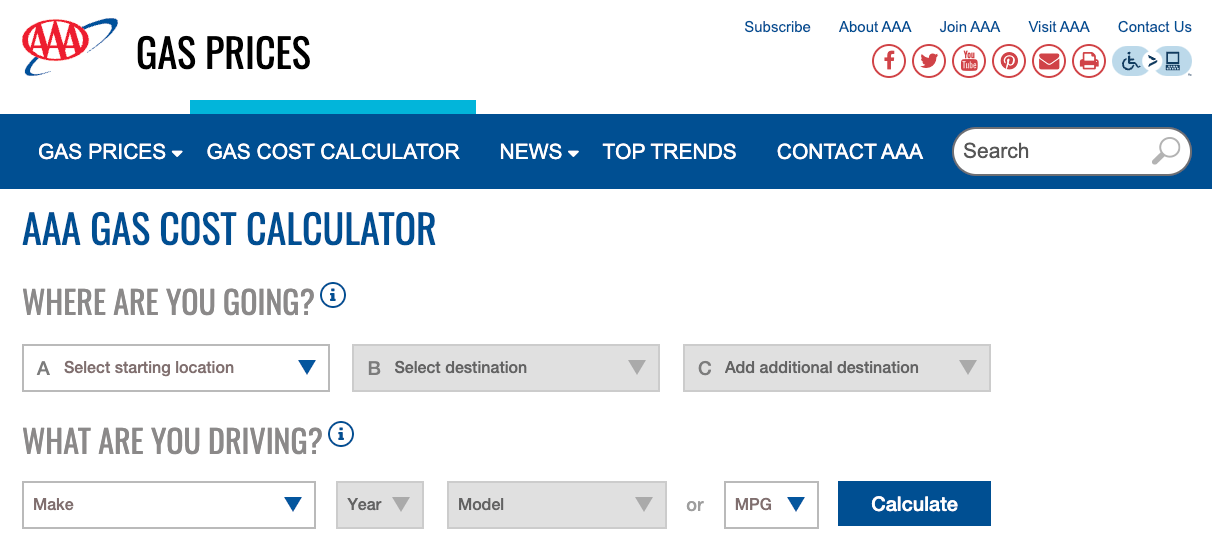
AAA gas calculator
AAA

Compare that price to the flight prices for everyone taking the trip. Flights on weekends or holidays will likely be more expensive, but if your dates are flexible, you may be able to find a good deal.

Choose a flight to anywhere
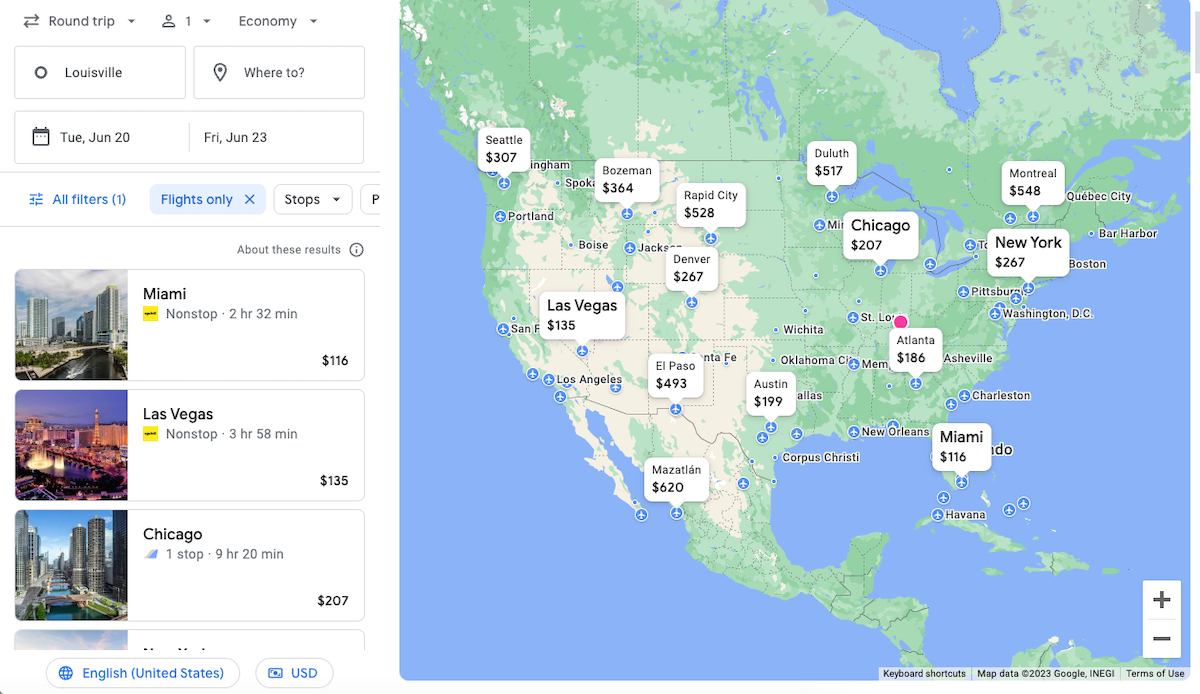
GOOGLE FLIGHTS

If you really want to play a wild card, you can use sites like Google Flights or Skyscanner to search for flights to multiple destinations by typing in only your airport of origin and travel dates. The results will show pricing to multiple destinations, so that you can find the best fit for your budget.

Consider the time commitment

Finally, you can’t forget about the time commitment between driving and flying. For long road trips, is it worth spending all that time stuck in a car staring at the highway to reach your final destination? Would you rather pay more to spend that time at home or at your destination? Or is the journey part of what makes the trip appealing? Only you can answer those questions, and the answer will vary from trip to trip.

A family at an airport with a cart of luggage
JACOBLUND/GETTY IMAGES

On the other hand, flying can take nearly as long as driving in some cases. You must arrive at the airport at least an hour before your flight (usually more), and if you have a connecting flight, you may have to wait through a long layover.

Find ways to save, no matter how you travel

RISKA/GETTY IMAGES

Whether you drive or fly, there are ways to mitigate rising costs.

Before you hit the road, sign up for any (or all) gas rewards programs and download their respective apps. You can save at least a few cents per gallon every time you fill up, and most also allow you to earn points you can redeem for even higher savings. It may not sound like much, but it all adds up.

Related: Top tips for how to save on gas

Some credit cards earn bonus points or cash back at gas stations, like the Citi Strata℠ Card (see rates and fees) (3 points per dollar spent), Blue Cash Preferred® Card from American Express (3% cash back at eligible U.S. gas stations; cash back is received in the form of reward dollars that can be redeemed as a statement credit and at amazon.com checkout) and the Marriott Bonvoy Business® American Express® Card (4 points per dollar spent at U.S. gas stations).

Lastly, if you choose to fly rather than drive, evaluate your points and miles stash as you are planning your trip. You may have enough points to cover some or all of your travel party’s flights, especially if your destination or travel dates are flexible.

Related: How to travel on a budget: Here are our 20 top tips

Bottom line

Driving isn’t always the cheapest way to get where you’re going. Quick road trips can be a great way to save money, but flying can be a surprising way to save money when booking your domestic getaways this year.


Source link

Leave a Reply

Subscribe to Our Newsletter

Get our latest articles delivered straight to your inbox. No spam, we promise.

Recent Reviews


Introduction To The SAP IBP

The SAP IBP (integrated business planning) is a cloud-based business planning software used in supply chain management. The SAP IBP uses real-time integrated information that enables companies to respond quickly. This tool offers integrated, demand and inventory planning, unified planning for sales and operations, and an analytical dashboard for monitoring. 

The SAP IBP is known for its new user experience solution because it offers the following business integrated solutions:

  • Integrated business planning for the sales and operations.
  • Integrated business planning for the demand.
  • Integrated business planning for inventory management.
  • Integrated business planning for supply.
  • Integrated business planning for response planning.

Interested in learning the SAP IBP ? Enroll in our SAP IBP Online Training program now !

SAP IBP Integration Architecture  :

Here we will be explaining how does SAP IBP works, and what are the basic components that it incorporates to perform data integration.

The below SAP IBP architectural image adheres you to know the overall workflow;

IMAGE

There are two possible ways the SAP IBP can integrate the data.

  • File based integration (Open API)
  • Table integration (ABAP)

The SAP smart data integration (SDI) approach integrates the data between the SAP OBP and SAP H/4 HANA.  The SDI approach process the data through back jobs .while the non-supported real-time integration causes the planning and execution issues in the SAP H/4 HANA environment.

After the 2111 version of the SAP H/4 HANA, real-time data integration happens on both SAP on-premise and cloud environments. This version type also supports the master and transactional data integration from source to target systems and also loads the delta data into the source system.

Advantages Of SAP IBP :

We have decided to explain the SAP IBP advantages based on the solution which it offers to integrate the real-time information.

Solution designed for the S &OP Process that supports ;
  • Process modeling.
  • Scenario planning.
  • Easy-to-use user interface both excel and web-based.
  • Social collaborations.
  • Consolidated information from different organizations, especially financial data ex. Price data.
  • Real-time analysis.
Demand planning solutions :
  • S&OP with basic forecasting methods.
  • IBP for demand with advanced statistical forecasting methods including ARIMA models, and gradient boosting or machine learning.
  • IBP for demand for short-term forecasting using demand sensing logics.
Supply planning :
  • S&OP supports technical planning through the heuristic with infinite capacity planning.
  • Supports operational supply planning with response algorithms based on order models.
Monitoring and decision support and reporting :
  • Control tower as a purpose-built solution.
  • Dashboards and customer alerts.
  • case management and social collaborations.
  • Real-time analytics.
  • Performance and management analytics.
Inventory optimization :
  • Multi-stage inventory optimization.
  • Same algorithm as the on-premise solution EIS (enterprise inventory and service level optimization).
  • Fully integrated into IBP.
Available to promise :
  • IBP responses algorithms can generate allocations that are used in ATP.
  • IBP response algorithm can re-schedule and confirm sales orders (response planning).
  • IBP for response can be used additionally to ATP tools (basic ATP ECC and S/4 ), APO -gATP, and S/4 ATO.

SAP IBP Training

  • Master Your Craft
  • Lifetime LMS & Faculty Access
  • 24/7 online expert support
  • Real-world & Project Based Learning

Key Features Of The SAP IBP :

The following are the key features of the SAP IBP;

Let me discuss them one by one:

  • Easy to use interface for planners to review and quickly modify plans.
  • S & OP powered by HANA provides real-time web-based analytics on the entire supply chain model.
  • Data integration: easy integration between any SAP or Non-SAP system and IBP HCI is included as part of the cloud license.
  • Offers real-time S&OP calculations: modeling of the supply chain in real-time during the S&OP cycle.
  • Social collaborations: SAP JAM brings together all functions of the business to solve business-critical problems and drive rapid results. 
  • Rapid simulations: the ability to run what-if scenarios in near real-time to analyze demand, supply, and changes.
  • IBP offers advanced demand sensing, analysis, and predictive forecasting.
  • IBP also provides an embedded social collaboration and MS-Excel-based planning.

Application areas of SAP IBP :

We already know that the benefits of using SAP IBP, now it’s time for us to know which are all the industrial applications adapt SAP IBP:

  • Product profitability 
  • Customer profitability 
  • Capital expenditures 
  • Manufacturing operations.
  • Supply chain operations
  • Business process (information and human-based)
  • Business policy 
  • Market demand curves
  • Competitive strategy

The below image illustrates the overall business planning of Integrated business planning ;

IMAGE

Enroll in our Java Web Dynpro Training program today and elevate your skills!

HKR Trainings Logo

Subscribe to our YouTube channel to get new updates..!

Why technology is important in the SAP IBP?

SAP IBP offers various industry-driven business solutions across the world. Let’s see how SAP IBP changes the business to deliver high-quality outcomes.

Below are the few listed reasons which will explain why high tech companies looking for the SAP IBP solution:

The rapid pace of change : 

The factors include are;

  • A process led by senior management that evaluates and revises for demand, supply, product, and portfolio changes, strategic projects, and the resulting financial plans 
  • Realign the technical plan for all business functions in all graphics to support the company’s business goals and targets.
  • Drive a single consequences operating plan, deploying resources effectively to satisfy customers in a profitable way.
Increasingly complex networks : 
  • Monitor, analyze, and troubleshoot gaps between the business plan, current performance, and projected future performance.
  • Continuously monitor the performance of finance, product portfolio, sales, and operations against projections in real-time.
  • Identify and analyze gaps, and predict future performance.
  • Sense and predict market direction and customer needs quickly.
Global competitions :
  • React and execute a dynamic strategy.
  • Ability to make make and execute decisions in hours and days, not weeks and months.
  • Manage business risks and take advantage of market opportunities by quickly aligning operations plans.
  • Ability to develop deep customer insights, segment customers, and align service levels to maximize profitability.
  • Manage the complex supplier and partner network with real-time visibility, enabling agile operations with system-assisted decision support and management by exceptions.

Differences between the SAP IBP and traditional S&OP :

The major differences between the SAP IBP and traditional S &OP are as follows;

We are going to explain the differences according to their features:

Business objective :

  • Traditional S &OP offers supply and demand balancing.
  • Whereas IBP is not about matching demands and customer needs. They also consider several plan alternatives and choose one that best represents the business drivers, the objective is revenue and profit

Process :

  • Traditional S&OP offers processes in a Rigid and perspective way.
  • Whereas the IBP process is more rules and exception-based.

Technology :

  • Traditional S&OP provides a weak and non-integrated technology.
  • Whereas in SAP IBP, the technologies enable the process through the workflow.

Frequency :

  • The frequency of the traditional S&OP available on a monthly or quarterly basis.
  • SAP IBP is still available on a monthly basis in a lot of cases but with the ability to rapidly handle exceptional situations.

Focus :

  • Traditional S&OP provides an inward focus.
  • The SAP IBP offers a collaborative and outward focus.

Join our SAP Ariba Training In Pune today and enhance your skills to new heights!

SAP IBP Training

Weekday / Weekend Batches

Final Words :

In this SAP IBP blog, we have tried to explain the concepts in such a way that even non-SAP programmers can also read our blogs. We adhere to all our SAP community people to stay tuned to our website to know more about SAP updated posts.

Related Articles:

SAP Supply Chain Management


Source link