
If you’re traveling domestically in the U.S. and trying to save money, deciding whether to drive or fly can be an important decision.

You may assume a road trip is always cheaper for those traveling on a budget, but as fuel prices surge due to the ongoing conflict in the Middle East, that’s not necessarily true. As of April 14, 2026, AAA pegged the national average fuel price at $4.12 per gallon for regular gasoline, up from $3.18 from this time last year.

It goes without saying that flying is almost always faster than driving, but, as with calculating the cost of driving to your destination, airfare prices are similarly volatile right now. Domestic airfare for summer 2026 is trending nearly 15% higher than last year, and that goes for cash fares and points pricing alike.

In 2026, the cheapest option isn’t always what you might think, especially when you factor in credit cards, points and miles and rewards programs that can help you save.

Here’s how to determine which transport mode is best for you and your budget.

How to calculate the cost of driving vs. flying

THOMAS BARWICK/GETTY IMAGES

It’s best to start by breaking out some good ol’ pen and paper (and ideally a calculator, unless you still remember everything you learned in high school) to do the math. Let’s examine the numbers of a hypothetical trip between Chicago and Denver.

A June 2026 flight between Chicago’s O’Hare International Airport (ORD) and Denver International Airport (DEN) costs as little as $271 round-trip with United Airlines if you choose a Main Cabin economy ticket.

If you make the same trip in your car, you’ll drive about 2,000 miles round-trip. Assuming gas costs $4.12 per gallon, and you’d make the drive in a vehicle with a gas tank capacity of 14 gallons and a fuel economy of 25 miles per gallon, you would need to fill your car with fuel 5.71 times to get from Chicago to Denver, totaling $329.35.

Related: Fuel surcharges and higher fares hit travelers’ wallets: How you can prepare

Reward your inbox with the TPG Daily newsletter

Join over 700,000 readers for breaking news, in-depth guides and exclusive deals from TPG’s experts

For a solo trip, flying between Chicago and Denver is cheaper than driving. However, if you’re traveling as a family or with more than one person, driving is a far cheaper option per head.

delta-wing-airplane-view-mountains-window-landscape
DARREN MURPH/THE POINTS GUY

Of course, you may want to get a hotel room to break up the drive, and you’ll have to stop for meals along the way. Both of those add to the trip’s cost, and you’ll need to factor them into your calculations.

Consider how many people are in your travel party

If you find a great flight deal or book with a low-cost airline, you can score one-way flights for under $100. However, that cost goes up when you throw in a spouse and kids. If you travel with a large group, flying may be more expensive than driving — even if you add the cost of gas, meals and an overnight hotel room.

Use a calculator to help compare costs

How do you determine whether flying or driving is the more affordable trip for you? The best way is to crunch the numbers, as shown in the example above.

Consider how much it costs to fill up your car’s gas tank and how many times you’d need to do so for the trip. Then, add estimates for food stops along the way as well as any accommodations you’ll need if it’s a multiday journey.

Tools like AAA’s easy-to-use gas cost calculator do most of the work for you. Plug in your point of origin, your destination, and the make and model of your car to find out how much you’ll pay in gas to get where you are going.
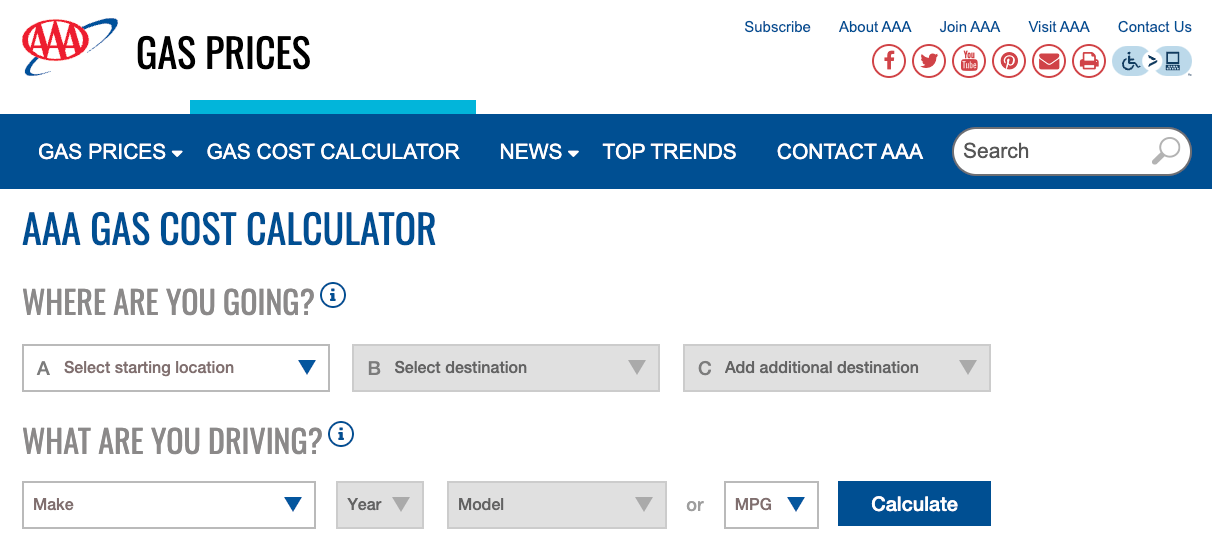
AAA gas calculator
AAA

Compare that price to the flight prices for everyone taking the trip. Flights on weekends or holidays will likely be more expensive, but if your dates are flexible, you may be able to find a good deal.

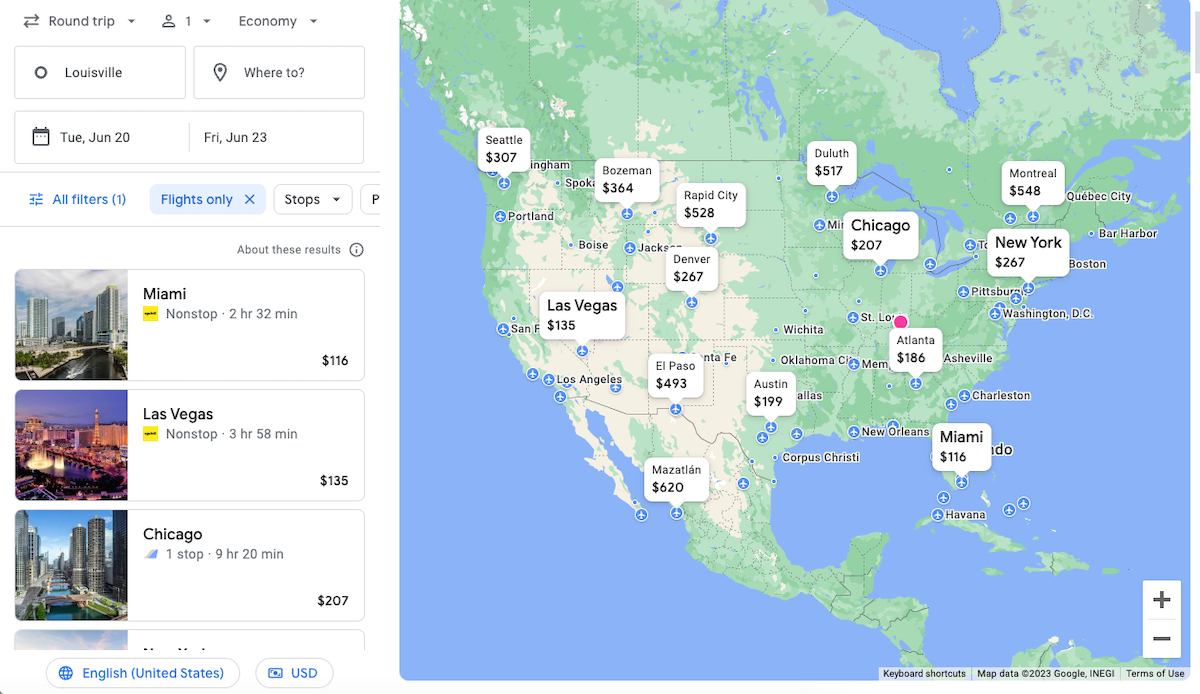
Choose a flight to anywhere
GOOGLE FLIGHTS

If you really want to play a wild card, you can use sites like Google Flights or Skyscanner to search for flights to multiple destinations by typing in only your airport of origin and travel dates. The results will show pricing to multiple destinations, so that you can find the best fit for your budget.

Consider the time commitment

Finally, you can’t forget about the time commitment between driving and flying. For long road trips, is it worth spending all that time stuck in a car staring at the highway to reach your final destination? Would you rather pay more to spend that time at home or at your destination? Or is the journey part of what makes the trip appealing? Only you can answer those questions, and the answer will vary from trip to trip.

A family at an airport with a cart of luggage
JACOBLUND/GETTY IMAGES

On the other hand, flying can take nearly as long as driving in some cases. You must arrive at the airport at least an hour before your flight (usually more), and if you have a connecting flight, you may have to wait through a long layover.

Find ways to save, no matter how you travel

RISKA/GETTY IMAGES

Whether you drive or fly, there are ways to mitigate rising costs.

Before you hit the road, sign up for any (or all) gas rewards programs and download their respective apps. You can save at least a few cents per gallon every time you fill up, and most also allow you to earn points you can redeem for even higher savings. It may not sound like much, but it all adds up.

Related: Top tips for how to save on gas

Some credit cards earn bonus points or cash back at gas stations, like the Citi Strata℠ Card (see rates and fees) (3 points per dollar spent), Blue Cash Preferred® Card from American Express (3% cash back at eligible U.S. gas stations; cash back is received in the form of reward dollars that can be redeemed as a statement credit and at amazon.com checkout) and the Marriott Bonvoy Business® American Express® Card (4 points per dollar spent at U.S. gas stations).

Lastly, if you choose to fly rather than drive, evaluate your points and miles stash as you are planning your trip. You may have enough points to cover some or all of your travel party’s flights, especially if your destination or travel dates are flexible.

Related: How to travel on a budget: Here are our 20 top tips

Bottom line

Driving isn’t always the cheapest way to get where you’re going. Quick road trips can be a great way to save money, but flying can be a surprising way to save money when booking your domestic getaways this year.


Source link

Leave a Reply

Subscribe to Our Newsletter

Get our latest articles delivered straight to your inbox. No spam, we promise.

Recent Reviews


What Are Selection Techniques

Selection techniques in machine learning help in reducing the noise by taking in only the relevant data after the pre-processing. The techniques have the ability to choose the relevant variables according to the type of user’s problem. In case any data comes up that is not relevant to the requirement, it tends to slow down the efficiency process of the model and also decrease the accuracy. Therefore, it is very important to have appropriate feature selection techniques for the models in order to have better outcomes and accuracy. 

The main idea of working with selection techniques is to manually extract the relevant settings from the parent set to have high-accuracy model structures.

Feature Selection in Machine learning

The techniques are divided into the category of supervised and unsupervised learning. These two categories are further divided into 4 main methods for selecting the features.

Filter Method :

There are statistical ways for selecting the features using the filter method. The features are selected in the pre-processing stage as there is no learning process involved in this. The aim of this approach is to filter out the unrequired and irrelevant features by using matrices and ranking methods. The most important advantage of using the filter method is that it does not overfit the data.

IMAGE

Wrapper Method :

In this method, a user makes different combinations that are evaluated or compared with a lot of other possible combinations. In this way, the feature selection is done. A subset of features is selected and the algorithm is trained based on the subset. The output of the algorithm then decides if the features will be added or not. This method is further based on 4 types which are:

  • Forward Selection : This process takes in an empty feature set. It keeps adding a feature to each interaction and checks the progress simultaneously as if it is improving or not. This method keeps on iterating unless there comes a feature that does not improve the progress of the model.
  • Backward Elimination : This approach is the complete opposite of the forward selection approach. The process takes in all the features of the algorithm and then keeps removing a feature one by one on each iteration. It checks the progress simultaneously as if it is improving or not. This method keeps on iterating unless there comes a feature that does not improve the progress of the model.
  • Exhaustive Feature Selection : It is the most common approach for feature selection as each feature is set as brute-force. The approach aims to try various combinations of features in order to give the best outcome.
  • Recursive Feature Elimination : This method is based on the greedy approach as its features are selected in a smaller amount. An estimator is made to test every set of features designed and thus we get an outcome of the best features.
  • IMAGE
Embedded Method :

This is a great method for feature selection as it has the advantages for both filter and wrapper methods collectively. The processing time in the embedded method is very high just like the filter method, however, they provide more accurate outcomes.

IMAGE

There are a few techniques involved with embedded methods which are:

  • Regularisation : This aims at regularising the feature selection method simply by adding a penalty if the data gets overfitted in the model. The points shrink to a value of 0 and they are eliminated from the dataset. The types of regularizations are L1, L2, L3, etc. 
  • Random Forest Importance : This technique involves a lot of tree-based approaches to select the features for an algorithm. A number of decision trees are involved in this as the ranking of nodes is performed in all the trees to get the results. After filtering out the irrelevant nodes, a subset of the most relevant nodes creates a final selection of features.
Hybrid Method :

This approach takes in features as small-sized samples. The main idea is to select the features using instance learning. The features that correspond to the instances are selected as they are relevant to the algorithm.

Want to Become a Master in Machine Learning? Then visit here to Learn Machine Learning Training

Machine Learning Training

  • Master Your Craft
  • Lifetime LMS & Faculty Access
  • 24/7 online expert support
  • Real-world & Project Based Learning

Feature Selection Models

Supervised Model :

This model is defined as the class of machine learning methodologies where the user can train with the help of continuous and well-labelled data. For instance, the data can be historical data where the user wishes to predict whether a customer will take a loan or not. Supervised algorithms tend to train over the well-structured data after the preprocessing and feature characterization of this labelled data. It is further tested on a completely new data point for the prediction of a loan defaulter. The most popular supervised learning algorithms are the k-nearest neighbour algorithm, linear regression algorithm, logistic regression, decision tree, etc.

This is further divided into 2 categories:

  • Regression: The dealing of output variables is done using regressions as it includes graphs, images, etc. For example to determine age, height, etc. 
  • Classification: it helps in classifying different objects such as yellow, orange, wrong or right, etc.
Unsupervised Model

This model is defined as a class of machine learning methodologies where the tasks are performed using the unlabelled data. Clustering is the most popular use case for unsupervised algorithms. It is defined as the process of grouping similar data points together without manual intervention. The most popular unsupervised learning algorithms are k-means, k-medoids, etc. 

This is further divided into 2 categories:

  • Clustering :This means when the machine requires an inherent group while training the data.
  • Association :This category has a set of rules which helps in the identification of massive data. For example, a list of students who could be interested in artificial intelligence as well as machine learning.
HKR Trainings Logo

Subscribe to our YouTube channel to get new updates..!

How To Choose a Feature Selection Model

It is very important for machine learning engineers as well as researchers to understand which feature selection model is most suitable for them. The most data types are known by the engineer, the easier it will be for him to choose properly and wisely. This whole concept is based on 4 main approaches which are:

  • Numerical Input, Numerical Output : There are two methods used in this technique which are Pearson’s correlation coefficient and Spearman’s Rank Coefficient.  The numerals are basically used for the prediction of regression models for continuous numerical such as int, float, etc. 
  • Numerical Input, Categorical Output : There are two methods used in this technique which are the ANOVA correlation coefficient, and Kendall’s rank coefficient. The numerals are basically used for the classification of predictive models for continuous numerical such as int, float, etc. 
  • Categorical Input, Numerical Output : This is a case of the prediction of regression models using input based on categories. The process is the same as numerical input, and categorical output but in a reverse fashion. 
  • Categorical Input, Categorical Output : This is a case of classification of predictive models using both categorical inputs as well as outputs. The main approach affiliated with this method is the Chi-squared method. Moreover, information gain can also be used with this technique.

Machine Learning Training

Weekday / Weekend Batches

Conclusion:

The process of selecting features in machine learning is a vast concept and it involves a lot of research to select the best features. However there is no hard and fast rule for making the selection, it all depends on the type of model and its algorithm and how a machine learning engineer wants to pursue it. Selection techniques in machine learning help in reducing the noise by taking in only the relevant data after the pre-processing. 

In this article, we have talked about various feature selection methods that use certain algorithms for making the best possible outcomes and why we should make this feature selection method. Along with this, we have talked about how we can finalise the best feature selection model to work with.

Related Articles:

EDA in Machine learning


Source link