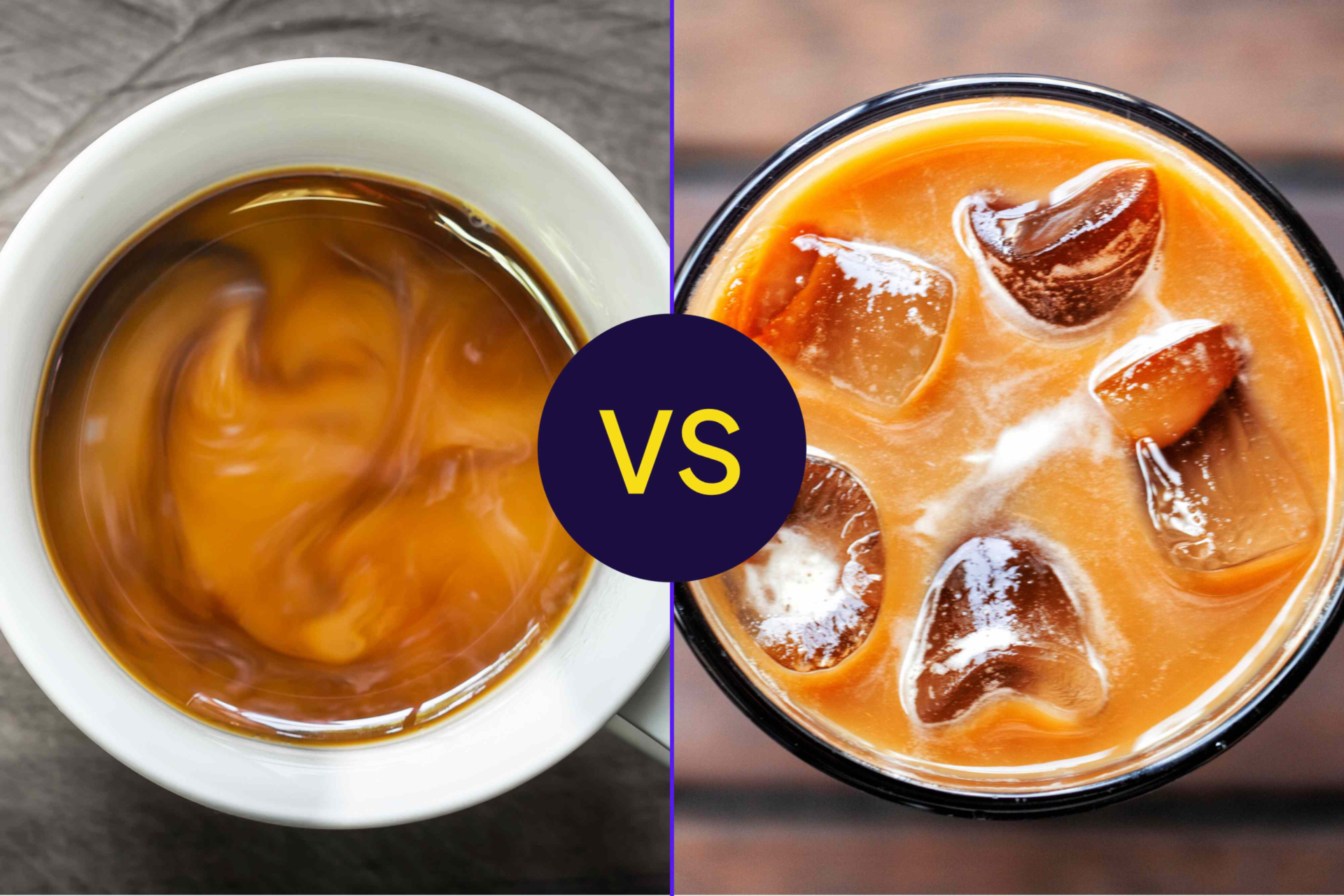
Cold brew coffee can sometimes contain more caffeine than hot coffee depending on how it’s made. Credit: Xesai / PJjaruwan / Getty Images
Caffeine levels vary more by brewing method than temperature.
Hot coffee may have slightly more antioxidants, while cold brew is often perceived as smoother and less acidic.
The biggest may come from what you add, like sugars and creamers—not whether your coffee is hot or iced.
Hot or iced? It’s a common coffee question—but does the temperature of your drink actually change how it affects your body?
How Caffeine Content and Energy Effects Compare
Hot coffee, iced coffee, and cold brew can have varying levels of caffeine. This depends on many different factors, including the type of bean, grind size, time spent brewing, and how the coffee is prepared or diluted.
Iced coffee and cold brew are also often confused, but they’re made differently: iced coffee is typically brewed hot and then cooled over ice, while cold brew is steeped in cold water for 12–24 hours.
Research suggests that caffeine content can vary widely between brewing methods. Since iced coffee is often served over ice, it may contain slightly less caffeine due to dilution. However, cold brew can sometimes contain more caffeine because of its longer extraction time.
Additionally, some research shows that light and medium roast coffees may contain slightly more caffeine than dark roast coffee—the roasting process may burn off some of the caffeine content. Certain beans may contain more caffeine than others as well—robusta coffee beans, for example, can have almost twice as much caffeine as arabica beans.
While caffeine certainly influences energy levels, temperature and context can also play a role in how energizing your drink feels. Cold coffee may feel more refreshing, while hot coffee in the morning may make you feel more stimulated.
What you add to your coffee may also have a significant effect on perceived energy levels. Creamers and flavorings that are high in added sugars can quickly spike blood sugar levels, but lead to a rapid drop afterward.
Which Has More Antioxidants?
Coffee is well known to be an excellent source of antioxidants (or polyphenols) like quercetin and flavonoids, which can help reduce inflammation in the body and may offer neuroprotective, cardioprotective, and immune health benefits.
But between hot coffee and cold brew, which boasts more of these compounds? Some research suggests that hot brewing may extract slightly more antioxidants from coffee grounds than cold brew, including compounds like chlorogenic acids.
That said, differences between these coffee options were modest, and both offer meaningful amounts of antioxidants.
Which Is Easier on Your Stomach?
The acidic nature of coffee can be a source of discomfort for people with acid reflux, also known as gastroesophageal reflux disease (GERD).
Evidence shows that while the acid content of hot coffee and cold brew is similar, hot coffee has slightly higher acidity levels. Further research highlights this difference—though, again, it’s marginal.
Acid reflux symptoms in response to coffee can be highly individualized and vary widely, so some trial and error can help determine which option works best for those with GERD. Some people also find cold brew to be smoother and easier on the stomach, although this may be due to factors beyond acidity.
How to Choose the Right Coffee for You
All options—hot coffee, iced coffee, and cold brew—can be healthy choices.
However, there are some slight differences if you’re looking for specific benefits. Hot coffee may offer slightly higher levels of antioxidants, while cold brew is often perceived as smoother and less acidic.
Temperature itself may also influence your experience: Hot drinks can feel more soothing and may support digestion for some people, while cold drinks can feel more refreshing and hydrating—especially in warmer weather.
Keep in mind that coffee drinks may also include added sugars, syrups, or cream, which can significantly increase calorie content and impact blood sugar levels.
Ultimately, these differences are generally minimal, so personal preference is the biggest factor to consider.
Data science is the study of how to gain insightful knowledge from data for business choices, developing strategies, and other reasons utilizing state-of-the-art analytical technologies and scientific ideas. Businesses are becoming aware of its significance: among other things, data science insights assist companies in improving their marketing and sales efforts as well as operational effectiveness. They might eventually give you a competitive edge over other businesses.
Data Science combines a number of fields, including statistics, mathematics, software programming, predictive analytics, data preparation, data engineering, data mining, machine learning, and data visualization. Skilled data scientists are generally responsible for it, however, entry-level data analysts may also be engaged. Additionally, a growing number of firms now depend in part on citizen data scientists, a category that can encompass data engineers, business intelligence (BI) specialists, data-savvy business users, business analysts, and other employees without a formal experience in Data Science.
Become a Data ScienceCertified professional by learning this HKRData Science Training!
What is Linear Algebra
Within Data Science and ML, linear algebra is a field of mathematics that is very helpful. In machine learning, linear algebra is perhaps the most crucial math concept. The vast majority of machine learning models may be written as matrices. A matrix is a common way to represent a dataset. The preprocessing, transformation, and assessment of data and models require linear algebra.
A study of linear algebra may involve the following:
Vectors
Matrices
Transpose of a matrix
The inverse of a matrix
Determinant of a matrix
Trace of a matrix
Dot product
Eigenvalues
Eigenvectors
Why learn Linear Algebra in Data Science?
One of the fundamental building elements of Data Science is linear algebra. Without a solid foundation, you cannot erect a skyscraper, can you? Try to picture this example:
You wish to use Principal Component Analysis to minimize the dimensionality of your data (PCA). If you were unsure of how it would impact your data, how would you choose how many Principal Components to keep? Obviously, in order to make this choice, you must be familiar with the workings of the algorithm.
You will be able to gain a better sense for ML and deep learning algorithms and stop treating them as mysterious black boxes if you have a working knowledge of linear algebra. This would enable you to select suitable hyperparameters and create a more accurate model. Additionally, you would be able to develop original algorithms and algorithmic modifications.
Linear Algebra Applications for Data Scientists
We will now learn more about the most common application of linear algebra for data scientists:
Machine learning: loss functions and recommender systems
Without a question, the most well-known use of artificial intelligence is machine learning (AI). Systems automatically learn and get better with experience employing machine learning algorithms, free from human intervention. In order to detect trends and learn from them, machine learning works by creating programs that access and analyze data (whether static or dynamic). The algorithm can use this expertise to analyze fresh data sets once it has identified relationships in the data. (See this page for more information on how algorithms learn.)
Machine learning uses linear algebra in many different ways, including loss functions, regularization, support vector classification, and plenty more.
Machine learning algorithms function by gathering data, interpreting it, and then creating a model via various techniques. They can then forecast upcoming data queries depending on the outcomes.
Now, we may assess the model’s correctness by utilizing linear algebra, specifically loss functions. In a nutshell, loss functions provide a way to assess the precision of the prediction models. The output of the loss function will be greater if the model is completely incorrect. In contrast, a good model will cause the function to return a lower value.
Modeling a link involving a dependent variable, Y, and numerous independent variables, Xi’s, is known as regression. We attempt to build a line in place on these variables upon plotting these points, and we utilize this line to forecast future values of Xi’s.
The two most often used loss functions are mean squared error and mean absolute error. There are many different forms of loss functions, many of which are more complex than others.
A subset of machine learning known as recommender systems provides consumers with pertinent suggestions based on previously gathered data. In order to forecast what the present user (or a new user) might like, recommender systems employ data from the user’s prior interactions with the algorithm focused on their interests, demographics, and other available data. By tailoring material to each user’s tastes, businesses can attract and keep customers.
The performance of recommender systems depends on two types of data being gathered:
Characteristic data: Knowledge of things, including location, user preferences, and details like their category or price.
User-item interactions: Ratings and the volume of transactions (or purchases of related items).
Artificial intelligence’s Natural Language Processing (NLP) field focuses on how to connect with people through natural language, most frequently English. Applications for NLP encompass textual analysis, speech recognition, and chatbot.
Applications such as Grammarly, Siri, and Alexa are all based on the concept of NLP.
Word embedding
Text data cannot be understood by computers, not by its own. We use NLP algorithms on text since we need to mathematically express the test data. The use of algebra is now necessary. A sort of word representation known as word embedding enables ML algorithms to comprehend terms with comparable meanings.
With the backdrop of the words still intact, word embeddings portray words as vectors of numbers. These representations are created using the language modeling learning technique of training various neural networks on a huge corpus of text. Word2vec is among the more widely used word embedding methods.
Computer vision: image convolution
Using photos, videos, and deep learning models, the artificial intelligence discipline of computer vision teaches computers to comprehend and interpret the visual environment. This enables algorithms to correctly recognize and categorize items.
In applications like image recognition as well as certain image processing methods like image convolution and image representation like tensors, we utilize linear algebra in computer vision.
Image Convolution
Convolution results from element-wise multiplying two matrices and then adding them together. Consider the image as a large matrix and the kernel (i.e., convolutional matrix) as just a tiny matrix used for edge recognition, blurring, as well as related image processing tasks. This is one approach to conceiving image convolution. As a result, this kernel slides over the image from top to bottom and from left to right. While doing so, it performs arithmetic operations at every image’s (x, y) location to create a distorted image.
Different forms of image convolutions are performed by various kernels. Square matrices are always used as kernels. They are frequently 3×3, however, you can change the form depending on the size of the image.
Acquire Data Science with R certification by enrolling in the HKR Data Science with R Training program in Hyderabad!
Subscribe to our YouTube channel to get new updates..!
Where do we use linear algebra in Data Science?
Data Scientists often make use of Linear Algebra for various applications including:
Vectorized Code: To create vectorized codes that are relatively more effective than their non-vectorized counterparts, linear algebra is helpful. This is so that results from vectorized codes can be produced in a single step instead of results from non-vectorized codes, which frequently involve numerous steps and loops.
Dimensionality Reduction: In the preparation of data sets required for machine learning, dimensionality reduction is a crucial step. This is particularly true for big data sets or those with many attributes or dimensions. Many of these characteristics may occasionally have a strong correlation with one another.
The speed and effectiveness of the ML algorithm are improved by doing dimensionality reduction on a big data set. This is due to the fact that the algorithm only needs to consider a small number of features before producing a forecast.
Linear Algebra for Data Preprocessing – Linear algebra is used for data preprocessing in the following way:
Import the required libraries for linear algebra such as NumPy, pandas, pylab, seaborn, etc.
Read datasets and display features
Define column matrices to perform data visualization
Covariance Matrix– One of the most crucial matrices in Data Science and ML is the covariance matrix. It offers details on the co-movement (correlation) of characteristics. We can create a scatter pair plot to see how the features are correlated. One could construct the covariance matrix to determine the level of multicollinearity or correlation between characteristics. The covariance matrix could be written as a symmetric and real 4 x 4 matrix. A unitary transformation, commonly known as a Principal Component Analysis (PCA) transformation, can be used to diagonalize this matrix. We note that the sum of the diagonal matrix’s eigenvalues equals the total variance stored in features because the trace of a matrix stays constant during a unitary transformation.
Linear Discriminant Analysis Matrix – The Linear Discriminant Analysis (LDA) matrix is another illustration of a realistic and symmetrical matrix in Data Science. This matrix could be written as follows
where SW stands for the scatter matrix within the feature and SB for the scatter matrix between the feature. It implies that L is real and symmetric because the matrices SW & SB are also realistic and symmetrical. A feature subspace with improved class separability and decreased dimensionality is created by diagonalizing L. So, whereas PCA is not a supervised method, LDA is.
Data Science Certification Training
Weekday / Weekend Batches
Conclusion
Often a skipped-over concept due to premeditated assumptions of difficulty, a good hold over linear algebra could help build a crucial foundation for those aspiring to have flourishing careers in Data Science.
To provide the best experiences, we use technologies like cookies to store and/or access device information. Consenting to these technologies will allow us to process data such as browsing behavior or unique IDs on this site. Not consenting or withdrawing consent, may adversely affect certain features and functions.
Functional
Always active
The technical storage or access is strictly necessary for the legitimate purpose of enabling the use of a specific service explicitly requested by the subscriber or user, or for the sole purpose of carrying out the transmission of a communication over an electronic communications network.
Preferences
The technical storage or access is necessary for the legitimate purpose of storing preferences that are not requested by the subscriber or user.
Statistics
The technical storage or access that is used exclusively for statistical purposes.The technical storage or access that is used exclusively for anonymous statistical purposes. Without a subpoena, voluntary compliance on the part of your Internet Service Provider, or additional records from a third party, information stored or retrieved for this purpose alone cannot usually be used to identify you.
Marketing
The technical storage or access is required to create user profiles to send advertising, or to track the user on a website or across several websites for similar marketing purposes.

:max_bytes(150000):strip_icc():format(jpeg)/HDC-hot-vs-iced-coffee-892801680193462aab0c4343ff047fdf.png "A comparison of hot coffee and iced coffee with a VS in the center")