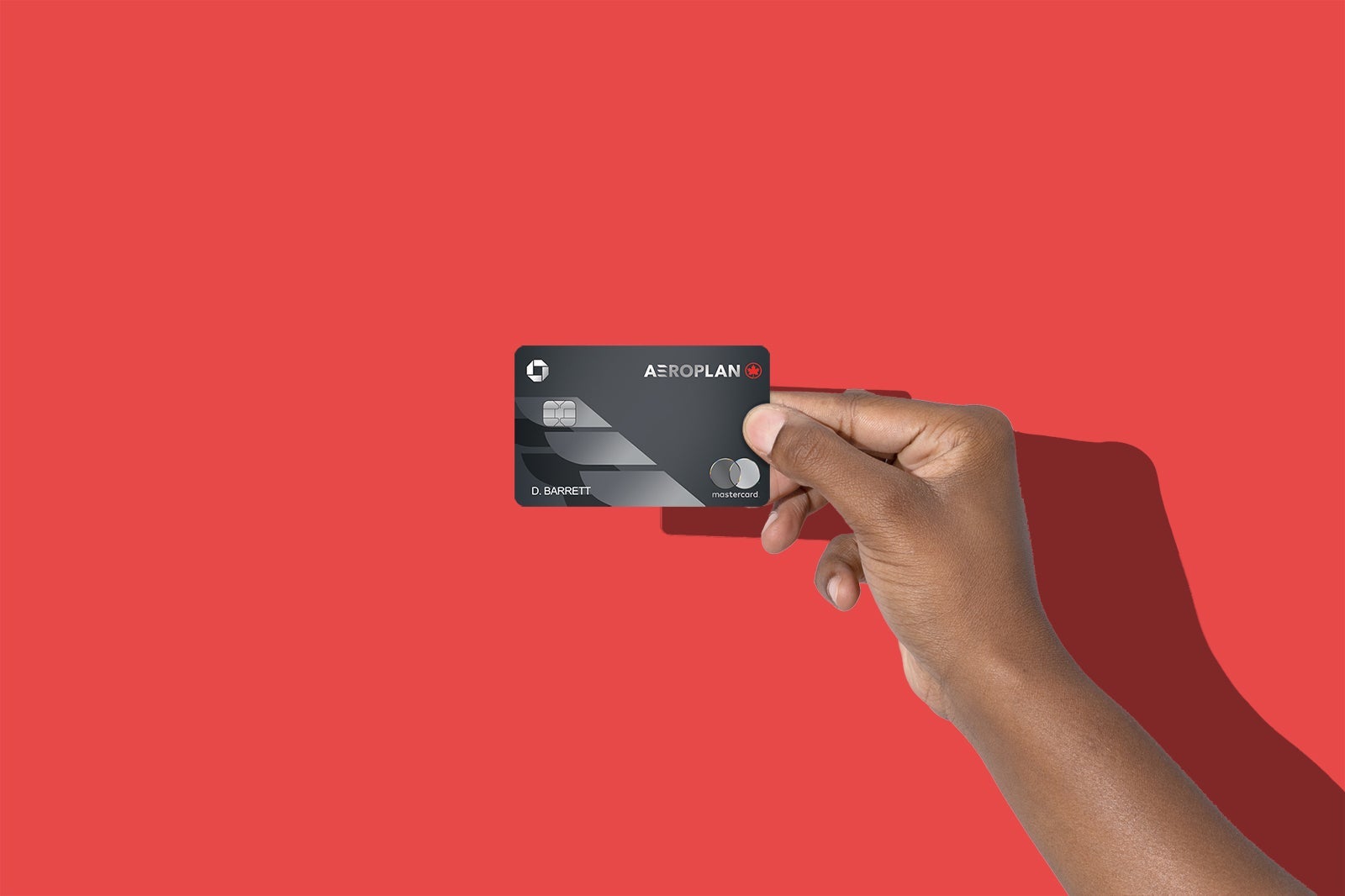
Chase’s Aeroplan® Credit Card (see rates and fees) is one of our favorite cobranded airline credit cards, offering award flexibility and valuable airline benefits. With its strong earning rate and incentives to spend on the card beyond earning the welcome bonus, the Aeroplan Credit Card is worth considering for many points and miles enthusiasts — even those who don’t live in Canada. Card rating*: ⭐⭐⭐⭐
*Card rating is based on the opinion of TPG’s editors and is not influenced by the card issuer.
The Aeroplan Credit Card offers unique benefits we’ve rarely seen on other cobranded airline cards, all for a reasonable annual fee of $95.
You’ll most likely need a good credit score of at least 670 to get approved for this card.
If the ability to use points on more than 50 partner airlines worldwide and automatic elite status appeal to you, keep reading.
New cardholders of the Aeroplan Credit Card can earn 75,000 bonus points after spending $4,000 on purchases in the first three months from account opening.
This offer is worth $1,050, according to TPG’s April 2026 valuations.
Reward your inbox with the TPG Daily newsletter
Join over 700,000 readers for breaking news, in-depth guides and exclusive deals from TPG’s experts
THE POINTS GUY
This is an elevated offer above the usual 60,000 to 70,000 bonus points, making now a compelling time to apply.
Keep in mind that since Chase issues this card, it’s subject to Chase’s 5/24 rule. If you’ve opened five or more credit cards in the past 24 months, you may not be eligible to open the Aeroplan Credit Card.
One of the standout features of the Aeroplan Credit Card is automatic elite status.
Status-linked benefits
New cardholders receive Aeroplan 25K status for the remainder of the calendar year in which they’re approved, plus the entire following calendar year. We recommend applying early in the year to maximize this benefit.
Aeroplan 25K status includes perks such as:
Star Alliance Silver status (priority waitlisting and standby)
Priority check-in and boarding
Complimentary checked baggage (two bags, 23kg each) on Air Canada flights
Five eUpgrade credits for cabin upgrades
Complimentary Avis Preferred Plus elite status
After the introductory period, you can retain or build on your Aeroplan elite status through a combination of spending and overall program activity.
AIR CANADA
The card helps by contributing Status Qualifying Credits (SQC) — the primary metric used to earn and maintain status — as follows:
5,000 SQC headstart each calendar year
10,000 additional SQCs when cardholders spend $25,000 in a calendar year
10,000 additional SQCs when cardholders spend $50,000 in a calendar year
This means you can earn up to 25,000 SQC per year from the card.
For context, higher tiers of Aeroplan status require increasing amounts of SQC. With significant spending, the card can meaningfully accelerate your progress.
For example, spending $75,000 in a calendar year can help you reach Aeroplan 35K status.
In addition, Aeroplan offers Milestone Benefits — extra perks unlocked as you earn SQC throughout the year, typically in increments of 10,000 SQC.
While the Aeroplan Credit Card can give you a strong head start and boost, it works best alongside flying and partner activity rather than as a stand-alone path to elite status.
Non-status-linked benefits
Even if you don’t maintain your elite status beyond the first year, here are all of the other benefits you’ll get from the Aeroplan Credit Card:
First free checked bag on Air Canada flights for primary cardholders and up to eight companions on the same reservation
Travel protections, such as auto rental insurance, baggage delay insurance, roadside assistance, trip cancellation and interruption insurance and trip delay reimbursement
For every $2,000 you spend on the card each month, you can receive up to a 500-point bonus (up to 1,500 points per month; maximum 18,000 points annually). These bonus points can add up if you’re a heavy spender.
This benefit will come in handy if you plan on spending heavily on the Aeroplan Credit Card to maintain 25K status or elevate your status to another tier.
For those who prefer a simple redemption option, the Aeroplan Credit Card offers Chase’s Pay Yourself Back feature, allowing you to redeem points for statement credits toward recent purchases.
Cardholders can currently redeem points at the following rates:
Travel purchases† and the card’s annual fee: 1.25 cents per point
Dining, gas stations and grocery stores‡: 0.8 cents per point
†Up to 200,000 points (or $2,500) per year
‡Excluding Target, Walmart and wholesale clubs
Eligible purchases must typically be made within 90 days before the redemption request.
This provides a straightforward way to offset everyday expenses, especially if you’re not looking to maximize award travel.
This card’s Pay Yourself Back categories may change annually.
You can redeem your points for flights to over 1,300 destinations through Air Canada’s more than 50 airline partners, including Star Alliance airlines and for generally fewer points than you’d need with other loyalty programs.
Even better, Air Canada publishes distance-based award charts with tons of sweet spots to look out for. For example, you can fly from Seattle-Tacoma International Airport (SEA) to Frankfurt Airport (FRA) on Lufthansa business class for just 70,000 points.
ZACH GRIFF/THE POINTS GUY
Alongside the Aeroplan Credit Card, if you also have a Chase Ultimate Rewards earning card like the Chase Sapphire Reserve® (see rates and fees), you’ll receive a 10% bonus on every 50,000 or more Chase Ultimate Rewards points you transfer to Aeroplan (maximum 25,000 bonus points per calendar year).
Which cards compete with the Aeroplan Credit Card?
The Aeroplan Credit Card has a $95 annual fee, which is comparable to the price of other popular travel credit cards that earn transferable rewards. Let’s compare some same-caliber credit cards and determine if the Aeroplan Credit Card is the best option for you.
For additional options, check out our full list of the best travel cards.
With solid perks for just a $95 annual fee, the Aeroplan Credit Card can be well worth it for the average consumer, especially if you can capitalize on the complimentary 25K status offered to new cardholders.
Even if you’re not a regular flyer of Air Canada — or perhaps have never flown the airline at all — chances are that you’ve flown its Star Alliance partners. We recommend the Aeroplan card as a strong option for many frequent travelers so they can maximize the loyalty program’s lucrative award chart.
Complimentary elite status is a meaningful perk, no matter the airline. And with Aeroplan points being one of the most valuable airline currencies out there, this credit card is an excellent way to help you book your dream vacation using points to save money on flights — no matter where you may be going.
Who can use the Salesforce Lightning Design System?
The Salesforce Lightning Design System gives you everything you need to develop user interfaces that follow Salesforce Lightning’s concepts, design style, and practice guidelines. Developers may concentrate on app logic instead of pixels, whereas developers could concentrate on customer experience, interfaces, and workflows. The website offers a variety of services for developers and designers, including:
Component markup that is both meaningful and accessible.
CSS that is cross-browser compatible.
Design guidelines, icons, and fonts
The three users are as follows:
Developers
Make sure you’re familiar with the ones that follow:
Have a quick rundown of the Markup and Style rules, along with the CSS class naming practices.
Examine the Components; for each offers semantically valid and readily available markup and documentation.
Take a look at the platform-specific setup instructions beneath.
Designers Begin with the following:
Learn about the Salesforce product development patterns and concepts by looking through the Guidelines.
Examine the Components section to become familiar with the current components that you can use in your projects.
Design Guidelines
The Lightning Design System is based on the Salesforce product’s designs and components. While creating applications and solutions inside the Salesforce ecosystem, such designs and elements could provide specific language and uniform appearance and experience.
Design Concepts:
When we make design choices at Salesforce, we always keep those key points into consideration, and also inspire you to do the same.
Clarity: Get rid of any ambiguity. Allow individuals to confidently perceive, comprehend, and act.
Efficiencies: Simplify and improve workflows. Predict requirements wisely to help individuals perform better, wiser, and quicker.
Employing the very same approach to a certain situation creates familiarity and strengthens instinct.
Beauty: By deliberate and exquisite craftsmanship, show respect for a person’s attention and time.
Lightning
In Lightning, begin using the Lightning Design System. Kindly give particular attention to the criteria for such Lightning technology you’re using:
There’s a great deal of discussion nowadays about Salesforce Lightning Components being used in Salesforce App solutions. Salesforce administrators use such components to build mono web apps that have an end-to-end encounter for just a variety of roles on the system. It’s important to keep in mind that:
Lightning components has end .cmp extensions.
Web components seem to be the foundation for Lightning components.
The Salesforce lightning application is installed with Apex, HTML, JavaScript, and CSS.
Salesforce Lightning and Lightning Components were developed in response to the growing demand for mobile devices and fully responsive website development. There are three different types of Lightning Components you should know about. They are –
Standard Lighting Components:
These are pre-installed in the templates of the salesforce object pages. You could prefer to cover them or not use them, however, you can’t take advantage of them. It’s for this reason that they’re known as Standard Lighting Components. Each edition has been added to the list of Standard Lightning Components. The types accessible in Salesforce’s Lightning App Builder are determined by the Page Type and Object you choose. An App Page, for example, has the fewest Standard Lightning Components whereas a Record Page has the most. Certain Standard Components, like Tabs and linked Lists, serve as containers for many other Page Components.
Custom Developed Lighting Components:
All of those are advanced lightning components that are created to meet the organization’s specific requirements. Custom Lightning Components can be developed by somebody with development expertise. This enables us to search and format information in Salesforce in new ways, draw information from external platforms for presentation, and develop custom functions in a system. Designers test and validate Components in a Sandbox or a Developer Org. When the Component is ready, a programmer elevates it to Production so it can be used in a Lightning Page.
AppExchange Lightning Components:
Most of the elements you’ll require may already be constructed and accessible on the AppExchange platform. All you have to do now is install them and then drag – and – drop them into the area where you wish to use them. Custom Managed Lightning Components can be created by Salesforce and its partners. These components are available for download and installation on Salesforce’s AppExchange. There are about 200 Components accessible on the AppExchange until this type, with 160 of them being free. Catalogs, grid layouts for Related Lists, or maps are common among some of the free ones. There are indeed several that give you access to third-party systems like Box, Vidyard, DocuSign, TaskRay, and others. Whereas the paid listing of Lightning Components remains currently limited, it will keep growing as Lightning becomes more widely adopted. Here’s an example of a free component named USA Heatmap included in an account page.
Considerations for Components
Lightning Components have diverse attributes and could be rendered conditionally displayed on the page, which are two crucial concerns. Tap on an item in the Lightning App Builder to view its Data from an existing to the right. Filters can also be applied to control the component’s presentation related to data contents in the Record. As example, we could opt to reveal the Component solely to clients while hiding it from buyers and partners. To do the same, go to Set Component Visibility and select Add Filter. The Account Type element is then used to declare that the Component should only be visible to Customers. Additional thing to keep in mind is that many Components could be placed in the same Lightning page template slot.
Subscribe to our YouTube channel to get new updates..!
Components
Components seem to be the application’s self-contained, replaceable units. These are reusable pieces of the user interface that can be as small as a single line of text or as large as a full app. A collection of prebuilt components is incorporated within the framework. Inside an application, you could combine and adjust components to create new ones. Components are displayed in the browser to create HTML DOM elements. HTML, CSS, JavaScript, or other Web-enabled code could be included in a component. This allows you to create apps with advanced user interfaces. The specifics of a component are contained. This lets the component’s user to concentrate on developing their application, whereas the author of the component can experiment and implement modifications without disrupting users. The named properties that components reveal in their definition are used to configure them. Responding to or broadcasting events allows components to interact with their surroundings.
Lightning Component Framework
The Lightning Component framework’s functional units are called components. A component is a flexible and presumably reusable UI piece that can be as small as a single line of text or as large as an entire program. This is a Lightning Platform framework for creating single-page apps with a flexible, adaptable User Interface.
Creating Components
In the Developer Console, build Lightning Components.
The Developer Console is a built-in tool that allows you to create new Lightning components and other packages as well as edit existing ones.
Component resources include a.cmp suffix and contain markup. The markup might include text or links to certain other components, as well as provide metadata for the component.
A component bundle is a collection of resources that includes a component or an application.
Component IDs In JavaScript, you can obtain a component by using its local ID. A universal ID could be beneficial for debugging or distinguishing between several instances of a component.
The framework treats an HTML tag as a first-class component. Each HTML tag is converted into a component, giving the same liberties and facilities as other components.
CSS is used to style the components.
In Apex, component attributes are similar to member variables on a class. They are specified fields that are established on a particular example of a component and could be retrieved through the use of an expression syntax from inside component’s HTML. You can use attributes to create elements more flexible.
Composition of components
You may create highly intriguing components and apps by combining perfectly alright components in a bigger component. Every component’s root-level tag is called the component body.
Any Aura attribute is referred to as a facet.
Component[]. A facet is something like the body attribute.
Conditional Markup Best Practices
To conditionally show markup, use the tag. You can also use JavaScript logic to dynamically modify markup. While designing components, keep in mind the cost of functionality and also the manageability of the code. Your optimal design option is determined by your use case.
Component versioning allows you to express dependencies on certain revisions of a managed package that has been installed.
Putting Expressions to Work
Within component markup, phrases attempt to perform computations and retrieve property prices and other data. Use expressions to generate dynamic output or to send values to components via attributes.
The Label is a text which displays data about the user interface in places like the headers (1), input boxes (2), and buttons (3). (3). While you can define labels using text variables in components markup, you could also use the $Label worldwide value providers in expression syntax to obtain labels maintained beyond your code.
In input and output components, the framework supports client-side localization.
Versioning of individual components
You can indicate dependencies on individual components by using component versioning. Documentation for your components aids others in comprehending and using them.
The Lightning Component framework is depicted in the diagram below. There are three parts to this:
Client-side: JavaScript is in charge of this.
Salesforce Cloud is used to link both the server and the client.
Apex Controller is in charge of this on the server-side.
Salesforce Lightning Component is based on the Aura Component, which allows for the creation of dynamic web pages with just a scalable lifecycle to facilitate the development of growth-oriented apps. Aura Components are customizable UI parts represented by reusable components. Aura Components can be used in anything from a single statement to a full application. Aura Component is the foundation for Salesforce Lightning Component. Aura Component allows for the creation of dynamic web pages using a scalable lifetime to serve growth-oriented applications. The client and browser are linked through a multi-tier divided component in Aura Component. It features a responsive web design because it is built on the Aura framework. The lightning component in this way utilizes the very same code for all computers, mobile devices, and tablets, however, display based on the screen.
Lightning strikes quickly and will not replicate its sequence in real life; similarly, the Salesforce lightning design methodology is easy to use and isn’t using a similar model with different service customers. It allows you to deliver customer service, technical expertise, and varied instances all in one place.
Lightning Component Structure
In a word, Lightning Web Components have customized HTML objects created on the front end utilizing JavaScript, HTML, and CSS, with the potential to link to Apex as a console on the backend. The best part is that you can use both Lightning Web Components & Aura Components on a very similar page. The lighting component is adaptable, dynamic, and aids in focusing on the business visualization. Both the client and server sides of the lightning component employ separate technologies: the client-side uses JavaScript and the server-side uses Apex. When you start using the lightning component framework, you’ll discover that it will have a lot of benefits.
The Salesforce Lightning framework makes it easier to create and develop apps.
Many Salesforce users can access and use these components.
All browser technologies, including CSS, HTML5, and others, are enabled by the Lightning framework.
It allows for more engagement between users.
Data was exchanged between customer and server via JSON.
It has reusability, as well as adaptive and appealing designs.
It has an appealing user interface.
The framework aids in the development of various apps for mobile and desktop platforms.
It aids in the rapid performance of applications.
How to start building lighting components?
To make Salesforce Lightning Components, you’ll need to do the following:
Go to Developer Console after logging into the Salesforce developer account.
Then select File, then New, after that choose Lightning Component from the File menu.
Give the lightning component a name and a description that you like. and then press the Save button.
Configure the new component with component configurations. Inside the Component Configuration section, you could choose quite as many parameters as you want.
To develop the component, click Submit.
Where can you use Lightning Components?
Lightning is a CRM solution that responds to customer requests for a quicker, easier application development method and more efficient cycles in between business, IT, and client. Lightning components can be used to personalize your Salesforce organization in a variety of ways. It could be used to develop self-contained applications that are shared on Salesforce. You’ll gain a better understanding of Salesforce once you learn how to use Lightning Components.
Why we should be using the Lightning Component Framework?
An out-of-the-box set of characteristics, event-driven design, and a performance-optimized framework are among the advantages.
The following are some reasons to use the Lightning component.
Comes with a pre-installed collection of components to get you started designing apps right away. You won’t have to waste time customizing your applications for various devices because the components will do it for you.
The ecology in use is made up of several different elements. Develop business-ready components for Lightning Experience, Salesforce1, and Communities and give them access. The navigation menu allows Salesforce1 consumers to connect your components. Drag-and-drop components on such a Lightning Page inside the Lightning App Builder or even use Community Builder to personalize the Lightning Experiences or Communities. The AppExchange has more elements for your organization. You could also share and distribute your components with certain other users.
Faster and more effective performance. Provides a domain-specific consumer and stateless server architecture to handle Ui metadata and app data on the consumer side, relying on JavaScript. The user only communicates with the server when it becomes absolutely essential, such as to obtain additional metadata or information. To enhance productivity and effectiveness, the server simply provides data that the user requires. The framework communicates information between both the client and the server using JSON. It uses the server, browsers, gadgets, and networking smartly so you can concentrate just on the structure and interactivity of your apps.
Architecture that is based on events. For improved dissociation between components, it employs an event-driven architecture. Every component that really can observe an application event or a component event could subscribe to it.
Design that is both responsive and reusable. Allows members to work more quickly with out-of-the-box parts working on both desktop and mobile platforms. Using components to build an app allows for parallel design, which enhances overall production efficiency. Components are wrapped, and its internal components are kept private, but its public form is available to component users. Such tight separation allows component authors to modify core details of the implementation while shielding component users from them.
Cross-benefits browsability’s, Apps are designed to be responsive and give a pleasant user experience. The Lightning Component framework is compatible with the most up-to-date browser technology, including CSS3, HTML5, and tap events.
The user interface is stunning.
Visualization is compelled.
More user-interactive features.
Benefits of SLDS :
SLDS offers a variety of tools to construct applications that follow Lightning Experience’s concepts, design language, & methodologies. The following are some of the advantages that could create SLDS so beneficial:
By enhancing existing functionality or combining it with peripheral devices, it gives a seamless experience and simplified workflows.
Padding and margins are not over-enforced by default.
It is updated frequently. Till you’re utilizing the most recent edition of SLDS, the pages will be Lightning Experience compliant.
The CSS foundation contains accessibility.
It is compatible with various CSS frameworks, such as Bootstrap.
Using SLDS to Create Visualforce Pages
Visualforce pages which could mimic the appearance of the Salesforce application can be created with the Lightning Design System (SLDS). For using SLDS, you’ll need to make a few changes to the code and memorize a few points. Visualforce programming which employs SLDS, in the most portion, functions without a hitch.
In Visualforce, utilize SLDS Icons.
The actions, customized, doctype, basic, and utility logos are available in PNG and SVG (individual and sprite map) formats in the Lightning Design System (SLDS).
Using SLDS, construct a Visualforce page for the Salesforce Mobile App.
Now let us add a Visualforce page to the mobile navigation bar which shows your frequently accessed profiles and is designed using the Lightning Design System (SLDS).
SLDS for Responsive Page Design
Responsive design is indeed a website design technique that aims to create digital user interfaces that deliver the best visual experience possible, incorporating simple reading and navigation, on such a variety of devices.
Lightning Components are simple to generate, divide, and combine with some other parts, allowing you to make extremely customizable pages. Designers can expand lightning web components, encouraging different components to be created on top of existing ones, rather than constructing distinct components all across the app. Salesforce’s lightning component architecture benefits from the usage of HTML, CSS, Java, and other internet techniques to provide a complex user experience. This article would be helpful in making you familiar with the Lightning components and their benefits to some extent.
To provide the best experiences, we use technologies like cookies to store and/or access device information. Consenting to these technologies will allow us to process data such as browsing behavior or unique IDs on this site. Not consenting or withdrawing consent, may adversely affect certain features and functions.
Functional
Always active
The technical storage or access is strictly necessary for the legitimate purpose of enabling the use of a specific service explicitly requested by the subscriber or user, or for the sole purpose of carrying out the transmission of a communication over an electronic communications network.
Preferences
The technical storage or access is necessary for the legitimate purpose of storing preferences that are not requested by the subscriber or user.
Statistics
The technical storage or access that is used exclusively for statistical purposes.The technical storage or access that is used exclusively for anonymous statistical purposes. Without a subpoena, voluntary compliance on the part of your Internet Service Provider, or additional records from a third party, information stored or retrieved for this purpose alone cannot usually be used to identify you.
Marketing
The technical storage or access is required to create user profiles to send advertising, or to track the user on a website or across several websites for similar marketing purposes.