



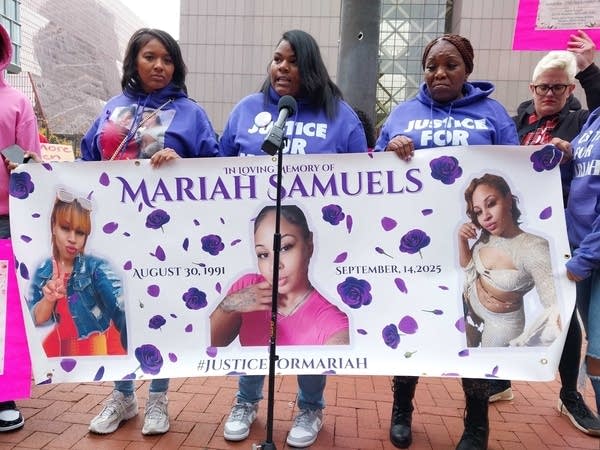
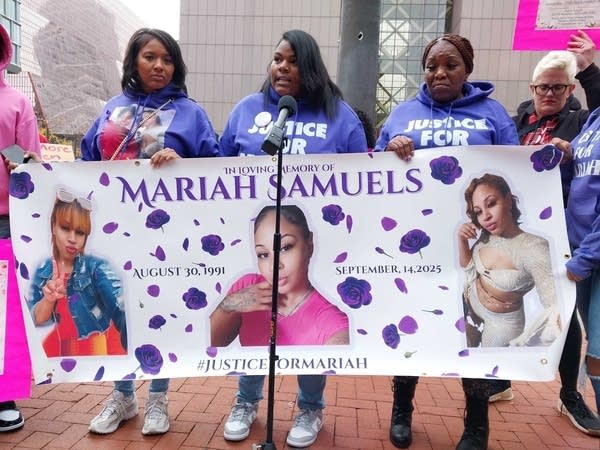
Demi Callender was ready to see justice for Mariah Samuels.
She, along with a full courtroom of family and friends, had waited months to see her cousin’s killer, David Wright, handed a life sentence. They had waited for Wright to finally hear the pain he made them endure.
When Friday’s sentencing hearing finally came around, their wait was finally over. Or, so they thought.
“We had plans today to celebrate justice, but yet again, this system has not only failed us, they have failed every victim that is a victim of domestic violence,” Callender said.
The delayed sentencing was just the latest in a string of decisions from officials that has left the family waiting for some kind of justice.
Wright is scheduled — for the second time — to receive a life sentence Monday afternoon. But the fight for justice will not be over, then, as the family continues to press the Minneapolis Police Department for accountability.
Last September, Wright, 51, fatally shot 34-year-old Samuels, a mother of two. That same morning, Samuels asked the police for help.
She reported that Wright, her ex-boyfriend, had violated a no-contact order after he pistol-whipped her the day she tried to end the relationship three weeks earlier.
A police officer who responded left after four minutes, falsely claiming in his report that she “felt safe,” according to a Minnesota Star Tribune investigation. About two hours later, Wright shot Samuels 10 times, killing her outside her home.
Since the start of April, family members have missed work to spend brutal days in court. They said they had to look at gruesome photos of their loved one’s body riddled with bullets and listen to Wright belittle her on the stand. The process was prolonged by Wright failing to show up to court on multiple occasions — including his Friday sentencing.
Family members, many from out of town, filled the courtroom benches that morning, ready to watch Wright receive a life sentence for first-degree murder without the possibility of parole. Wright was to hear their pain through victim impact statements.
But he didn’t show.
Prosecutors asked the judge to force Wright into court, arguing that a delay was endorsing Wright’s “utter and pure manipulation.” His attorneys said he was “unable” to attend but would not provide further explanation.
Ultimately, Judge Mark Kappelhoff decided to move the sentencing to Monday.
That decision was immediately met by wails of grief. The wait for Samuels’ family continued.
“Yet again, we have to go home and hold each other up because the system continuously smacks us in the face,” Callender said through tears.
Hennepin County Attorney Mary Moriarty came down to the Hennepin County Government Center lobby to offer the family support. She said her office demanded Kappelhoff force Wright to appear, as is within his power.
“The family has had to sit through this trial, they have said to me that they have had to look at him looking very smugly at them throughout the trial,” Moriarty said. “And then he exercises more manipulation and control by refusing to come to court for his sentencing.”
Samuels’ family had planned a celebration of justice that afternoon, anticipating the trial would come to a close. Although they did not get the closure they had hoped for, they refused to wait any longer, gathering at the house where Samuels’ life ended.
Samuels’ died in front of her father’s house, where he still has to live — forced to pass the spot, daily, where his daughter’s life was taken. Family members hope to move him out as soon as they can, but it’s currently too expensive.
That goal was further set back by the days of work they all took off for the trial.
“We are still stuck with this,” said Simone Hunter, Samuels’ little sister. “We still have to come here every day. We had to clean the blood off the streets. We had to spruce things up.”
Family and community members planted a garden along the walkway to the house Friday afternoon. As they dug into the dirt, replacing old soil with purple and yellow flowers, Hunter felt her sister’s absence sharply.
Samuels had a beautiful spirit, she said. She was strong-willed and ready to help anybody. She was the “sun and the stars” to her family and they were her whole world.
Hunter said at the family gathering she wished her big sister was still by her side, especially as she fixed up her hair beforehand. Even if Hunter was wearing a “potato sack,” Samuels would have a way of raising her up, she said.
“Not many people are like that,” Hunter said. “Mariah just always knew how to uplift you and make you feel like you were a great person.”
After Wright is sentenced to life in prison Monday, Samuels said she will finally take some rest.
But then, she will continue pressing the Minneapolis Police Department for answers, she said, and speaking out about how the system fails victims of domestic violence. She won’t wait around for things to get better.
Police never assigned an investigator to Samuels’ domestic violence case before her murder, according to the Minnesota Star Tribune investigation. In response, Chief Brian O’Hara vowed to review the case and ordered all officers to be retrained in how to handle domestic violence calls.
Samuels’ case has been compared to those of Allison Lussier, an Indigenous woman found dead in her apartment in 2024 after reporting domestic violence to the police, and Davis Moturi, a Black man who was shot by a neighbor after months of asking police for help from the escalating harassment. The city auditor is anticipated to issue reports on MPD’s handling of both cases later this week.
Hunter said she wants more transparency from police — to share body camera footage and records — and for Mayor Jacob Frey to work with her family on a plan to ensure victims of domestic violence are better protected.
“Mariah should be alive. She did everything and then some to be protected by MPD,” Hunter said. “Their shortfallings left my family in an actual upheaval. We are beside ourselves with this.”