Minnesota cannabis growers sue township over roadblock


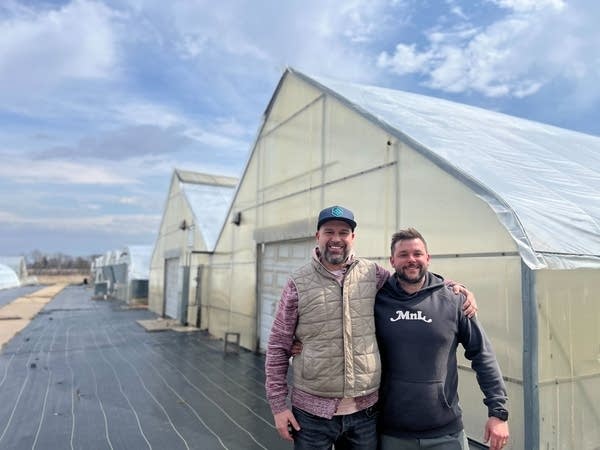
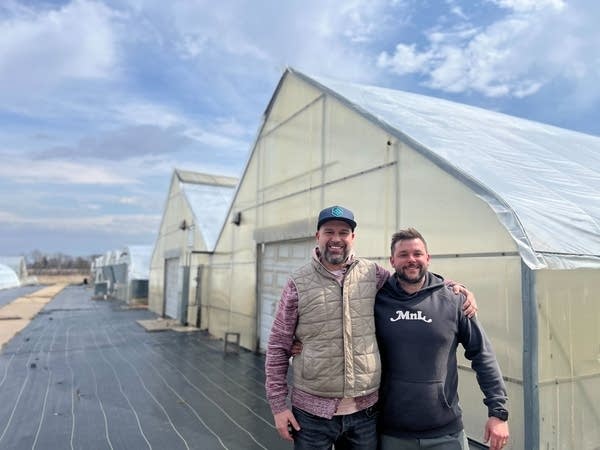
two men stand in front of greenhouses

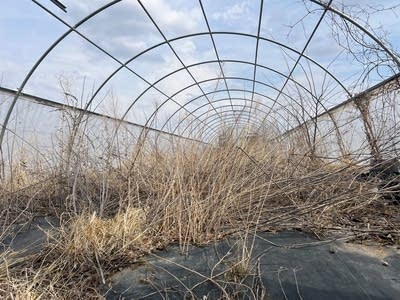
Out at a farm near Farmington, a dozen greenhouses sit on 12 and a half acres of land that have been left untouched for over a year.

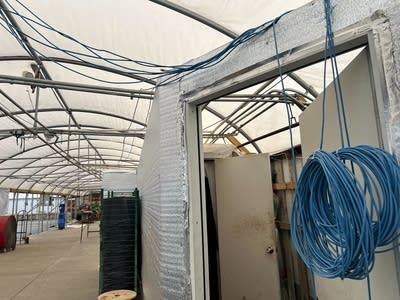
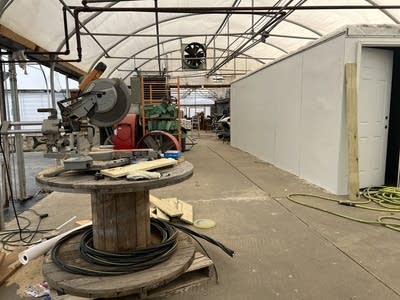
Overgrown weeds poke out of a clear tarp that just barely covers the greenhouse roofs. Tangled hoses are piled on the floor by one of the doors. Bundles of blue wire hang from the ceiling in the main corridor, where a new security system was supposed to be installed.

Regulatory problems, namely getting local signoff, have the plans stuck in place. That’s led to litigation and is among a series of lawsuits cropping up around Minnesota as the still-forming legal marijuana industry is getting off the ground. Clashes between local authorities and would-be cannabis operations are leading to rearranged plans, court fights or resignation that some might not come to pass as planned.

In the case of the Farmington fields, things are in limbo.

“It’s honestly depressing,” said Josh Kasprzyk. “We’ve invested millions here.”
Since 2019, Kasprzyk and his business partner, Richard Brama, have grown hemp at the farm to produce low-dose THC products under BKR Brands. The plan had always been to cultivate recreational cannabis there once it became legal in Minnesota and lease some of their space to other license holders.

“We were transparent [with the township] about what we were attempting to do,” Brama said. “We felt like we had a really good relationship with the community.”

But when the time came to pivot into the adult-use market, the duo ran into issues with the local township. They spent about half a year working with Eureka Township — which has jurisdiction in this instance — but couldn’t get approval for their cultivation plans.

Now, Kasprzyk is suing the township for barring their operation.

“It's absolutely been very painful for us personally, for our business, employees, and our families,” he said.

Denied approval

Last year, Kasprzyk and Brama stopped cultivating hemp at the farm to prepare for the shift into cannabis. In early 2024, they got approval from Eureka Township to construct two buildings where he planned to grow indoors for hemp and later for cannabis.

Kasprzyk then secured one of 50 cannabis cultivator licenses through a lottery held by the Minnesota Office of Cannabis Management last June. Everything seemed to be on track, except for the local township.

It started out as Eureka requiring them to obtain an interim use permit.

“Instead of bringing us into a conversation to see how we could make this work together in a partnership, they passed a special use permit without informing us knowing that we had put all this money into the infrastructure anticipating adult-use cannabis,” Brama said.

The operators applied for an interim use permit, a process that cost more than $100,000 between architects, lawyers and site planning. They were also invoiced by Eureka about $24,000 for legal research.

After months of back and forth on building codes and other disputes, Kasprzyk told the town they would scratch plans for the two new buildings and use the existing land they had used for hemp. But the town ultimately denied their permit last November.
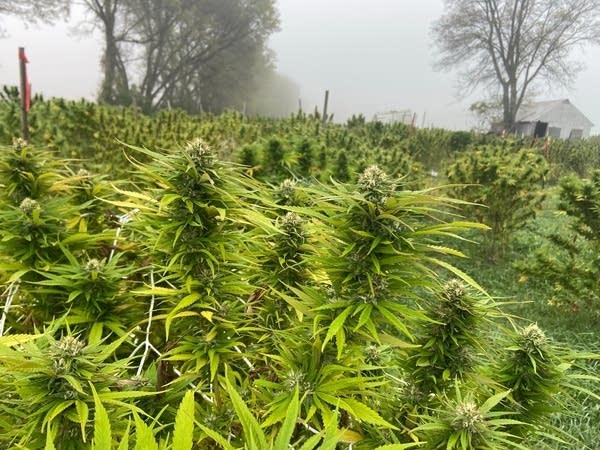
Hemp plants grow outdoors
Hemp plants grow outdoors on six and a half acres at the farm on October 21, 2021. The farm has the ability to grow up to 2,000 pounds of hemp or cannabis during one harvest.
Courtesy of Josh Kasprzyk

“The township had multiple reasons the proposed project did not meet the criteria for issuing an IUP, including but not limited to the incompatibility with the neighboring property, the adverse effect on the neighboring property and the traffic concerns,” said Jason Kuboushek, the township’s attorney.

In its denial letter, the town cited concerns with increased traffic on a nearby public road, neighbors who were worried about their property value dropping and an “unwillingness” to comply with local building codes and other rules.

“The law is clear that they can't deny us because we're asking for cannabis, as long as we meet the conditions,” Kasprzyk said.

State law says cities and counties can only govern time, place and manner of a cannabis business and enact “reasonable restrictions,” but cannot prohibit it. Despite that, several municipalities have passed ordinances that zone out or restrict cannabis.

In response to allegations that Eureka is acting in defiance of state law and is biased against cannabis, Kuboushek said cannabis businesses are allowed in certain locations but “for the reasons set forth in the resolution, this was not the right location.”

A few other lawsuits are pending challenging similar decisions by local governments. Minnesota’s cannabis agency says it cannot compel a city or county to action even if it’s not complying with state law.

“The office has recommended that license applicants seek legal counsel about their options if they believe their local government is not complying with the law,” said Jim Walker, an agency spokesperson.

The agency is monitoring ongoing cannabis lawsuits and court decisions.

In Albert Lea, a dispensary owner argues the city unlawfully denied him registration for his retail cannabis store after a past criminal conviction involving a minor became the center of controversy. And a farmer in Silver Bay is fighting against an ordinance that explicitly prohibits local approval of all cannabis businesses.
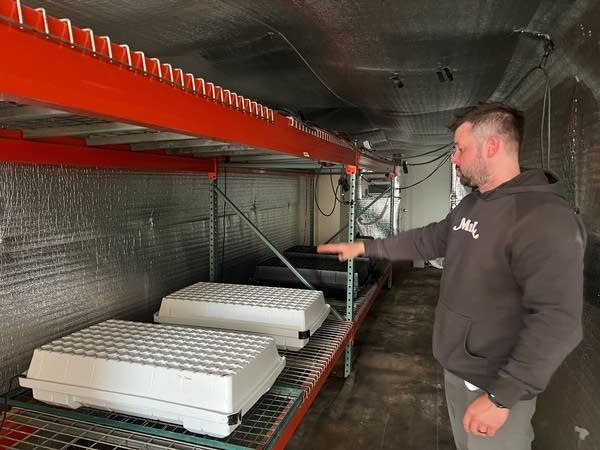
Man points to racks
Josh Kasprzyk points to racks that used to hold hemp plants. This is where he had planned to grow new cannabis plants.
Nicole Ki | MPR News

House DFL Speaker Zack Stephenson, one of the major sponsors of cannabis legalization, said he anticipated conflicts with local governments. He’s confident lawsuits like Kasprzyk’s will be successful.

“We wanted a uniform approach across the state, so cities have very little discretion when it comes to these businesses. And yet they are. Some of them continue to try and push the envelope,” he said.

Other efforts are underway at the Capitol to focuses on local government’s ability to approve a cannabis business. Rep. Jessica Hanson, DFL-Burnsville, is pushing a bill that would allow the OCM to waive the requirement of getting local government certification and may issue a license to an applicant if a municipality does not issue certification within 30 days of receiving a copy of the application. The prospective business owner still has to comply with local zoning ordinances and state fire and building codes.

A companion bill is also making its way through the Senate.

Early struggles

That leaves Minnesotans like Kasprzyk and Brama with losses they’ll never be able to recover.

They estimate damages could stretch into the millions if they can't get crop into the ground. That’s from the farm sitting idle, missing out on getting into the market early and an ongoing lawsuit with the township.

“They went behind our backs, pulled the rug out from underneath us, and put us in a position where not only could they have bankrupt our businesses, but they could have bankrupt us personally,” Brama said.

Many say the most crucial time to get into the market is the first 12 to 24 months, which is the goal for most prospective cannabis business owners. The adult-use market is still in its early stages, but is slowly shaping up with at least 180 businesses licensed and more than $64 million in retail revenue.

Supply is still extremely limited and Minnesota only has four licensed cultivators so far.

The pair say they have lost the opportunity to take advantage of that window where their business would be the most successful. Fortunately, Kasprzyk and Brama found a new cultivation facility in St. Paul and have about another year before the market matures and profit margins slim down.
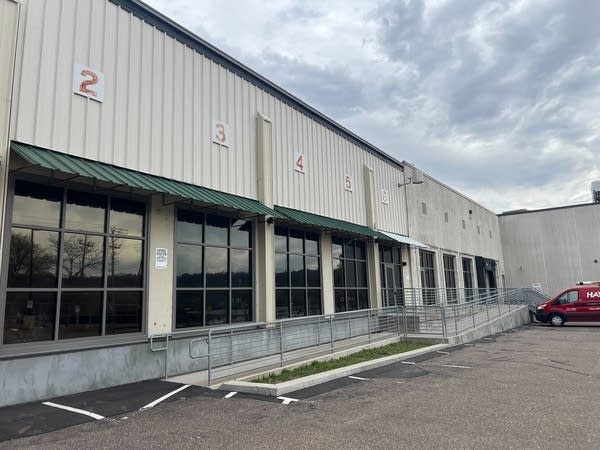
New cannabis facility stands
Josh Kasprzyk, Richard Brama and their business partners are revamping a former cabbage microgreen facility in St. Paul to a cannabis cultivation operation after plans in Eureka Township hit a wall.
Nicole Ki | MPR News

The difference between Eureka and St. Paul is night and day. Their focus now is getting the facility ready to grow cannabis.

“Our hope is to get operational within three to four months,” Brama said.

He also hopes they win the lawsuit so they can still grow cannabis at the farm in Farmington, like they originally planned eight years ago.

“The damage has been done,” Brama said. “And so at this point, I'm hopeful that we can continue to find a path forward in Farmington, that’s the goal.”

MPR News political correspondent Dana Ferguson contributed to this report.


Source link

Leave a Reply

Subscribe to Our Newsletter

Get our latest articles delivered straight to your inbox. No spam, we promise.

Recent Reviews


ServiceNow Visual Task Board – Table of Content

Visual Task Boards

Visual Task Boards (VTB) change the route of lists and structures into an intuitive graphical experience. Using the Visual Task Boards, you could view and refresh various task records that show up as cards which can be transferred between paths. An action stream on the board shows recent action so you can undoubtedly follow changes to assignments. You could add task cards from any table which stretches out Task to naturally and effectively track refreshes and alter records straightforwardly from the board. Any client can utilize task sheets, paying little heed to the role, however access control rules (ACLs) may restrict which cards every client can see. The Visual Task Board interface gives a realistic rich climate appropriate for overseeing and working together on records. For instance, a supervisor may make a load up for the group to follow their appointed incidents by state continuously.

ServiceNow provides an incredible apparatus for keeping steady over your everyday obligations. Visual Task Boards change the drilling plan for the day into an intuitive and outwardly satisfying experience. They fill in as an incredible instrument for extensive undertakings with different colleagues where association is critical. Tasks are shown as cards which can be shifted across various paths to address the situation with that task. All progressions are followed continuously, so your group is consistently up to date on where assignments stand.

 Become a Servicenow Certified professional by learning this HKR Servicenow Training !

Types of Visual Task Boards

Visual Task Boards can be made in three unique designs: Freeform, Flexible and Guided. Every format has remarkable settings that oblige explicit necessities. For instance, Guided sheets are best for Project Managers who need to allot singular tasks to explicit individuals from the venture team. Users can likewise arrange their Visual Task Boards with swimlanes, an element that basically permits you to have the choice between a horizontal view or a vertical view, whichever you prefer. Three kinds of Visual Task Boards

  1. Freedom: Personal organizer
  2. Guided boards: Utilises incident states
  3. Flexible: From the list but lane alters to not update given task data

To begin with vtb, you can navigate to self-service > visual task boards and follow the instructions for creating a board

Acquire Tasktop certification by enrolling in the HKR Tasktop Training program in Hyderabad!

ServiceNow Training

  • Master Your Craft
  • Lifetime LMS & Faculty Access
  • 24/7 online expert support
  • Real-world & Project Based Learning

Create a data driven board

  • Go to Self-Service, then Visual Task Boards Next to My Task Boards, choose New, or if you have never created a task board before select Create New Visual TaskBoard .
  • In the Create New Board window, click Data DrivenBoard .
  • In the Task Table list, choose a base table of tasks where you can base your board, for example, an incident table.
  • (Optional)From the Lane Field list, choose the field you need to utilise for the lane headers. Make a Flexible board using editable headers by choosing None. The sort of board which is made and the lanes that show up on the board rely upon the kind of segment you choose. In the event that you choose a reference or decision section, the board is a guided board . Every path in a guided board addresses one potential value for that segment and the cards show up in the fitting lane. For instance, in the event that you make a guided task board for occurrences utilizing the State section, the board displays one lane for every episode state, like New or Closed . On the off chance that you choose a section that isn’t a reference or decision, the board is a flexible board and the board displays the default paths, To Do , Doing , and Done , with all cards in the To Do path.
  • (Optional)Make a filter to display the records you need to operate with. For instance, you may sift through occurrences that are not doled out to you. Any card which no longer suits the boundaries of the filter is automatically eliminated from the task board. 
  • (Optional)Select the board name and enter another name. Note: For guided sheets made from decision fields, like State, the framework makes a lane for every possible decision value. For guided sheets made from reference fields, the system makes a path just for each value being used by a task card. The lanes are included on a case by case basis if the reference field esteems change.

 Top 30 frequently asked Servicenow Interview Questions !

, others, servicenow-visual-task-board-description-0, , others, servicenow-visual-task-board-description-1

Subscribe to our YouTube channel to get new updates..!

Domain separation and Visual Task Boards

Support level: Basic

Visual task boards have domain division at the information level only. Domain separation is upheld in the Visual Task Boards application. Domain separation empowers you to isolate information, measures, and system assignments into intelligent groupings called domains. You can handle a few parts of this separation, including which clients can see and access information. 

Business rationale: This ensures that information goes into the legitimate domain for the application’s service organization use cases. The application upholds domain separation at run time. The domain separation incorporates partition from the UI,reporting, cache keys, rollups, and collections. The proprietor of the case should set up the application to work across numerous tenants. 

Use case: When a service provider (SP) utilizes chat to react to an tenant client’s message, the customer should have the option to view the SP’s reaction. 

How does domain separation operates in Visual Task Boards

Visual Task Boards which are “information driven” displays the information from tables that resemble Task tables. The information that is domain isolated is additionally supported. Condition-based models are utilized to channel that information. Freestyle VTBs utilize Private Tasks (vtb_task), that upholds domain separation as an expansion of Task and acquires domain separation rationale accordingly.

Want to know more about Servicenow,visit here Servicenow Tutorial !

Benefits of Visual Task Boards (VTB)

  • Picturize your methods through an intuitive drag and drop interface to distinguish measure bottlenecks initially, and in real time. 
  • Change the manner in which you see your work by survey records or inquiries as a task board as simple as right-tapping on a list. Immediately make freestyle task boards to handle ad hoc methods whenever you require them. 
  • Stay up to date with an embedded action stream to guarantee that you could see all updates in a single spot, regardless of whether you join the discussion late.

ServiceNow Training

Weekday / Weekend Batches

Conclusion

You can change your lists and structures into an intuitive graphical experience utilizing Visual Task Boards (VTB) It also allow you to deal with your taks through a visual, intuitive interface and recognize process bottlenecks at a glance, in real-time along with tracking embedded activity monitors to see updates all in one place.Utilize visual  task boards to make your own daily agenda, team up continuously with group individuals on tasks, and more. Shown graphically as lanes and cards, vtb gives a page to see and arrange all your work in servicenow.

Related Article:


Source link