Chase Points Boost hits highest-ever 2.5 cents in value


Points Boost is one of my personal favorite features to come out of the 2025 revamp of the Chase Sapphire Reserve® (see rates and fees).

It raised the ceiling on what your Chase Ultimate Rewards points can be worth when booking through Chase Travel up to 2 cents per point on select flights and hotels. The standard value per point for Chase Travel bookings outside of Points Boost is now 1 cent per point.

Since launch, redemption values have become more variable, with many bookings landing somewhere between 1 and 2 cents per point. But now, Chase is taking things a step further: you can get up to 2.5 cents per point on a curated list of high-end hotels.

These properties are all located in destinations featured on Chase’s “Top 26 trips to take in 2026” list and mark the highest-value Points Boost opportunity we’ve seen so far.

Related: Enjoy luxury perks at our favorite hotels that are part of The Edit by Chase Travel

Hotels where you can get 2.5 cents in value from Points Boost

Here is the list of 11 hotels where you can get 2.5 cents of value per point with Points Boost:

Reward your inbox with the TPG Daily newsletter

Join over 700,000 readers for breaking news, in-depth guides and exclusive deals from TPG’s experts

  • Hotel du Couvent, a Luxury Collection Hotel — Nice, France
  • InterContinental Dominica Cabrits Resort & Spa — Dominica
  • Four Seasons Hotel Osaka — Osaka, Japan
  • Salterra, a Luxury Collection Resort & Spa — South Caicos
  • Nobu Hotel San Sebastian — Basque Country, Spain
  • Gardena Grodnerhof Hotel — Italian Dolomites
  • Sofitel Legend The Grand Amsterdam — Amsterdam, Netherlands
  • Grand Hyatt Deer Valley — Park City, Utah
  • The Ritz-Carlton, Portland — Portland, Oregon
  • Four Seasons Resort Rancho Encantado — Santa Fe, New Mexico
  • The Surrey, A Corinthia Hotel — New York City, New York

In my test searches, some of these hotels are available for booking at that increased Points Boost rate through the end of the booking calendar, which currently extends to March 2027. That means you could lock in a 2027 ski season stay at the Grand Hyatt Deer Valley, as an example, at these increased Points Boost values.

Though in that example, also compare to the Points Boost points rate the World of Hyatt program would charge, since Hyatt is a 1:1 transfer partner of Chase.

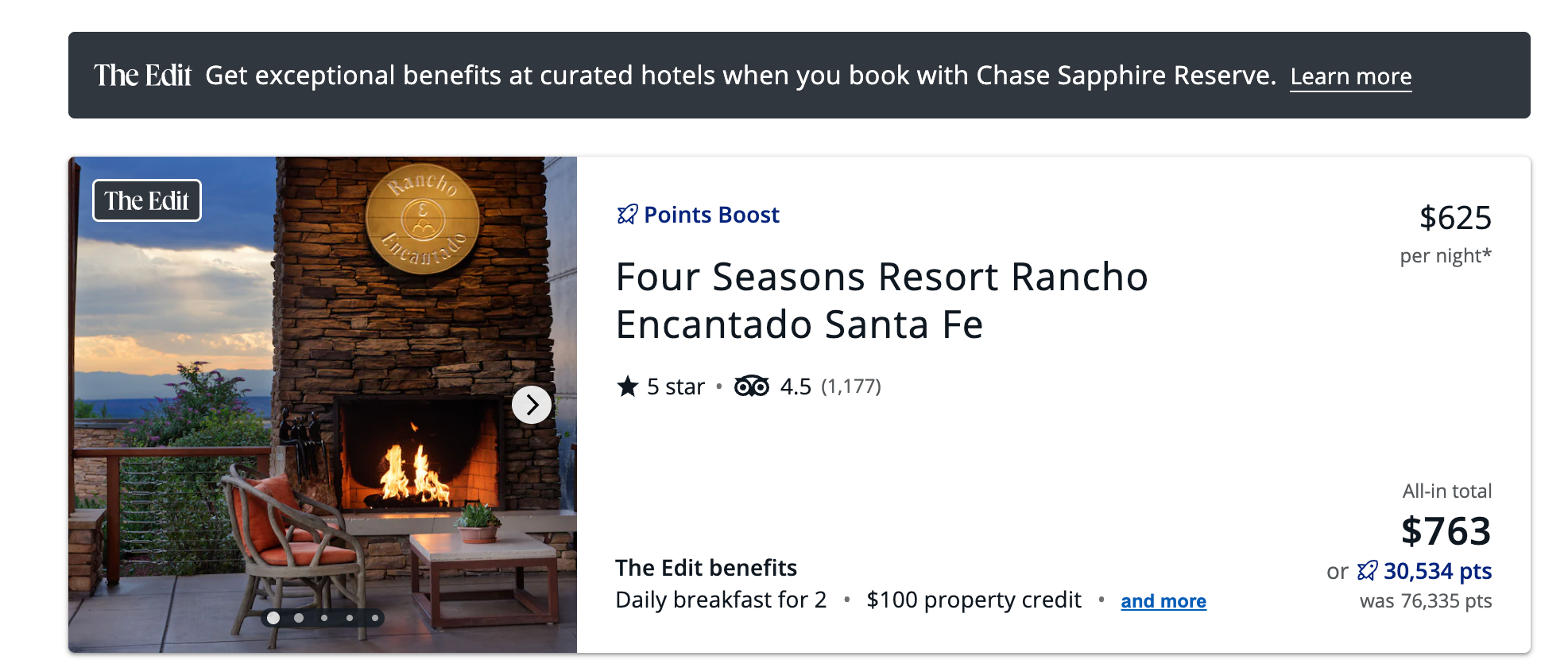
To give an example of how this works, for a stay in Feb. 2027, Four Seasons Resort Rancho Encantado in Santa Fe is priced at $763 all-in via Chase Travel. With this Points Boost increased rate, that comes out to just 30,543 Chase Ultimate Rewards points for the stay. Without Points Boost it would cost 76,300 points per night.
CHASE

Since all of these properties are a part of The Edit, you also get included breakfast for two, a $100 property credit, potential upgrades and more.

Additionally, if you pay “cash” for a portion of the stay, you should be able to stack on using one of your two annual $250 credits towards prepaid stays of at least two nights at The Edit properties. Just be sure to pay with a combo of cash and points at checkout on Chase Travel and select at least $250 for your cash portion, which should be offset if you have one of those two statement credits at your disposal.

Even if none of these 11 hotels are right for you to book using Points Boost right now, this offering is still very exciting as it demonstrates some potential and willingness for Chase to offer some outsized redemption opportunities from time to time.


Source link

Leave a Reply

Subscribe to Our Newsletter

Get our latest articles delivered straight to your inbox. No spam, we promise.

Recent Reviews


Medically reviewed by Kierra Brown, RD

Canned sardines and anchovies are high in protein and healthy fats, plus they have a long shelf life.Credit: Design by Health; Getty Images
Canned sardines and anchovies are high in protein and healthy fats, plus they have a long shelf life.
Credit: Design by Health; Getty Images
  • The nutritional profiles of anchovies and sardines are very similar.
  • Compared to sardines, anchovies contain slightly more protein and omega-3 healthy fats.
  • However, sardines have higher concentrations of many vitamins and minerals, and usually have less added sodium.

Anchovies and sardines are both small, oily fish that are usually canned or jarred. Despite their similarities, anchovies and sardines do have some nutritional differences when it comes to protein, healthy fats, and micronutrient content.

Which Small Fish Has More Protein?

 While both fish are excellent sources of lean protein, anchovies have a slight edge:

  • Sardines, canned in oil: 6.97 grams in a 1-ounce serving
  • Anchovies, canned in oil: 8.19 grams in a 1-ounce serving

The amount of protein your body needs depends on a number of factors, including age, health status, and physical activity levels.

Healthy adults should consume 1.2-1.6 grams of protein per kilogram of body weight, according to updated federal dietary guidelines.

For example, if someone weighs 70 kilograms (or 155 pounds), they may want to consume at least 84 grams of protein every day. A 1-ounce serving of anchovies canned in oil would get them about 10% of the way toward that daily protein goal.

Protein is critical for cell development and repair, contributing to physical growth and development.

Is One a Better Source of Healthy Fats Like Omega-3s?

When it comes to healthy fats in general, sardines come out on top:

  • Sardines, canned in oil: 2.56 grams of unsaturated fat in a 1-ounce serving
  • Anchovies, canned in oil: 1.8 grams of unsaturated fat in a 1-ounce serving

But if you're looking to boost your levels of omega-3 fatty acids—a specific type of healthy unsaturated fat—anchovies are the better choice. A 1-ounce serving contains 594 milligrams of omega-3s, while the same amount of sardines has 278 milligrams.

Consuming more omega-3s and healthy fats in general may benefit multiple different aspects of your health:

  • Heart health: Omega-3s help reduce levels of triglycerides, or fats in the blood; high triglyceride levels are a risk factor for heart disease and stroke. In general, research has shown that eating unsaturated fats in place of saturated fats—the kind found in full-fat dairy, red meat, and tropical oils—reduces your risk of heart disease.
  • Brain health and cognitive function: Some research suggests that insufficient levels of omega-3s may increase the risk of brain health concerns, including Parkinson's disease, schizophrenia, attention deficit hyperactivity disorder (ADHD), and depression. Another study found that omega-3 supplements could improve mild cognitive impairment, a condition that causes memory and thinking issues that can develop into dementia.
  • Eye health: In some studies, people who ate fatty fish (and more omega-3s) had a lower risk of age-related macular degeneration, a condition that can blur vision. Similarly, there's evidence that diets higher in omega-3s could reduce the risk of dry eye disease. However, more research is needed.

How Do They Compare for Vitamin and Mineral Content?

Along with protein and healthy fats, sardines and anchovies are packed with essential micronutrients. However, they contain different amounts of these key vitamins and minerals:

  • Vitamin B12: Sardines have about 10 times more vitamin B12 than anchovies. This B vitamin supports nerve cell function, red blood cell formation, metabolism, and the creation of DNA.
  • Vitamin D: One sardine has the vitamin D content of about eight anchovies. Vitamin D helps the body absorb calcium and supports bone maintenance and growth.
  • Iron: As compared to sardines, anchovies contain about 60% more iron. This mineral helps form red blood cells, supports muscle and tissue function, and more.
  • Phosphorus: Sardines are nearly twice as rich in phosphorous than anchovies are. In fact, a 1-ounce serving of sardines contains about 20% of the daily recommended intake for adults. Phosphorus is key in creating structures in the body, including teeth, DNA, and cell membranes.
  • Calcium: As compared to anchovies, sardines are a better source of calcium, a mineral which helps support and maintain bone health.

Comparing Sardines and Anchovies

Nutritional content always varies based on packaging and other factors, but here's how a typical 1-ounce serving of anchovies compares to a 1-ounce serving of sardines:

Sardines, canned in oil Anchovies, canned in oil
Calories 59 60
Protein 6.97 grams (g) 8.10 g
Total fat 3.23 g 2.75 g
Carbohydrates 0 g 0 g
Calcium 108 milligrams (mg) 65.8 mg
Iron 0.828 mg 1.31 mg
Magnesium 11.1 mg 19.6 mg
Phosphorus 139 mg 71.4 mg
Potassium 113 mg 154 mg
Selenium 14.9 micrograms (mcg) 19.3 mcg
Sodium 87 mg 1,040 mg
Zinc 0.371 mg 0.692 mg
Vitamin B12 2.53 mcg 0.249 mcg
Vitamin D 1.36 mcg 0.482 mcg

In addition to their relatively similar nutritional profiles, sardines and anchovies share many other commonalities.

Both are considered forage fish, and they're often eaten by larger fish or marine mammals. Sardines are a bit bigger—they're 4-12 inches while anchovies are usually 7-8 inches—but both species' relative small size and low position on the food chain ensures they have low mercury levels.

Once they're harvested, anchovies and sardines are usually jarred or canned in water or oil to make them shelf stable. One difference is that canned anchovies are often salt-cured—this gives them a pink color and a salty flavor (as well as high amounts of sodium).

What To Know Before Adding These Small Fish to Your Diet

Anchovies and sardines aren't naturally high in sodium (or salt), but jarred or canned versions often have a lot of salt added.

For instance, a 1-ounce serving of anchovies canned in oil contains 1,040 milligrams of sodium, which is 45% of the recommended daily limit for adults.

Diets high in sodium raise your risk of developing high blood pressure, heart diseases, artery diseases, heart attack, and stroke.

When purchasing canned fish, check the nutrition label and try to find a product that has lower amounts of sodium.

Sardines and anchovies also usually contain bones. The canning process makes these bones safe to eat, though young children and people with swallowing concerns may want to avoid them.


Source link