Agora and thymia Partner to Enable Real-Time Health and Safety Intelligence Across Voice Communications


Clinically validated voice intelligence deployed at global scale, enabling systems to understand the human state behind every interaction

 Bangalore | April 23, 2026  – Agora, Inc. (NASDAQ: API), a global leader in real-time engagement and conversational AI, today announced a strategic partnership with thymia, the human state voice intelligence company that has built the first clinically validated infrastructure for reading the complete signal carried in voice – and acting on it in real-time.

The partnership brings together Agora’s global, low-latency real-time conversational AI infrastructure and thymia’s clinically validated voice intelligence layer. Together, they enable a new class of voice applications that understand the human state during live interactions, delivering both safety and commercial value across healthcare, automotive, workplace wellness, education, and other safety-critical environments.

The collaboration is laying the foundation for voice communication systems that don’t just process what is said but understand how it’s said.

From Voice Data to Health Intelligence – In Real-Time

Voice is one of the most widely used interfaces in the world, yet most systems today focus only on transcription, intent, and commands. Signals carried in voice – including engagement, cognitive load, stress, fatigue, emotional state, and physical health – remain invisible to current systems.

thymia’s proprietary AI models analyze just 15 seconds of speech to extract acoustic, linguistic, and temporal biomarkers associated with conditions such as depression, anxiety, stress, burnout, respiratory disease, cardiovascular risk, and metabolic health. Built to clinical-grade standards, these models are already being used by healthcare systems, Fortune 500 companies, and safety-critical industries.

“Voice carries far more information than words alone; it carries signals about our mental and physical health, our emotional state, our cognitive load – the complete picture of our nervous system, of how we actually are. For the first time, that complete signal can be understood and acted on in real-time. Partnering with Agora brings clinically validated human state voice intelligence into real-world interactions at global scale, driving better outcomes, safer systems, and experiences that genuinely understand the human in the conversation,” said Emilia Molimpakis, CEO and Co-founder of thymia.

Agora provides the real-time orchestration layer that makes this intelligence actionable in production. Built on its Software-Defined Real-Time Network (SDRTN®) – processing over 80 billion minutes of engagement monthly – the platform delivers ultra-low latency, continuous audio fidelity, and network resilience required to apply voice intelligence within live interactions, not in post-processing.

Powering a New Health & Safety Infrastructure Layer

By embedding thymia’s voice intelligence directly into Agora-powered voice interactions, platforms can move from passive communication to active, real-time health and safety awareness.

Use cases include:

  • Healthcare & Mental Health Platforms: Objective, biomarker-driven insights during and between sessions, supporting faster triage, better clinical decisions, and reduced clinician burnout.
  • Automotive & Mobility: Real-time detection of driver fatigue and stress to reduce accidents and enable safer voice-first vehicle experiences.
  • Workplace Wellness & Call Centers: Early identification of burnout, stress, and emotional distress, before performance drops or attrition increases.
  • Education & Remote Learning: Insight into student and tutor mental states to improve engagement, retention, and learning outcomes.

This integration enables enterprises to deploy safe, production-ready voice AI systems without adding user friction or requiring new infrastructure.

Built for Enterprise Scale and Regulatory Trust

thymia’s technology is built to clinical-grade standards, validated across one of the largest datasets of its kind – including more than 75,000 unique voices – and trusted in healthcare and safety-critical settings for high-stakes decisions. Engineered on consent, transparency, and human oversight, the models ensure compliant and secure AI deployment.

Agora operates 200+ global points of presence, powered by its SDRTN®, and maintains SOC 2, ISO 27001, and HIPAA certifications, ensuring compliant, enterprise-grade infrastructure for deploying health and safety intelligence at scale. With 99.999% uptime, resilience under degraded network conditions, and multi-platform support across edge and enterprise environments, the platform ensures this intelligence is available where and when it matters most, not just in ideal conditions.

“Voice is becoming the primary interface between people and AI, yet the human state behind those words has remained invisible to most systems. Through our partnership with thymia, we’re introducing this critical layer into live interactions – combining real-time, production-grade infrastructure with clinically validated voice intelligence to enable safer, more secure AI experiences at scale,” said Tony Wang, Co-founder and Chief Revenue Officer of Agora.

Shaping the Future of Voice-First AI

As voice becomes the dominant interface for AI agents, vehicles, healthcare platforms, and connected devices, Agora and thymia are defining what comes next: voice systems that are not only intelligent but safe, responsive, empathetic, and human-aware.

The next generation of voice AI will not be measured solely by accuracy or speed, but by its ability to understand the human behind the conversation. The gap between systems that process voice and systems that truly understand it is where safety, trust, and competitive advantage are won or lost.

​​​​​Together, Agora and thymia enable voice-first experiences that put people at the center of every interaction, driving better outcomes, safer systems, and more responsible AI deployment across industries where the cost of not understanding people is simply too high.

About Agora

Agora is the global leader in real-time engagement, providing developers with simple, flexible, and powerful APIs to embed conversational AI, voice, video, interactive live streaming, and chat into applications and IoT devices. Headquartered in Santa Clara, CA, Agora is trusted by over 2000 organizations worldwide to power best-in-class digital experiences across all industries.

Learn more at agora.io

About thymia

thymia is the human state voice intelligence company. Its technology reads the complete signal carried in voice – detecting 30+ clinical-grade biomarkers from just 15 seconds of speech – and acts on it in real-time, delivering safety and experience value to partners. Built on one of the largest datasets of its kind, including 75,000+ unique voices, thymia is trusted across healthcare, safety-critical industries and beyond.

Learn more at thymia.ai


Source link

Leave a Reply

Subscribe to Our Newsletter

Get our latest articles delivered straight to your inbox. No spam, we promise.

Recent Reviews


What is Cloud FinOps?

A functioning structure and informational flux that gathers businesses, finance, and technological operations alongside each other to drive up the businesses through cloud transformation.

It promotes data-powered decision-making in due time and results in financial responsibility. The collaboration of finance, operations, and business teams makes it possible to achieve it.

FinOps is a field that integrates principles of financial management with cloud engineering and operations to give organizations an analysis of their cloud expenditure. It also allows them to make well-versed decisions on the allocation of their cloud budget and costs. Its goal is to increase the revenue or the business value with the help of the cloud. It also helps organizations control their cloud expenditure while still maintaining the performance level, dependability, and security required to assist their business operations.

Principles of Cloud FinOps

Accountability

With a set of pre-defined KPIs and benchmarks, the teams responsible for value realization reporting and costing amendment can be held accountable. This makes decision-making a process with standards.

Business Value Realization

Decisions taken from the perspective of business make Cloud FinOps successful.

Flexibility

Encourage constant budget allocation, IT spending, and forecasting to push ahead with agile budgeting and planning procedures in the IT industry.

Clarity of Costs

All organizational levels have access to instantaneous cost and billing data.

Partnerships

For cloud finance management, collaborate with departments like IT, finance, app development, and architecture.

Fluctuating nature of the cloud

Accept the pay-as-you-go aspect of cloud and gain from providing dynamic customer service to meet their ever-changing requirements.

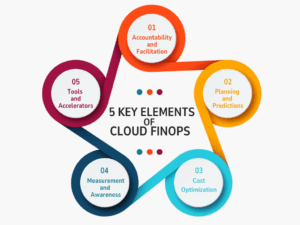
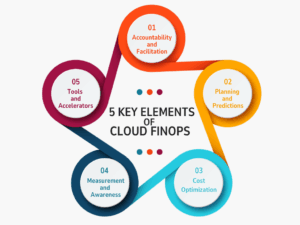
Five Key Elements that Make Cloud FinOps

5 Key Elements of Cloud FinOps

1. Accountability and Facilitation

This element centers on setting up centralized, multi-functional teams that include engineering, finance, operations, architecture, and app developers, while also setting up governance and benchmarks for cloud expenditure.

2. Planning and Predictions

For cloud planning and predictions to be effective, an organization must allocate resources, benchmark efficacy, and gain a deeper understanding of the cost drivers.

3. Cost Optimization

This element, which is an ongoing, repetitive process that focuses on identifying key cost-optimization drivers, offers a consistent methodology to manage cloud consumption in the most economical way.

4. Measurement & Awareness

This key element focuses on building a key set of KPIs and business-value metrics to calculate the transformation’s success. Customers frequently begin with a set of cost-optimization metrics before switching to unit economics or business value metrics, like cost per transaction or cost per customer served.

5. Tools and Accelerators

To sum up, using the right tools and accelerators is crucial for efficiently managing and monitoring cloud spending. It comprises:

  1. Using Google Cloud cost-management tools to examine cost and billing data in real time
  2. Creating a reporting dashboard for tracking values and managing cloud spending
  3. Putting automation scripts into place to create budget alerts and account guardrails

Benefits That Cloud FinOps Offer

Business Value Realization

Initial focus on cloud migration often leaves the business goal of infrastructure in the rear. Proper cooperation between various departments makes FinOps effective and a success. This allows the reconsideration of business values while lifting cloud management to new heights.

Better Decision Making

Making decisions to make business better than today is the whole point here. Using the insights from cloud data and financial analytics, the FinOps team is able to make informed decisions regarding the business’s cloud computing commodities. This also makes them focus on the business goals.

Art of Predictions and Cloud Reporting

FinOps teams analyze cloud spend and set standards for future cloud costs using analytics, reporting, and forecasting cloud FinOps tools. They can create budgets fittingly and evade unplanned surplus costs thanks to the jacked-up cost visibility.

Accountability for Clear Cloud Use

By providing clarity into resource ownership and cloud spending, FinOps promotes accountability while leveling the time and effort needed for research and change implementation.

Challenges That FinOps Come With

Before Cloud FinOps begins to show results, you must surpass many predicaments. These may include issues with organizational processes, technical implementation, or how the teams as a whole perceive the changes.

Governance

Incorporating new methods, tools, and challenges requires all the things to be in place and well-governed. The processes to be incorporated ought to adhere to existing laws, rules, and compliance standards. It can be challenging to describe these approaches, create policies, and implement them.

Technical Glitches

There might be considerable technical glitches in putting the suggested modifications into practice, from planning effective cost data collection and processing to putting per-instance optimizations, element migration, and access management into practice.

All of the alterations should certainly be based on practicality, as well as administering the right balance between cost-effectiveness and effort, while taking into account the gross solution’s business value.

Cultural Alterations

As the FinOps framework requires processes to be established at every level of an organization, an actual cultural transformation must take place for FinOps methodologies to be implemented successfully. This entails setting up a culture of financial responsibility and accountability while maintaining the requirements of the company and the objectives of the other players in mind.

It could be challenging to bring in this culture, as it needs not only the establishment of appropriate processes but also a shift in the team’s mentalities. So, it is a task!

From Chaos of Cloud to Clarity: An Imperative for Businesses

Cloud FinOps is the way of the future for businesses, but excessive cloud spending can undermine the very advantages that companies are trying to achieve. Cloud FinOps management transforms from a standalone finance function into a vital business capability with FinOps.

Businesses that adopt Cloud FinOps not only reduce cloud expenses but also acquire the flexibility to change course more quickly, the assurance to make more intelligent investments, and the transparency to match IT with business value.

The ability to forecast precisely, budget dynamically, and optimize continuously is not a luxury in a world where cloud usage is only increasing; rather, it is a competitive necessity.

To learn more, visit KnowledgeNile!


FAQs for Cloud FinOps

1. What is another name for FinOps?
Answer: FinOps is the blend of “Finance” and “DevOps”. It shows the collaboration between business and engineering groups. It is also known by terms like Cloud Financial Management and Cloud Financial Optimization.

2. When did FinOps start?
Answer: It began in 2019 as an open community comprising individuals and organizations where knowledge of cloud financial management could be shared.

3. What is the future of FinOps?
Answer: FinOps’s future depends on comprehensive innovation and teamwork. FinOps and ITAM combination will be essential as cloud infrastructure develops to trim the financial waste, promote sustainability, and improve AI-powered optimization.


Also Read:
Cloud Migration Process Explained in Easy Steps
Edge and Cloud Computing for IoT and Their Key Roles
What is The Distributed Cloud: Advantages and Disadvantages


Source link