Monticello sets stage for allowing data centers


Data centers in Montecello

The Monticello City Council voted 4-1 Monday night to adopt an ordinance that could open the door to developers building massive data centers in this community 40 miles northwest of Minneapolis.

The ordinance also includes new restrictions for data centers that city officials say are aimed at reducing negative impacts on people living nearby and ensuring Monticello residents don’t bear any financial costs.

After the vote, council member Tracy Hinz called it “one of the best, most well-framed ordinances in our state, if not broader.”

“I feel disappointed that I've let down some people with my vote, but I also have really, I think, balanced that disappointment out with my duty as a public servant,” she said. “It’s not about pleasing everyone. It’s about doing what’s in the best interest of the community and not closing any doors for future development.”

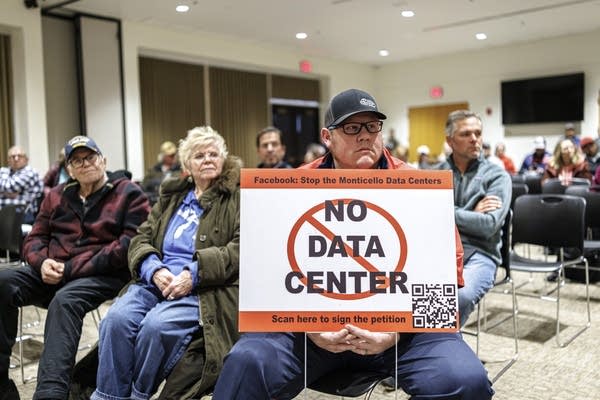
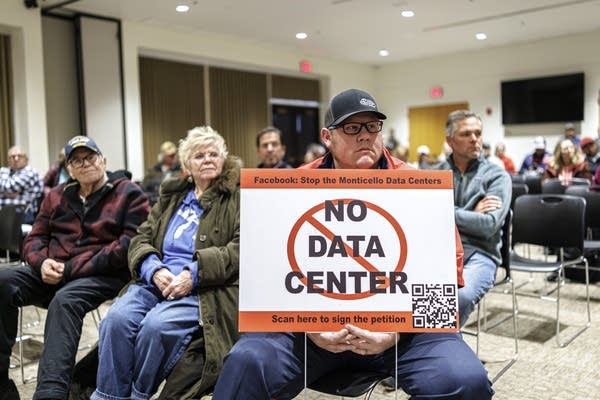
The vote came after more than two hours of debate. About a dozen people spoke, nearly all opposed to data centers being built in Monticello.

Data centers in Montecello
Lisa Keenan addresses the Monticello City Council during a meeting at the Monticello Community Center on Monday. Keenan questioned council members, the mayor and city staff as officials considered zoning amendments related to a proposed data center and technology campus development.
Kerem Yücel | MPR News

Many expressed deep worry that the massive facilities could lower their property values, drain resources like water and electricity and create constant noise from equipment, affecting people and wildlife.

“I am very much against the data center, because to me, it’s experimental, and I don’t think Monticello should have to be the guinea pigs for this,” said Joan Bondhus, who has lived in the city since 1964.

Monticello is one of several Minnesota cities wrestling with whether to permit hyperscale data centers, which are huge warehouses filled with computer servers that help power cloud computing and artificial intelligence.

The plans have sparked strong opposition from some residents who are concerned about their massive size, water and energy consumption and possible noise and light pollution.

But some cities, including Monticello, see potential benefits they could bring, including property tax revenue, construction jobs and investment in roads and utilities.

“We need to diversify our tax base,” Hinz said before the vote. “We need to think about opportunities. And I cannot possibly deny an ordinance that allows for future applications and consideration of opportunities."

Data centers in Montecello
Monticello City Councilmember Tracy Hinz, center, speaks during a City Council meeting as councilmember Kip Christianson, left, and Mayor Lloyd Hilgart listen on Monday. The council discussed zoning amendments related to regulating a proposed data center and technology campus development.
Kerem Yücel | MPR News

Monticello is considered a prime location for a data center because of available land, water and electricity. No developers have submitted formal applications to build a data center yet. But at least two have expressed interest in building facilities on land the city plans to annex.

That includes Monticello Tech, which has proposed building a data center campus covering about 3 million square feet — about 50 football fields — on about 550 acres east of Highway 25.

Another developer, Scannell Properties, wants to build a 1.3 million-square-foot data center on about 100 acres near the Bertram Chain of Lakes Regional Park.

Monticello’s ordinance creates a zoning designation specifically for data centers. Developers who want to build a data center would first have to get the property rezoned, then apply for a conditional use permit.

The ordinance requires data centers to demonstrate that there’s adequate water and energy to meet their needs. It also tries to reduce impacts to people living nearby by setting standards for landscape buffers, screening, noise and lighting.
Data centers in Montecello
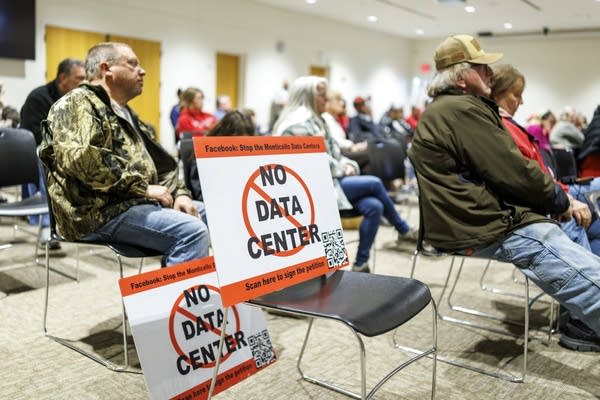
“NO DATA CENTER” signs opposing a proposed data center development sit on chairs as residents attend a Monticello City Council meeting. Community members gathered as the council considered zoning amendments related to regulating data center and technology campus land uses.
Kerem Yücel | MPR News

After a debate, the council increased the distance that data centers will be required to be located from residential areas to at least 300 feet. Opponents of data centers wanted to require a much greater distance.

David Thorsen, who lives in a neighborhood near one of the proposed sites, said he’s worried about potential health impacts if he has to live next to a data center, and not being able to sell his house if he wants to move.

“I dont want to sit on my patio for six years and listen to construction,” he said. “And fine, great, it brings temporary jobs to the community to build it, but it doesn’t bring long-term jobs.”

Several residents asked the city to consider pausing new data center development, as some other Minnesota cities have done.

Monticello officials say the ordinance does not mean that the city will automatically approve a proposal to build a data center. They say each application will be considered individually.

The ordinance also makes clear that the city will not extend tax incentives to lure a data center to Monticello, and the project’s developers would have to pay for any new infrastructure that’s needed.

Data centers in Montecello
Monticello Mayor Lloyd Hilgart listens during a City Council meeting at the Monticello Community Center on Monday. The council considered zoning amendments related to regulating a proposed data center and technology campus development.
Kerem Yücel | MPR News

Mayor Lloyd Hilgart said he thinks that the city has done “everything within our power” to create an ordinance that is the best for the city of Monticello” and addresses residents’ concerns.

“I believe that everything but the kitchen sink is in that ordinance,” he said.

After the meeting, some residents voiced disappointment, but said the ordinance was better than originally proposed because of public input. They vowed to closely watch any applications to build a data center to make sure they follow the rules and aren’t granted any exceptions.

Jenna Van Den Boom, who helped organize a group called Stop the Monticello Data Centers, called the council’s vote “a kick in the gut.”

“I think we kind of expected that it was going to happen,” she said. “But also, I think there's always that hope that Monticello is family-first city, and that we would pick our families and our community. And it was just really disappointing that we didn't see that.”




Source link

Leave a Reply

Subscribe to Our Newsletter

Get our latest articles delivered straight to your inbox. No spam, we promise.

Recent Reviews


Can you deduct costs incurred while investigating whether to start a business? What if you spend several years researching, planning, and preparing to launch and you incurred costs during these years to do so?

Are these expenses deductible in the years before your business officially begins operations? Does the answer change if the business actually starts and is not just a start-up that never started?

The rules for “pre-start-up” businesses are not all that clear. Court cases like the recent Eason v. Commissioner, T.C. Summary Opinion 2024-17, help explain when these pre-start-up costs are deductible.

Facts & Procedural History

The taxpayer in this case, an engineer by profession, lost his job around the start of 2016. He and his spouse decided to explore various ways to earn a living.

The couple enrolled in two courses offered by a real estate investment seminar company. They paid this company $41,934 for courses in 2016.

The couple then formed a corporation on July 29, 2016, and made an election to have it taxed as an S corporation. The stated purpose of the S corporation was to provide advice and guidance to real estate owners and investors, though the specific services it intended to offer remained unclear.

Throughout 2016, the taxpayers had business cards and stationery printed and attended some training sessions related to the courses they were taking. However, by the end of 2016, no income had been generated from these activities which seems to have been because the seminar business went out of business.

On their federal income tax returns for 2016, the taxpayers claimed deductions for expenses related to the S corporation, including the cost of the education courses.

The IRS audited the taxpayers’ 2016 tax returns and concluded that the business expenses were not deductible. It denied the deductions and proposed an accuracy related penalty. This disagreement eventually led to litigation in the U.S. Tax Court.

About Section 162

Section 162 is the section that allows for a deduction for most business expenses. More specifically, it provides a tax deduction of “ordinary and necessary expenses paid or incurred during the taxable year in carrying on any trade or business.” This seemingly straightforward provision has been the subject of extensive interpretation by courts and the IRS over the years.

The term “ordinary” in this context doesn’t mean common or frequent. Instead, it refers to expenses that are normal, usual, or customary in the particular business. An expense can be ordinary even if it occurs only once in a taxpayer’s lifetime. The “necessary” requirement is generally interpreted to mean appropriate and helpful for the development of the taxpayer’s business.

As relevant to this article, the statute also says that the expense has to be for “carrying on any trade or business.” This language implies that the business must already be in existence for expenses to be deductible under Section 162. Expenses incurred before a business begins operations are generally not deductible under this section.

The question of when a business officially begins “carrying on” its activities is not always clear. Courts have developed various tests and factors to determine this, including whether the taxpayer has made a firm decision to enter into business and whether they have taken substantial steps to prepare for business operations.

Start-Up Tax Rules Under Section 195

Recognizing the potential unfairness of disallowing all pre-operational expenses, Congress enacted Section 195 in 1980. This section deals specifically with start-up expenditures and provides some relief for taxpayers incurring costs before their business begins.

Under Section 195, start-up expenditures are defined as amounts paid or incurred in connection with:

  1. Investigating the creation or acquisition of an active trade or business,
  2. Creating an active trade or business, or
  3. Any activity engaged in for profit before the day on which the active trade or business begins, in anticipation of such an activity becoming an active trade or business.

However, these expenses are not immediately deductible. Instead, they are treated as deferred expenses. Once the business actually begins operations, the taxpayer can elect to deduct a portion of these start-up costs (up to $5,000, reduced by the amount by which the start-up costs exceed $50,000) in the year the business begins. The remainder is amortized over a 180-month period beginning with the month in which the business starts.

It is important to note that Section 195 only applies once the business actually starts. If a planned business never comes to fruition, these rules don’t apply, and the expenses generally cannot be deducted or amortized.

When Does a Business Start for Tax Purposes?

This brings us to the very question presented by this court case. When does a business start for tax purposes? (This question is very similar to the question of when is real estate placed in service for tax purposes)

The determination of when a business begins is required for applying both Section 162 and Section 195. To understand the answer, we have to start with the Richmond Television Corp. v. United States, 345 F.2d 901 (4th Cir. 1965) case. This is a landmark court case that has been cited many many times.

In Richmond Television, the court said that a taxpayer has not “engaged in carrying on any trade or business” within the meaning of Section 162 until the business has begun to function as a going concern and performed those activities for which it was organized. The company in that case was denied deductions for staff training expenses incurred two years before it received its broadcasting license and went on air.

Like Richmond Television, the taxpayers in Eason incurred significant expenses (course fees, business formation costs) before generating any income. However, the timeline in Eason was much shorter – all within one tax year. Richmond Television involved expenses incurred several years before the business operations started.

More importantly, the critical fact in Richmond Television was when the FCC license was issued. This provided a definitive fact or event that one can point to. The Eason case did not have a definitive event like this. The court in Eason notes that there is no license required for the taxpayer’s business activities in Eason. Thus, the nature of the planned business (real estate advising) didn’t require a specific license or permit to begin operations, which would have provided an identifiable marker for when the business could have started.

Given the short time frame and the absence of an identifiable marker, the U.S. Tax Court focused on the evidence that the taxpayers had actually started providing any services by the end of 2016. The court noted that there was no evidence of this. The court completely discounted the activities of forming a corporation, taking courses, getting business cards, etc. The court simply concluded that there was no indication that the taxpayers had begun to function as a going concern or performed the activities for which their business was organized.

This decision shows that merely taking preparatory steps, even significant ones like forming a legal entity and investing in education, is not enough to be considered “carrying on” a trade or business. The court’s analysis suggests that there needs to be some actual attempt to provide services or generate income, even if unsuccessful, to cross the threshold into an active trade or business. With that said, even if the business has started, this does not mean that the expenses are deductible. The IRS can also assert that a business that has started was really a hobby and not a business at all.

The Takeaway

This case shows the type of challenges taxpayers face in deducting expenses related to new business ventures. When taking deductions for these types of expenses, taxpayers should carefully consider the timing and nature of business activities when planning to claim deductions for new ventures. This case also shows why it is important to document preparation activities in addition to actual attempts to conduct business operations. This should include steps that go beyond the steps the taxpayers took in this court case. A misstep here can result in signficant tax balances, which would no doubt mean the end of the start-up as a viable business.

Watch Our Free On-Demand Webinar

In 40 minutes, we’ll teach you how to survive an IRS audit.

We’ll explain how the IRS conducts audits and how to manage and close the audit.  


Source link