Monticello sets stage for allowing data centers


Data centers in Montecello

The Monticello City Council voted 4-1 Monday night to adopt an ordinance that could open the door to developers building massive data centers in this community 40 miles northwest of Minneapolis.

The ordinance also includes new restrictions for data centers that city officials say are aimed at reducing negative impacts on people living nearby and ensuring Monticello residents don’t bear any financial costs.

After the vote, council member Tracy Hinz called it “one of the best, most well-framed ordinances in our state, if not broader.”

“I feel disappointed that I've let down some people with my vote, but I also have really, I think, balanced that disappointment out with my duty as a public servant,” she said. “It’s not about pleasing everyone. It’s about doing what’s in the best interest of the community and not closing any doors for future development.”

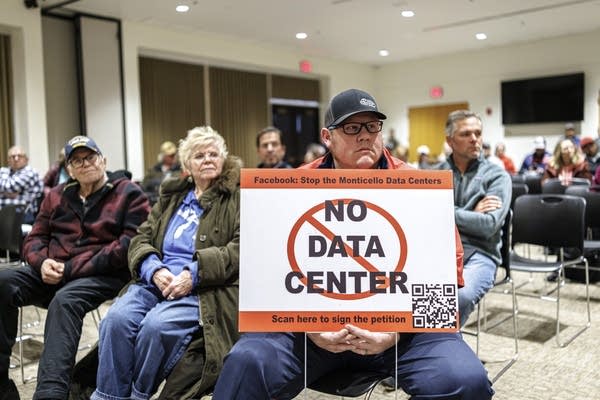
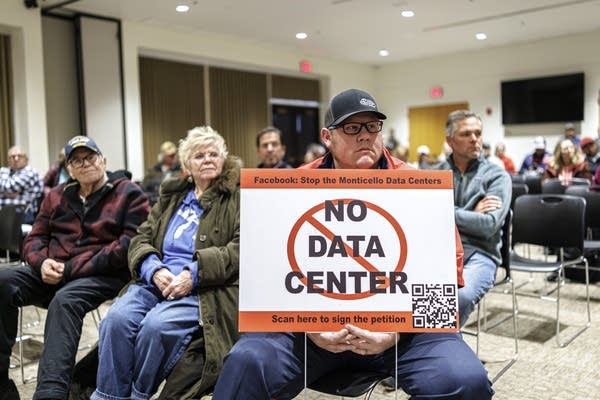
The vote came after more than two hours of debate. About a dozen people spoke, nearly all opposed to data centers being built in Monticello.

Data centers in Montecello
Lisa Keenan addresses the Monticello City Council during a meeting at the Monticello Community Center on Monday. Keenan questioned council members, the mayor and city staff as officials considered zoning amendments related to a proposed data center and technology campus development.
Kerem Yücel | MPR News

Many expressed deep worry that the massive facilities could lower their property values, drain resources like water and electricity and create constant noise from equipment, affecting people and wildlife.

“I am very much against the data center, because to me, it’s experimental, and I don’t think Monticello should have to be the guinea pigs for this,” said Joan Bondhus, who has lived in the city since 1964.

Monticello is one of several Minnesota cities wrestling with whether to permit hyperscale data centers, which are huge warehouses filled with computer servers that help power cloud computing and artificial intelligence.

The plans have sparked strong opposition from some residents who are concerned about their massive size, water and energy consumption and possible noise and light pollution.

But some cities, including Monticello, see potential benefits they could bring, including property tax revenue, construction jobs and investment in roads and utilities.

“We need to diversify our tax base,” Hinz said before the vote. “We need to think about opportunities. And I cannot possibly deny an ordinance that allows for future applications and consideration of opportunities."

Data centers in Montecello
Monticello City Councilmember Tracy Hinz, center, speaks during a City Council meeting as councilmember Kip Christianson, left, and Mayor Lloyd Hilgart listen on Monday. The council discussed zoning amendments related to regulating a proposed data center and technology campus development.
Kerem Yücel | MPR News

Monticello is considered a prime location for a data center because of available land, water and electricity. No developers have submitted formal applications to build a data center yet. But at least two have expressed interest in building facilities on land the city plans to annex.

That includes Monticello Tech, which has proposed building a data center campus covering about 3 million square feet — about 50 football fields — on about 550 acres east of Highway 25.

Another developer, Scannell Properties, wants to build a 1.3 million-square-foot data center on about 100 acres near the Bertram Chain of Lakes Regional Park.

Monticello’s ordinance creates a zoning designation specifically for data centers. Developers who want to build a data center would first have to get the property rezoned, then apply for a conditional use permit.

The ordinance requires data centers to demonstrate that there’s adequate water and energy to meet their needs. It also tries to reduce impacts to people living nearby by setting standards for landscape buffers, screening, noise and lighting.
Data centers in Montecello
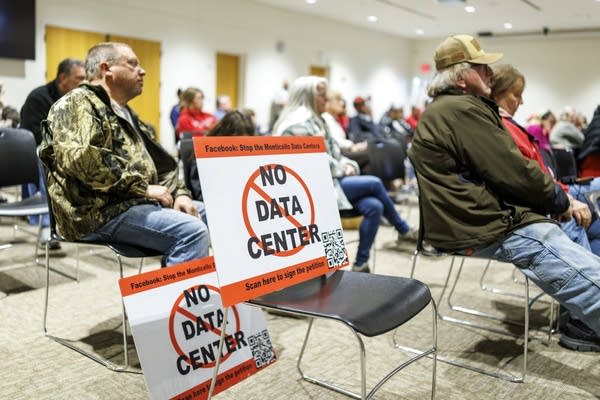
“NO DATA CENTER” signs opposing a proposed data center development sit on chairs as residents attend a Monticello City Council meeting. Community members gathered as the council considered zoning amendments related to regulating data center and technology campus land uses.
Kerem Yücel | MPR News

After a debate, the council increased the distance that data centers will be required to be located from residential areas to at least 300 feet. Opponents of data centers wanted to require a much greater distance.

David Thorsen, who lives in a neighborhood near one of the proposed sites, said he’s worried about potential health impacts if he has to live next to a data center, and not being able to sell his house if he wants to move.

“I dont want to sit on my patio for six years and listen to construction,” he said. “And fine, great, it brings temporary jobs to the community to build it, but it doesn’t bring long-term jobs.”

Several residents asked the city to consider pausing new data center development, as some other Minnesota cities have done.

Monticello officials say the ordinance does not mean that the city will automatically approve a proposal to build a data center. They say each application will be considered individually.

The ordinance also makes clear that the city will not extend tax incentives to lure a data center to Monticello, and the project’s developers would have to pay for any new infrastructure that’s needed.

Data centers in Montecello
Monticello Mayor Lloyd Hilgart listens during a City Council meeting at the Monticello Community Center on Monday. The council considered zoning amendments related to regulating a proposed data center and technology campus development.
Kerem Yücel | MPR News

Mayor Lloyd Hilgart said he thinks that the city has done “everything within our power” to create an ordinance that is the best for the city of Monticello” and addresses residents’ concerns.

“I believe that everything but the kitchen sink is in that ordinance,” he said.

After the meeting, some residents voiced disappointment, but said the ordinance was better than originally proposed because of public input. They vowed to closely watch any applications to build a data center to make sure they follow the rules and aren’t granted any exceptions.

Jenna Van Den Boom, who helped organize a group called Stop the Monticello Data Centers, called the council’s vote “a kick in the gut.”

“I think we kind of expected that it was going to happen,” she said. “But also, I think there's always that hope that Monticello is family-first city, and that we would pick our families and our community. And it was just really disappointing that we didn't see that.”




Source link

Leave a Reply

Subscribe to Our Newsletter

Get our latest articles delivered straight to your inbox. No spam, we promise.

Recent Reviews


The common idea that business expenses are deductible while personal expenses are not is an oversimplification. In reality, the tax rules are more nuanced.

Some personal expenses are deductible, and the line between personal and business expenses is often blurry. This complexity is further compounded by the fact that many businesses, particularly small ones, fail to properly segregate personal and business expenses, often commingling them in shared bank accounts.

This commingling practice frequently leads to disputes with the IRS, even over expenses that are clearly business-related. In fact, such disputes are among the most common tax issues that taxpayers face with the IRS.

The IRS administrative system is specifically structured to address these types of cases and to sort out what is often best described as a mess. The recent case of Henry v. Commissioner, T.C. Memo. 2024-3, provides an opportunity to consider how the tax system handles tax deductions when there are few or inadequate records.

Facts & Procedural History

The taxpayers in this case owned and operated several businesses providing tax and financial services to clients. Notably, the taxpayer-wife apparently advised clients on strategies to deduct personal expenses as if they were business expenses.

For the tax years 2011 through 2014, the taxpayers did not file tax returns. This led the IRS to prepare substitute for returns (“SFRs”). Subsequently, the taxpayers filed their returns, which the IRS then audited.

The IRS audit disclosed that the taxpayers failed to maintain adequate records and commingled their personal and business expenses. Through a bank deposit analysis, the IRS determined that the taxpayers owed over $1.7 million in taxes. Additional assessments included penalties for failure to file, fraudulent failure to file, and failure to pay estimated income tax.

After the IRS issued Notices of Deficiency, the taxpayers filed a timely petition with the U.S. Tax Court, setting the stage for litigation.

The Tax Deduction Framework

To understand how the IRS evaluates tax deductions during audits, especially when records are inadequate, we have to start with the tax deduction rules.

The tax code contains various provisions distinguishing between personal and business expenses, along with rules allowing and disallowing deductions. While these rules may seem chaotic at first glance, there is a method to the apparent madness.

Business Expenses

The general rule for business expenses is found in Section 162 of the tax code. Section 162(a) allows deductions for “ordinary and necessary expenses paid or incurred during the taxable year in carrying on any trade or business.” This provision serves as a broad authorization for tax deductions, but allows outs for expenses that are not ordinary, necessary, or paid.

Beyond this general rule, several specific provisions allow for particular business expenses. These sections typically add limitations to the amount allowable for specific types of business expenses. Common examples include:

These provisions target specific types of expenses with more nuanced rules, often including detailed definitions and limitations to govern the deductions.

Personal Expenses

On the flip side, Section 262 generally prohibits deductions for “personal, living, or family expenses” unless specifically allowed by the code. This rule acts as a counterpart to Section 162, but instead of granting deductions, it restricts them.

The code then includes several provisions that allow deductions for specific personal expenses. Unlike the business expense provisions, these rules permit deductions for expenses that would otherwise be non-deductible. They also stipulate conditions for the expenses to qualify. Common examples include:

These are just a few examples.

Limitation Rules

Adding another layer of complexity, the tax code includes various rules that restrict or eliminate otherwise allowable deductions. Some common examples of these limitation rules include:

  • Section 274(n): Limiting business meal deductions
  • Section 280E: Prohibiting deductions for businesses trafficking controlled substances
  • Section 162(m): Limiting deductions for executive compensation
  • Section 280A: Restricting home office deductions
  • Section 267: Disallowing losses between related parties
  • Section 274(a): Disallowing entertainment expense deductions
  • Section 280F: Limiting luxury auto depreciation deductions
  • Section 162(f): Disallowing deductions for government fines or penalties

These provisions target more specific scenarios where Congress sought to limit deductions for various policy reasons.

Separating Expenses on Audit

When auditing a taxpayer with inadequate records and commingled personal and business expenses, IRS auditors typically employ a straightforward approach. They review bank statements and credit card records to trace the nature of transactions, identifying spending patterns and determining whether expenses are primarily personal or business-related.

Often, the IRS auditors will stop at this point. They may disallow expenses if any tax law limitations apply or if personal and business expenses are commingled, concluding that the taxpayer isn’t entitled to any deductions. This approach shifts the burden of proof to the taxpayer to substantiate that the expenses are deductible personal expenses, the amount of the expenses, and that the expenses were actually paid.

This process effectively puts the responsibility of performing the IRS audit on taxpayers. They must identify, gather records, and reconcile numbers for the IRS auditors. Taxpayers usually undertake this exercise as part of the audit process. They may also compare their claimed expenses to industry standards or similar businesses to demonstrate consistency and reasonableness, create travel and mileage logs, etc., arguing that the deductions should be allowed.

Narrowing the Disputed Items

As the process moves from the initial audit to appeals and potentially litigation, the amount and number of disputed tax deductions typically decrease. The auditor may accept some deductions, the appeals officer may allow a few more, and the IRS attorney might concede additional items. Conversely, the taxpayer may also abandon certain deduction claims along the way.

By the time a case reaches the tax court, often only a handful of tax deductions remain in dispute. This pattern is evident in the Henry case, where it appears that many disputed issues were resolved through last-minute concessions by the IRS attorney just before the trial.

The tax court then only has to consider a few categories of tax deductions. That is exactly what it did in the Henry case. It was able to get the types of deductions to just these categories:

  1. Merchant banking fees
  2. Bank service fees
  3. Savvy Bill Pay remittances
  4. Office rent and home office expenses
  5. Advertising and web hosting costs
  6. Travel, meals, and entertainment expenses
  7. Cell phone and landline expenses
  8. Casual labor payments

By narrowing the focus to these specific categories, the tax court can analyze and rule on just these disputed deductions. This process of winnowing down the issues is typical in tax litigation and allows for a more targeted and manageable review of even the most complex and messy cases.

Takeaway

This case shows how the IRS applies the tax deduction rules and how the IRS administrative process works. It highlights the risks of commingling personal and business expenses and the challenges taxpayers face when trying to substantiate deductions without adequate documentation. The case also demonstrates the iterative nature of tax disputes, where the scope of disagreement often narrows as the case progresses through various stages of review. Ultimately, it underscores the need for taxpayers, especially small business owners, to maintain clear separation between personal and business finances and to keep thorough, well-organized records to support their tax positions.

Watch Our Free On-Demand Webinar

In 40 minutes, we’ll teach you how to survive an IRS audit.

We’ll explain how the IRS conducts audits and how to manage and close the audit.  


Source link