Kirsten Storms Claims She Called Cops Over Hacking … Months After Ex Granted Protective Order
Published
4/9/26
Actress Kirsten Storms claimed she called police to report alleged hacking of her phone — months after her ex-husband Brandon Barash was granted a protective order against her … TMZ has learned.
On April 9, the actress posted an odd Instagram video captioned, “Update on cellphone hacking situation, apt break-in and investigation by Franklin PD.”
Kirsten said she had been MIA from Instagram for weeks due to the alleged drama. She said her devices had been hacked while she lived at an apartment building in Tennessee.
Kirsten said she’d been “unable to get on my Instagram.” She said when she connects to Wi-Fi on her cell phone, “certain things start happening.” The soap star said emails are deleted, and things go missing.
The actress said there was an active police investigation into the matter.
As TMZ first reported, Kirsten’s ex — Brandon, who also starred on “General Hospital” — was granted a temporary restraining order against the actress. The court found the actress had been suffering a mental health crisis.
Brandon claimed Kirsten had been bouncing between hotels and friends’ homes. He claimed she had been “experiencing delusions and hallucinations” in mid-2025. He said she seemed to get better for a bit … only for things to take a turn.
In his petition, Brandon claimed one of Kirsten’s friends told him she believed the actress was abusing Adderall. The court signed off on the restraining order, but allowed Kirsten supervised visitation with their 12-year-old daughter.
The exes are set to appear in court later this week.
Cloud modernization is when the current business establishment applications, architecture, and data sources are developed, renovated, and transferred into an environment and infrastructure that is based on the cloud. This whole ordeal is a multistage process.
In general, when we talk about digital transformation in businesses, it comes with improved efficiency, lower costs, better security, and compliance. However, a lot of businesses associate digital transformation with cloud migration, and yet it is so much more. On the path of transforming companies in their cloud journey is modernization. It is fundamental in unlocking the maximum potential of innovative cloud technology. The question now is of importance.
Why is Cloud Modernization Important?
For legacy architectures, surpassing the direct process of migration may be an intimidating change.
We have all heard the phrase – if it ain’t broke, don’t fix it! Sometimes it is said because of the fear of change in the mind. Any inherited system cannot go on functioning forever, but if it is amended, as is needed for modernization, the concern of innumerable harm it could cause the business operations rises if it breaks.
Moving an on-premises application to the cloud is enticing initially. But both financially and with respect to time, it doesn’t fully utilize what the cloud has to offer. Furthermore, even if the application can be transferred to the cloud, it may not function properly once it is there. It is necessary to perform a proper cloud migration and the related update.
Strategies of Cloud Modernization
When upgrading applications and information to the cloud, these strategies need caution and carefulness. Those strategies are mentioned below.
Evaluate and Highlight the Workload
Carrying out the full inventory of the data and applications gives insights into identifying the order of modernization priority, from highest to lowest, which is critical for the business.
Select the correct cloud strategy & create cloud governance
Selecting a suitable cloud strategy is important. According to the needs of the business, a suitable strategy for the cloud can be decided. Further, creating clear regulations for cloud resource and access control, defining roles and duties for all actions, and applying the best practices in security to safeguard critical data.
Automation of Deployment and Management
This is the time to shift to a DevOps model, as it is a customary practice for the development of cloud, while deploying the automation tools.
Constant monitoring and improvement
The cloud resources can be unsteady; therefore, they need unvarying monitoring and tracking. It also needs upgrading and changing accordingly.
Benefits that Cloud Modernization Offers
Among its various benefits, cloud modernization offers –
Swiftness
The new products and services can be brought into the market swiftly through cloud solutions. The cloud brings a broad range of pre-constructed tools and services that organizations can quickly develop and implement new apps across a collection of devices. The time-to-market is reduced here, and it also helps businesses to remain ambitious.
Security
Cloud deployers offer effective protection of apps and data, as their investment in security is great. These suppliers provide different security services, like identity and access management, encryption, and network security.
Adaptability
Being adaptable allows them to adjust swiftly or expand their resources depending on the needs and the circumstances. This allows the business to meet the ever-changing demands and dodge the cost and trouble that comes with it. This adaptability allows the companies to grow without causing distress over infrastructure constraints.
Costs
By cutting down the need to maintain on-site tools and architecture, it can help lower costs. On a pay-per-use basis, the cloud allows companies to only pay for the services they need. Businesses can benefit from this model as there are no additional expenses, since there is no usage. Tool-based infrastructure, in contrast, needs payment from companies whether or not it is used.
Flexibility
It is simpler for companies with this technology to combine technology into their operations. This can be done by allowing them to achieve flexible and remote working arrangements. Along with getting employees to maintain a healthy work-life balance, this advantage can be a godsend for appealing and retaining top talent. Because of its adaptability, the cloud is a great option for businesses trying to bring in new methods of operation.
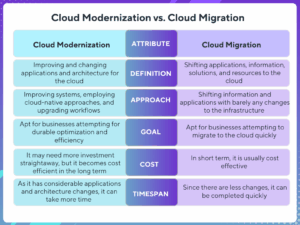
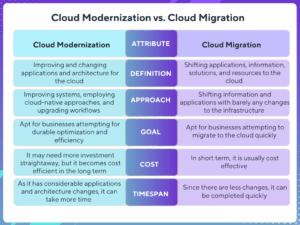
Cloud Modernization vs. Cloud Migration
Cloud modernization and cloud migration are the two most crucial strategies for businesses that can utilize the cloud. They are different in their purview and approach. We compare them below.
Parting Words to Keep in Mind
As businesses come to adjust to the requirements of today’s world, cloud modernization provides a calculated avenue to better efficiency, flexibility, and enhanced business speed. By encompassing the latest cloud technologies, businesses can upgrade their cloud architecture, obtaining better performance and cost savings.
This transformation allows businesses to improve their cloud migration and modernization strategies and efforts, restructure operations, and nurture innovation. By engaging in a strong cloud modernization strategy, companies can ensure they stay motivated to compete and prepare for forthcoming obstacles.
Finally, utilizing cloud-native solutions and services enables businesses to obtain important long-term advantages, including improved outputs and growth.
To provide the best experiences, we use technologies like cookies to store and/or access device information. Consenting to these technologies will allow us to process data such as browsing behavior or unique IDs on this site. Not consenting or withdrawing consent, may adversely affect certain features and functions.
Functional
Always active
The technical storage or access is strictly necessary for the legitimate purpose of enabling the use of a specific service explicitly requested by the subscriber or user, or for the sole purpose of carrying out the transmission of a communication over an electronic communications network.
Preferences
The technical storage or access is necessary for the legitimate purpose of storing preferences that are not requested by the subscriber or user.
Statistics
The technical storage or access that is used exclusively for statistical purposes.The technical storage or access that is used exclusively for anonymous statistical purposes. Without a subpoena, voluntary compliance on the part of your Internet Service Provider, or additional records from a third party, information stored or retrieved for this purpose alone cannot usually be used to identify you.
Marketing
The technical storage or access is required to create user profiles to send advertising, or to track the user on a website or across several websites for similar marketing purposes.