
Feds: Fraud ringleader leaked documents from jail


the Feeding Our Future fraud case

Federal prosecutors in Minneapolis are asking a judge to prohibit convicted fraudster Aimee Bock from speaking with her two adult sons from jail after she allegedly directed the men to send sensitive evidence from her case to elected officials and the news media ahead of her May 21 sentencing.

In March 2025, a jury found Bock and restaurateur Salim Said guilty of charges including wire fraud and bribery for their roles in a scheme to steal around $250 million from taxpayer-funded child nutrition programs during the COVID-19 pandemic by submitting false reimbursement claims for meals.

Because of the scale of the theft, Bock could face life in prison under federal sentencing guidelines. Bock is among 79 defendants charged in the wider case since September 2022, which prosecutors say was the nation’s largest pandemic-era fraud scheme.

The investigation has since led to fraud charges in connection with several Medicaid programs in Minnesota. Bock is white, but most of her co-defendants in the Feeding Our Future case are Somali-American. National attention to the case in late 2025 prompted racist comments from President Donald Trump along with increased immigration enforcement targeting the community, though the vast majority are naturalized U.S. citizens.

A man points to a woman sitting down
A prosecutor points to Aimee Bock during the Feeding Our Future trial on Feb. 10, 2025.
Cedric Hohnstadt

The government has secured 65 convictions, largely through guilty pleas. Of the 13 people sentenced, Abdiaziz Farah, another key player, received 28 years, the longest prison term handed down so far. Farah could face additional time when he’s sentenced separately for his role in an attempt to bribe a juror during his 2024 trial.

In a document filed on Tuesday, Assistant U.S. Attorneys Matthew Murphy and Rebecca Kline allege that Bock, 45, the founder of the defunct nonprofit Feeding Our Future, violated a 2022 protective order from U.S. District Judge Nancy Brasel that requires all parties to the case to hold most evidence in the case “in strict confidentiality.”

Murphy and Kline say that on April 2, an unnamed Minnesota state representative received two emails from a Proton Mail address. The sender, “Daisy Hill” claimed that “Tim Walz, Keith Ellison and the Minnesota Department of Education intentionally set Feeding Our Future and Aimee Bock up as a scapegoat.”

A March 17 email to MPR News from a sender with the same name includes identical language. In a subsequent message, the sender promised to send “examples of fraud in MN that were identified and stopped by Aimee Bock and Feeding Our Future.”

The emailer later sent files including screenshots of text messages, other communications, and audio recordings that Bock apparently made of conversations with operators of meal sites. MPR News did not verify the authenticity of the documents shared in the anonymous emails until the Minnesota U.S. Attorney’s Office leveled the fresh allegations against Bock in the Tuesday court filing.

MPR News replied to the “Daisy Hill” address on Tuesday to request comment about the government’s new allegations.

Kenneth Udoibok, Bock’s defense attorney, said in an email reply to MPR News that his client’s sons “in an inartful way” are “hoping that the media and the legislative branch see their mom’s plight. Aimee is not trying to harm or intimidate anyone; rather, she wants the whole truth out before the legislature and the president. She’s crying for help!!!”

In their motion, the prosecutors also recount that on April 21, they learned that a Minnesota Star Tribune reporter contacted an attorney for a cooperating witness in the case and said that “they had obtained copies of reports of two of the witnesses’ law enforcement interviews” and intended to quote from them in an article about “the conduct of certain uncharged individuals.”

Murphy and Kline write that they learned through another attorney that the reporter “had claimed to have over one hundred law enforcement interview reports” and that given their nature “they could only have come from the government’s discovery disclosures,” in violation of the protective order.

three people enter a federal courthouse
Aimee Bock (center), founder and executive director of the nonprofit organization Feeding Our Future arrives at the Minneapolis federal courthouse on March 19, 2025, in Minneapolis.
Kerem Yücel | MPR News

Bock has been held in the Sherburne County Jail for more than a year as she awaits sentencing. Citing recorded jail calls, prosecutors say Bock directed her son, Camden Bock, 20, to download documents from her case from a Dropbox account and send them to elected officials and news reporters.

“Her purpose for doing so can best be described as a public relations campaign — to seek to minimize her starring role in pilfering the Federal Child Nutrition Program while casting the ‘real’ blame for the rampant fraud on the Walz administration, state administrators and uncharged individuals,” Murphy and Kline write in their filing.

On March 16, the day before MPR News received the first email from “Daisy Hill,” Bock allegedly directed her son to download documents that she believed would show that she tried to combat fraud in the nonprofit she once led.

“She told Camden to remove the trial exhibit stickers, and other markings indicating the documents came from her federal criminal case, before emailing them from a newly created Proton Mail account to ‘all republicans [sic] and the media,’” the prosecutors write.

In late March, “Bock told Camden to send the files to ‘Republicans in DC,’ especially the ‘guy who told [Minnesota Attorney General Keith] Ellison he should be in jail’ and the ‘right wing people that [President] Trump follows.’”

On April 1, Bock allegedly told her son Cale Bock, 19, that a Star Tribune reporter had been planning a “whole story on [an uncharged individual] and why she never got indicted,” and explained that Camden used an email account with a “fake name.”

In a later conversation, when Camden voiced concerns that speaking to the media might result in a longer sentence, Bock allegedly replied “they want to sentence me to life anyway.”

In an April 19 call with an unidentified person, according to prosecutors, Bock said that “someone had given the Star Tribune reporter “every interview the FBI did with people.”

Murphy and Kline write that they can’t say “with absolute certainty whether Bock is the person directly responsible” for leaking cooperating witness statements to the newspaper, “it is clear that she was leaking other protected documents” to the media and is endangering “the safety of those witnesses who have chosen to come forward and speak to law enforcement.”

The prosecutors are asking Judge Brasel to prohibit Bock from accessing her Dropbox account and surrender all copies of any protected files in her control, including Camden Bock’s computer. The government is also seeking to prohibit Bock from “any form of contact” with her sons prior to her sentencing hearing.

Brasel ordered Bock’s attorney to respond to the government’s request by 5 p.m. Wednesday. A hearing on the motion is scheduled for Thursday afternoon.




Source link

Leave a Reply

Subscribe to Our Newsletter

Get our latest articles delivered straight to your inbox. No spam, we promise.

Recent Reviews


What is Cloud FinOps?

A functioning structure and informational flux that gathers businesses, finance, and technological operations alongside each other to drive up the businesses through cloud transformation.

It promotes data-powered decision-making in due time and results in financial responsibility. The collaboration of finance, operations, and business teams makes it possible to achieve it.

FinOps is a field that integrates principles of financial management with cloud engineering and operations to give organizations an analysis of their cloud expenditure. It also allows them to make well-versed decisions on the allocation of their cloud budget and costs. Its goal is to increase the revenue or the business value with the help of the cloud. It also helps organizations control their cloud expenditure while still maintaining the performance level, dependability, and security required to assist their business operations.

Principles of Cloud FinOps

Accountability

With a set of pre-defined KPIs and benchmarks, the teams responsible for value realization reporting and costing amendment can be held accountable. This makes decision-making a process with standards.

Business Value Realization

Decisions taken from the perspective of business make Cloud FinOps successful.

Flexibility

Encourage constant budget allocation, IT spending, and forecasting to push ahead with agile budgeting and planning procedures in the IT industry.

Clarity of Costs

All organizational levels have access to instantaneous cost and billing data.

Partnerships

For cloud finance management, collaborate with departments like IT, finance, app development, and architecture.

Fluctuating nature of the cloud

Accept the pay-as-you-go aspect of cloud and gain from providing dynamic customer service to meet their ever-changing requirements.

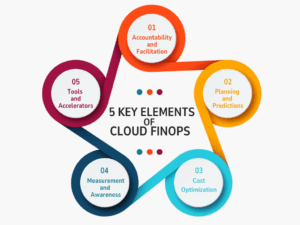
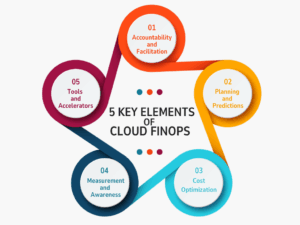
Five Key Elements that Make Cloud FinOps

5 Key Elements of Cloud FinOps

1. Accountability and Facilitation

This element centers on setting up centralized, multi-functional teams that include engineering, finance, operations, architecture, and app developers, while also setting up governance and benchmarks for cloud expenditure.

2. Planning and Predictions

For cloud planning and predictions to be effective, an organization must allocate resources, benchmark efficacy, and gain a deeper understanding of the cost drivers.

3. Cost Optimization

This element, which is an ongoing, repetitive process that focuses on identifying key cost-optimization drivers, offers a consistent methodology to manage cloud consumption in the most economical way.

4. Measurement & Awareness

This key element focuses on building a key set of KPIs and business-value metrics to calculate the transformation’s success. Customers frequently begin with a set of cost-optimization metrics before switching to unit economics or business value metrics, like cost per transaction or cost per customer served.

5. Tools and Accelerators

To sum up, using the right tools and accelerators is crucial for efficiently managing and monitoring cloud spending. It comprises:

  1. Using Google Cloud cost-management tools to examine cost and billing data in real time
  2. Creating a reporting dashboard for tracking values and managing cloud spending
  3. Putting automation scripts into place to create budget alerts and account guardrails

Benefits That Cloud FinOps Offer

Business Value Realization

Initial focus on cloud migration often leaves the business goal of infrastructure in the rear. Proper cooperation between various departments makes FinOps effective and a success. This allows the reconsideration of business values while lifting cloud management to new heights.

Better Decision Making

Making decisions to make business better than today is the whole point here. Using the insights from cloud data and financial analytics, the FinOps team is able to make informed decisions regarding the business’s cloud computing commodities. This also makes them focus on the business goals.

Art of Predictions and Cloud Reporting

FinOps teams analyze cloud spend and set standards for future cloud costs using analytics, reporting, and forecasting cloud FinOps tools. They can create budgets fittingly and evade unplanned surplus costs thanks to the jacked-up cost visibility.

Accountability for Clear Cloud Use

By providing clarity into resource ownership and cloud spending, FinOps promotes accountability while leveling the time and effort needed for research and change implementation.

Challenges That FinOps Come With

Before Cloud FinOps begins to show results, you must surpass many predicaments. These may include issues with organizational processes, technical implementation, or how the teams as a whole perceive the changes.

Governance

Incorporating new methods, tools, and challenges requires all the things to be in place and well-governed. The processes to be incorporated ought to adhere to existing laws, rules, and compliance standards. It can be challenging to describe these approaches, create policies, and implement them.

Technical Glitches

There might be considerable technical glitches in putting the suggested modifications into practice, from planning effective cost data collection and processing to putting per-instance optimizations, element migration, and access management into practice.

All of the alterations should certainly be based on practicality, as well as administering the right balance between cost-effectiveness and effort, while taking into account the gross solution’s business value.

Cultural Alterations

As the FinOps framework requires processes to be established at every level of an organization, an actual cultural transformation must take place for FinOps methodologies to be implemented successfully. This entails setting up a culture of financial responsibility and accountability while maintaining the requirements of the company and the objectives of the other players in mind.

It could be challenging to bring in this culture, as it needs not only the establishment of appropriate processes but also a shift in the team’s mentalities. So, it is a task!

From Chaos of Cloud to Clarity: An Imperative for Businesses

Cloud FinOps is the way of the future for businesses, but excessive cloud spending can undermine the very advantages that companies are trying to achieve. Cloud FinOps management transforms from a standalone finance function into a vital business capability with FinOps.

Businesses that adopt Cloud FinOps not only reduce cloud expenses but also acquire the flexibility to change course more quickly, the assurance to make more intelligent investments, and the transparency to match IT with business value.

The ability to forecast precisely, budget dynamically, and optimize continuously is not a luxury in a world where cloud usage is only increasing; rather, it is a competitive necessity.

To learn more, visit KnowledgeNile!


FAQs for Cloud FinOps

1. What is another name for FinOps?
Answer: FinOps is the blend of “Finance” and “DevOps”. It shows the collaboration between business and engineering groups. It is also known by terms like Cloud Financial Management and Cloud Financial Optimization.

2. When did FinOps start?
Answer: It began in 2019 as an open community comprising individuals and organizations where knowledge of cloud financial management could be shared.

3. What is the future of FinOps?
Answer: FinOps’s future depends on comprehensive innovation and teamwork. FinOps and ITAM combination will be essential as cloud infrastructure develops to trim the financial waste, promote sustainability, and improve AI-powered optimization.


Also Read:
Cloud Migration Process Explained in Easy Steps
Edge and Cloud Computing for IoT and Their Key Roles
What is The Distributed Cloud: Advantages and Disadvantages


Source link