Lufthansa introduces new stopover program in Munich


Many travelers dream of enjoying Munich’s expansive parks, bustling squares, iconic architecture, and lively beer halls and festivals. And now, Lufthansa is making that kind of trip much more attainable. The Germany-based airline recently launched a stopover program that allows travelers with a layover in Munich to easily extend their stay in the city for up to seven days.

This flexible booking option is integrated directly into the reservation process on the airline’s website, so it only takes a few clicks to plan a trip extension.

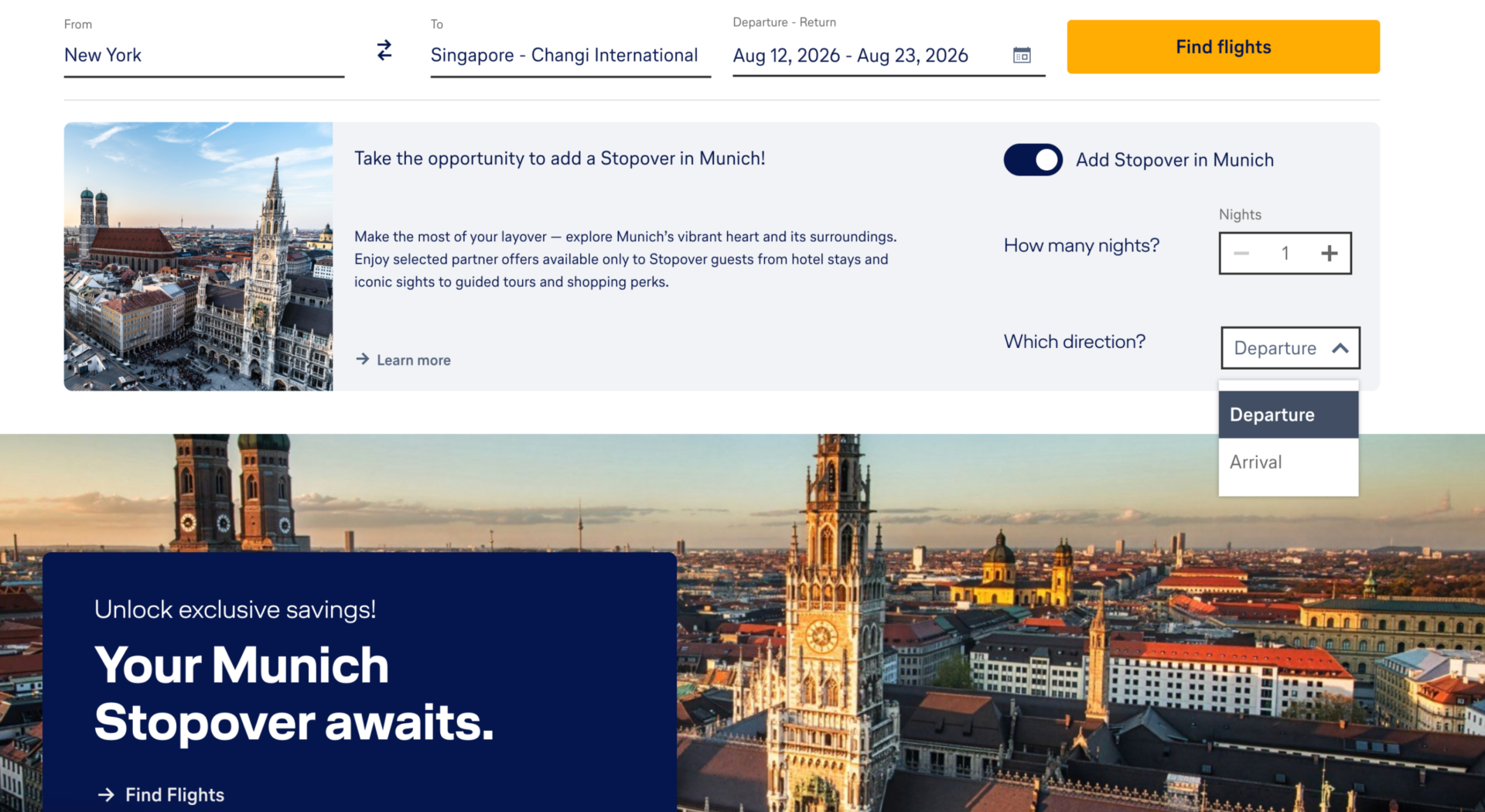
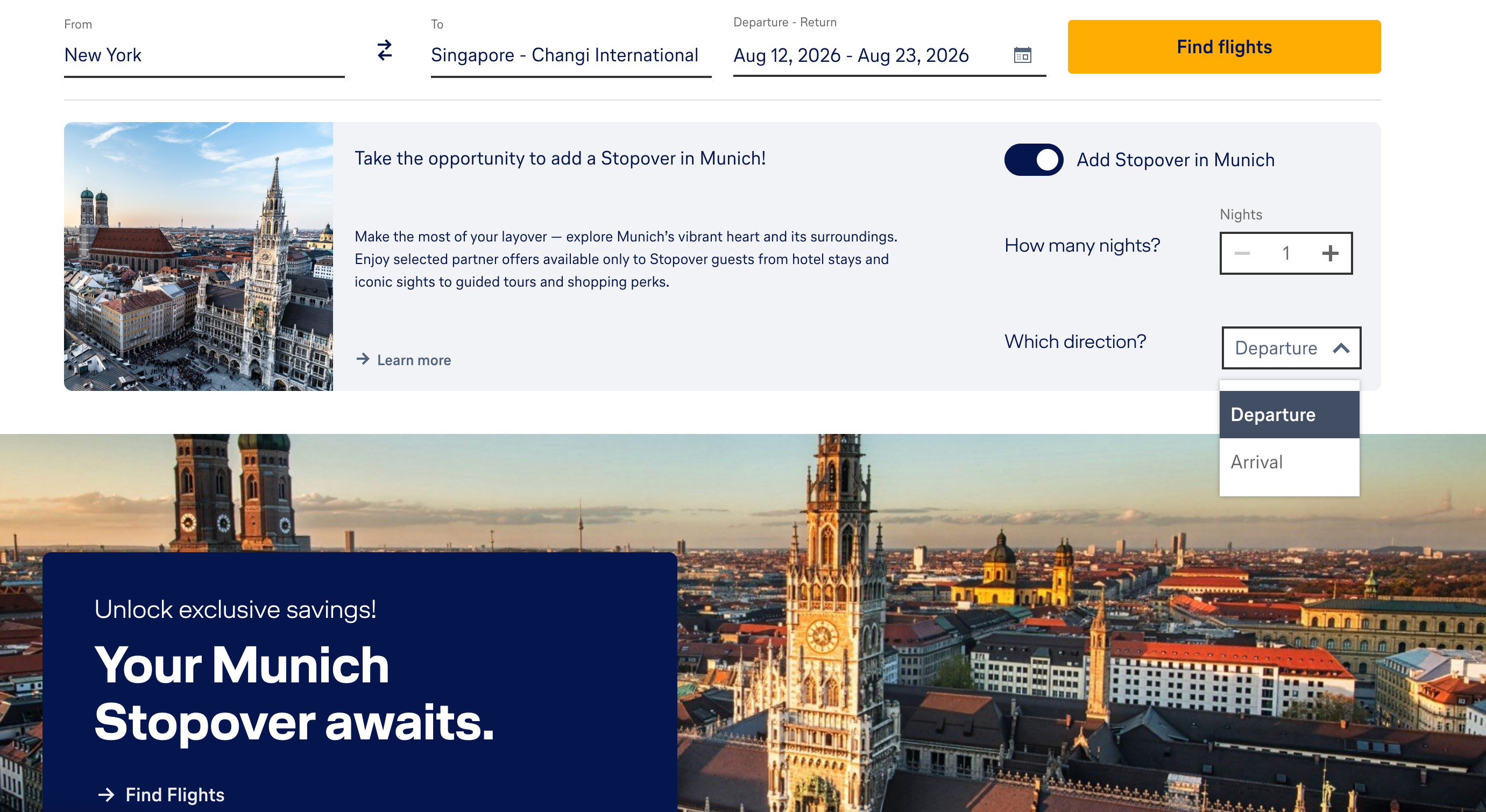
All you have to do is toggle the “Add a stopover in Munich” option when inputting your travel information to your final destination. You can then select the number of nights you wish to stay in the Bavarian capital, and choose whether you want to add this adventure to the beginning or end of your trip.
lufthansa booking page
LUFTHANSA

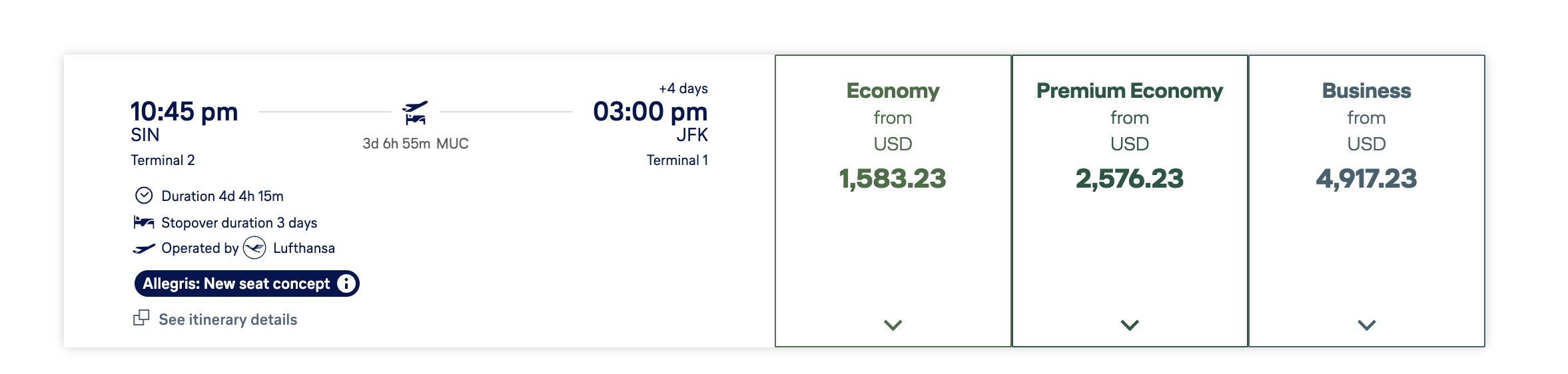
The rest of the booking process is just as simple. I selected to add a three-day stopover in Munich on an example flight home from Singapore. After choosing my outbound flight, I saw the stopover at Munich International Airport (MUC) built into all the inbound flight options.
lufthansa booking page
LUFTHANSA

The final screen of the booking process shows the itinerary with the stopover clearly outlined.
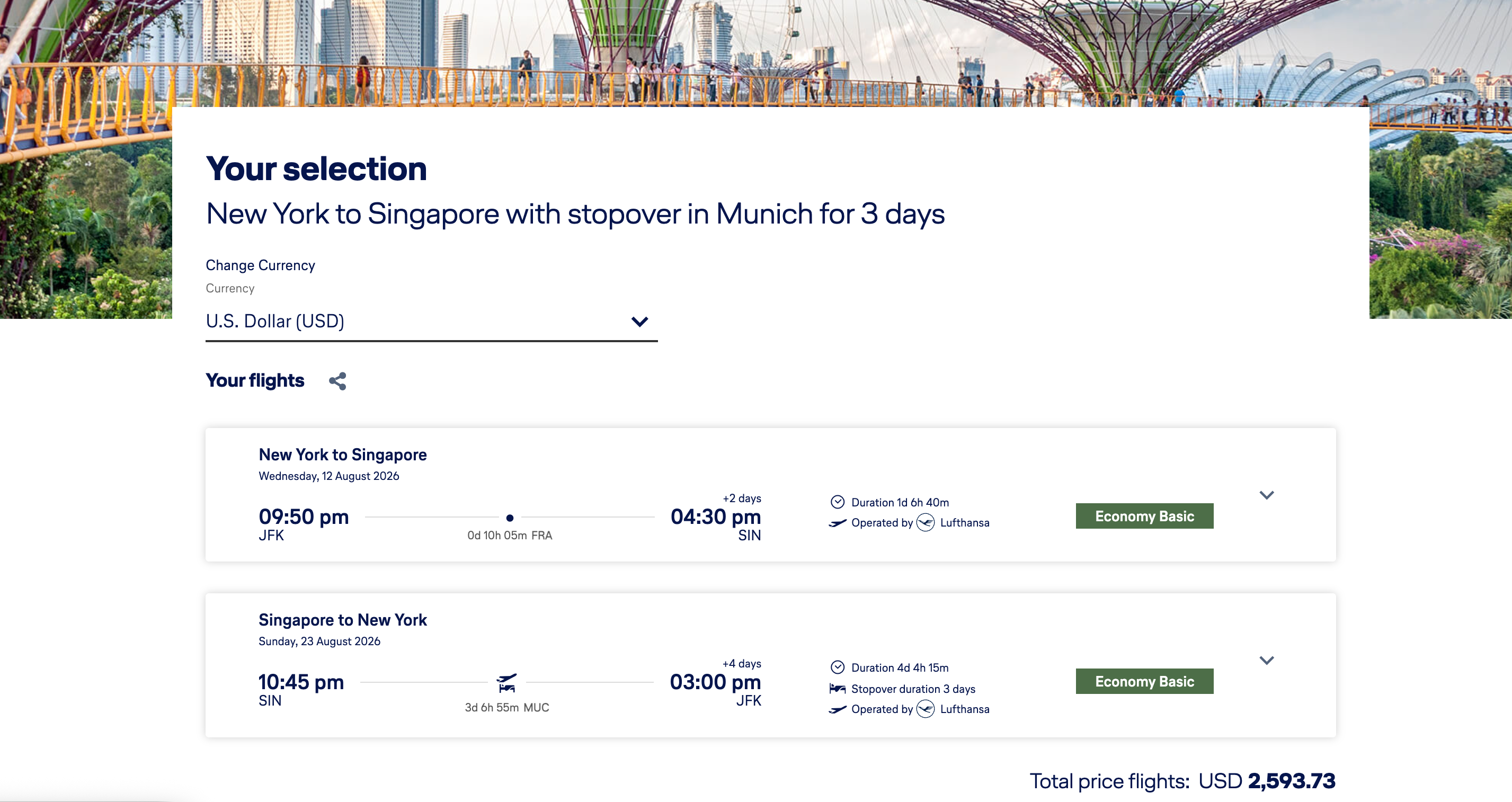
lufthansa booking page
LUFTHANSA

It may seem intimidating or overwhelming to plan activities for a Munich layover extension after you have already planned a whole trip elsewhere. To ease this planning process, Lufthansa has some discounts and deals specifically for stopover passengers.
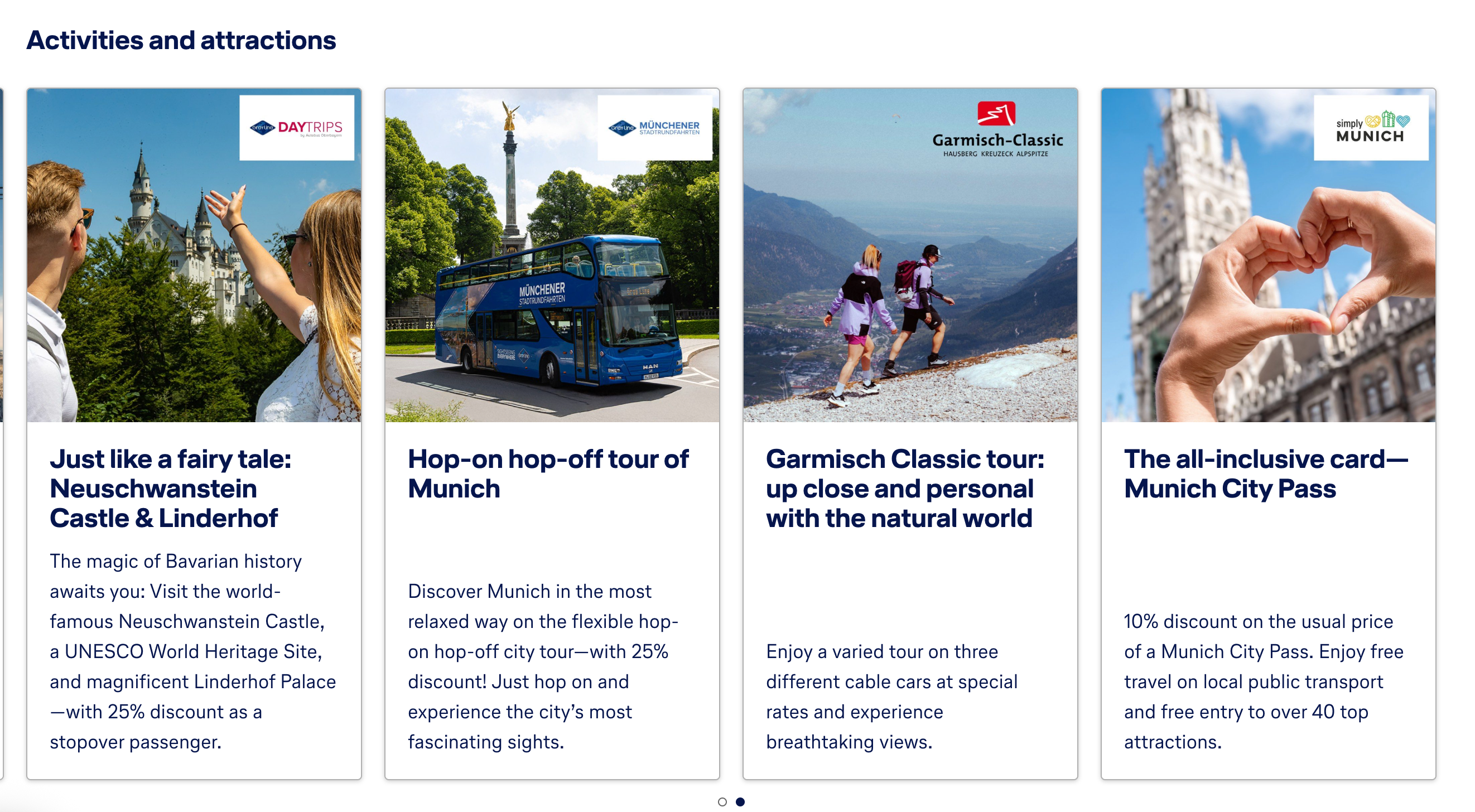
lufthansa booking page
LUFTHANSA

Travelers can add these discounted activities and hotel stays to their itineraries starting 24 hours after booking the flight.

Related: Marvelous in Munich: A review of the Rosewood Munich

Lufthansa offers the Munich stopover option to travelers across all classes, so even those flying on the most restrictive ticket option can add it.

Reward your inbox with the TPG Daily newsletter

Join over 700,000 readers for breaking news, in-depth guides and exclusive deals from TPG’s experts

Right now, the stopover option is only available on flights from Singapore and the U.S. However, it will be available on more routes in the future.

Stopover offers are planned for other hubs within the Lufthansa Group, according to the carrier. That means you could see similar offerings on Lufthansa Group airlines like Swiss Air, ITA Airways, Brussels Airlines and Austrian Airlines, among others.

Stopover programs have proven to be great ways to encourage tourism and drive local economic growth, and Lufthansa joins a growing list of airlines with this offering.

It can often serve as a way to visit multiple cities without paying extra.

For instance, Copa Airlines allows travelers to extend their stops in Panama for up to seven days, and Icelandair does the same in Reykjavik. Some airlines have even more generous stopover deals: TAP Air Portugal allows travelers an up to 10-day stopover in Portugal, while Turkish Airlines includes a one- or two-night hotel stay for stopover passengers free of charge. Many of these programs have similar rules to Lufthansa’s, but be sure to read the fine print of your chosen airline when booking.

Related: This luxurious Munich hotel has historic digs, contemporary art and an outpost of Matsuhisa

You can earn and redeem points on Lufthansa flights through the airline’s Miles & More program which, unfortunately, doesn’t have a major U.S. credit card transfer partner.

However, because the airline is a Star Alliance member, you can also typically redeem miles from other Star Alliance programs — such as United MileagePlus and Air Canada Aeroplan — to book award seats on Lufthansa-operated flights.

Related reading:


Source link

Leave a Reply

Subscribe to Our Newsletter

Get our latest articles delivered straight to your inbox. No spam, we promise.

Recent Reviews


Denodo Data Virtualization – Table of Content

Need for Denodo:

Denodo is really the market leader in Data Virtualization, offering data access, data governance, and data delivery capabilities across the most diverse enterprise, cloud, big data, and unorganized information sources without requiring data to be moved from their existing directories.

                       Interested in learning Denodo Join HKR and Learn more on Denodo Training!

Features of Denodo:

Denodo Platform goes above and beyond any other data virtualization solution, providing:

  • A newly designed web-based user interface provides an exceptional user experience that is tailored to the specific needs of business and IT stakeholders.
  • Intelligent and optimal query execution strategy utilizing a Dynamic Query Optimizer for faster data access
  • With assistance of Summaries, Smart Query Acceleration can be used for complex analytical scenarios.
  • In-Memory Parallel Processing accelerates data access to unprecedented speeds.
  • A collection of computerized lifecycle management options that enable users to spend a little less time controlling information and much more time utilizing information to make decisions.
  • A Dynamic Denodo Data Catalog enables seamless data access, improved collaboration, and ML-driven automatic recommendation.
  • Cloud infrastructure management that is automated, with PaaS support for cloud and hybrid environments.
  • A modern data services layer that supports OAuth 2.0, SAML, OpenAPI, OData 4, GraphQL, and other cloud standards for easy integration with existing cloud systems.
  • Denodo can be deployed using marketplaces such as Amazon Web Services (AWS), Microsoft Azure, Google Cloud Platform (GCP), and Docker.
  • Secure, selective availability to a firm’s entire data holdings via a single point of control and management ensures seamless safety and accountability.

The Denodo Platform connects to numerous data sources, combining and publishing data in a business-friendly format to multiple consumers.

Denodo Training

  • Master Your Craft
  • Lifetime LMS & Faculty Access
  • 24/7 online expert support
  • Real-world & Project Based Learning

Data Virtualization:

Data virtualization seems to be a logical data layer which really incorporates all business intelligence silos scattered throughout different systems, maintains the unified data for consolidated security and governance, and provides it in near real – time to corporate customers.

  1. Data virtualization provides a unique strategy to viewing, controlling, and delivering data with no need for a physical repository.
  2. Data virtualization unifies data that has been siloed throughout all enterprise applications, irrespective of data format, destination, or latency.
  3. Data virtualization creates a centrally controlled secure layer for cataloging, searching, discovering, and managing unified data and its relationships.
  4. Data virtualization provides interconnected information about business applicable in real time.

The Real Time Challenge with the Data Virtualization:

Data virtualization is a cutting-edge method for data integration. Unlike ETL solutions, that mostly reproduce data, data virtualization keeps data in source systems while providing data consumers with an accurate understanding of all data.When enterprise customers dig deeper into documents, data virtualization retrieves the information from the resource description systems in real time. Data virtualization demonstrates that accessing the data is far better compared to accumulating it.

Uses of Data Virtualization:

Businesses in a wide range of industries can motivate complex systems with real-time direct connections to comprehensive information.

  • Examine existing business productivity in comparison to previous years.
  • Act in accordance with rules that govern historical information to be traceable.
  • Look for and explore data that is related to one another.
  • Replace legacy applications while modernizing business applications.
  • Simply move from on-premises to cloud-based applications.
  • Data can be digitized by providing it as a service.

Lets’s get started with Denodo Tutorial !

HKR Trainings Logo

Subscribe to our YouTube channel to get new updates..!

How Data Virtualization Works?

To provide a comprehensive view of corporate data to corporate customers throughout all fundamental data sources, data virtualization provides a straightforward three-step process: connect, combine, and consume.

  • Connect to any data source
  • Combine any data type
  • Consume the data in any mode

Connect to any Data Source:

Data virtualization connects to a wide variety of data sources, including databases, data warehouses, cloud applications, big data repositories, and even Excel files.

The Connect layer uses data from diverse repositories while masking the complexities of the upper layers’ underpinning network topologies and formats. Data virtualization makes a connection to a wide variety of data sources, from organised to unorganised, such as databases, big data systems, streaming sources, cloud repositories, the Web, NoSQL sources, and flat files.It accesses particular data repositories or applications using highly specialised connectors and performs data source form conversions and widespread acceptance so all base views occur as relational views to the upper layers.

Combine any type of Data:

Data virtualization integrates pertaining data into actionable views regardless of data forma relational databases, noSQL, Hadoop, web services and Cloud APIs, files, and so on.

The Combine layer efficiently simplifies Web processes by modeling them with a library of pre-built layouts and elements for workflow, connectivity, and retrieval, and also the organizing of Web, semi-structured, and unstructured data. It supports dynamic transitions with logical operators for the smooth development of composite data views on top of the base views provided by the coprocessor.

In this layer, consumers can use SQL and relational techniques those who already are acquainted with to execute large data transformations, metadata designing, quality management, and semantic color coordinated operations.

Consume the Data in any Mode:

Business users can consume data through reports, analysis tools, portals, mobile apps, and Web apps thanks to data virtualization.

The Consume layer provides a unified interface for accessing and interacting with both the inherent data sources, and also abstracted data views in a delivery time format.JDBC, ODBC, ADO.NET, SOAP web services, RESTful web services (output as XML, JSON, HTML, or RSS), OData, portlets and data widgets (JSR-168, JSR-286, or Microsoft Web Parts to be implemented in SharePoint), exports to Microsoft Excel/SQL, and JMS message queues are available in the Consume layer to meet the needs of business users.

Interested in learning Denodo Join HKR Denodo training in Hyderabad!

Denodo Training

Weekday / Weekend Batches

Conclusion:

In this blog post we learned about dendo and how it acts as an most prominent data virtualization tool in today’s global market. Had any doubts drop your quieres in the comments.

Related Artilces:

  1. Denodo Tool
  2. Denodo Architecture
  3. Denodo certification


Source link