The best premium credit cards: A side-by-side comparison


Premium credit cards can unlock luxury perks, airport lounge access and high-value rewards, but they can also come with hefty annual fees and a laundry list of benefits. So how do you know which one is actually worth it?

To help you decide, we’ve compared some of the top premium rewards cards across the factors that matter most — from welcome offers and earning rates to lounge access and statement credits — so you can find the right fit for your travel habits and spending style.

Here are the nine premium credit cards included in our comparison:

Methodology for comparing the best premium credit cards

For this comparison, we’ll compare these cards across seven categories:

  • Annual fee
  • Current welcome offer
  • Potential to earn points
  • Redemption options
  • Statement credits and notable perks
  • Lounge access
  • Travel and purchase protections

This analysis is based on an everyday traveler trying to decide which one of these cards is right for them. Since premium credit cards offer different perks and benefits, the card that’s right for your wallet depends on your specific needs.

Comparison of the best premium cards

Card Annual fee Additional cardholder fee Welcome offer Welcome offer value* Earnings

Find out your offer and see if you are eligible for as high as 175,000 bonus points after spending $12,000 on purchases within the first six months of card membership. Welcome offers vary, and you may not be eligible for an offer.

Up to $3,500

  • 5 points per dollar spent on airfare purchases booked through the airline or American Express Travel® (on up to $500,000 of these purchases per calendar year, then 1 point per dollar spent)
  • 5 points per dollar spent on prepaid hotels booked through Amex Travel
  • 1 point per dollar spent on other eligible purchases

$395

$0 for up to four authorized users

$125 for up to four authorized users for them to receive lounge access

Earn 75,000 bonus miles after spending $4,000 on purchases in the first three months from account opening.

$1,388

  • 10 miles per dollar spent on hotels and car rentals booked through Capital One Travel
  • 5 miles per dollar spent on flights and vacation rentals booked through Capital One Travel
  • 2 miles per dollar spent on other eligible purchases

$795

$195 for each additional cardholder

Earn 150,000 bonus points after spending $6,000 on purchases in the first three months from account opening.


 $3,075

  • 10 points per dollar spent on Peloton equipment and accessory purchases of $150 or more, with a maximum of 50,000 points (through Dec. 31, 2027)
  • 8 points per dollar spent on purchases made through Chase Travel℠, including The Edit
  • 5 points per dollar spent on Lyft rides (through Sept. 30, 2027)
  • 4 points per dollar spent on flights and hotels booked directly
  • 3 points per dollar spent on dining worldwide
  • 1 point per dollar spent on everything else

Purchases that qualify for the $300 annual travel credit will not earn points.

$595

$175 annual fee for the first three authorized users; $175 for each authorized user after that

Earn 70,000 bonus miles after spending $7,000 on purchases in the first three months of account opening.

$1,330

  • 10 miles per dollar spent on eligible hotels booked through aa.com/hotels and eligible car rentals booked through aa.com/cars
  • 4 miles per dollar spent on eligible American Airlines purchases
  • 1 mile per dollar spent on all other purchases

$595

$75 per additional cardholder

Earn 75,000 bonus points after spending $6,000 on purchases in the first three months from account opening.

$1,425

  • 12 points per dollar spent on hotels, car rentals and attractions booked through Citi Travel
  • 6 points per dollar spent on air travel booked through Citi Travel
  • 6 points per dollar spent at restaurants, including restaurant delivery services, on CitiNights℠ purchases every Friday and Saturday from 6 p.m. to 6 a.m. Eastern time; earn 3 points per dollar spent on dining any other time
  • 1.5 points per dollar spent on all other purchases

Find out your offer and see if you are eligible for as high as 100,000 bonus miles after spending $5,000 on purchases in the first six months of card membership. Welcome offers vary, and you may not be eligible for an offer.

Up to $1,200

  • 3 miles per dollar spent on eligible Delta purchases
  • 1 mile per dollar spent on other eligible purchases

Earn 150,000 bonus points after spending $6,000 on purchases in the first six months of card membership.

$600

  • 14 points per dollar spent at Hilton portfolio properties worldwide
  • 7 points per dollar spent on flights booked directly with the airline or through Amex Travel
  • 7 points per dollar spent on car rentals booked directly from select car rental companies
  • 7 points per dollar spent at U.S. restaurants (including takeout and delivery)
  • 3 points per dollar spent on other eligible purchases

Earn 200,000 bonus points after spending $6,000 on purchases within the first six months of card membership. Offer ends May 13.

$1,600

  • 6 points per dollar spent on eligible purchases at hotels participating in the Marriott Bonvoy program
  • 3 points per dollar spent at restaurants worldwide and on airfare purchased directly with the airline
  • 2 points per dollar spent on other eligible purchases

$695

$0 for each additional cardholder

Earn up to 110,000 bonus miles and 3,000 PQPs: Earn 100,000 bonus miles and 3,000 PQPs after spending $5,000 on purchases in the first three months from account opening. Plus, earn 10,000 bonus miles after adding an authorized user in the first three months from account opening.

Up to $1,485 (including the points from adding an authorized user; not including the value of the PQPs)

  • 5 miles per dollar spent when you book directly with Renowned Hotels and Resorts for United® Cardmembers
  • 5 miles per dollar spent on United purchases
  • 2 miles per dollar spent on all other travel and dining purchases (including eligible delivery services)
  • 1 mile per dollar spent on other purchases

*Welcome offer value is an estimated value based on TPG’s May 2026 valuations and is not provided by the issuer.

Annual fee

When evaluating a card’s annual fee, weigh the benefits and statement credits it offers to see whether the value justifies the cost. Some cards with high annual fees can provide so much value that you might still come out ahead.

Reward your inbox with the TPG Daily newsletter

Join over 700,000 readers for breaking news, in-depth guides and exclusive deals from TPG’s experts

Whether or not a card charges a fee for additional cardholders also matters. Several of the cards on our list don’t charge a fee for additional cardholders (though some limit the number of complimentary users you can add).

The Hilton Honors American Express Aspire Card allows authorized users to enjoy an up-to-$400 Hilton resort statement credit each calendar year (up to $200 semiannually).

20241016_Credit Card Legislation Sponsored Article_Person using smart phone while holding credit card while relaxing on couch at home
DELMAINE DONSON/GETTY IMAGES

Meanwhile, authorized users on the Citi / AAdvantage Executive World Elite Mastercard receive Admirals Club access for themselves and their immediate family members or up to two traveling companions with a same-day boarding pass for an eligible flight.

Still, the Venture X is the winner in this category. First and foremost, its $395 annual fee is much lower than the rest of the crowd. Plus, you can add up to four authorized users for no additional charge.

But it is important to note that if your authorized user wants Capital One lounge access, you’ll need to pay $125 per person for up to four authorized users.

Related: The 7 credit cards with the greatest value for authorized users

Welcome offer

All the premium cards listed above come with lucrative welcome offers that can help get you closer to your next big trip.

Cards that earn transferable rewards for their welcome offers are worth more than their cobranded counterparts.

For example, with the Amex Platinum, you can find out your offer and see if you are eligible for as high as 175,000 bonus points after spending $12,000 on purchases within the first six months of card membership. Welcome offers vary, and you may not be eligible for an offer.

The Amex Platinum welcome offer is worth up to $3,500 based on TPG’s May 2026 valuations. That’s substantially more valuable than virtually any cobranded card’s welcome offer.

Related: The best welcome offers of the month

Points-earning potential

Another important aspect when comparing premium credit cards is the points-earning potential and the rewards you can earn.

The Sapphire Reserve, for example, comes out on top here. It offers one of the most valuable currencies for a wide variety of purchases. Chase Ultimate Rewards points are worth 2.05 cents apiece, according to TPG’s May 2026 valuations.

The Strata Elite also provides high earning rates when spending through its portal. Citi ThankYou Rewards points are worth slightly less than Ultimate Rewards points, at a 1.9 cents-per-point valuation per TPG’s May 2026 valuations.

Related: Maximizing credit cards to become points-rich without spending a ton

Redemption options

Another important aspect when comparing premium cards is the redemption options. Generally, the card that provides the most value is the one that offers transfer partners.

Card Redemption/transfer options
You can redeem points to book travel directly through Chase Travel; with the Points Boost perk, your points can be worth up to 2 cents apiece, depending on the specific redemption (see your rewards program agreement for full details).

You can also offset some purchases through Chase’s Pay Yourself Back feature or transfer them to one of 10 airline and four hotel partners.

You can redeem miles for flights on American Airlines and its various Oneworld alliance partners and non-alliance partners like Etihad Airways, as well as upgrades, hotels, rental cars, experiences and Admirals Club passes.
You can redeem miles for flights on Delta and its various SkyTeam or non-alliance partners like WestJet, as well as seat upgrades, Delta Vacations packages, Delta Stays, car rentals, SkyMiles experiences and magazines.

Related: Guide to transferring points and miles to airlines and hotels

Statement credits and notable perks

All these premium card options offer statement credits and perks designed to provide value to cardholders. In some cases, if you use the full value of these credits and perks, you can recover your annual fee. In some cases, you might even come out ahead.

Card Statement credits and benefits

  • Up to $600 in prepaid hotel statement credits for eligible Fine Hotels + Resorts or The Hotel Collection bookings per calendar year through Amex Travel (up to $300 semiannually)
  • Up to $400 Resy statement credit per calendar year (allotted up to $100 quarterly) when you pay with your card at participating U.S. Resy restaurants
  • Up to $300 per calendar year in Equinox statement credits
  • Up to $300 per calendar year in Lululemon statement credits at U.S. Lululemon retail stores (excluding outlets) and lululemon.com (allotted up to $75 quarterly)
  • Up to $300 per calendar year (allotted up to $25 monthly) in digital entertainment statement credits
  • Up to $209 per calendar year for a Clear+ membership statement credit
  • Up to $200 per calendar year in airline fee statement credits
  • Up to $200 per calendar year (allotted up to $15 monthly, plus an up to $20 bonus in December) in Uber Cash (valid on U.S. purchases; add your Amex Platinum to your Uber account and redeem with any Amex card)
  • Up to $200 per calendar year in statement credits toward Oura Ring purchases (hardware only)
  • Up to $155 per calendar year (allotted up to $12.95 monthly) in statement credits for one Walmart+ membership (Plus Ups are excluded)
  • $120 Global Entry or up to $85 TSA PreCheck application fee statement credit (once every four years for Global Entry or every 4 1/2 years for TSA PreCheck)
  • Up to $120 per calendar year toward an annual Uber One membership
  • Hilton Honors Gold status, Marriott Bonvoy Gold Elite status and Leaders Club Sterling status from The Leading Hotels of the World

Enrollment is required for select benefits.
Select benefits are subject to auto-renewal.

  • $300 annual credit for bookings made through Capital One Travel
  • Up to $120 Global Entry or TSA PreCheck application fee statement credit
  • Hertz President’s Circle status**
  • 10,000 bonus miles on every account anniversary

  • Up to $500 in annual statement credits (given as two $250 statement credits) for The Edit hotels to use on bookings (minimum two-night stay required)
  • Up to $300 annual flexible travel credit
  • Up to $300 annual StubHub and Viagogo credit (allotted $150 biannually) through Dec. 31, 2027; activation required
  • Up to $300 annual dining credit at OpenTable
  • Up to $300 annual value with DoorDash: Cardholders receive up to $25 in monthly promos with two $10 nonrestaurant promos and one $5 restaurant promo, plus a complimentary DashPass membership for at least one year (must activate by Dec. 31, 2027)
  • Up to $288 annually in complimentary Apple TV and Apple Music subscriptions (one-time activation per service through chase.com or Chase Mobile app required; subscriptions run through June 22, 2027)
  • Up to $120 annual in-app Lyft credits (allotted up to $10 monthly; through Sept. 30, 2027); credit does not apply to Wait & Save, bike or scooter rides
  • Up to $120 Peloton credit ($10 monthly; through Dec. 31, 2027; activation required)
  • Up to $120 Global Entry, TSA PreCheck or Nexus application fee statement credit (once every four years)

  • Up to $120 in Lyft credits; after taking three eligible rides in a calendar month, you will earn a $10 Lyft credit (for a total of up to $120 Lyft credits annually)
  • Up to $120 back on Grubhub purchases as a statement credit of up to $10 per monthly billing statement on eligible Grubhub purchases (for a total of up to $120 for every 12 billing statements)
  • Up to $120 back in statement credits per calendar year on Avis or Budget car rentals as a statement credit on eligible prepaid Avis or Budget car rentals booked directly
  • Up to $120 Global Entry or TSA PreCheck application fee statement credit (once every four years)
  • Free checked bag on domestic flights and 25% off of inflight food-and-beverage purchases

  • Up to $300 annually on prepaid hotel stays booked with Citi Travel (minimum two-night stay required)
  • Up to $200 annually in Splurge credits for choice of up to two of the following brands: 1stDibs (selling luxury art, furniture and jewelry), American Airlines, Best Buy, Future Personal Training and Live Nation (exclusions apply)
  • Up to $200 annually for Blacklane private chauffeur service (split into $100 biannually)
  • Up to $120 Global Entry or TSA PreCheck application fee statement credit (once every four years)

  • Up to $240 Resy statement credit per calendar year (allotted up to $20 monthly) when you pay with your card at participating U.S. Resy restaurants
  • Up to $200 Delta Stays statement credit per calendar year (Delta’s hotel booking platform)
  • Up to $120 ride-hailing statement credit per calendar year (allotted up to $10 monthly) when you use your card at select ride-hailing providers in the U.S.
  • $120 Global Entry or up to $85 TSA PreCheck application fee statement credit (once every four years)
  • Free checked bag
  • Upgrade priority and being placed on the complimentary upgrade list
  • 20% off in-flight purchases (in the form of a statement credit)
  • TakeOff15 (a 15% discount on Delta award flight redemptions)
  • Hertz President’s Circle status (enrollment in the Hertz Gold Plus Rewards program is required)
  • Annual companion certificate

Enrollment is required for select benefits.

  • Up to $400 Hilton resort statement credit per calendar year (allotted up to $200 semiannually)
  • Up to $200 flight statement credit per calendar year (allotted up to $50 quarterly) for flights booked directly or through amextravel.com
  • Up to $209 Clear+ membership statement credit per calendar year (subject to auto-renewal)
  • Up to $100 in on-property credit for two-night Waldorf Astoria or Conrad stays
  • Free night certificate upon account opening and a free night certificate on each cardmember anniversary
  • Hilton Diamond status
  • National Car Rental Emerald Club Executive status

Enrollment is required for select benefits.

Enrollment is required for select benefits.

  • Up to $120 Global Entry, TSA PreCheck or Nexus application fee statement credit (once every four years)
  • Free first and second checked bags for you and one travel companion
  • 25% back on in-flight United purchases and premium drink purchases in the United Club
  • Access to Premier Access airport services when available
  • Complimentary upgrades on award tickets
  • IHG One Rewards Platinum Elite status
  • Avis President’s Club elite status (enrollment required)

**Upon enrollment, accessible through the Capital One website or mobile app, eligible cardholders will remain at that status level through the duration of the offer. Note that enrolling through the normal Hertz Gold Plus Rewards enrollment process (e.g., at hertz.com) will not automatically detect a cardholder as being eligible for the program, and cardholders will not be automatically upgraded to the applicable status tier. Additional terms apply.

Analysis

The Amex Platinum has a slew of benefits; if you can maximize them, you will more than offset the card’s annual fee. However, the value they can provide in your situation can vary.

The Sapphire Reserve also offers a lot of value. The card’s best benefit is its $300 travel credit, which is higher than most competitors’ and applies to any travel purchase (as opposed to just fees or airfare, like some of its competition).

The Strata Elite provides some credits and benefits to help offset its annual fee, but they aren’t as plentiful or useful as other premium cards.

The Venture X also has a $300 travel credit, though it’s more limited: It only applies to bookings made through Capital One Travel. On the plus side, with the 10,000 anniversary bonus miles and the full value of the travel credit, you can net positive value every year.

The cobranded hotel cards offer substantial value when staying at Hilton or Marriott properties, plus useful hotel-related statement credits and benefits like elite status and free night awards.

The cobranded airline cards provide modest statement credits, but the in-flight discounts and free checked bags can be very useful if you frequently fly on one of those airlines.

Related: The best credit cards to reach elite status

Lounge access

Card Lounge access

  • Centurion Lounges
  • Priority Pass™ Select (does not include restaurants)
  • Delta Sky Clubs when flying Delta or a Delta-marketed flight operated by WestJet
    • Eligible cardmembers will receive 10 visits per year to the Delta Sky Club; to earn an unlimited number of visits each year, cardmembers must spend $75,000 or more in a year; basic economy tickets are not eligible for entry
  • Aspire and Escape lounges
  • Plaza Premium lounges
  • Select Lufthansa lounges (until Oct. 1)
  • Other Global Lounge Collection partner lounges as an eligible cardmember

Enrollment is required for select benefits.

  • Capital One Lounges (seven locations: five Lounges and two Landings)
  • Priority Pass Select (does not include restaurants)

  • Full Admirals Club membership with access to Alaska Airlines lounges and over 50 partner lounges
    • Must have a same-day boarding pass for an eligible flight
  • Can add up to three authorized users for $175, and $175 for each authorized user after that; each will receive Admirals Club access
    • Must have a same-day boarding pass for an eligible flight

  • Four Admirals Club Citi Strata Elite passes each calendar year
  • Priority Pass lounge access

  • 15 Sky Club visits when traveling on Delta-coded or Delta-operated flights
    • To earn an unlimited number of visits each year, cardmembers must spend $75,000 or more in a year; basic economy tickets are not eligible for entry
    • Authorized users get their own 15-visit Sky Club allotment
  • Cardholders receive four one-time Sky Club guest passes each year
  • Access to Amex Centurion Lounges and Escape Lounges when you book a same-day Delta-operated or -marketed flight with your Reserve card

None

  • Priority Pass Select (does not include restaurants)

Enrollment is required.

Related: Best credit cards for airport lounge access

Travel and purchase protections

All these cards also provide various coverages and protections when you’re traveling or making purchases, which can make your life easy if things go awry. They all have some combination of the following protections and insurance:

Analysis

The Sapphire Reserve is the best premium credit card here, with its slew of protections like primary car rental insurance, emergency evacuation insurance and travel accident insurance.

The Venture X comes in second, thanks to fairly comprehensive protections that include cellphone coverage.

The Amex Platinum offers significant travel insurance coverage***, but note that the rental car benefit provides secondary coverage**** and there is no baggage delay coverage.

While many of these benefits look similar overall, your best bet is to examine the differences between policies and determine how likely those are to affect your trips. All of these cards offer various protections and insurances, so analyze what is best for your needs.

***Terms, conditions and limitations apply for travel insurances and protections. Visit americanexpress.com/benefitsguide for details.

****Eligibility and benefit level varies by card. Not all vehicle types or rentals are covered, and geographic restrictions apply. Terms, conditions and limitations apply. Visit americanexpress.com/benefitsguide for details. Policies are underwritten by AMEX Assurance Company. Coverage is offered through American Express Travel Related Services Company, Inc.

Related: Your complete guide to travel protections on American Express cards

Bottom line

Premium credit cards can deliver significant value, but only if their perks align with how you actually travel and spend.

With high annual fees and a wide range of benefits, the key is focusing on the features you’ll use most — whether that’s lounge access, statement credits or rewards earning.


Apply here: Amex Platinum
Apply here: Chase Sapphire Reserve
Apply here: Citi / AAdvantage Executive World Elite Mastercard
Apply here: Citi Strata Elite
Apply here: Delta SkyMiles Reserve American Express Card
Apply here: Marriott Bonvoy Brilliant American Express Card
Apply here: United Club Card
Apply here: Hilton Honors Aspire
Learn more: Capital One Venture X


For Capital One products listed on this page, some of the benefits may be provided by Visa® or Mastercard® and may vary by product. See the respective Guide to Benefits for details, as terms and exclusions apply.

For rates and fees of the Amex Platinum Card, click here.
For rates and fees of the Delta SkyMiles Reserve American Express Card, click here.
For rates and fees of the Marriott Bonvoy Brilliant American Express Card, click here.
For rates and fees of the Hilton Honors Aspire, click here.


Source link

Leave a Reply

Subscribe to Our Newsletter

Get our latest articles delivered straight to your inbox. No spam, we promise.

Recent Reviews


If you’ve been trading anything other than cash over the past eighteen months, you’ve noticed something peculiar: periods of calm tend to persist, but so do periods of chaos. A quiet Tuesday in January rarely suddenly explodes into volatility on Wednesday—market turbulence comes in clusters. This isn’t market inefficiency; it’s a fundamental stylized fact of financial markets, one that most quant models fail to properly account for.

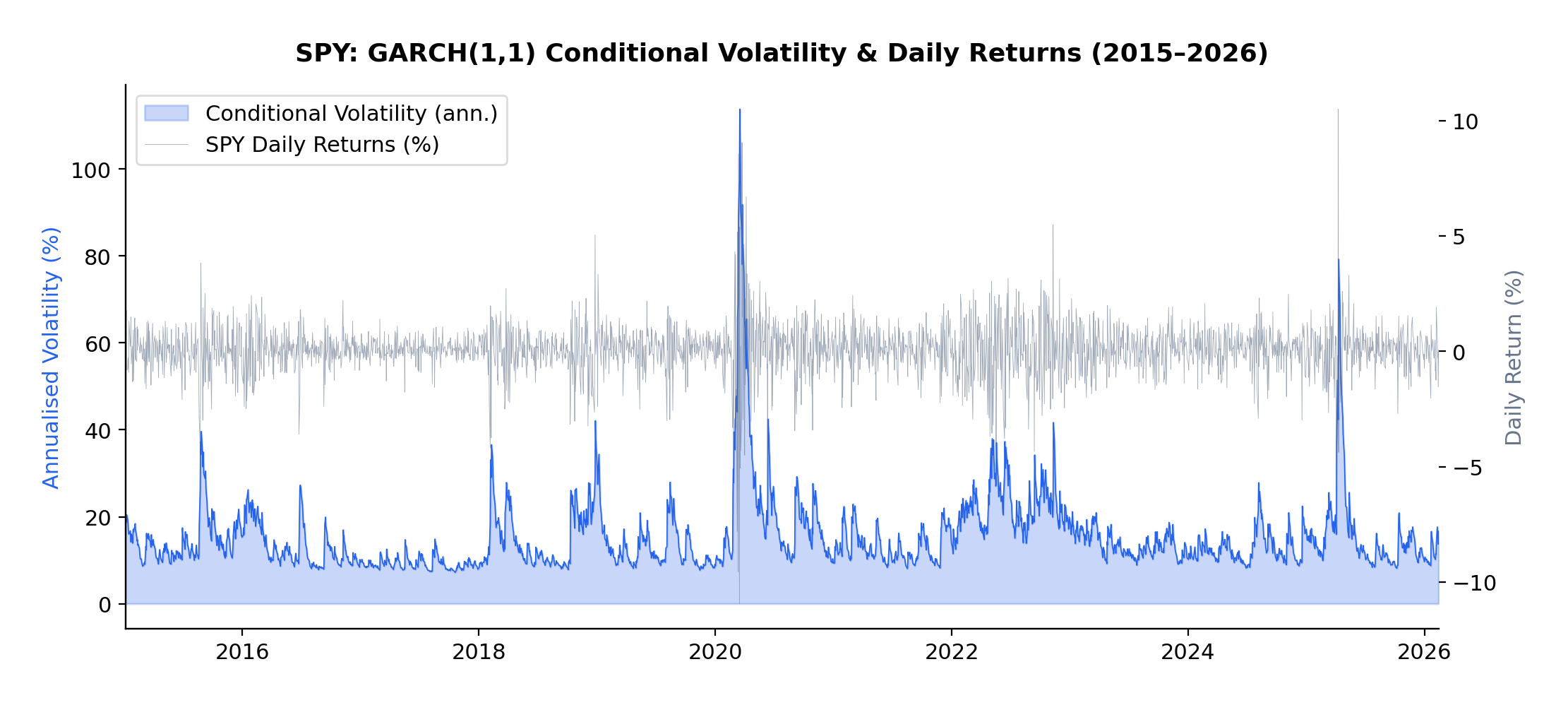
The current volatility regime we’re navigating in early 2026 provides a perfect case study. Following the Federal Reserve’s policy pivot late in 2025, equity markets experienced a sharp correction, with the VIX spiking from around 15 to above 30 in a matter of weeks. But here’s what interests me as a researcher: that elevated volatility didn’t dissipate overnight. It lingered, exhibiting the characteristic “slow decay” that the GARCH framework was designed to capture.

In this article, I present an empirical analysis of volatility dynamics across five major asset classes—the S&P 500 (SPY), US Treasuries (TLT), Gold (GLD), Oil (USO), and Bitcoin (BTC-USD)—over the ten-year period from January 2015 to February 2026. Using both GARCH(1,1) and EGARCH(1,1,1) models, I characterize volatility persistence and leverage effects, revealing striking differences across asset classes that have direct implications for risk management and trading strategy design.

This extends my earlier work on VIX derivatives and correlation trading, where understanding the time-varying nature of volatility is essential for pricing complex derivatives and managing portfolio risk through volatile regimes.


Understanding Volatility Clustering

Before diving into the results, let’s build some intuition about what GARCH actually captures—and why it matters.

Volatility clustering refers to the empirical observation that large price changes tend to be followed by large price changes, and small changes tend to follow small changes. If the market experiences a turbulent day, don’t expect immediate tranquility the next day. Conversely, a period of quiet trading often continues uninterrupted.

This phenomenon was formally modeled by Robert Engle in his landmark 1982 paper, “Autoregressive Conditional Heteroskedasticity with Estimates of the Variance of United Kingdom Inflation,” which introduced the ARCH (Autoregressive Conditional Heteroskedasticity) model. Engle’s insight was revolutionary: rather than assuming constant variance (homoskedasticity), he modeled variance itself as a time-varying process that depends on past shocks.

Tim Bollerslev extended this work in 1986 with the GARCH (Generalized ARCH) model, which proved more parsimonious and flexible. Then, in 1991, Daniel Nelson introduced the EGARCH (Exponential GARCH) model, which could capture the asymmetric response of volatility to positive versus negative returns—the famous “leverage effect” where negative shocks tend to increase volatility more than positive shocks of equal magnitude.

The Mathematics

The standard GARCH(1,1) model specifies:

\sigma_t^2 = \omega + \alpha r_{t-1}^2 + \beta \sigma_{t-1}^2

where:

  • σt2 is the conditional variance at time t
  • rt-12 is the squared return from the previous period (the “shock”)
  • σt-12 is the previous period’s conditional variance
  • α measures how quickly volatility responds to new shocks
  • β measures the persistence of volatility shocks
  • The sum α + β represents overall volatility persistence

The key parameter here is α + β. If this sum is close to 1 (as it typically is for financial assets), volatility shocks decay slowly—a phenomenon I observed firsthand during the 2025-2026 correction. We can calculate the “half-life” of a volatility shock as:

\text{Half-life} = \frac{\ln(0.5)}{\ln(\alpha + \beta)}

For example, with α + β = 0.97, a volatility shock takes approximately ln(0.5)/ln(0.97) ≈ 23 days to decay by half.

The EGARCH model modifies this framework to capture asymmetry:

\ln(\sigma_t^2) = \omega + \alpha \left(\frac{r_{t-1}}{\sigma_{t-1}}\right) + \gamma \left(\frac{|r_{t-1}|}{\sigma_{t-1}}\right) + \beta \ln(\sigma_{t-1}^2)

The parameter γ (gamma) captures the leverage effect. A negative γ means that negative returns generate more volatility than positive returns of equal magnitude—which is precisely what we observe in equity markets and, as we’ll see, in Bitcoin.


For each asset in the sample, I computed daily log returns as:

r_t = 100 \times \ln\left(\frac{P_t}{P_{t-1}}\right)

The multiplication by 100 converts returns to percentage terms, which improves numerical convergence when estimating the models.

I then fitted two volatility models to each asset’s return series:

  • GARCH(1,1): The workhorse model that captures volatility clustering through the autoregressive structure of conditional variance
  • EGARCH(1,1,1): The exponential GARCH model that additionally captures leverage effects through the asymmetric term

All models were estimated using Python’s arch package with normally distributed innovations. The sample period spans January 2015 to February 2026, encompassing multiple distinct volatility regimes including:

  • The 2015-2016 oil price collapse
  • The 2018 Q4 correction
  • The COVID-19 volatility spike of March 2020
  • The 2022 rate-hike cycle
  • The 2025-2026 post-pivot correction

This rich variety of regimes makes the sample ideal for studying volatility dynamics across different market conditions.


GARCH(1,1) Estimates

The GARCH(1,1) model reveals substantial variation in volatility dynamics across asset classes:

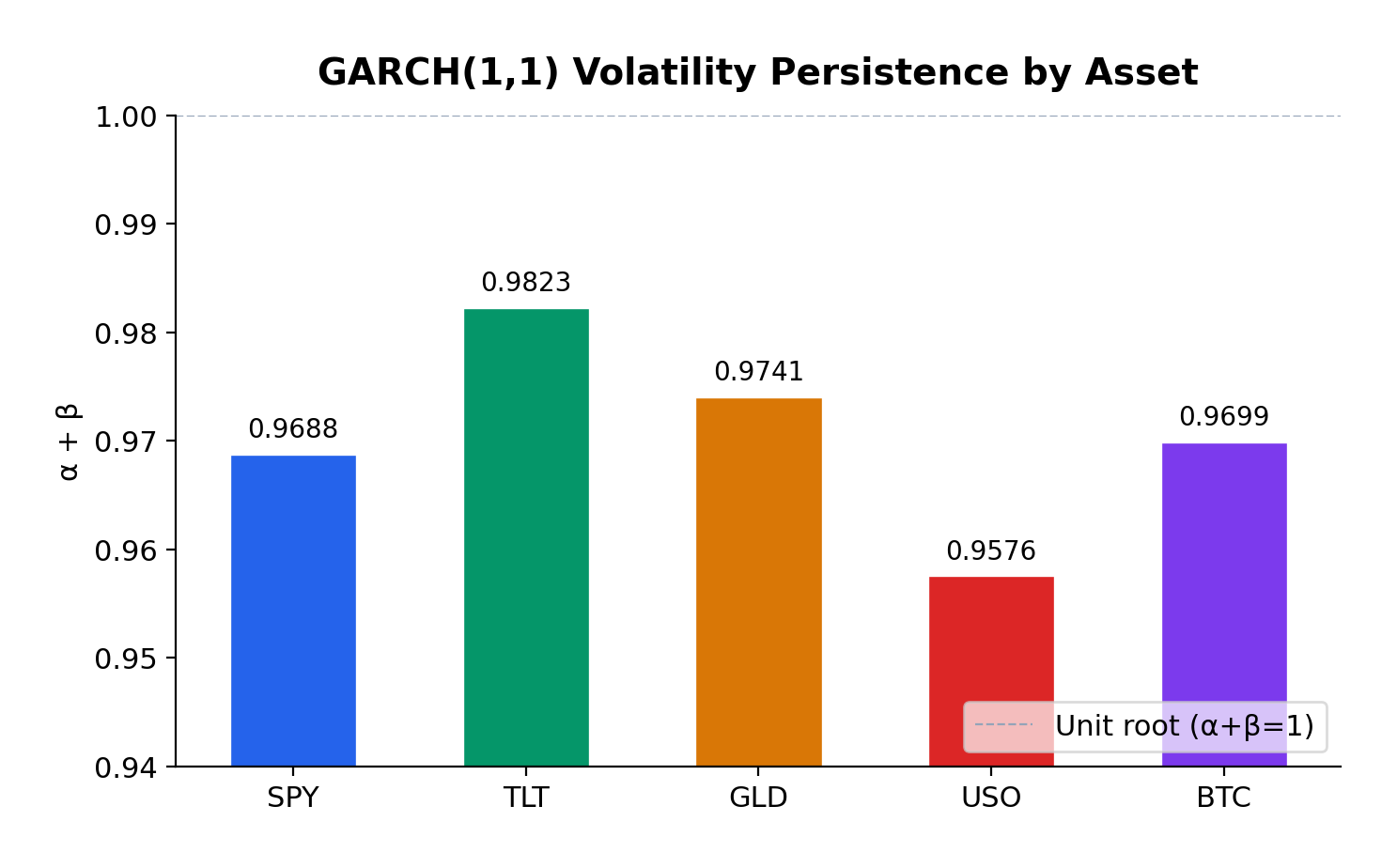
Asset α (alpha) β (beta) Persistence (α+β) Half-life (days) AIC
S&P 500 0.1810 0.7878 0.9688 ~23 7130.4
US Treasuries 0.0683 0.9140 0.9823 ~38 7062.7
Gold 0.0631 0.9110 0.9741 ~27 7171.9
Oil 0.1271 0.8305 0.9576 ~16 11999.4
Bitcoin 0.1228 0.8470 0.9699 ~24 20789.6


EGARCH(1,1,1) Estimates

The EGARCH model additionally captures leverage effects:

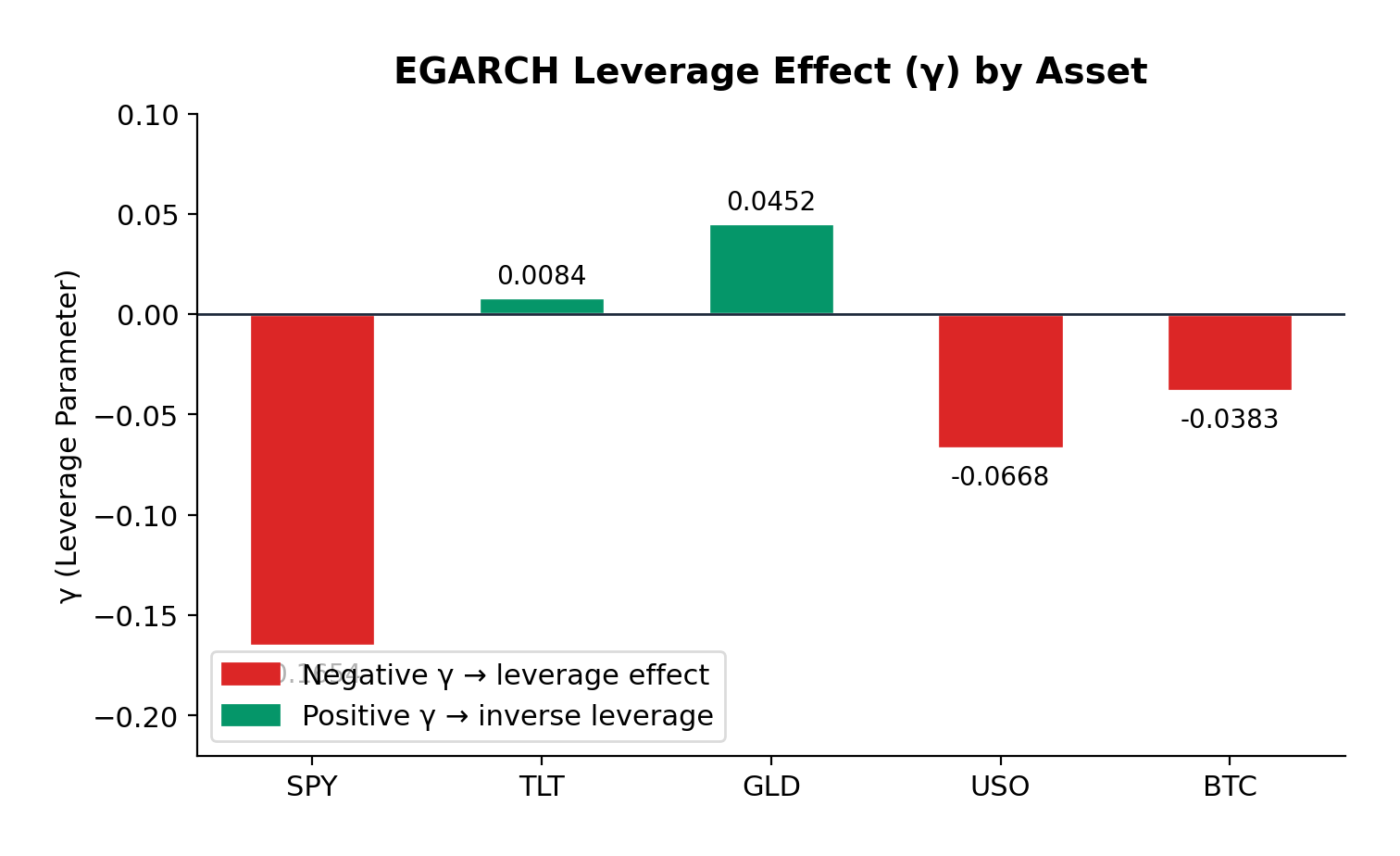
Asset α (alpha) β (beta) γ (gamma) Persistence AIC
S&P 500 0.2398 0.9484 -0.1654 1.1882 7022.6
US Treasuries 0.1501 0.9806 0.0084 1.1307 7063.5
Gold 0.1205 0.9721 0.0452 1.0926 7146.9
Oil 0.2171 0.9564 -0.0668 1.1735 12002.8
Bitcoin 0.2505 0.9377 -0.0383 1.1882 20773.9


Volatility Persistence

All five assets exhibit high volatility persistence, with α + β ranging from 0.9576 (Oil) to 0.9823 (US Treasuries). These values are remarkably consistent with the classic empirical findings from Engle (1982) and Bollerslev (1986), who first documented this phenomenon in inflation and stock market data respectively.

US Treasuries show the highest persistence (0.9823), meaning volatility shocks in the bond market take longer to decay—approximately 38 days to half-life. This makes intuitive sense: Federal Reserve policy changes, which are the primary drivers of Treasury volatility, tend to have lasting effects that persist through subsequent meetings and economic data releases.

Gold exhibits the second-highest persistence (0.9741), consistent with its role as a long-term store of value. Macroeconomic uncertainties—geopolitical tensions, currency debasement fears, inflation scares—don’t resolve quickly, and neither does the associated volatility.

S&P 500 and Bitcoin show similar persistence (~0.97), with half-lives of approximately 23-24 days. This suggests that equity market volatility shocks, despite their reputation for sudden spikes, actually decay at a moderate pace.

Oil has the lowest persistence (0.9576), which makes sense given the more mean-reverting nature of commodity prices. Oil markets can experience rapid shifts in sentiment based on supply disruptions or demand changes, but these shocks tend to resolve more quickly than in financial assets.

Leverage Effects


The EGARCH γ parameter reveals asymmetric volatility responses—the leverage effect that Nelson (1991) formalized:

S&P 500 (γ = -0.1654): The strongest negative leverage effect in the sample. A 1% drop in equities increases volatility significantly more than a 1% rise. This is the classic equity pattern: bad news is “stickier” than good news. For options traders, this means that protective puts are more expensive than equivalent out-of-the-money calls during volatile periods—a direct consequence of this asymmetry.

Bitcoin (γ = -0.0383): Moderate negative leverage, weaker than equities but still significant. The cryptocurrency market shows asymmetric reactions to price movements, with downside moves generating more volatility than upside moves. This is somewhat surprising given Bitcoin’s retail-dominated nature, but consistent with the hypothesis that large institutional players are increasingly active in crypto markets.

Oil (γ = -0.0668): Moderate negative leverage, similar to Bitcoin. The energy market’s reaction to geopolitical events (which tend to be negative supply shocks) contributes to this asymmetry.

Gold (γ = +0.0452): Here’s where it gets interesting. Gold exhibits a slight positive gamma—the opposite of the equity pattern. Positive returns slightly increase volatility more than negative returns. This is consistent with gold’s safe-haven role: when risk assets sell off and investors flee to gold, the resulting price spike in gold can be accompanied by increased trading activity and volatility. Conversely, gradual gold price increases during calm markets occur with declining volatility.

US Treasuries (γ = +0.0084): Essentially symmetric. Treasury volatility doesn’t distinguish between positive and negative returns—which makes sense, since Treasuries are priced primarily on interest rate expectations rather than “good” or “bad” news in the equity sense.

Model Fit

The AIC (Akaike Information Criterion) comparison shows that EGARCH provides a materially better fit for the S&P 500 (7022.6 vs 7130.4) and Bitcoin (20773.9 vs 20789.6), where significant leverage effects are present. For Gold and Treasuries, GARCH performs comparably or slightly better, consistent with the absence of significant leverage asymmetry.


1. Volatility Forecasting and Position Sizing

The high persistence values across all assets have direct implications for position sizing during volatile regimes. If you’re trading options or managing a portfolio, the GARCH framework tells you that elevated volatility will likely persist for weeks, not days. This suggests:

  • Don’t reduce risk too quickly after a volatility spike. The half-life analysis shows that it takes 2-4 weeks for half of a volatility shock to dissipate. Cutting exposure immediately after a correction means you’re selling low vol into the spike.
  • Expect re-leveraging opportunities. Once vol peaks and begins decaying, there’s a window of several weeks where volatility is still elevated but declining—potentially favorable for selling vol (e.g., writing covered calls or selling volatility swaps).

2. Options Pricing

The leverage effects have material implications for option pricing:

  • Equity options (S&P 500) should price in significant skew—put options are relatively more expensive than calls. If you’re buying protection (e.g., buying SPY puts for portfolio hedge), you’re paying a premium for this asymmetry.
  • Bitcoin options show similar but weaker asymmetry. The market is still relatively young, and the vol surface may not fully price in the leverage effect—potentially an edge for sophisticated options traders.
  • Gold options exhibit the opposite pattern. Call options may be relatively cheaper than puts, reflecting gold’s tendency to experience vol spikes on rallies (as opposed to selloffs).

3. Portfolio Construction

For multi-asset portfolios, the differing persistence and leverage characteristics suggest tactical allocation shifts:

  • During risk-on regimes: Low persistence in oil suggests faster mean reversion—commodity exposure might be appropriate for shorter time horizons.
  • During risk-off regimes: High persistence in Treasuries means bond market volatility decays slowly. Duration hedges need to account for this extended volatility window.
  • Diversification benefits: The low correlation between equity and Treasury volatility dynamics supports the case for mixed-asset portfolios—but the high persistence in both suggests that when one asset class enters a high-vol regime, it likely persists for weeks.

4. Trading Volatility Directly

For traders who express views on volatility itself (VIX futures, variance swaps, volatility ETFs):

  • The persistence framework suggests that VIX spikes should be traded as mean-reverting (which they are), but with the expectation that complete normalization takes 30-60 days.
  • The leverage effect in equities means that vol strategies should be positioned for asymmetric payoffs—long vol positions benefit more from downside moves than equivalent upside moves.

At the bottom of the post is the complete Python code used to generate these results. The code uses yfinance for data download and the arch package for model estimation. It’s designed to be easily extensible—you can add additional assets, change the date range, or experiment with different GARCH variants (GARCH-M, TGARCH, GJR-GARCH) to capture different aspects of the volatility dynamics.


This analysis confirms that volatility clustering is a universal phenomenon across asset classes, but the specific characteristics vary meaningfully:

  • Volatility persistence is universally high (α + β ≈ 0.95–0.98), meaning volatility shocks take weeks to months to decay. This has important implications for position sizing and risk management.
  • Leverage effects vary dramatically across asset classes. Equities show strong negative leverage (bad news increases vol more than good news), while gold shows slight positive leverage (opposite pattern), and Treasuries show no meaningful asymmetry.
  • The half-life of volatility shocks ranges from approximately 16 days (oil) to 38 days (Treasuries), providing a quantitative guide for expected duration of volatile regimes.

These findings extend naturally to my ongoing work on volatility derivatives and correlation trading. Understanding the persistence and asymmetry of volatility is essential for pricing VIX options, variance swaps, and other vol-sensitive products—as well as for managing the tail risk that inevitably accompanies high-volatility regimes like the one we’re navigating in early 2026.


References

  • Engle, R.F. (1982). “Autoregressive Conditional Heteroskedasticity with Estimates of the Variance of United Kingdom Inflation.” Econometrica, 50(4), 987-1007.
  • Bollerslev, T. (1986). “Generalized Autoregressive Conditional Heteroskedasticity.” Journal of Econometrics, 31(3), 307-327.
  • Nelson, D.B. (1991). “Conditional Heteroskedasticity in Asset Returns: A New Approach.” Econometrica, 59(2), 347-370.

All models estimated using Python’s arch package with normal innovations. Data source: Yahoo Finance. The analysis covers the period January 2015 through February 2026, comprising approximately 2,800 trading days.


"""
GARCH Analysis: Volatility Clustering Across Asset Classes
============================================== ==============
- Downloads daily adjusted close prices (2015–2026)
- Computes log returns (in percent)
- Fits GARCH(1,1) and EGARCH(1,1) models to each asset
- Reports key parameters: alpha, beta, persistence, gamma (leverage in EGARCH)
- Highlights potential leverage effects when |γ| > 0.05

Assets included: SPY, TLT, GLD, USO, BTC-USD
"""

import yfinance as yf
import pandas as pd
import numpy as np
from arch import arch_model
import warnings

# Suppress arch model convergence warnings for cleaner output
warnings.filterwarnings('ignore', category=UserWarning)

# ────────────────────────────────────────────────
# Configuration
# ────────────────────────────────────────────────
ASSETS = ['SPY', 'TLT', 'GLD', 'USO', 'BTC-USD']
START_DATE = '2015-01-01'
END_DATE = '2026-02-14'

# ────────────────────────────────────────────────
# 1. Download price data
# ────────────────────────────────────────────────
print("=" * 70)
print("GARCH(1,1) & EGARCH(1,1) Analysis – Volatility Clustering")
print("=" * 70)
print()

print("1. Downloading daily adjusted close prices...")
price_data = {}

for asset in ASSETS:
 try:
 df = yf.download(asset, start=START_DATE, end=END_DATE,
 progress=False, auto_adjust=True)
 if df.empty:
 print(f" {asset:6s} → No data retrieved")
 continue
 price_data[asset] = df['Close']
 print(f" {asset:6s} → {len(df):5d} observations")
 except Exception as e:
 print(f" {asset:6s} → Download failed: {e}")

# Combine into single DataFrame and drop rows with any missing values
prices = pd.DataFrame(price_data).dropna()
print(f"\nCombined clean dataset: {len(prices):,} trading days")

# ────────────────────────────────────────────────
# 2. Calculate log returns (in percent)
# ────────────────────────────────────────────────
print("\n2. Computing log returns...")
returns = np.log(prices / prices.shift(1)).dropna() * 100
print(f"Log returns ready: {len(returns):,} observations\n")

# ────────────────────────────────────────────────
# 3. Fit GARCH(1,1) and EGARCH(1,1) models
# ────────────────────────────────────────────────
print("3. Fitting models...")
print("-" * 70)

results = []

for asset in ASSETS:
 if asset not in returns.columns:
 print(f"{asset:6s} → Skipped (no data)")
 continue

 print(f"\n{asset}")
 print("─" * 40)

 asset_returns = returns[asset].dropna()

 # Default missing values
 row = {
 'Asset': asset,
 'Alpha_GARCH': np.nan, 'Beta_GARCH': np.nan, 'Persist_GARCH': np.nan,
 'LL_GARCH': np.nan, 'AIC_GARCH': np.nan,
 'Alpha_EGARCH': np.nan, 'Gamma_EGARCH': np.nan, 'Beta_EGARCH': np.nan,
 'Persist_EGARCH': np.nan
 }

 # ───── GARCH(1,1) ─────
 try:
 model_garch = arch_model(
 asset_returns,
 vol="Garch", p=1, q=1,
 dist="normal",
 mean='Zero' # common choice for pure volatility models
 )
 res_garch = model_garch.fit(disp='off', options={'maxiter': 500})

 row['Alpha_GARCH'] = res_garch.params.get('alpha[1]', np.nan)
 row['Beta_GARCH'] = res_garch.params.get('beta[1]', np.nan)
 row['Persist_GARCH'] = row['Alpha_GARCH'] + row['Beta_GARCH']
 row['LL_GARCH'] = res_garch.loglikelihood
 row['AIC_GARCH'] = res_garch.aic

 print(f"GARCH(1,1) α = {row['Alpha_GARCH']:8.4f} "
 f"β = {row['Beta_GARCH']:8.4f} "
 f"persistence = {row['Persist_GARCH']:6.4f}")
 except Exception as e:
 print(f"GARCH(1,1) failed: {e}")

 # ───── EGARCH(1,1) ─────
 try:
 model_egarch = arch_model(
 asset_returns,
 vol="EGARCH", p=1, o=1, q=1,
 dist="normal",
 mean='Zero'
 )
 res_egarch = model_egarch.fit(disp='off', options={'maxiter': 500})

 row['Alpha_EGARCH'] = res_egarch.params.get('alpha[1]', np.nan)
 row['Gamma_EGARCH'] = res_egarch.params.get('gamma[1]', np.nan)
 row['Beta_EGARCH'] = res_egarch.params.get('beta[1]', np.nan)
 row['Persist_EGARCH'] = row['Alpha_EGARCH'] + row['Beta_EGARCH']

 print(f"EGARCH(1,1) α = {row['Alpha_EGARCH']:8.4f} "
 f"γ = {row['Gamma_EGARCH']:8.4f} "
 f"β = {row['Beta_EGARCH']:8.4f} "
 f"persistence = {row['Persist_EGARCH']:6.4f}")

 if abs(row['Gamma_EGARCH']) > 0.05:
 print(" → Significant leverage effect (|γ| > 0.05)")
 except Exception as e:
 print(f"EGARCH(1,1) failed: {e}")

 results.append(row)

# ────────────────────────────────────────────────
# 4. Summary table
# ────────────────────────────────────────────────
print("\n" + "=" * 70)
print("SUMMARY OF RESULTS")
print("=" * 70)

df_results = pd.DataFrame(results)
df_results = df_results.round(4)

# Reorder columns for readability
cols = [
 'Asset',
 'Alpha_GARCH', 'Beta_GARCH', 'Persist_GARCH',
 'Alpha_EGARCH', 'Gamma_EGARCH', 'Beta_EGARCH', 'Persist_EGARCH',
 #'LL_GARCH', 'AIC_GARCH' # uncomment if you want log-likelihood & AIC
]

print(df_results[cols].to_string(index=False))
print()

print("Done."). 


Source link