Darrel Veldhouse has always been interested in alternative energy. It started when he was a farm kid growing up in western Minnesota and corn was beginning to be grown to make ethanol to help fuel cars and trucks.
The 63-year old Dilworth resident now drives a plug-in hybrid. He’s looked at installing solar panels to power his home. But his roof can’t support the panels. And the price tag would be prohibitive.
"It would cost a lot of money because we'd have to upgrade our entire electrical system, and we just can't afford to do that,” Veldouse said. Residential solar systems can cost $20-$30,000 or more.
But now there’s an attractive alternative for homeowners like Veldouse — whose properties aren’t good fits for a big solar panel installation — or for renters who don’t own their rooftops. It’s called “plug-in” or “balcony” solar.
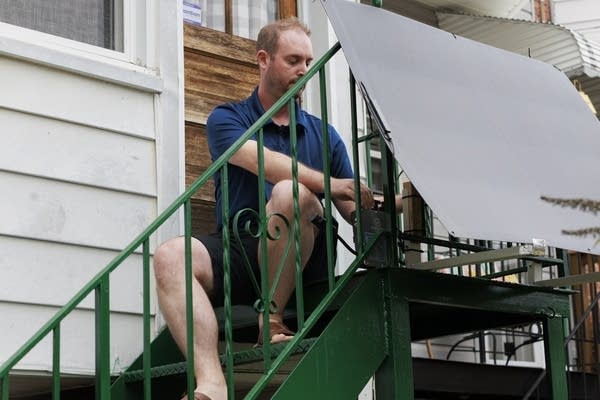
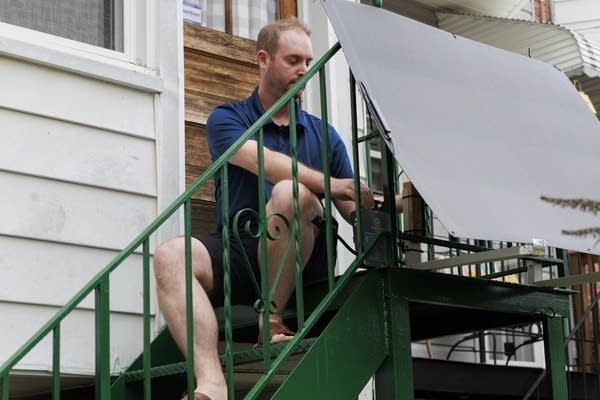
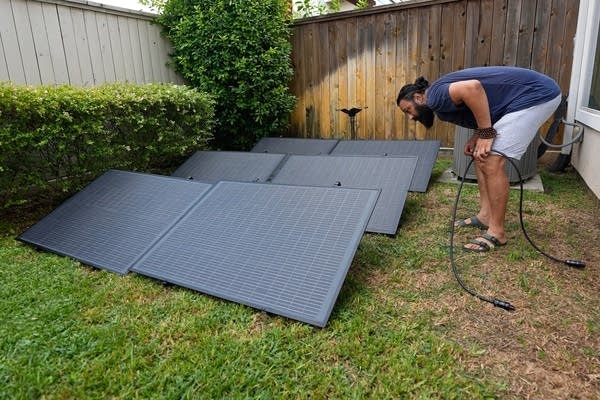
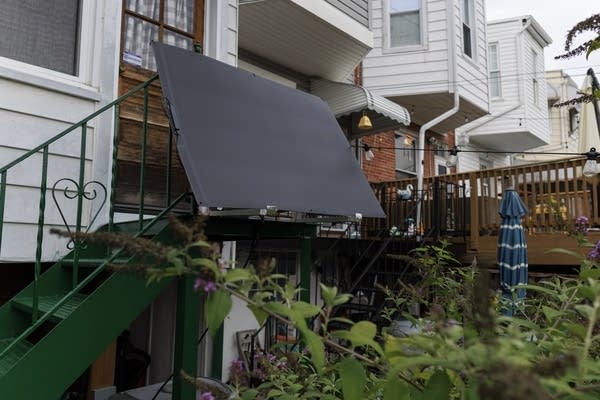
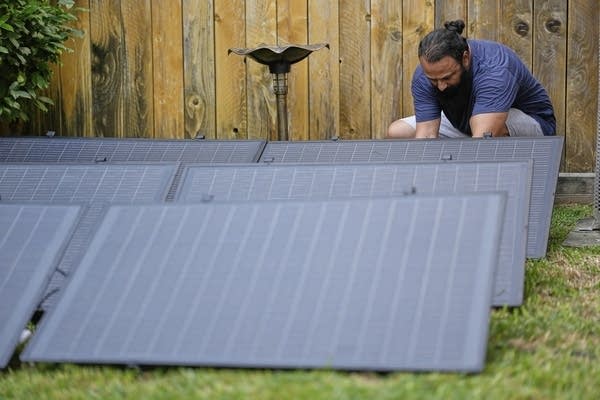
The smaller systems consist of just a few solar panels that can be placed on a deck or balcony or mounted on the ground outside a home. The systems reverse the typical flow of electricity– instead of pulling power off the grid, plug in solar pushes power back into the outlet and into the home’s wires.
Bhavin Misra assembles a Craftstrom Solar plug-in kit at his home Aug. 5, 2025, in Houston.
David J. Phillip | AP
A typical plug-in solar system set-up costs around $1,000 to $2,000 and can power a few appliances such as a refrigerator and modem. They usually provide about 20 percent of the electricity used by a typical home.
The technology has taken off in Germany in recent years. There are over a million of the mini-solar systems installed there.
“The price of electricity is going up, and this could help alleviate that problem for people," Veldhouse reasoned. So he went to a town hall meeting hosted by Democratic State Sen. Rob Kupec of nearby Moorhead and gave him some information on the technology.
“I knew nothing about it,” Kupec recalled. But he was intrigued. And the more he learned about it, the more it seemed to make sense.
“For those people who live in apartments who can't put up a solar array, or if your house just doesn't take one, it's a great opportunity,” Kupec said.
But to install one of these mini-solar systems now in Minnesota, a homeowner would have to jump through all the same interconnection hoops with their power provider and pay the same fees as someone putting in a big rooftop system. That can be costly, time-consuming and complicated.
A solar panel from Bright Saver hangs at Craig Keenan's home Aug. 1, 2025, in Baltimore.
KT Kanazawich | AP
Kupec has introduced a bill in the Minnesota Senate to streamline that interconnection process for certified plug-in solar systems. It's the companion legislation to a proposal from State Rep. Larry Kraft, a Democrat from St. Louis Park. Kraft told MPR News he's never seen so much excitement around a clean energy bill.
"It's a great thing for energy affordability, and it's also just a great thing for individual freedom,” Kraft said, for people who want to tap into the power of the sun that’s shining on their property.
That notion of personal freedom and consumer choice broadened the appeal of plug-in solar. Clean energy policy has become deeply partisan. But deep-red Utah was the first state to adopt a plug-in solar law last year. It was introduced by a Republican legislator and passed unanimously. A handful of other states followed suit this spring. And about 20 additional states, including Minnesota, are considering similar laws to allow residents to install plug-in solar systems.
Still, some in the state legislature have expressed safety concerns, because the technology reverses the flow of electricity and sends it back into a home’s electric wiring.
"I just think this year is too early to adopt this,” said Jason Rarick, a GOP State Sen. from Pine City who is also an electrician. Rarick wants to make sure proper safety procedures are in place for installation “before we're actually promoting people to start using it here."
Bhavin Misra assembles a Craftstrom Solar plug-in kit at his home Aug. 5, 2025, in Houston.
David J. Phillip | AP
A new safety standard was recently developed to certify plug-in solar equipment. But Rarick said that hasn’t yet been incorporated into the National Electrical Code.
Rarick also thinks the technology needs to be rebranded. “Because it's not going to be plug-in solar,” he said. “There's just no way to make that work.” He said, in most cases, an electrician will need to hook up the systems. Still, Rarick says it’s a matter of when, not if, the legislation will pass.
“This is something that’s absolutely coming,” he said. “Once the proper procedures have been followed to get this right, I'll be 100 percent behind it. Because it's not a mandate, and it's just giving people options.”
Kraft agrees homeowners will likely need to hire an electrician to set it up. But eventually, consumers will likely be able to purchase a small-scale system at Menards or Home Depot, said John Goeke, a Duluth electrician who specializes in installing solar and battery systems and who advocated for the bill at the state legislature.
“When you start to conceptualize how much power the sun is producing on a daily basis, on every square inch of land, you start to realize every plot of land is its own fortress, or its own microgrid,” he said.
The proposal is still alive in the Minnesota Senate. But advocates concede it has a narrow path to approval in a closely divided legislature.
“If we aren't successful with passing it this year, we will absolutely be coming back next year, and we'll have a better shot, probably, of getting it done,” said Patty O'Keefe, Midwest Regional Director for Vote Solar.
Back In Dilworth, Darrel Veldhouse isn’t waiting around. He’s already bought plug-in solar panels. He's confident the law will eventually pass, whether it’s this year or next.
“It should not be a partisan issue” for legislators, Veldhouse said. “Their constituents are facing growing expenditures on electricity. I hope that they would understand that.”
We landed at Keflavik Airport just as the sun was going down — and the views from the plane on descent were already something else. Golden light spilling across a volcanic landscape that looked like nothing I’d ever seen from 30,000 feet. That was our welcome to Iceland.
Four days later I left having seen the Northern Lights twice, walked inside a glacier, stood on a black sand beach in 50mph winds, and found a place that looked so much like Mars I genuinely had to remind myself I was still on Earth.
This is the exact route we took — every stop, every restaurant, every moment worth knowing about. My dad and I did this trip in January with Secret Spots Iceland, a local tour operator who knows these locations better than anyone. If you want a guided experience, they’re worth every penny. That said, every stop in this Iceland winter itinerary is completely doable on your own — and I’ll give you everything you need to navigate it independently.
Before you pack — check out our Iceland Packing List for exactly what to wear and bring. Waterproof everything. Trust me.
Before You Go: The Winter Light Reality
One thing nobody fully prepares you for in Iceland in winter the sunlight window is tiny.
Sunrise wasn’t until around 10:30am and sunset hit at roughly 4pm. That’s less than six hours of daylight. It sounds limiting but it actually works in your favor, the golden hour light lasts all day, every photo looks incredible, and the darkness gives you the best possible conditions for Northern Lights hunting.
Plan your driving between stops accordingly. Don’t underestimate how quickly it gets dark.
Day 1: Reykjavik & The Northern Lights
Keflavik Airport → Reykjavik (45 minutes)
Flying into KEF is a dream. Grab your 4×4 rental car immediately, this is non-negotiable in winter, don’t even consider a standard vehicle — and make the 45-minute drive into Reykjavik.
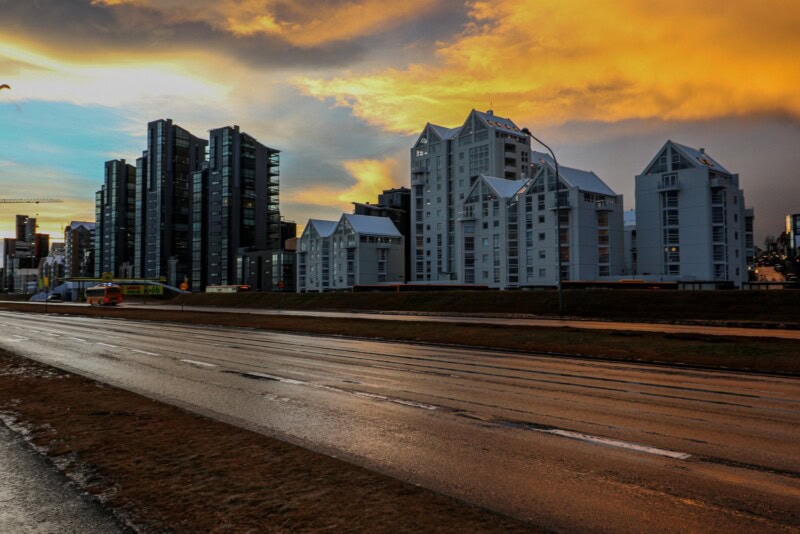
Spend your first afternoon and evening exploring the city. It’s compact, walkable, and packed with personality. The main landmark is Hallgrímskirkja, the iconic church that towers over the city and gives you sweeping views over the rooftops from the top. Walk Laugavegur Street for coffee, food, and a feel for the city.
Eat somewhere local. Reykjavik punches well above its weight for food.
Reykjavík → Hvolsvöllur (90 minutes)
Here’s the decision that changed our entire trip: instead of staying in Reykjavik, we drove 90 minutes east to Hvolsvöllur for the night.
The reason? Light pollution. Reykjavik’s glow kills your Northern Lights chances. Hvolsvöllur is deep in the South Iceland countryside, dark skies, privacy, and dramatically better odds of catching the aurora.
It paid off immediately.
Within minutes of checking into our Airbnb, I glanced outside and noticed the sky looking a little more colorful than usual. I walked out. The Northern Lights were directly above us, green ribbons moving across the entire sky, on night one within an hour of arriving.
We spent 45 minutes outside. Just standing there, staring, filming, not saying much. One of those moments where you understand immediately that you’ll remember it for the rest of your life.
If you’re chasing the Northern Lights, and want to get the most out of this Iceland winter itinerary, get out of Reykjavik at night.
Day 2: The South Coast – Waterfalls, Black Sand & Basalt
The South Coast is Iceland’s greatest hits. Give yourself a full day and don’t rush any of it.
Seljalandsfoss
Your first waterfall, and what a way to start.
Seljalandsfoss drops 60 meters off a cliff face and, uniquely, you can walk behind it through a narrow passage carved into the rock. Standing behind a waterfall while it crashes in front of you is a genuinely surreal experience. The mountains flanking it on both sides make the backdrop even more dramatic.
Wear your waterproof gear here. You will get wet. That’s not a warning, it’s a promise.
Reynisfjara Black Sand Beach – Near Vík (R.I.P.)
We were lucky enough to be some of the last visitors to experience Reynisfjara before a section of the cliff collapsed, permanently changing the beach.
Even before that, this place was unlike anything I’d ever seen. Black volcanic sand as far as you can see, enormous basalt columns stacked like organ pipes along the cliff face, and waves arriving with absolutely zero warning.
The wind here was brutal. My dad had forgotten his waterproof pants and within minutes he was completely soaked. I was fine. Wear your waterproof gear. All of it.
The rogue waves at Reynisfjara are genuinely dangerous, people have been swept away here. Stay well back from the waterline no matter how calm it looks.
Lunch at Ströndin Pub – Vík
After Reynisfjara, stop in Vík for lunch at Ströndin Pub. I had one of the best burgers I’ve eaten anywhere. Warm, unpretentious, and exactly what you need after getting sandblasted on a black sand beach.
Skógafoss
End the day at Skógafoss and save energy for it because this waterfall deserves your full attention.
Unlike Seljalandsfoss where you walk behind the water, at Skógafoss you walk directly underneath it. The scale is enormous, 60 meters of water crashing down so close you feel the full force of the mist on your face. Don’t be scared to get close. The photos are worth it.
Climb the stairs to the viewing platform at the top for a completely different perspective over the South Coast.
Day 3: Ice Caves, Glaciers & The Best Pizza in Vík
Yoda Cave
Start the morning at Yoda Cave, a lava tube formation whose jagged entrance looks almost exactly like the Star Wars character. I didn’t realize it until we got there and then couldn’t unsee it.
The best part? We were completely alone. No other visitors, no tour groups, just us walking into a cave on a black sand beach feeling like genuine explorers. Coming out alive was a bonus. (Just kidding. Mostly.)
The adjacent black sand beach gives the whole spot an otherworldly backdrop that made it one of the most photogenic stops of the entire trip.
Glacier & Ice Cave Tour with KatlaTrack – The Experience of a Lifetime
Clear your afternoon. This tour runs about 3 hours and it is without question, one of the most unforgettable experiences of my life.
The guide loads you into what can only be described as a war-ready 4×4 and takes you off-road across a glacier. It feels like driving on another planet. When we reached the ice caves, the scene was straight out of Interstellar, icy mountains on every side, electric blue walls of compressed glacial ice, complete silence except for the crunch of boots on ancient ice.
We spent the next hour or two trekking in and out of the caves. Every turn revealed something more extraordinary than the last.
Wear every layer you brought. It’s cold, it’s wet, and it’s worth every second of discomfort.
Book KatlaTrack in advance, this tour sells out. Don’t leave it to chance.
Dinner at Black Crust Pizzeria – Vík
Back in Vík for dinner. There’s really only one pizza place in town Black Crust Pizzeria, and honestly, that’s fine. It’s excellent. After a day on a glacier, it’s exactly what you need.
Day 4: The Golden Circle – Craters, Geysers & Iceland’s Bluest Waterfall
The Golden Circle is Iceland’s most famous tourist route for a good reason. But we did it with a few detours that most visitors never find, and those ended up being the best moments of the day.
One important note for winter: sunrise on this day was around 10:30am. We timed our first stop perfectly for the golden hour light. Plan your Golden Circle day around the sunrise.
Ingólfsfjall – Sunrise Overlook
On the way to Kerið, we spotted a beautiful overlook called Ingólfsfjall and pulled over on instinct. The timing was perfect, it was right at sunrise, the light was golden, and the views over the surrounding landscape were extraordinary.
This is the kind of stop that doesn’t make it into most itineraries. Pull over for it. The drone shots here were some of my favorites from the entire trip.
Kerið Crater
A volcanic crater lake that looks like it fell from another dimension. Deep red and black crater walls surround vivid teal water at the bottom, the color contrast is almost artificial looking, especially in winter light.
Walk the entire rim and go down to the water. The perspective changes completely from every angle you view it from. Don’t just look from the top and leave.
The Secret Spot (Near Kerið – You’ll Know It When You See It)
Just a short distance from Kerið, we found a place I’m deliberately not naming or mapping.
The entire landscape was varying shades of red, orange, and black. So alien-looking that the only reference point I had was Mars. We had the whole place completely to ourselves. No other visitors. Just us, the drone, and a landscape that genuinely didn’t look like Earth.
We flew the drone all around and spent time just sitting with it, reflecting on how one country can contain ice caves that feel like Interstellar AND a red volcanic landscape that feels like Mars. Keep your eyes open on the roads around Kerið. You’ll recognize it immediately when you see it.
Gullfoss
One of Iceland’s most iconic waterfalls, and one of the rare ones that actually lives up to every photo you’ve ever seen of it.
Gullfoss is so wide and encompassing that it made me feel genuinely small, which nature has a funny way of doing when it wants to put you in your place. Visit every viewpoint, each one gives you a completely different experience of the same waterfall. My favorite was the lower platform where you can feel the full force of it, mist was blowing directly into my face the entire time and I couldn’t have cared less.
Geysir – Strokkur
My first geyser. It didn’t disappoint.
Strokkur erupts every 7-10 minutes, shooting boiling water 20-30 meters into the air. The challenge is being ready with your camera every single time. Your arms will get tired holding the shot but the moment it erupts is absolutely worth it. You’ll watch it four or five times before you’re ready to leave.
There’s a visitor center right next to the geysir with a food court and a gift shop if you need to grab something for whoever you left at home.
Brú Horse Farm
A quick stop that became one of the warmest moments of the trip. Iceland’s native horses are a breed unlike any other, small, thick-maned, and completely uninterested in you unless you have snacks.
Buy the snacks. It’s the only way to get a good photo and honestly the horses’ complete mercenary attitude toward humans is hilarious and endearing at the same time.
Brúarfoss Waterfall My Favorite of the Entire Trip
Iceland’s bluest waterfall and the most undervisited stop on this entire itinerary.
The water here is a vivid cobalt blue that doesn’t look real. It’s fed by glacial meltwater filtering through ancient lava rock, and the color it produces is unlike anything else in Iceland. With the mountains in the background it was the most purely picturesque waterfall of the whole trip, not the biggest, not the most powerful, but the most beautiful.
Most Golden Circle visitors skip this entirely. Don’t be one of them.
The waterfall is intimate and quiet in a way that Gullfoss and Skógafoss aren’t. I flew my drone up and over it for some of the best footage of the trip. And then I just sat there for a while. Some places make you want to stop moving and just exist in them for a minute. Brúarfoss is one of those places.
Þingvellir National Park – End on a High
The final stop, and the right one to end on.
Þingvellir is where the North American and Eurasian tectonic plates meet above ground, creating a dramatic rift valley you can walk directly through. It’s also where Iceland’s first parliament was established in 930 AD, making it the most historically significant place on the entire route.
If you’re a Game of Thrones fan, there’s a section that will immediately remind you of the entrance to the Eyrie. You’ll recognize it the moment you see it.
We arrived at sunset. Overlooking the massive lake in that light, with the rift valley stretching out in every direction, it was the perfect way to close out four days in Iceland.
One Last Gift – Northern Lights at the Airport
We ended the night at Keflavik Airport waiting for our flight home. And Iceland gave us one final send-off, the Northern Lights appeared directly above the airport while we waited to board.
Twice in four days. Iceland doesn’t do things halfway.
FAQ
Should I rent a car for my trip to Iceland in winter?
4×4 is mandatory in winter. Non-negotiable.
How long is it day in Iceland?
Sunrise ~10:30am, sunset ~4pm in January (Roughly 5 hours of daylight). Plan accordingly.
Should I hire a guide or go on my own?
We used Secret Spots Iceland for Days 2 and 3, which gave us access to spots and knowledge we wouldn’t have found on our own. Every stop in this itinerary is doable independently — but if you want a local expert showing you the less-obvious spots, they’re excellent.
What are the road conditions in Iceland in winter?
Check roads on a daily basis. Iceland’s conditions change fast and F-roads close in winter without warning.
Where can I see the Northen Lights?
Get out of Reykjavik at night. The further from city lights the better. Download the Aurora app for real-time forecasts.
As a Manchester City fan, he made it his mission to catch matches at legendary stadiums from Camp Nou to the Etihad. But Nick’s travels go beyond football. He’s explored 20+ countries across Europe, Africa, and the Caribbean, always chasing authentic experiences over tourist traps. Nick lives by a simple rule: the best stories come from saying yes to the unexpected. And TravelFreak is his biggest yes yet.
To provide the best experiences, we use technologies like cookies to store and/or access device information. Consenting to these technologies will allow us to process data such as browsing behavior or unique IDs on this site. Not consenting or withdrawing consent, may adversely affect certain features and functions.
Functional
Always active
The technical storage or access is strictly necessary for the legitimate purpose of enabling the use of a specific service explicitly requested by the subscriber or user, or for the sole purpose of carrying out the transmission of a communication over an electronic communications network.
Preferences
The technical storage or access is necessary for the legitimate purpose of storing preferences that are not requested by the subscriber or user.
Statistics
The technical storage or access that is used exclusively for statistical purposes.The technical storage or access that is used exclusively for anonymous statistical purposes. Without a subpoena, voluntary compliance on the part of your Internet Service Provider, or additional records from a third party, information stored or retrieved for this purpose alone cannot usually be used to identify you.
Marketing
The technical storage or access is required to create user profiles to send advertising, or to track the user on a website or across several websites for similar marketing purposes.