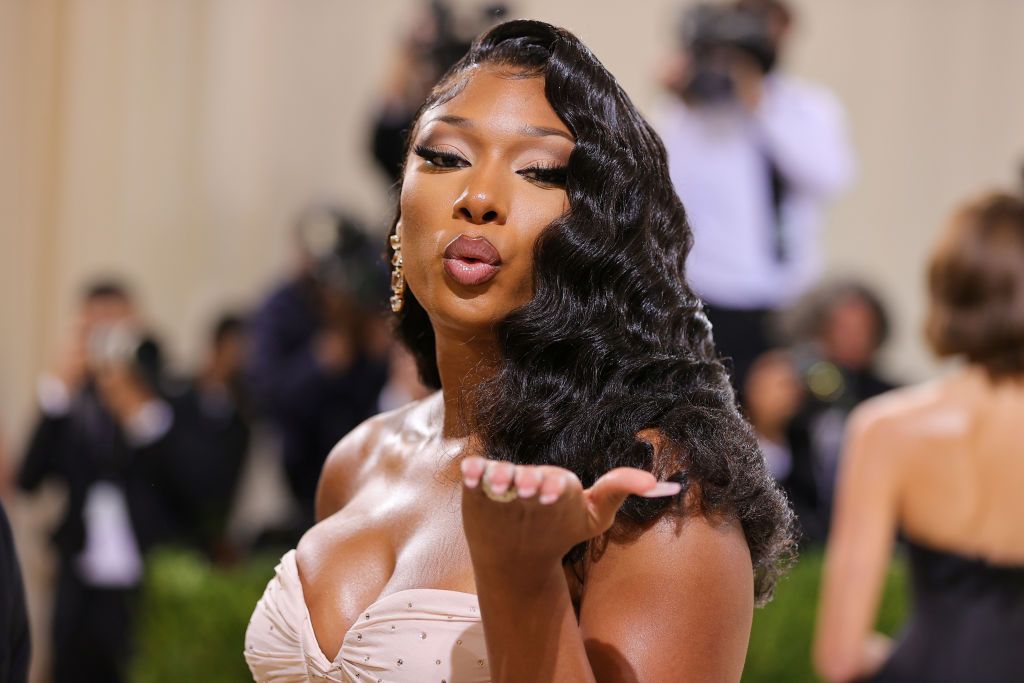
:max_bytes(150000):strip_icc():format(jpeg)/Health-GettyImages-1340132733-7d306b0293994c18955927c76c287d55.jpg "Person blowing a kiss at an event wearing formal attire with wavy hair")
Credit: Theo Wargo / Getty Images
When you’re struggling with your mental health, it can feel isolating—even when you know, logically, that you’re not the only one. That’s what makes it so powerful when celebrities—people we often associate with confidence, success, and happiness—pull back the curtain and share what they’re really going through.
1. Megan Thee Stallion

Megan Thee Stallion has been open about her struggles with anxiety and depression, especially after the loss of her parents.
On a panel hosted by the Boris Lawrence Henson Foundation, she shared that she realized she needed therapy when her sadness reached a point that scared her. “I didn’t care what happened to me. And I didn’t want to feel like that, like I should care about my life,” Megan said.
The rapper and songwriter has since used her platform to support others facing mental health challenges, particularly young Black women and LGBTQ communities.
She launched a wellness hub, Bad B–ches Have Bad Days Too, where she shares therapy platforms and other mental health resources. She’s also taken part in public campaigns like “Never a Bother” and “Seize the Awkward.”
In 2025, The Trevor Project named Megan its Mental Health Champion of the Year.
2. Dwayne "The Rock" Johnson

Actor Dwayne Johnson has spoken publicly about his experience with depression throughout his life. His first depressive episode came when he was in college, after a shoulder injury kept him from pursuing professional football. At the time, he didn't know what depression was or how to get help.
With his second major depressive episode, after his divorce from his first wife, Dwayne recognized the importance of reaching out for help. In a 2021 interview with Men's Health, Dwayne says, "Asking for help is not a weakness. As a matter of fact, asking for help is our superpower."
He notes that men can have a particularly hard time with vulnerability and the desire to appear strong. "But the truth is, you have to…learn to embrace vulnerability and learn to embrace this idea that you can't always solve everything," he says.
3. Simone Biles

During the 2020 Tokyo Olympics, gymnast Simone Biles experienced a mental block known as "the twisties," which causes a loss of spatial awareness in the air. This mind-body disconnect prevented her from completing most of her events safely.
Withdrawing from these events sparked a global conversation about the importance of mental health in athletics. The experience also encouraged Simone to prioritize her mental health, seek therapy, and become an advocate for others.
"Gymnasts aren't viewed as people who have weaknesses, and that was the first time that weakness was displayed on a global stage like that. Now, I look at it as being courageous and not so much a weakness," Simone said in a recent interview with CNN.
Simone returned to the 2024 Paris Olympics stronger than ever, winning three gold medals and one silver.
4. Justin Bieber

Justin Bieber has been open about his ups and downs with mental health over the years, particularly about experiencing depression, anxiety, anger, and substance use issues.
He's shared with fans that pillars of his recovery include getting therapy, staying sober, and having support from friends and family. He's also noted that healing isn't a linear process and can be frustrating at times.
In a 2025 Instagram post, Justin says, “Don’t you think if I could have fixed myself, I would have already? I know I’m broken. I know I have anger issues. I tried to do the work my whole life…and it just keeps making me more tired and more angry.”
In Justin's recent Coachella performance, in which he sang along to YouTube videos of his younger self, many fans speculated it was a nod to his healing journey and self-acceptance.
5. Bruce Springsteen

Bruce Springsteen has spoken out about his family's history of mental illness, including his own. He shares that he had a breakdown at the age of 32, during his rise to fame, and his manager at the time helped him get treatment.
Bruce notes that growing up, discussing mental health or asking for help was not encouraged. Many of his family members had untreated mental health conditions. "Nothing was known about it, and so everybody just suffered through it," Bruce says in a 2025 interview on BBC radio.
Despite feeling embarrassed to see a psychiatrist at first, he now says therapy and medications have helped him manage his depression and anxiety over the years.
"It was so forbidden in the world that I grew up in that it took me a long time to get used to it, and now it has been a big part of…half of my life," he says.




:max_bytes(150000):strip_icc():format(jpeg)/GettyImages-2253385503-49d609f27e75489cbb35796a15282f5b.jpg "Hong Kong - November 26, 2025 : Lululemon store at Hong Kong International Airport.")