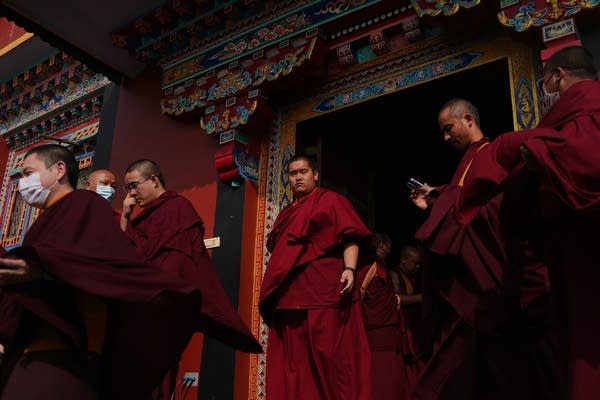
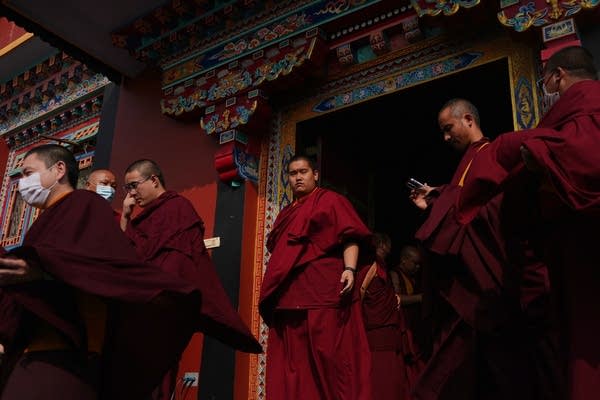
At a monastery in the Himalayan foothills, a teenage Buddhist lama blesses thousands. One by one, he taps bowed heads with a ritual vase and a peacock feather, sprinkling holy water for protection, purification, wisdom. He stops to smile at children who eye him with curiosity, reverence and awe. He tries to keep pace with others who, like him, are among the few chosen to give the final blessing.
Just six months earlier, thousands of miles away, this same young man was pulling all-nighters to play Madden NFL on his Xbox at his home near Minneapolis. Sometimes he'd pause to snack on pizza rolls and Diet Coke, or check his texts for the next hangout at TopGolf or Buffalo Wild Wings.
Two separate worlds. Both are home to Jalue Dorje.
A typical American teen, he grew up loving rap music, video games and football. He is also an aspiring spiritual leader who, from an early age, was recognized by the Dalai Lama and other Tibetan Buddhist leaders as a reincarnated lama.
Now he’s 19. He graduated from high school last year and moved to northern India to join the Mindrolling Monastery, about 7,200 miles (11,500 kilometers) from his home in Columbia Heights. Recently, he came to Nepal to meet his parents, who flew from Minneapolis, and attended sacred rituals and teachings conducted by the abbot of Shechen Monastery.
Maroon and golden monastic robes had replaced his usual hoodies and sweatpants. But he still quoted from Drake (the rapper) and Shantideva (the 8th-century Indian monastic). And beneath his robes, he wore white Crocs decorated with Jibbitz charms of “The Simpsons.” He wore them often at Shechen Monastery, near the 1,500-year-old Boudhanath stupa, one of Tibetan Buddhism’s most sacred sites.
Each morning, he’d awake at dawn. After prayers, he walked from his hotel through crowded Kathmandu streets lined with fruits, incense and spices, dodging mopeds near the soaring white dome and spire of Boudhanath with its colorful Tibetan prayer flags and the painted, ever-watching eyes of the Buddha.
On a recent day, he strode to the monastery and took off his Crocs before entering a prayer hall reserved for monks with doctorates and lamas like himself. Incense wafted. The sound of ancient instruments — cymbals, bells and drums — punctuated the monastic chants.
Standing before three huge gold statues of the Buddha, Dorje bowed to Shechen Rabjam Rinpoche, the monastery’s spiritual head, and presented him with a golden plate that symbolizes the entire universe, and a “khata” — a white Tibetan ceremonial scarf.
It was the first mandala, or offering, Dorje had made since his long journey to follow his predestined spiritual path. It was a moment, he says, when he realized how far he’d come.
“This is the real one, you know? We’re here and this is really happening,” he says. “I’m doing what the prophecy fulfilled.”
A reincarnation cycle dating to 1655
Since the Dalai Lama recognized him at age 2, Dorje had spent much of his life training to become a monk, memorizing sacred scriptures, practicing calligraphy, learning the Buddha’s teachings.
The process of identifying a lama is based on spiritual signs and visions. Dorje was four months old when he was identified by Kyabje Trulshik Rinpoche, a venerated master of Tibetan Buddhism. He was later confirmed by several lamas as the eighth Terchen Taksham Rinpoche — the first was born in 1655.
Jalue Dorje’s parents took him to meet the Dalai Lama in 2010 when Tibetan Buddhism's spiritual leader visited Wisconsin. The Dalai Lama cut a lock of Dorje’s hair in a ceremony. He advised the parents to let their son stay in the U.S. to perfect his English and then send him to a monastery.
“From my parents’ end, educating me was a really big one,” Dorje says. “They followed the words of his holiness; he laid the foundation, and they took that gamble.”
As a child, he often wondered why he couldn’t sleep later on weekends and watch cartoons like other kids. One day, it would pay off, his dad would tell him, “like planting a seed that one day would sprout.”
He remembered the early mornings of recitation and memorization. He recalled people who posted messages online doubting that he was a reincarnated lama, and how that troubled his parents. And how they both worked hard cleaning hotel rooms and doing laundry at hospitals while raising him.
“It wasn’t all rainbows and unicorns every day,” Dorje says. “We overcame a lot.”
Fluent in English and Tibetan, Dorje excelled in public school. Although he was officially enthroned as a lama in a 2019 ceremony in India, his parents let him stay in the U.S. until graduation.
Growing up, he kept a photo of the Dalai Lama in his room above DVD collections of “The Simpsons,” “South Park,” and “Family Guy,” next to the manga graphic novel series ″Buddha.”
On his bedside table, he kept a journal where he diagramed plays he’d like to try as a left guard with his school football team. On a wall in his living room he hung a poster with his senior year photo wearing sunglasses and his football uniform, touching thumb tips to index fingers in a meditation gesture.
He had a deal with his father, who would give him Pokémon cards in return for memorizing Buddhist scriptures. He collected hundreds, sometimes sneaking them in his robes at ceremonies. “I remember,” he says, “when I first learned my Tibetan ABCs, when I was able to recite it all by memory, my dad was so happy.”
A love of sports
The days were long. Every morning he awoke to recite sacred texts. Then school, followed by football practice. He returned home for tutoring on Tibetan history and Buddhism. At night, he practiced calligraphy or listened to rappers. When he got his license, he drove around listening to Taylor Swift.
What would he have been if not a spiritual leader? “Sports journalist would have been cool,” he says. He loves to write. An avid fan, he roots for the Atlanta Hawks in basketball, Real Madrid in soccer, and the Atlanta Falcons in football.
His favorite athlete is U.S. figure skater Alysa Liu: “She brings so much swagger, but it doesn’t overshadow the sports.” In high school, he wrote an award-winning story about Tibet for the student newspaper.
On the football field, his teammates praised his positivity; he reminded them to have fun and keep losses in perspective. But in the final game of his senior season, he shed tears, realizing it would likely be his last game ever.
He often helped with events representing the local Tibetan community. For his 18th birthday, more than 1,000 people gathered at the Tibetan American Foundation of Minnesota for the last party before joining the monastery in India.
Finding his groove
On the long plane ride, his mind wandered.
“I was like, ‘Dang! I’m missing the first week of NFL!’” He packed light: headphones, laptop, a fantasy football magazine and a book on Guru Rinpoche, the Indian Buddhist master who brought Tantric Buddhism to Tibet.
His parents flew with him to New Delhi and then drove north to Dehradun, near the Himalayan foothills, in the equivalent of a college dropoff. They bought him a larger bed. They painted his monastic room and erected a shrine where he could pray at dawn and dusk.
He is an only child, and his parents cried when saying goodbye. The farthest and longest that he'd gone from home on his own previously was a three-day camping trip in northern Minnesota.
“Everything leading up to this point in the history of all your lifetimes — the billions and billions of lifetimes you accumulated — leads to your family,” Dorje says. “To have such great parents is a result of a great past life’s merit. But not only past life merit, but the connection of karma — and love.”
Early on, his mother, Dechen Wangmo, worried about her then-toddler son during long prayer sessions.
“Would he be hungry? What if he fell asleep?” she recalled thinking. She kept worrying about him as a teenager: “He’s a tulku,” she says, using the Tibetan term for a reincarnated lama, “but he’s my son.”
To her relief, he thrived. While his friends attended history, science and literature classes in U.S. colleges, he took lessons on Buddhist philosophy, and practiced his calligraphy and chanting in India.
“He’s kind of found his groove at the monastery,” says Kate Thomas, one of his tutors in Minneapolis.
Becoming a ‘leader of peace’
Despite the 10-hour time difference, he kept in contact with friends back home through texts and WhatsApp. On time off, he built Legos, walked to an arcade to play the FIFA soccer video game and watched Marvel superhero films and NBA and NFL games on his laptop. He was especially psyched about the halftime Super Bowl show: “That was an incredible performance by Bad Bunny — I can ’t lie!”
It was his first time experiencing a life of asceticism, eating a daily ration of rice and lentils and washing his own clothes by hand. But he adjusted, getting along with monks from all over Asia, discussing spirituality, popular culture and sports.
“Dudes are dudes!” he says.
It was the first time that he was hanging out with other “tulkus' — reincarnated spiritual masters around his own age. Among them was Trulshik Yangsi Rinpoche, 13. He's believed to be the reincarnation of Kyabje Trulshik Rinpoche — the Tibetan Buddhist master who first recognized Dorje as a tulku at four months old.
At the monastery, they bonded over their love of Tintin comics. Dorje became his English teacher.
“I think of him as my spiritual teacher,” Dorje said after sharing a meal with the younger lama. “I’m profoundly grateful that I get to repay my debt to the one who found me and improving his English.”
Yangsi Rinpoche smiled, then reflected: “He’s my best friend.”
Just hours after Dorje blessed thousands — including his parents — on the last day of the 12-day rituals, the family awoke before dawn to visit the ancient Maratika or Halesi Mahadev Caves, 100 miles (160 kilometers) southwest of Mount Everest. They drove for eight hours on dirt roads, crossing mountains and valleys, for a pilgrimage to caves sacred to both Hindus and Buddhists.
After exploring the caves in awe, Dorje sat cross-legged on the rocky ground next to his father, Dorje Tsegyal. They prayed together, as they had done almost daily since his childhood.
Following several years of contemplation and asceticism, Dorje hopes to return to the United States to teach in Minnesota’s Buddhist community at the Nyingmapa Taksham Buddhist Center. His goal: become “a leader of peace,” following the example of the Dalai Lama, Nelson Mandela and Gandhi.
It’s a long path that began soon after his birth. He feels ready. “This,” he says, “is just the beginning.”






:max_bytes(150000):strip_icc():format(jpeg)/GettyImages-2253385503-49d609f27e75489cbb35796a15282f5b.jpg "Hong Kong - November 26, 2025 : Lululemon store at Hong Kong International Airport.")