Evacuation orders for North Shore wildfire


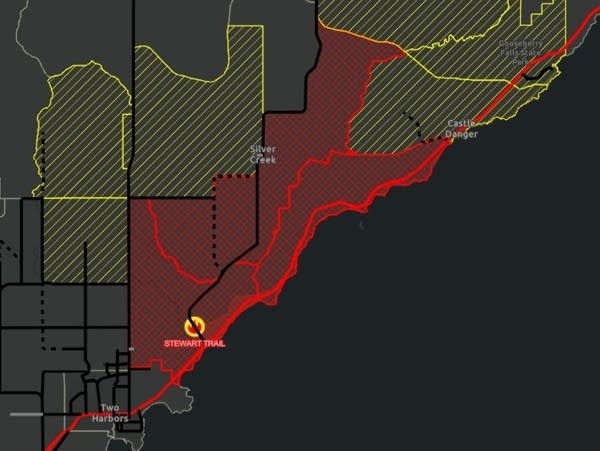
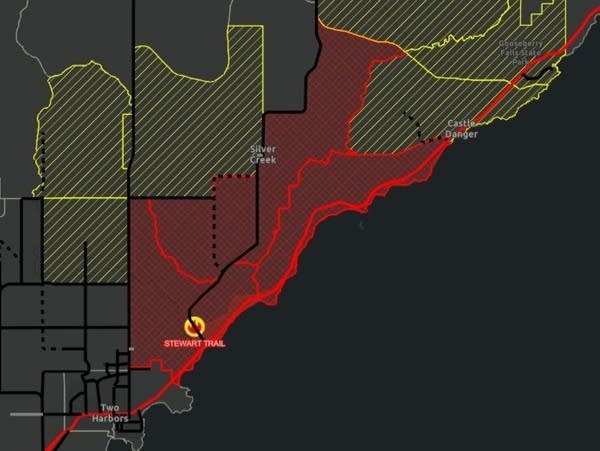
A map showing evacuation zones due to a wildfire

Evacuation orders were in place and Minnesota Highway 61 remained closed Saturday between Two Harbors and Castle Danger as crews continued working to contain a wildfire along the North Shore.

The Stewart Trail Fire started Friday afternoon northeast of Two Harbors amid gusty winds and tinder-dry conditions. As of Friday night, the Minnesota Interagency Fire Center estimated the fire to be 100 acres in size with no containment.

Local, state and federal crews were battling the fire on the ground and from the air. There was no official information yet on whether any buildings have burned and no immediate word on the cause of the fire.

“Multiple local, state and federal agencies are responding to the Stewart Trail Fire, along with numerous aircraft capable of providing water and fire retardant drops,” the Minnesota Interagency Fire Center reported in a Friday night update. It said crews were expected to remain on the scene overnight.

Lake County issued evacuation orders Friday for homes and businesses along State Highway 61 and County Road 3 northeast of Two Harbors. Those remained in effect as of Saturday morning.

Highway 61 remained closed between Two Harbors and Castle Danger as of Saturday morning — requiring a long detour for drivers heading to and from points farther up the North Shore. The fire also affected part of the Superior Hiking Trail.

The Stewart Trail Fire was one of at least 18 wildfires in northeastern Minnesota on Friday. Saturday was forecast to be another day of heightened wildfire risk across much of Minnesota, with gusty winds and low humidity.
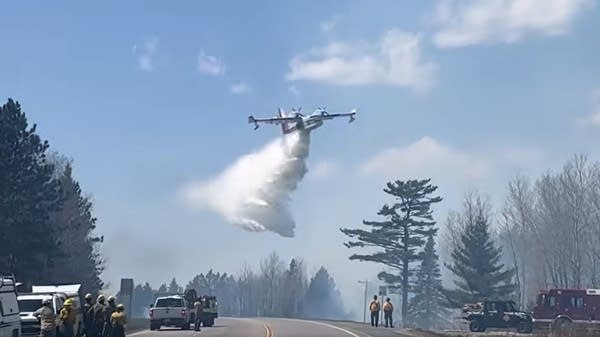
A plane drops water on a wildfire
A plane drops water on a wildfire along Highway 135 on the Iron Range, near Gilbert, on Friday. Crews responded to at least 18 wildfires in northeastern Minnesota on Friday.
Courtesy of St. Louis County Sheriff's Office

Community response

Amid the ongoing firefighting efforts — and uncertainty over whether any homes or businesses were lost to the flames — local residents and businesses offered free meals and other assistance.

The Rustic Inn Cafe in Castle Danger reported that “all of our staff members are safe. However, we have a couple of employees who most likely have lost their home in the fire, and our hearts are with them and every family affected. … We are incredibly grateful for the firefighters, first responders, volunteers, and emergency personnel working tirelessly to protect our community.”

The restaurant said it was offering free meals Saturday to first responders and families displaced by the wildfire. It was also accepting donations for firefighters and residents affected by the fire.

Do North Pizzeria in Two Harbors and the food truck Na-cho Bizness were also offering free meals to first responders and residents who had to evacuate.

“No questions. No expectations. Just neighbors helping neighbors,” the operators of the food truck posted online. “To every person working long hours, protecting homes, helping families and keeping our community safe — thank you.”

Additional firefighting help

Before Friday’s wildfires, the Minnesota Department of Natural Resources said this week that amid the elevated fire danger, additional wildland firefighting crews from Ontario and Manitoba were in Minnesota to assist local crews — part of an agreement called the Great Lakes Forest Fire Compact.

“Their presence reflects the value of long-standing partnerships and a shared commitment to helping one another during periods of increased wildfire potential,” the DNR said.




Source link

Leave a Reply

Subscribe to Our Newsletter

Get our latest articles delivered straight to your inbox. No spam, we promise.

Recent Reviews


Lululemon clothing is being investigated for PFAS.Credit: winhorse / Getty Images
Lululemon clothing is being investigated for PFAS.
Credit: winhorse / Getty Images
  • The Texas attorney general is investigating whether Lululemon clothing contains PFAS, commonly known as “forever chemicals.”
  • PFAS are widely used for stain- and water-resistant products, but their long-term health effects are still not fully understood.
  • Experts say exposure from clothing is likely low, but there are some signs to tell if your clothes contain PFAS.

Texas Attorney General Ken Paxton announced Monday that his office is launching an investigation into whether clothing from the athleisure brand Lululemon contains per- and polyfluoroalkyl substances (PFAS), long-lasting compounds commonly referred to as “forever chemicals.” The investigation has thrust these chemicals—linked to a range of negative health outcomes and used in a variety of products—into the spotlight. Here’s what to know about the Lululemon probe, PFAS, and what it could mean for your health if these compounds are lurking in your clothing.

What's the Investigation About, Exactly?

According to a press release from Paxton’s office, the investigation will examine whether Lululemon’s clothing contains PFAS "that their health-conscious customers would not expect based on the brand’s marketing.” The office “will also review the company’s Restricted Substances List, testing protocols, and supply chain practices to determine whether Lululemon’s products comply with its stated safety standards,” the release continued.

Per the release, the allegations stem from "emerging research and consumer concerns."

Lululemon, meanwhile, denied using PFAS in its apparel, which includes leggings, workout tops, and casual athleisure wear. In an email to Health, a company spokesperson said: 

"The company phased out the substance in FY23, which had been used in durable water repellent products, a small percentage of our assortment. The health and safety of our guests is paramount, and our products meet or exceed global regulatory, safety, and quality standards. We require all our vendors to regularly conduct testing for restricted substances, including PFAS, by credible third-party agencies to confirm ongoing compliance.”

What Are PFAS?

PFAS is an umbrella term for a class of chemical compounds used in a wide range of everyday products, including furniture, carpets, paint, food packaging, and clothing. They’re often added to fabrics for their stain-resistant or water-repellant properties, said Alex LeBeau, Ph.D., MPH, CIH, a toxicologist, certified industrial hygienist, and owner of Exposure Consulting in Orlando, Florida.

These compounds—which number in the thousands—have been dubbed “forever chemicals” because they don’t break down easily and have been discovered in soil, air, water, and in animals. They’ve been found in humans, too. Nearly everyone in the U.S. has measurable amounts of PFAS in their blood, according to the Centers for Disease Control and Prevention. 

How Harmful Are PFAS?

Scientists still don’t fully know how PFAS affect human health. The chemicals can be particularly challenging to study because the category includes thousands of compounds, products contain varying levels, and exposure can come from many sources.

Two of the most widely studied PFAS—PFOS and PFOA—were phased out in the U.S. in the 2010s, LeBeau said. Those long-chain PFAS, which tend to accumulate in the body and stick around for longer, were largely replaced with short-chain alternatives, which are thought to be less bioaccumulative but may still raise health concerns.

Much of the research into PFAS has focused on what happens when people ingest them through water or food. A 2025 study found a link between PFAS in drinking water and increased incidence of digestive, endocrine, respiratory, and oral cancers. Still, LeBeau said that overall, “the health impacts are still up for debate in the scientific community.” Many human studies have produced mixed results, and much of the existing research has been conducted in animals.  

While it’s possible for PFAS to be absorbed through the skin from clothing, LeBeau said it’s not considered as concerning as ingesting the chemicals. “Dermal PFAS uptake does not appear to be a concerning PFAS exposure route into the body,” he said. “Limited animal studies have suggested that PFAS may permeate the skin, but skin impact may also depend on the PFAS chemical form.”

How to Know If Your Clothing Contains PFAS

There is no federal law requiring clothing manufacturers to stop using PFAS or disclose whether their products contain them. Although, some states have banned their use in apparel and other products, and many well-known brands have said they are voluntarily phasing them out—including Lululemon. 

While LeBeau said people should be most concerned about PFAS in their food and water, it's understandable to want to avoid potentially harmful chemicals altogether. Unfortunately, it's not always easy to tell whether clothing contains PFAS—but there are a few clues.

One is if a garment is labeled as being made with GORE-TEX or Teflon, both of which are PFAS-based materials. Clothing marketed as moisture-wicking, waterproof or water-repellant, or stain-resistant is also more likely to contain PFAS. It’s also a good sign if a brand explicitly labels a product or line as PFAS-free and that claim has been verified through third-party testing.


Source link