When I started this blog ten years ago, there was no ChatGPT, no Claude, no Gemini. If you wanted to know something like the legal definition of a “trade secret,” you had to use a primitive tool called Google to find the answer.
Those dark days are over. AI has now materially improved everyone’s quality of life. Don’t believe me? Consider a recent Annenberg survey finding that at least 17% of Americans believe AI will have a positive impact on the country over the next decade.
We’re at the dawn of a golden age. Especially when it comes to legal services. Gone are the days when you had to talk to an actual person to find out the statute of limitations for a breach of fiduciary claim. Now you can just ask CoPilot to write a memo on it.
But there are still some things AI can’t do. It can’t wash the dishes. It can’t tuck your kids in bed at night. It can’t stop Jerry Jones from micromanaging my Dallas Cowboys.
At least not yet.
Another thing AI can’t do yet is to give you practical legal advice you can rely on. I say “practical” because to be fair, AI is pretty good at telling you what the law is, at least in theory.
I mean, it’s not foolproof. We’ve all seen the horror stories about hallucinated case cites. But that’s just a bug in the system. I’m sure the tech bros will get it worked out eventually, so they can buy more fleece vests.
Even then, the problem will remain. Even when the private equity guys roll up the AI startups and roll out an app that can accurately tell you what the law is in theory, it still won’t replace a good human lawyer. Why? Because it won’t be good at telling you what the law is in practice.
This is the Legal Realist challenge to AI-generated legal advice.
The Legal Realist Challenge
The problem, anticipated by the OG Legal Realists starting over a century ago, is twofold.
First, even on its own terms, “the law” is often indeterminate. Some legal questions have simple answers, like what is the statute of limitations for a car accident claim in Texas? But many legal questions, especially the ones that tend to matter most to the outcome of a dispute, are not so clear cut. There are going to be reasonable arguments on both sides. Let’s call that “rational indeterminacy.”
I understood this point in law school. There are hard cases that existing precedents don’t answer. What I didn’t grasp at the time is how pervasive those hard cases are in actual law practice. Trust me, they come up all the time.
And that’s not the worst of it.
The second problem is that even when “the law” is relatively clear on an issue, there’s no guarantee a real life judge will correctly apply the law. If you’re a law school student, please skip the next paragraph because I’m fixin’ to impart some forbidden knowledge.
For the intrepid souls ready to take the red pill, what if I told you that sometimes judges are bad at applying the law? And by “sometimes” I mean probably around half the time. Even worse, sometimes a judge might be ok at applying the law correctly, but just doesn’t care. Maybe the judge understands the law but doesn’t like it. Maybe he just rules for the lawyer who donates to his campaign. Maybe the judge is just in a hurry to pad her stats by getting the trial over with. Maybe the judge is bored and wants to threaten your client with arrest by federal marshals, even though your client did nothing wrong.
These are all hypotheticals, of course.
Let’s call this “causal indeterminacy.” It’s the obvious fact that regardless of what the law says in theory, there are many other factors that determine how an actual flesh and blood judge will rule on your case.
(I’m borrowing the terms rational determinacy, causal determinacy, real rules, and paper rules from Prof. Brian Leiter, who taught the philosophy of law course when I was in law school.)
When you combine rational indeterminacy with causal indeterminacy, it gets very difficult to predict outcomes, even for a seasoned human lawyer. Can AI handle that challenge?
Paper Rules vs. Real Rules
It’s not easy. Let’s say the question is whether the statute of limitations for a car accident claim is subject to the “discovery rule,” i.e. does the clock start running when the accident happened, or when the plaintiff discovered he was injured in the accident?
Suppose there are some cases that say yes it applies, and other cases that say no it doesn’t. It may be difficult, but you can try to reconcile those cases based on their facts and reasoning to arrive at a general rule. Let’s call that the “paper rule.” Discerning the paper rule is only the first step.
The next problem is that the paper rule is not necessarily the real rule. By “real rule,” I mean the rule that actually explains the different outcomes in different reported cases. I think the fundamental insight of Legal Realism is that the reasons courts give you for their decisions are not necessarily the actual reasons for the result. In other words, the paper rules are not necessarily the real rules.
Don’t get me wrong, I’m not suggesting the paper rules are meaningless, or that they have nothing to do with the outcome. There is, of course, some overlap between the paper rules and the real rules. And if you’re a practicing litigator, you need to be well versed in the paper rules.
But if there’s one thing almost 30 years of litigation practice has confirmed, it’s that the Legal Realists were right that you can’t just take the reasons judges give for their decisions at face value.
This presents a real challenge for AI. Is it sophisticated enough to distinguish between the real rules and the paper rules?
Test Case: The Irreparable Injury Rule
Let’s take another test case. I’m going to use an issue that commonly comes up in my law practice: does a former employee’s breach of a noncompete agreement establish the “irreparable injury” required (in theory) to get a temporary injunction?
As I explained there, the paper rule is that there are a bunch of cases that say it does, and a bunch of cases that say it doesn’t.
Funny thing is, the judges who write the opinions usually just cite the cases that answer the question the way they want, and ignore the ones that don’t. This is another point I didn’t fully appreciate in law school.
In my experience since then, very rarely do you read an opinion that says “some cases say it does, others say it doesn’t, we’re choosing to follow the ones that say it does because . . .” etc. For whatever reason, most judges like to pretend like a hard question has an easy answer when they write the opinion.
But I digress.
You could try to reconcile the different rules cited in the opinions based on their facts, but let me cut to the chase: you would be wasting your energy. The truth is that there just isn’t a coherent paper rule.
The real rule, as I explained in that post, is that the trial court judge is going to do what he thinks is fair, and if you appeal that decision, you will probably lose, absent extraordinary circumstances.
Is AI smart enough to tell you that? Maybe. In my admittedly anecdotal experience, AI doesn’t like to give fuzzy answers like “it depends,” even when that’s the right answer.
I could see the next generation of AI getting better at that, but another problem will still remain. Even if AI gets good enough to tell you what the real rule is, that’s just a start. Because it’s only telling you what the real rule is in theory.
In other words, even if AI can solve the problem of rational determinacy in the law, that still leaves the question of causal determinacy.
Can AI Handle Causal Indeterminacy?
By “causal indeterminacy” I mean the question of how courts actually decide cases, regardless of what “the law” says. I’m skeptical about AI’s ability to handle the problem of causal indeterminacy. I just don’t see it being astute enough to give you an answer like “yes, that claim is probably preempted by TUTSA, but Judge Smith hardly ever grants summary judgment, so don’t bother.”
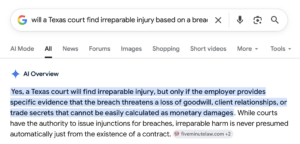
As a test case, I Googled “will a Texas court find irreparable injury based on a breach of a noncompete?” Here’s the AI Overview Google provided:
Ok, I take it back. That’s a pretty good answer.
Give it another ten years and you won’t even need me.
________________________
Zach Wolfe (zach@zachwolfelaw.com) is a Texas trial lawyer who handles non-compete and trade secret litigation at Zach Wolfe Law Firm (zachwolfelaw.com). Thomson Reuters has named him a Texas “Super Lawyer”® for Business Litigation every year since 2020.
These are his opinions, not the opinions of his firm or clients. Reasonable people can disagree. Every case is different, so don’t rely on this post as legal advice for your case.
You know that feeling when you call the customer service line and an automated voice, says “press 1 if you’re calling about a new application, press 2 if you’re calling in response to a letter you received, press 3 if . . .”
“I’m not calling about any of those things,” you shout, to no one in particular. “I just want to talk to a real person!” You just want to explain your specific situation.
That’s what it feels like when you’re trying to explain to a judge why the Pattern Jury Charge (PJC) question doesn’t work for your particular case. You want to dial “0.”
And the result is often the same. More about that later.
Background on the PJC
First, let me explain what I’m talking about, especially for non-lawyers.
In Texas, where I defend non-compete and trade secret lawsuits, the Committee on Pattern Jury Charges of the State Bar of Texas publishes the Texas Pattern Jury Charges, affectionately known as the “PJC.” I’d guess most other states have something similar.
The PJC provides standard templates for the questions and instructions that a trial court judge submits to the jury for a verdict. Each template has a “Comment” section that cites to the statutes and/or case law that support it.
For example, the PJC question on breach of contract says “Did Don Davis fail to comply with the agreement?” The question is supported by case law that says a party breaches a contract when he fails to comply with the contract.
And now you know where I got Paula Payne and Dawn Davis, the characters in most of my hypotheticals. But I digress.
The PJC question on breach of contract works 90% of the time. But sometimes it doesn’t fit the particular facts of the case.
When the PJC is a Bad Fit
Suppose Dawn Davis sues Paula Payne for stealing Paula’s super-secret invoice template. Dawn claims this was misappropriation of trade secrets.
The PJC question asks, “Did Dawn Davis misappropriate Paula Payne’s trade secret?” It then provides a complicated definition of “misappropriation” taken straight out of the Texas trade secrets statute.
That sounds good in theory, but often that definition is a bad fit for the facts of the case. Under the statutory definition, there are six different ways a defendant can “misappropriate” a trade secret. We can condense those into essentially three ways: acquisition, use, or disclosure.
Suppose the case is only about acquisition. Dawn allegedly took the super-secret invoice template and kept it, but there’s no evidence she used it, or disclosed it to anybody.
In that case, the PJC question and definition is a bad fit, and should not be used. It would be better to simply ask “did Dawn Davis acquire Paula Payne’s trade secret?”
In this case, the PJC instruction is not necessarily wrong, it’s just a bad fit. It is likely to cause confusion because it provides instructions about things that are not at issue.
Unfortunately, a lot of trial court judges are going to submit the PJC instruction anyway. It’s a warm fuzzy blanket. It provides a feeling of security, especially when the judge is not real strong on the area of law at issue.
This is wrong, and should not happen, but it could be worse.
It Gets Worse
In some cases, the PJC is not just a bad fit, it’s wrong under the facts of the case.
The best example is when an employer sues a former employee for breach of “fiduciary” duty. In that case, the PJC instruction on breach of fiduciary duty is simply wrong, and should not be used.
Recently, the Houston Court of Appeals expressly recognized this in Coe v. DNOW LP, __ S.W.3d __, No. 14-23-00410-CV, 2025 WL 1759382, at *22-23 (Tex. App.—Houston [14th Dist.] June 26, 2025, no pet. h.), holding that the PJC instruction “not an accurate statement of the law applicable to this case,” where a former employer alleged that its high-level managerial employees breached their fiduciary duties.
More about that case later. First some background.
A fiduciary duty is the highest kind of duty the law imposes. It includes a duty of care, a duty of loyalty, and a duty of full disclosure. Unlike any other legal duty, it requires the fiduciary to put the beneficiary’s interests ahead of his own.
Some classic examples of fiduciary duty would include:
An attorney’s duty to a client
A trustee’s duty to a trust beneficiary
A business partner’s duty to his partners
An officer or director’s duty to a corporation
For simplicity, let’s call the fiduciary duty owed by this kind of fiduciary an “absolute” fiduciary duty.
An employee owes an employer a kind of “fiduciary” duty. But does anybody seriously think an employee owes an employer an absolute fiduciary duty? No. This is not controversial.
I explained this in one of my oldest blog posts, labeling the employee’s duty Fiduciary Duty Lite.
For convenience let’s call the employee’s fiduciary duty a “limited” fiduciary duty.
Texas case law is pretty clear about what an employee can and cannot do under this limited fiduciary duty.
The employee cannot compete with the employer while still employed. But the employee can make plans to compete and can even conceal those plans from the employer. Abetter Trucking Co. v. Arizpe, 113 S.W.3d 503, 512 (Tex. App.—Houston [1st Dist.] 2003, no pet.).
This last point proves that the employee’s fiduciary duty is not an absolute fiduciary duty.
A true fiduciary would have a duty of full disclosure and a duty to put the employer’s interests ahead of his own. He wouldn’t be allowed to make secret plans to compete against his employer. He would have to tell his employer “I’m looking for another job and planning to join a competing company.”
No one thinks an employee has a duty to do that. An employee doesn’t have that kind of fiduciary duty.
And that’s why the PJC instructions on breach of fiduciary duty are wrong.
The PJC Instructions on Breach of Fiduciary Duty
The PJC instruction on breach of fiduciary duty doesn’t work for claims against former employees, because it is based on an absolute fiduciary duty, not an employee’s limited fiduciary duty.
Here’s what the PJC question and instruction on breach of fiduciary duty says. I’ve used “Employee” and “Employer” in place of “Don Davis” and “Paula Payne.”
Did Employee comply with his fiduciary duty to Employer?
As Employer’s agent, Employee owed Employer a fiduciary duty. To prove he complied with his duty, Employee must show—
1. The transaction in question was fair and equitable to Employer; and
2. Employee made reasonable use of the confidence that Employer placed in him; and
3. Employee acted in the utmost good faith and exercised the most scrupulous honesty toward Employer; and
4. Employee placed the interests of Employer before his own and did not use the advantage of his position to gain any benefit for himself at the expense of Employer; and
5. Employee fully and fairly disclosed all important information to Employer concerning the transaction.
PJC 104.2.
Two critical features make these instructions inappropriate for an employer’s claim that an employee breached a fiduciary duty by competing or making plans to compete:
First, the instructions in PJC 104.2 are intended for cases where the defendant is a fiduciary who engages in a transaction with the plaintiff, and the plaintiff claims that doing so was a breach of the defendant’s fiduciary duty.
This is apparent in Instruction 1, which refers to “the transaction[s] in question,” and Instruction 5, which refers to disclosure of information “concerning the transaction[s].” On their face, these instructions are intended for a situation where the defendant-fiduciary is involved in a transaction with the plaintiff-beneficiary.
For example, in Kinzbach Tool Co. v. Corbett-Wallace Corp., 160 S.W.2d 509, 510-11 (Tex. 1942), an employee negotiated a contract between his employer and a third party, secretly knowing what the third party was willing to pay, and secretly receiving a commission, without disclosing these facts to the employer.
In such a case, “when the fiduciary has profited or benefited from a transaction with the beneficiary,” the burden is on the fiduciary to show he fully disclosed information concerning the transaction. Comment to PJC 104.2.
Second, the instructions in PJC 104.2 are intended for absolute fiduciaries, not limited fiduciaries such as employees. Most of the instructions are derived from cases that did not involve mere employees.
Instruction 1, for example, says “the transaction[s] in question [was/were] fair and equitable to Paul Payne.” Instruction 2 says “Don Davis made reasonable use of the confidence that Paul Payne placed in him.” This instruction is derived from Stephens County Museum, Inc. v. Swenson, 517 S.W.2d 257, 261 (Tex. 1974), where a brother operating under a power of attorney advised his two sisters about management of their property. But Stephens did not say that a mere employee owes such a duty.
More recent Texas case law has made it clear that the duties referenced in these instructions do not apply to a defendant who is a mere employee.
In Johnson v. Brewer & Pritchard, P.C., 73 S.W.3d 193 (Tex. 2002), the court approved decisions holding that “an employee does not owe an absolute duty of loyalty to his or her employer” and accordingly held that an associate does not owe a law firm an “absolute fiduciary duty.” Id. at 201. The Comment to PJC 104.2 expressly acknowledges this. “Not every fiduciary relationship creates a general fiduciary duty,” the Comment states, citing cases including Johnson.
Applying Johnson to Claims Against Employees
Applying this principle from Johnson, Texas courts of appeals have repeatedly made it clear that a mere employee does not have an absolute fiduciary duty to his employer:
“An at-will employee may properly plan to compete with his employer, and may take active steps to do so while employed. . . . The employee has no general duty to disclose his plans and may secretly join with other employees in the endeavor without violating any duty to the employer.” Abetter Trucking, 113 S.W.3d at 512; accord PAS, Inc. v. Engel, 350 S.W.3d 602, 613-14 (Tex. App.—Houston [14th Dist.] 2011, no pet.).
Evidence that an employee formed a competing business without telling his employer does not conclusively establish a breach of fiduciary duty. Ameristar Jet Charter, Inc. v. Cobbs, 184 S.W.3d 369, 373-74 (Tex. App.—Dallas 2006, no pet.).
“An employee may prepare to go into competition with his employer, and can actively take steps to do so while still employed. The employee does not have a general duty to disclose his plans and can secretly join with other employees to compete without violating a duty to his employer.” Cuidado Casero Home Health of El Paso, Inc., 404 S.W.3d 737, 752 (Tex. App.—El Paso 2013, no pet.).
“[A] fiduciary may make plans to compete with its employer and make some preparations to compete without breaching its fiduciary duty.” Shufood LLC v. Liu, No. 01-21-00463-CV, 2024 WL 4628402, at *15 (Tex. App.—Houston [1st Dist.] Oct. 31, 2024, no pet. h.) (mem. op.).
As these cases illustrate, an employee does not have a general duty of full disclosure to an employer or a duty to put the employer’s interests before his own.
This is apparent in the rule that it is not a breach of fiduciary duty for an employee to make plans to compete with his employer and to conceal those plans from the employer. Abetter Trucking, 113 S.W.3d at 512. That rule would make no sense if an employee had an absolute fiduciary duty of full disclosure and to put the employer’s interests before his own.
Considering the limited scope of an employee’s fiduciary duty established by the case law cited above, the instructions in PJC 104.2 are simply incorrect when applied to a claim for breach of fiduciary duty against a mere employee.
The Comment to the PJC instruction gives a slight nod to this problem. Tucked away in the Comment is this nugget: “The instruction may require modification based on the specific facts involved. Not every fiduciary relationship creates a general fiduciary duty . . . In such cases, it may be appropriate to modify the list of duties in PJC 104.2 to define the scope of the fiduciary duty.”
Strangely, though, the Comment to the PJC instructions doesn’t specifically talk about the need to modify the instructions for claims against employees, and it doesn’t cite any of the cases above that specifically apply Johnson to claims against employees. No Abetter. No Ameristar. No Cuidado.
The result is a PJC instruction that is almost destined to be misapplied.
The DNOW Case
I can confirm from personal experience that Texas trial courts are prone to mistakenly using the PJC instructions for breach of fiduciary duty for claims against mere employees.
It would be so nice to have a case that specifically says the PJC instruction is wrong when applied to a defendant who was merely an employee of the plaintiff.
Enter DNOW.
Coe v. DNOW involved competition in the oilfield equipment industry. After DNOW bought Odessa Pumps, a group of Odessa Pumps employees left to work for Permian Pump & Valve. 2025 WL 1759382 at *1. You can already tell this is the most Texas trade secrets case imaginable.
And get this: some of the former DNOW employees transferred DNOW documents to flash drives or personal email accounts and took the documents to Permian. Id. at *2. The documents filled at least 32 boxes. Id. And one former employee admitted lying under oath when he denied copying DNOW’s information and using it after he joined Permian. Id.
In many cases like this, the employees take a bunch of documents and don’t really do anything with them. But in DNOW, there was actually evidence the former employees used DNOW’s documents at Permian.
For example, one former employee provided Permian the rates DNOW’s San Angelo and Odessa branches were charging Pioneer, a big customer. He even texted “I think if we match price and can deliver our mechanics and parts [at] a slightly lower rate we can choke the market in 6 months with them.” Id. at *12.
In trade secrets litigation, we call this a “bad fact.”
Armed with plenty of bad facts, DNOW sued a big group of the former employees, alleging a conspiracy to misappropriate DNOW’s trade secrets. DNOW also claimed that four of its former employees breached their fiduciary duties to DNOW. DNOW described them as “executive, managerial, and high-level employees,” although it appears they were not directors or officers. Id. at *19.
DNOW asked for a jury instruction on breach of fiduciary duty that tracked the Pattern Jury Charge instruction. See id. at *22. The former employees cried foul, objecting that the instruction did not accurately describe the limited fiduciary duty of an employee. They proposed an alternative instruction clarifying that an “employee does not owe an absolute duty of loyalty to the company,” “can properly plan to compete with his employer,” “can take active steps to do so while still employed by that employer,” and “has no general duty to disclose his plans to the employer.” Id. at *22-23.
The trial court sided with DNOW, submitting the PJC-based instruction. Id. at *22.
The court of appeals said the trial court got it wrong. The PJC-based instruction “is not an accurate statement of law applicable to this case,” the court reasoned, “because even a fiduciary employee ‘may plan to compete with his employer and take certain steps toward that goal without disclosing his plans to the employer.’” Id. (citing PAS, Inc. v. Engel, 350 S.W.3d at 613-14).
The court of appeals held that the former employees’ requested instruction was “substantially correct and was necessary to avoid misleading the jury about the duties the fiduciary appellants owed to DNOW.” Id. at *23. Therefore, the trial court “abused its discretion in refusing the instruction.” Id.
This error was harmful. “The charge permitted the jury to find breach of fiduciary duty on legally invalid bases,” the court said. Id. at *25. Thus, the court could not be “reasonably certain that the jury was not significantly influenced by the error.” Id. Accordingly, the court of appeals reversed the portion of the judgment addressing DNOW’s breach of fiduciary duty claims and send those claims back to the trial court for a new trial. Id.
Of course, the trouble of a new trial could have been avoided if the trial court had not made the mistake of submitting a PJC-based instruction that did not follow the law on fiduciary duties of employees. Hopefully the DNOW case will be a warning to other trial courts not to make the same mistake.
Should Plaintiffs Be Careful What They Wish For?
The trial court’s mistake in DNOW was not unusual. I know from my own practice, and from talking with lawyers who practice in this field, that the siren song of the PJC instruction can be hard for trial court judges to resist.
Keep in mind, typically the lawyer for the plaintiff is actively urging the trial court down the wrong road. “Your Honor, the instruction we’re asking for is routine, it’s verbatim out of the PJC!” You can imagine the rhetoric.
That same kind of argument was made in Bestway Oilfield, Inc. v. Cox, another recent Texas case involving oilfield equipment. In that case, Cox was not even a managerial employee. He worked in the purchasing department of Bestway Oilfield, a company that sells valves to the oil and gas industry. While employed by Bestway, Cox formed a side business called ServicePlus, focusing on selling small parts like seals, without telling Bestway.
After Cox left, Bestway sued him for various claims including breach of fiduciary duty. Citing the PJC, Bestway’s counsel requested a jury instruction almost identical to the instruction submitted in DNOW.
Of course, Cox’s lawyer protested vigorously. The PJC instruction is based on an absolute fiduciary duty, not the limited fiduciary duty of an employee, he said. Cox wasn’t an officer or director. Heck, he wasn’t even a manager.
I recall the argument well because I was the lawyer doing the protesting.
Anyway, the trial court rejected my argument and submitted the PJC-based instruction on breach of fiduciary duty. In closing argument, I did my best to argue the jury should answer “no,” but it was tough sledding, considering how much the instruction favors the plaintiff. So I was disappointed, but not really surprised, when the jury answered “yes.”
But in a way, Bestway did us a favor. By asking for an incorrect instruction on breach of fiduciary duty, Bestway gave us a compelling issue for appeal. If Bestway had submitted an instruction that correctly stated the applicable law, and if the jury had answered yes, we would be in a tougher spot. As in DNOW, perhaps it’s a case of “be careful what you wish for.”
I can hear it now. “Hello, this is the Houston Court of Appeals. Press 1 for charge error. Press 2 for harmful error. Press 3 for . . .”
________________________
Zach Wolfe (zach@zachwolfelaw.com) is a Texas trial lawyer who handles non-compete and trade secret litigation at Zach Wolfe Law Firm (zachwolfelaw.com). Thomson Reuters has named him a Texas “Super Lawyer”® for Business Litigation every year since 2020.
These are his opinions, not the opinions of his firm or clients. Reasonable people can disagree. Every case is different, so don’t rely on this post as legal advice for your case.
To provide the best experiences, we use technologies like cookies to store and/or access device information. Consenting to these technologies will allow us to process data such as browsing behavior or unique IDs on this site. Not consenting or withdrawing consent, may adversely affect certain features and functions.
Functional
Always active
The technical storage or access is strictly necessary for the legitimate purpose of enabling the use of a specific service explicitly requested by the subscriber or user, or for the sole purpose of carrying out the transmission of a communication over an electronic communications network.
Preferences
The technical storage or access is necessary for the legitimate purpose of storing preferences that are not requested by the subscriber or user.
Statistics
The technical storage or access that is used exclusively for statistical purposes.The technical storage or access that is used exclusively for anonymous statistical purposes. Without a subpoena, voluntary compliance on the part of your Internet Service Provider, or additional records from a third party, information stored or retrieved for this purpose alone cannot usually be used to identify you.
Marketing
The technical storage or access is required to create user profiles to send advertising, or to track the user on a website or across several websites for similar marketing purposes.