
When I started this blog ten years ago, there was no ChatGPT, no Claude, no Gemini. If you wanted to know something like the legal definition of a “trade secret,” you had to use a primitive tool called Google to find the answer.
Those dark days are over. AI has now materially improved everyone’s quality of life. Don’t believe me? Consider a recent Annenberg survey finding that at least 17% of Americans believe AI will have a positive impact on the country over the next decade.
We’re at the dawn of a golden age. Especially when it comes to legal services. Gone are the days when you had to talk to an actual person to find out the statute of limitations for a breach of fiduciary claim. Now you can just ask CoPilot to write a memo on it.
But there are still some things AI can’t do. It can’t wash the dishes. It can’t tuck your kids in bed at night. It can’t stop Jerry Jones from micromanaging my Dallas Cowboys.
At least not yet.
Another thing AI can’t do yet is to give you practical legal advice you can rely on. I say “practical” because to be fair, AI is pretty good at telling you what the law is, at least in theory.
I mean, it’s not foolproof. We’ve all seen the horror stories about hallucinated case cites. But that’s just a bug in the system. I’m sure the tech bros will get it worked out eventually, so they can buy more fleece vests.
Even then, the problem will remain. Even when the private equity guys roll up the AI startups and roll out an app that can accurately tell you what the law is in theory, it still won’t replace a good human lawyer. Why? Because it won’t be good at telling you what the law is in practice.
This is the Legal Realist challenge to AI-generated legal advice.
The Legal Realist Challenge
The problem, anticipated by the OG Legal Realists starting over a century ago, is twofold.
First, even on its own terms, “the law” is often indeterminate. Some legal questions have simple answers, like what is the statute of limitations for a car accident claim in Texas? But many legal questions, especially the ones that tend to matter most to the outcome of a dispute, are not so clear cut. There are going to be reasonable arguments on both sides. Let’s call that “rational indeterminacy.”
I understood this point in law school. There are hard cases that existing precedents don’t answer. What I didn’t grasp at the time is how pervasive those hard cases are in actual law practice. Trust me, they come up all the time.
And that’s not the worst of it.
The second problem is that even when “the law” is relatively clear on an issue, there’s no guarantee a real life judge will correctly apply the law. If you’re a law school student, please skip the next paragraph because I’m fixin’ to impart some forbidden knowledge.
For the intrepid souls ready to take the red pill, what if I told you that sometimes judges are bad at applying the law? And by “sometimes” I mean probably around half the time. Even worse, sometimes a judge might be ok at applying the law correctly, but just doesn’t care. Maybe the judge understands the law but doesn’t like it. Maybe he just rules for the lawyer who donates to his campaign. Maybe the judge is just in a hurry to pad her stats by getting the trial over with. Maybe the judge is bored and wants to threaten your client with arrest by federal marshals, even though your client did nothing wrong.
These are all hypotheticals, of course.
Let’s call this “causal indeterminacy.” It’s the obvious fact that regardless of what the law says in theory, there are many other factors that determine how an actual flesh and blood judge will rule on your case.
(I’m borrowing the terms rational determinacy, causal determinacy, real rules, and paper rules from Prof. Brian Leiter, who taught the philosophy of law course when I was in law school.)
When you combine rational indeterminacy with causal indeterminacy, it gets very difficult to predict outcomes, even for a seasoned human lawyer. Can AI handle that challenge?
Paper Rules vs. Real Rules
It’s not easy. Let’s say the question is whether the statute of limitations for a car accident claim is subject to the “discovery rule,” i.e. does the clock start running when the accident happened, or when the plaintiff discovered he was injured in the accident?
Suppose there are some cases that say yes it applies, and other cases that say no it doesn’t. It may be difficult, but you can try to reconcile those cases based on their facts and reasoning to arrive at a general rule. Let’s call that the “paper rule.” Discerning the paper rule is only the first step.
The next problem is that the paper rule is not necessarily the real rule. By “real rule,” I mean the rule that actually explains the different outcomes in different reported cases. I think the fundamental insight of Legal Realism is that the reasons courts give you for their decisions are not necessarily the actual reasons for the result. In other words, the paper rules are not necessarily the real rules.
Don’t get me wrong, I’m not suggesting the paper rules are meaningless, or that they have nothing to do with the outcome. There is, of course, some overlap between the paper rules and the real rules. And if you’re a practicing litigator, you need to be well versed in the paper rules.
But if there’s one thing almost 30 years of litigation practice has confirmed, it’s that the Legal Realists were right that you can’t just take the reasons judges give for their decisions at face value.
This presents a real challenge for AI. Is it sophisticated enough to distinguish between the real rules and the paper rules?
Test Case: The Irreparable Injury Rule
Let’s take another test case. I’m going to use an issue that commonly comes up in my law practice: does a former employee’s breach of a noncompete agreement establish the “irreparable injury” required (in theory) to get a temporary injunction?
I broke it down in a past blog post, aptly titled Does a Breach of a Texas Non-Compete Cause Irreparable Injury?
As I explained there, the paper rule is that there are a bunch of cases that say it does, and a bunch of cases that say it doesn’t.
Funny thing is, the judges who write the opinions usually just cite the cases that answer the question the way they want, and ignore the ones that don’t. This is another point I didn’t fully appreciate in law school.
In my experience since then, very rarely do you read an opinion that says “some cases say it does, others say it doesn’t, we’re choosing to follow the ones that say it does because . . .” etc. For whatever reason, most judges like to pretend like a hard question has an easy answer when they write the opinion.
But I digress.
You could try to reconcile the different rules cited in the opinions based on their facts, but let me cut to the chase: you would be wasting your energy. The truth is that there just isn’t a coherent paper rule.
The real rule, as I explained in that post, is that the trial court judge is going to do what he thinks is fair, and if you appeal that decision, you will probably lose, absent extraordinary circumstances.
Is AI smart enough to tell you that? Maybe. In my admittedly anecdotal experience, AI doesn’t like to give fuzzy answers like “it depends,” even when that’s the right answer.
I could see the next generation of AI getting better at that, but another problem will still remain. Even if AI gets good enough to tell you what the real rule is, that’s just a start. Because it’s only telling you what the real rule is in theory.
In other words, even if AI can solve the problem of rational determinacy in the law, that still leaves the question of causal determinacy.
Can AI Handle Causal Indeterminacy?
By “causal indeterminacy” I mean the question of how courts actually decide cases, regardless of what “the law” says. I’m skeptical about AI’s ability to handle the problem of causal indeterminacy. I just don’t see it being astute enough to give you an answer like “yes, that claim is probably preempted by TUTSA, but Judge Smith hardly ever grants summary judgment, so don’t bother.”
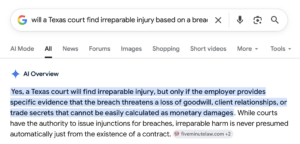
As a test case, I Googled “will a Texas court find irreparable injury based on a breach of a noncompete?” Here’s the AI Overview Google provided:

Ok, I take it back. That’s a pretty good answer.
Give it another ten years and you won’t even need me.
________________________

Zach Wolfe (zach@zachwolfelaw.com) is a Texas trial lawyer who handles non-compete and trade secret litigation at Zach Wolfe Law Firm (zachwolfelaw.com). Thomson Reuters has named him a Texas “Super Lawyer”® for Business Litigation every year since 2020.
These are his opinions, not the opinions of his firm or clients. Reasonable people can disagree. Every case is different, so don’t rely on this post as legal advice for your case.

Stephan is the sports journalist for the Maple Grove Report.