

Fear of deportation, delays discourage some immigrants


A person poses for a photo next to a blooming tree

B was born in Mexico and had lived in the U.S. for more than 20 years before finally deciding to apply for U.S. citizenship this winter. MPR News is identifying him only by his first initial out of concern about immigration enforcement.

He built a life in the U.S., raised three children, and became a lawful permanent resident. But until recently, he says he never felt urgency to become a citizen.

“I didn’t see the need. I mean, if I can work and live here legally, that’s enough,” B said.

That changed this winter during the ICE surge in Minnesota.

B says for months, fear shaped nearly every part of his daily life. He even had to close his used car business after customers stopped coming in.

“Well it’s been the toughest time in my life,” he recalls.

At his current job, he says supervisors told him to hide in the back when ICE agents were nearby. And eventually, he started carrying a GPS tracker hidden in his shoes so his family could find him in case he was detained.

Now 55 years old, B applied for citizenship for the first time just months ago. He started to worry his legal permanent residency might no longer protect him from deportation.

Past year has brought significant changes to application process

Unlike B, immigration advocates say that fear, combined with policy changes and processing delays — is discouraging some eligible immigrants from applying for citizenship at all.

At the International Institute of Minnesota in St. Paul, staff help immigrants navigate the naturalization process, from legal screenings to English and civics classes.

Corleen Smith, the organization’s director of immigration and anti-trafficking services, says the past year has brought changes unlike anything she has seen in more than two decades of immigration work.

“We are definitely seeing a decrease in people applying,” Smith said. “People are just discouraged from applying.”

Smith says the organization typically helps submit between 50 and 70 citizenship applications each month. Recently, she says, that number has dropped closer to 20 to 25 applications a month — a decline of roughly 50 percent.

The Immigrant Law Center of Minnesota says it is seeing similar trends. The organization reported 108 naturalization intake cases between Jan. 1 and mid-May of 2025. During the same period this year, that number dropped to 42.

According to federal data cited by the New Americans Campaign, more than 840,000 people became U.S. citizens nationwide in 2025. The total number of naturalization applications filed and approved that year was slightly lower than in 2024, while denial rates increased by almost 15 percent.

The Immigrant Legal Resource Center, which leads the initiative, also reports a sharp drop in both applications and adjudications in November and December 2025. It attributes the decline to recent policy changes that have added new barriers and made the naturalization process more difficult to access. The organization warns these trends could lead to significantly fewer new citizens in 2026.

Applying for citizenship has always involved challenges. Applicants must complete lengthy forms detailing years of personal history, pass background checks and pay filing fees that can exceed $700. Many must also pass English and civics exams.

“There’s always kind of those normal hurdles,” Smith said. “Answering history and government questions, being able to read and write in English … the legal process itself.”
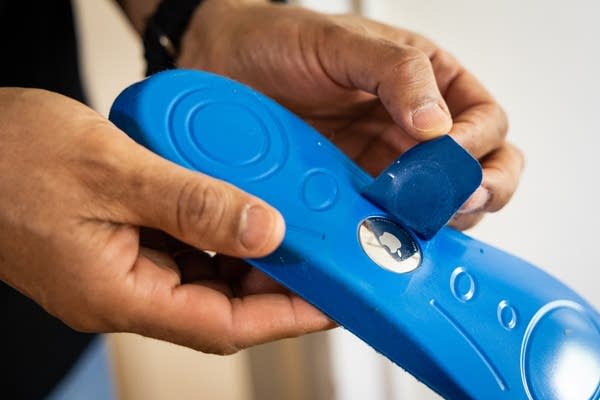
A person show a hidden AirTag
B., a green card holder who is applying for U.S. citizenship, shows where he keeps an Apple AirTag hidden in his shoe so relatives can track his location in case he’s detained by ICE agents.
Ben Hovland | MPR News

But attorneys and advocates say the current political climate has introduced new fears – even for immigrants with straightforward cases and no criminal history.

“What I’m really hearing from immigrants and other clients that are approaching us talking about citizenship is they don’t want to be on the radar of this administration,” Smith said. “Despite not having any red flags, any issues, they just don’t want to have to go through the increased scrutiny.”

Immigration attorney Peter Nagell says while some of his clients are choosing not to interact with the immigration system, other clients who would previously have completed the citizenship process on their own are now seeking attorneys because they fear making mistakes or attracting scrutiny.

“So we are seeing more, in some ways, more straightforward applicants seeking legal assistance. But we certainly are seeing people who just would rather not interact with the immigration system, even if they’re very clearly eligible to pursue some kind of benefit, whether that's citizenship or anything else,” Nagell said.

Delays, stricter scrutiny and changing policies

Immigration advocates say processing delays and policy changes are contributing to those fears.

The Immigrant Law Center of Minnesota says naturalization cases that once moved from filing to oath ceremony within a few months are now commonly taking nine months or longer. Some applicants interviewed last year are still waiting for final decisions or oath ceremonies.

Advocates also say immigration officers are applying greater scrutiny to applications involving fee waivers or disability exemptions.

Last year, some applicants reportedly received unannounced home visits from U.S. Citizenship and Immigration Services officers after requesting medical waivers or fee waivers. During those visits, applicants were questioned about employment, income, public benefits and their ability to speak English.

“We haven’t seen home visits since last fall,” the Immigrant Law Center said in a statement. “Applicants do express concern about enforcement actions during screening calls and often ask if it is the right time to apply for citizenship.”

Smith says new federal guidance has also made medical waivers more difficult to obtain.

“There’s been some new guidance that essentially gives immigration officers more opportunities to deny applicants that are requesting medical waivers,” she said.

Those waivers are intended for applicants whose disabilities or medical conditions make it impossible to complete the English or civics requirements.

According to the American Immigration Lawyers Association, a revised citizenship test introduced for applications filed after Oct. 20, 2025 expanded the civics question bank and increased the number of questions applicants must answer correctly to pass.

“The question bank has expanded from 100 to 128 items, and during the interview, officers now ask up to 20 questions instead of 10,” Cristina Santiago Ruitort, an American Immigration Lawyers Association member, said in a statement to MPR News. “To pass, applicants must correctly answer at least 12 questions. While the test remains oral, the new content places a much heavier emphasis on federalism, recent constitutional interpretations, and civic responsibilities.”

A person poses for a photo next to a blooming tree
B., a green card holder who is applying for U.S. citizenship, poses for a photo.
Ben Hovland | MPR News

Nagell says attorneys are also seeing broader changes in how immigration officers evaluate “good moral character,” a legal standard required for citizenship.

“In the past, if somebody had no prior issues or encounters with immigration or law enforcement and they had been living and working in the United States, it’s sort of presumed that they were a person of good moral character,” Nagell said. “Now they have indicated that they are going to really put that onus more on the applicant to establish that.”

Advocates say applicants are also hearing reports that the English reading and writing portions of the citizenship test have become more difficult and that officers are more strict about spelling and comprehension.

The strongest protection — but still a difficult choice

Advocates and attorneys stress that citizenship remains the strongest legal protection available to immigrants who qualify.

“Anyone that essentially is not a citizen has the potential for removal,” Smith said. “Citizenship is really the ultimate security and stability.”

But attorneys also acknowledge that deciding whether to apply has become emotionally complicated for many immigrants.

“There is a lot of fear in the community,” Nagell said. “Although I do caution people to take it seriously and to ensure eligibility and understand any potential risks, I do also routinely put things into context for people and say, ‘Look, you are clearly entitled to this.’”

Nagell encourages immigrants considering citizenship to seek advice from licensed attorneys or accredited legal organizations rather than relying on misinformation or social media.

“There is both great information on social media and also distorted and incorrect information,” he said. “Consuming information carefully is important.”

After 20 years as a green card holder, B says that even with legal status, fear of deportation outweighed the fear of interacting with the legal system during a time of uncertainty.

“Being with my children, safety, peace. I’m applying for jobs. I have a job right now, but I want to restart my business,” he said.

He says music and dancing have helped him regain a sense of normalcy after months of fear and uncertainty. He especially enjoys live cover bands playing music from the 1970s, ’80s and ’90s, and says he tries to go out dancing every weekend — sometimes Friday, Saturday and even Sunday if there’s a show.

Now that his citizenship paperwork has been submitted, he says life has slowly started to feel more stable again. While other personal challenges remain, he says things are improving little by little.

For now, B waits to learn whether he will become a U.S. citizen. He says the process has already given him a new perspective on how fragile his sense of security can feel, even after decades in the country.



Source link

Leave a Reply

Subscribe to Our Newsletter

Get our latest articles delivered straight to your inbox. No spam, we promise.

Recent Reviews


Scaled Agile Framework – Table of Content

Introduction to the Scaled Agile Framework (SAFe)

The Scaled Agile Framework (SAFe) is part of the agile integration method. This provides a freely proven knowledge base and also offers integrated business patterns for large-scale enterprises. It is modular and higher scalable, allows each business organization to insert in a way that offers higher customer satisfaction, better business results, and engaged team members.

Scaled Agile framework adds the proper alignment, business collaboration, and proper time product delivery to the Agile project teams. This framework also collaborates with software solutions and complex cyber network –physical systems, this collaboration requires a large number of employees to create, design, and maintain. The main moto of the Scaled Agile framework is to solve customers’ most challenging and complex scaling issues. As I said above Agile framework support for the knowledge base, so it contains three major knowledge base bodies such as Agile development knowledge base, Agile lean scalable product developments, and flow, and Systems-level thinking.

Become an Agile Certified professional by learning Agile Training from hkrtrainings!

Overview of Scaled Agile Framework (SAFe)

The scaled Agile framework is mainly developed to solve the customers’ complex and challenging scaling issues in large business enterprises. The below figures explains the architecture of the Scaled Agile Framework and its nature of work.

  • This level 4.0 big picture explains the Visual overview of the scaled agile framework. Each icon in the big picture provides navigation and guidance to the customers.
  • The big picture of the Scaled framework has two views.
  • The default three-level view: this provides the solutions to the agile team in a modest way.
  • The four-level view: this view helps the customers to develop building large scale solutions that involve a large number of team members to maintain, construct, and develop.

There are four organizations levels as well as foundation levels;

Team level: the scaled agile framework is based on Agile team members; they are responsible for software-defined, product building, and software testing from their agile backlogs. This agile team can also work on Scrum or Kanban iteration methods, checking of quality practices, and to deliver better product outcome.

Program level: the scaled agile framework teams are worked based on a virtual program called “Agile Release Train”. Each Agile Release Train is a long-lived and cross-functional self-organizing team of 10 to 20 agile teams, business stakeholders to plan, design, commit, adapt, and deliver the solution.

Value stream level: this value stream level provides the development of larger business and complex product solutions. This type of stream level needs multiple and synchronized agile release teams as well as a stronger focus on intent product and context of solutions.

Portfolio level: This Agile release team involves in organizing and funding of value streams. The portfolio level provides the software development funding through Lean – agile cost, provides supportive governance and value coordination.

Foundation layer: this foundation layer level holds additional elements that support designing and scaling. The elements may include are lean-agile leaders, agile communities, team core values, lean-agile principles that guide scaled agile framework, and an implementations strategy.

Foundation layer explanation

The Foundation layer is one of the very important knowledge base layers of the Scaled Agile Framework (SAFe). This layer is considered when there is a critical, necessary, and supportive of software product delivery. This Foundation layer includes the following:

Lean-Agile leaders: this is considered to be responsible for the success of any business enterprises and also users can modify the product while they are working with management. In the end, the scaled agile framework has new leadership executed by lean-agile leaders.

Communities of practices:  In this section, value streams of lean approach will be moved to pivot the functional organizations to produce a more flexible and adaptive business value approach. The scaled agile framework also helps the communities of the project, the internal group of team members and other project experts will collaborate to work together to produce a valuable outcome.

Core Values: there are four major core values of the scaled agile framework that make it effective and valuable. The four core values included are;

  • Alignments
  • Built-in quality
  • Transparency
  • Finally program executions.

Lean-agile mindset: scaled agile framework (SAFe) leaders are lifelong teachers and learners who are well known for lean and agile principles, practices, and core values. To make the framework perform in a better way, all the lean leaders should undergo training and teach them properly. To become a perfect leader or teacher they should have different ways of thinking, building, and operating.

Lean-agile principles: Scaled agile framework should work on nine fundamental principles. I would like to name them,

  • Take an eye on an economic view
  • Apply effective system thinking
  • Assume preserve options and variability
  • Build iteration and incremental in a fast, integrated leaning agile cycles
  • Objectives based on the milestones of the working system
  • Proper visualization and limit of WIP, reduces the team batch size and manages the project queue lengths
  • Applying of cadence synchronizes the cross-domain project planning
  • Decentralization of team decision-making
  • Unlocking of the intrinsic motivations and knowledge workers.

Implementing 1-2-3 levels: based on the scaled agile frameworks implementations, “implementing scaled agile frameworks 1-2-3” patterns for successful iterations of frameworks. The train implementers and lean-agile change agents (SPCs). The consultants can then train all the team executives, managers, and team leaders.

Want to gain knowledge in Struts? Then visit here to learn Struts Training!

Agile Online Training

  • Master Your Craft
  • Lifetime LMS & Faculty Access
  • 24/7 online expert support
  • Real-world & Project Based Learning

Team level

The scaled agile frameworks, team level provides the organization, artifact, team role, and process model for the implementation activities in agile teams.

All scaled agile framework teams are the part of agile release train (ART). The scaled agile team is responsible for project defining, designing, and testing the use case stories from their agile team backlog in fixed-length iterations, iteration cadence, and synchronization to assign with other project teams, so this will help to iterate the entire system.

Both team Scrum and team Kanban, mostly work on built-in quality practices to deliver the project outcome every two weeks. The project demo creates a “pull event “for all the team members to make them work together, designing the integration part, and testing the model phase during the software development lifecycle.

Each team should consist of 5-9 members and train them properly to build a valuable product in each iteration. The team members may be Scrum master, product owner, stakeholders, project contributors, and specialist, they involve in deliver the valuable product.

Program Level

The program level is now considered as the heart of a Scaled agile framework. The following diagram explains the work nature of the program level.

Scaled Agile framework’s program level appears in the “Agile Release train”. Program level team members’ roles and activities to be based on only the incremental and iteration value of the product.

The main fundamental functionalities of Agile release train are the formation of span functional boundaries, elimination of unnecessary steps taken, and acceleration of product delivery values through the implementation of Scaled Lean-agile practices and SAFe’s principles.

It is called as a program level in agile release train (ART) because this level of scaled agile framework generally long-lived and offers self-organization, programming structure, and mission than any existing “program level of ART” which has a piece of information like start and end date of the project resource planning. It is known for it’s a long-lived, knowledge base, and self-organizing nature of the Agile release train.

Agile release train composed of 5-12 agile team members, they will be responsible for delivering the fully tested agile product, working on iteration, and system-level solutions. Many agile release trains are virtual, spanning, and geographic boundaries.

Join our CAPM Training today and enhance your skills to new heights!

Project Management & Methodologies, scaled-agile-framework-description-0, Project Management & Methodologies, scaled-agile-framework-description-1

Subscribe to our YouTube channel to get new updates..!

The Spanning palette

The spanning palette in the scaled agile frameworks is nothing but special icons located at the conjunction of both program-level and virtual stream levels on the SAFe big picture.

Each of spanning palette in Agile release trains describes the “vision”, “metrics’”, “project milestone”, “Release date”, “Developments”, “Team members”, “Release managements”, “shared software devices”, and “user experience test cases”. These elements also “span” the SAFe’s levels as they are more often used in other levels.

Value stream level

Value stream level is an optional level in Scaled agile frameworks, as they are widely used when the project type is big and largely independent. So this type of level needs thousands of team members and expensive too. Agile release train will operate for three-levels when you have decided to implement a Value stream level.

This type of SAFe level is commonly used in building large scale applications, multiple software, and virtual-cyber systems. Building value stream level applications need additional constructs, team coordination, and software articraft.

The value stream level is organized and works for program increments like program level. This type of level is helpful for cadence and multiple synchronizations of Agile release trains and suppliers. The value stream level roles that may be included are solution management, solution engineering, system architect, and value level stream, engineers.

Portfolio level

The portfolio level in the scaled agile framework is considered as the highest level and consists of value stream level, people, and processes required to offer funding, financial details, and governance for the products, software services, and product solutions to fulfill the high-level business strategy.

The following diagram explains the nature of the Portfolio level of Scaled agile frameworks:

This is the basic construction for organizing the Lean-level Agile enterprise to flow of valuable data through one or more value level streams. The portfolio level incorporates the elements to provide the basic details on funding and governance related to the project. One interesting thing about the portfolio level is that it will return the necessary budgets to meet the top-level strategic principles.

The portfolio level in SAFe has bidirectional connections to the enterprise’s business. One direction of the portfolio guides the larger, complex, and challenging business objectives. The other direction of the portfolio describes the constant value flow to the business enterprises.

Top 30 frequently asked Agile Interview Questions !

Agile Online Training

Weekday / Weekend Batches

The primary elements of Portfolio level are Value streams which help in funding for the business people and other available resources. Each portfolio value stream elements are long-lives business developments, system definitions, product delivery, and deployments. Whereas program portfolio describes the stakeholders who are responsible to deliver the final product outcomes and also provide financial strength.

Conclusion

Scaled Agile frameworks are considered as one of the major parts of the Agile software development lifecycle. This Scaled Agile framework is most commonly used in large-scale and complex product developments due to itsunique  knowledge base and Incremental features. This article may help a few of you learn the Agile methodologies in-depth and also for Agile community forums.

Other Related Article:

1. Agile Prioritization Techniques

2. Agile VS Scrum


Source link