Estate Planning Attorney Personally Liable for Client’s Unpaid Taxes? – Houston Tax Attorneys


Estate planning and business attorneys often serve dual roles for their clients. Beyond providing legal advice, they might accept positions as registered agent, corporate secretary, or director of a client’s holding company.

The arrangements can streamline matters and be a more efficient way to handle transactions. The attorney maintains control over corporate records, handles filings, and bills for the work. Everyone benefits from the streamlined structure.

But what happens when that client entity falls behind on taxes? Can the attorney face personal liability for debts owed by the client’s company? The United States v. Neuberger, Civil Action No. EA-22-2977 (D. Md. Jan. 23, 2026), case addresses this question. It involves back taxes owed by the IRS and an estate planning attorney that the government sued under the Federal Priorty Statute.

Facts & Procedural History

Neuberger is an estate planning and business law attorney at a Baltimore firm. He represents high-net-worth families.

One of his longtime clients, Konig, was the subject of this lawsuit. Neuberger formed a corporation for Konig that was to hold the Konig family’s investments. Neuberger served as its sole director, president, and treasurer. Under the bylaws, Neuberger had authority to sign contracts, borrow money, and manage the company’s property and business.

The corporation borrowed approximately $8.8 million from a British Virgin Islands company that lent money to Konig family entities. For tax years 2010 through 2020, Lehcim claimed substantial deductions for interest on these loans.

The IRS began auditing the corporation’s returns in 2014. The corporation was represented by outside tax counsel during the IRS audit, with Neuberger assisting. By 2018, the IRS concluded that the corporation’s interest deductions were improper because the loans were not bona fide debt but rather capital contributions.

In 2019, the IRS sent the corporation a 30-day letter proposing tax deficiencies, penalties, and interest totaling $1,880,987.96 for tax years 2010 through 2015. Neuberger personally received a copy. The corporation did not respond or appeal. On November 20, 2019, the IRS issued a statutory notice of deficiency. The corporation did not petition the U.S. Tax Court.

After receiving notice of the IRS’s proposed assessments

After receiving notice of the IRS’s proposed assessments, Neuberger worked with another firm attorney and an accountant to develop a “repayment plan.” In 2019 through early 2020, the corporation transferred $8,816,813 to the lending entity in seven wire transfers. The stated purpose was to repay the loans and demonstrate their legitimacy to the IRS.

Evidence at trial showed that Neuberger helped develop th…

Evidence at trial showed that Neuberger helped develop the plan conceptually, directed which entities to include, and monitored its progress. When outside counsel suggested putting the plan on hold, Neuberger overruled that decision. No one told the IRS about the repayment plan while it was being executed.

The United States sued Neuberger on November 16, 2022, under the Federal Priority Statute. After a bench trial in August 2025, the court found Neuberger personally liable. The January 2026 that is the subject of this article was a follow up hearing as to whether Neuberger was liable for damages.

The Federal Priority Statute

The Federal Priority Statute is not in the tax code. It is not limited to tax liablities. The statute is found in 31 U.S.C. § 3713.

The statute requires that claims owed to the United States be paid before other debts when certain conditions exist. The statute provides that “a claim of the United States Government shall be paid first when a person indebted to the Government is insolvent” and triggering events occur, such as when “the debtor without enough property to pay all debts makes a voluntary assignment of property” or “an act of bankruptcy is committed.”

The statute applies not only to debtors but extends liability to “representatives” through Section 3713(b). That provision states that a “representative paying any part of a debt of the person before paying a claim of the Government is liable to the extent of the payment for unpaid claims of the Government.”

Although this language appears to create strict liability, courts have developed a three-element test. The government must prove: (1) the representative transferred the debtor’s assets before paying the United States’ claim; (2) the debtor was insolvent; and (3) the representative had knowledge or notice of the government’s claim.

The statute does not define “representative,” but courts have interpreted it broadly to include executors, administrators, trustees, and corporate officers.

Is an Attorney a “Representative”?

Neuberger’s central defense in this case was that he should not be considered a representative because he did not exercise sufficient control over the corporation. He testified that while he took “full responsibility,” he was “not involved in the mechanics” of the corporation’s investments or transactions. He claimed he took all direction from his client, Konig.

The court did not agree. It noted that Neuberger was the corporation’s sole director, president, and treasurer. Under the bylaws, he had authority to act on behalf of the corporation, sign contracts, borrow money, and manage its property. These powers made him a representative regardless of his claims about deferring to Konig.

The court noted that it had previously ruled that the term ‘representative’ in Section 3173(b) includes corporate officers, among others. Neuberger failed to identify any authority supporting his position that a corporate officer might avoid liability due to insufficient control.

This creates particular risk for attorneys. Many estate planning and business attorneys serve as officers or directors for client holding companies, family investment entities, or closely held businesses. These roles often seem ministerial—signing documents, maintaining records, filing annual reports. But when tax liabilities arise and the entity is insolvent, can these roles trigger millions of dollars in personal exposure?

Does “Following Client Directions” Provide a Defense?

Throughout the case, Neuberger emphasized that he was following his client’s instructions. He testified that although he held the corporate positions, he took direction from Konig. The evidence showed that Konig was ultimately responsible for deciding to implement the repayment plan.

The court found this defense irrelevant. The evidence established that although Konig made the ultimate decision, Neuberger was integral to developing and executing the repayment plan. He helped develop the plan conceptually. He directed which entities to include or exclude. He monitored progress. When outside counsel recommended putting the plan on hold, Neuberger overruled that decision.

The court noted that the evidence in the case showed that Neuberger was sole director, president, and treasurer and managing the corporation’s affairs. The court held that this was the very purpose of the representative liability statute and the obligation to see to it that the government is paid.

What Constitutes “Knowledge” of the Claim?

The third element requires that the representative have “knowledge of the debt owed to the United States or notice of facts that would lead a reasonably prudent person to inquire as to the existence of the debt” before making the payments. According to the court opinion, this element was easily satisfied in this case.

The parties stipulated that by July 2018, Neuberger knew about the IRS’s preliminary conclusion that the corporation owed additional taxes. He received the March 2019 30-day letter identifying proposed deficiencies totaling $1,880,987.96. He received the November 2019 statutory notice of deficiency. All repayment plan transfers occurred after Neuberger had actual knowledge of the government’s claim.

The court noted that knowledge requirement does not demand that the representative know the exact amount down to the penny. It requires knowledge that a claim exists. Once you know the IRS has assessed or proposed assessments, that knowledge suffices.

For attorneys serving as corporate officers, this means that awareness of an uncontested IRS audit resulting in a balance and preliminary findings creates the requisite knowledge. One cannot avoid liability by claiming uncertainty about the final amount or by noting that the assessment might be challenged.

The Takeaway

This case shows that estate planning attorneys serving as corporate officers for client entities face substantial personal liability when the entity has unpaid tax debts. The Federal Priority Statute reaches representatives who pay other creditors before paying the government’s claim when the entity is insolvent. Holding a corporate office with financial authority can make the attorney a representative under the statute. Following client directions does not provide a defense. Knowledge of an IRS audit and proposed assessments may satisfy the knowledge requirement. In the end, those who control the debtor’s assets bear responsibility for ensuring that the government’s priority is respected.

Watch Our Free On-Demand Webinar

In 40 minutes, we’ll teach you how to survive an IRS audit.

We’ll explain how the IRS conducts audits and how to manage and close the audit.  


Source link

Leave a Reply

Subscribe to Our Newsletter

Get our latest articles delivered straight to your inbox. No spam, we promise.

Recent Reviews


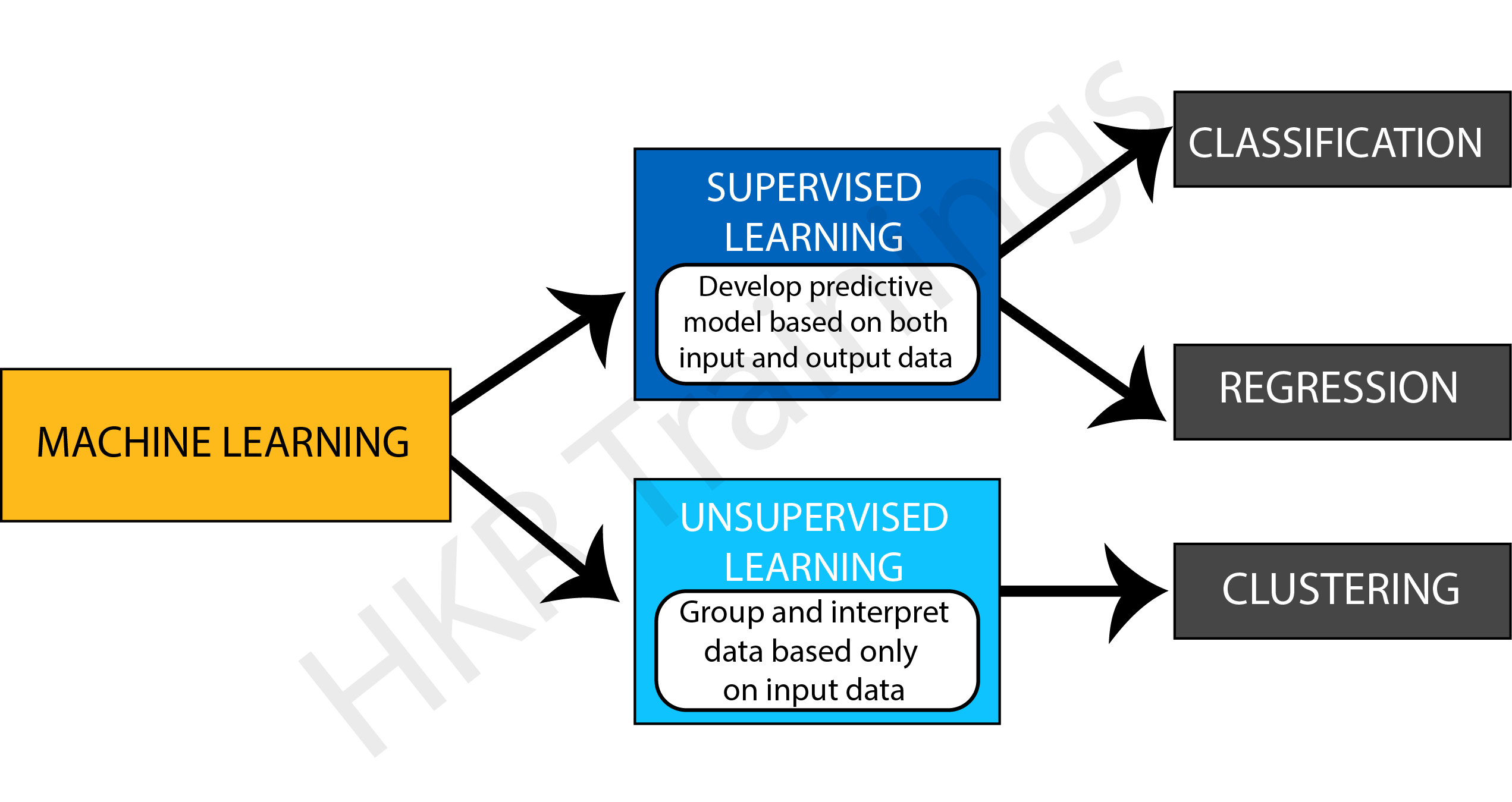
The Classification algorithm is a supervised learning method that trains data to determine the category of future observations. This is why firstly, let us understand what is supervised learning.

What is Supervised Learning

Understanding Supervised Learning

Supervised learning develops a function to predict a defined label based on the input data.

The model in Supervised Learning learns by action. During training, the model examines which label is related to the given data and, as a result, can identify patterns between the data and particular labels.

Let us understand supervised learning with an example of Speech Recognition. It is an application where you train an algorithm with your voice. Virtual assistants such as Google Assistant and Siri, which recognize and respond to your voice, are the most well-known real-world supervised learning applications.

Supervised Learning might sort data into categories (a classification challenge) or predict a result (regression algorithms). This article will specifically address everything we need to know about classification in Machine Learning.

What is Classification in Machine Learning?

The process of recognizing, interpreting, and classifying objects or thoughts into various groups is known as classification. Machine learning models use a variety of algorithms to classify future datasets into appropriate and relevant categories with the help of already-categorized training datasets.

Classification in Machine Learning

In other words, classification is a type of “pattern recognition.” In this case, classification algorithms applied to training data detect the same pattern (same number sequences, words, etc.) in consecutive data sets.

Want to Become a Master in Machine Learning? Then visit here to Learn Machine Learning Training

Types of Classification Models

There are four primary classification tasks you could come across:

  • Binary Classification
  • Multi-Class Classification
  • Multi-Label Classification
  • Imbalanced Classification

Binary Classification

The term “binary classification” refers to tasks that can provide one of two class labels as an output. In general, one is regarded as the normal state, while the other is abnormal. The following examples can assist you in better comprehending them.

For example, for email spam detection, the normal condition is “not spam,” whereas the abnormal state is “spam.” “Likewise, Cancer not found” is the normal condition of an activity involving a medical test, whereas “cancer identified” is the abnormal state.

The normal state class is usually allocated the class label 0, whereas the abnormal state class is assigned the class label 1.

Some of the popular algorithms used for binary classification are:

  • Decision Trees
  • Logistic Regression
  • Support Vector Machine
  • k-Nearest Neighbors
  • Naive Bayes

Machine Learning Training

  • Master Your Craft
  • Lifetime LMS & Faculty Access
  • 24/7 online expert support
  • Real-world & Project Based Learning

Multi-Label Classification

We refer to multi-label classification tasks as those in which we need to assign two or more distinct class labels that can be predicted for each case. A simple example is photo classification, in which a single shot may contain many items, such as a puppy or an apple, and so on.  In this type of classification, you can predict many labels rather than just one.

The most common algorithms are:

  • Multi-label Random Forests
  • Multi-label Decision trees
  • Multi-label Gradient Boosting

Multi-Class Classification

Tasks that have two or more class labels are called multi-class classification.

The multi-class classification does not differentiate between normal and abnormal results. 

In some situations, the number of class labels might be rather big. For instance, a model may predict that a photograph belongs to one of thousands or tens of thousands of faces in a facial recognition system. Examples are classified into one of several known classes.

Some of the popular algorithms used for multi-class classification are:

  • Naive Bayes
  • k-Nearest Neighbors
  • Random Forest
  • Gradient Boosting
  • Decision Trees

Imbalanced Classification

Imbalanced Classification refers to tasks in which the number of items in each class is distributed unequally. In general, unbalanced classification problems are binary classification tasks in which most of the training dataset belongs to the normal class and just a small percentage to the abnormal class.

Learners in Classification Problem

There are two types of learners in a classification problem, namely:

  • Eager Learners
  • Lazy Learners

Eager Learners

Eager learning occurs when a machine learning algorithm constructs a model shortly after obtaining training data. It’s named eager because the first thing it does when it obtains the data set is, it creates the model. The training data is then forgotten. When new input data arrives, the model is used to evaluate it. The vast majority of machine learning algorithms are eager to learn.

Lazy Learners

Lazy learning, on the other hand, occurs when a machine learning algorithm does not develop a model immediately after receiving training data but instead waits until it is given input data to analyze. It’s named lazy because it waits until it’s absolutely essential to construct a model if it builds any at all. It only saves training data when it receives it. When the input data arrives, it uses the previously stored data to evaluate the output. Instead of learning a discriminative function from the training data, the lazy learning algorithm “memorizes” the training dataset. The eager learning algorithm, on the other hand, learns its model weights (parameters) during training.

Types of Machine learning Classification Algorithms

Classification algorithms use input training data in machine learning to predict the likelihood or probability that the following data will fall into one specified category. One of the most popular classifications used to sort emails into “spam” and “non-spam” categories, as employed by today’s leading email service providers.

They are two types of classification models, namely:

  • Linear Models
  • Non-linear Models

1. Linear Models

Support Vector Machine

Support Vector Machine

The support vector machine (SVM) is a frequently used machine learning technique for classification and regression problems. It is, however, mostly employed to tackle categorization difficulties. SVM’s main goal is to determine the best decision boundaries in an N-dimensional space that can classify data points, and the optimal decision boundary is known as the Hyperplane. The extreme vector is chosen by SVM to locate the hyperplane, and these vectors are referred to as support vectors.

Logistic Regression
Logistic Regression

In logistic regression, the sigmoid function returns the probability of a label. It is used widely when the classification problem is binary, for example, true or false, win or lose, positive or negative.

Logistic regression is used to determine the right fit between a dependent variable and a set of independent variables. Because it quantifies the factors that lead to categorization, it beats alternative binary classification algorithms like KNN.

Enroll in our Machine Learning With Python Training program today and elevate your skills!

HKR Trainings Logo

Subscribe to our YouTube channel to get new updates..!

2. Non-Linear Models

Decision Tree

Decision Tree

The classification model is developed using the decision tree algorithm as a tree structure. The data is then divided down into smaller structures and connected to an incremental decision tree to complete the process. The final output looks like a tree, complete with nodes and leaves. Using the training data, the rules are learned one by one, one by one. Every time a rule is learned, the tuples that cover the rules are removed. The technique is repeated on the training set until the termination point is reached.

The tree is built using a recursive top-down divide and conquer method. A leaf symbolizes a classification or decision, and a decision node will contain two or more branches. The root node of a decision tree is the highest node that corresponds to the best predictor, and the best thing about a decision tree is that it can handle both category and numerical data.

Kernel SVM

A kernel in SVM is a function that assists in problem resolution. They provide you shortcuts so you don’t have to complete hard calculations. Kernel is remarkable since it allows us to go to higher dimensions and do smooth calculations. It is possible to work with an infinite number of dimensions with kernels.

K-Nearest Neighbor

The K-Nearest Neighbor technique divides data into groups based on the distance between data points and is used for classification and prediction. The K-Nearest Neighbor algorithm implies that data points near together must be similar. Hence, the data point to be classed will be grouped with the closest cluster.

Naive Bayes

The classification algorithm Naive Bayes is based on the assumption that predictors in a dataset are independent. This implies that the features are independent of one another. For example, when given a banana, the classifier will notice that the fruit is yellow in color, rectangular in shape, and long and tapered. These characteristics will add to the likelihood of it becoming a banana in its own right and are not reliant on one another. Naive Bayes is based on the Bayes theorem, which is represented as:

P(A|B) = (P(A) P(B|A)) / P(B)

 Here:
         P(A | B) = how likely B happens
         P(A) = how likely A happens
         P(B) = how likely B happens
         P(B | A) = how likely B happens given that A happen

Stochastic Gradient Descent

It is an extremely effective and simple method for fitting linear models. If the sample data is vast, Stochastic Gradient Descent is beneficial. For classification, it provides a variety of loss functions and penalties.

The only benefit is the ease of implementation and efficiency. Still, stochastic gradient descent has several drawbacks, including the need for many hyper-parameters and sensitivity to feature scaling.

Random Forest

Random Forest

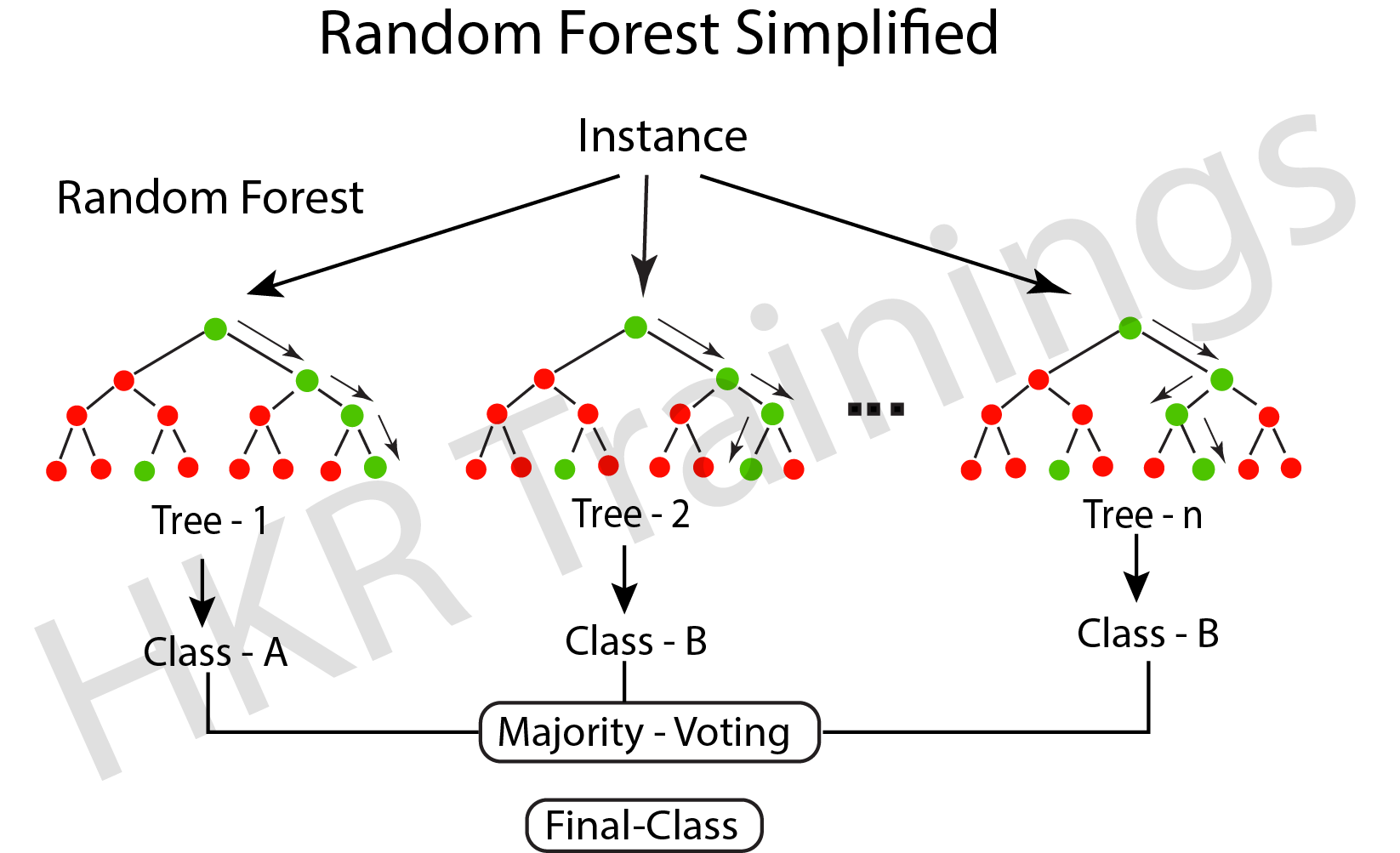
Random decision trees, also known as random forest, may be used for classification, regression, and other tasks. It works by building many decision trees during training and then outputs the class that is the individual trees’ mode, mean, or classification prediction.

A random forest (meta-estimator) fits several trees to different subsamples of data sets and averages the results to increase the model’s predicted accuracy. The sub-sample size is similar to the original input size; however, replacements are frequently used in the samples.

Artificial Neural Networks

Artificial Neural Networks

A neural network uses a model inspired by neurons and their connections in the brain to convert an input vector to an output vector. The model comprises layers of neurons coupled by weights that change the relative relevance of different inputs. Each neuron has an activation function that controls the cell’s output (as a function of its input vector multiplied by its weight vector). The output is calculated by applying the input vector to the network’s input layer, then computing each neuron’s outputs via the network (in a feed-forward fashion).

Machine Learning Training

Weekday / Weekend Batches

Conclusion

In this blog, we looked at what Supervised Learning is and its sub-branch Classification, some of the most widely used classification models, and how to predict their accuracy and see whether they are trained correctly. 

Related Articles:

Feature Selection Techniques In Machine Learning


Source link