
It’s a big day in the world of hotel loyalty, as World of Hyatt — long revered as the most valuable hotel program out there — has officially launched its new award charts.
While the changes were first announced in February, the updated pricing appears to be live across the portfolio. And unfortunately, this also means that 112 properties have shifted to a higher category, while 24 have moved to a lower category.
We’ll be digging into the full ramifications of the changes in the days to come, including some number-crunching to assess their extent, but here’s our initial take on what we’re seeing.
There are now five different award rates
As expected, there are now five possible prices for a standard room at each property:
- Lowest
- Low
- Moderate
- Upper
- Top
The old “Standard” award rate is most closely aligned to the new “Low” price — though it’s not an exact match across Hyatt’s eight award categories.
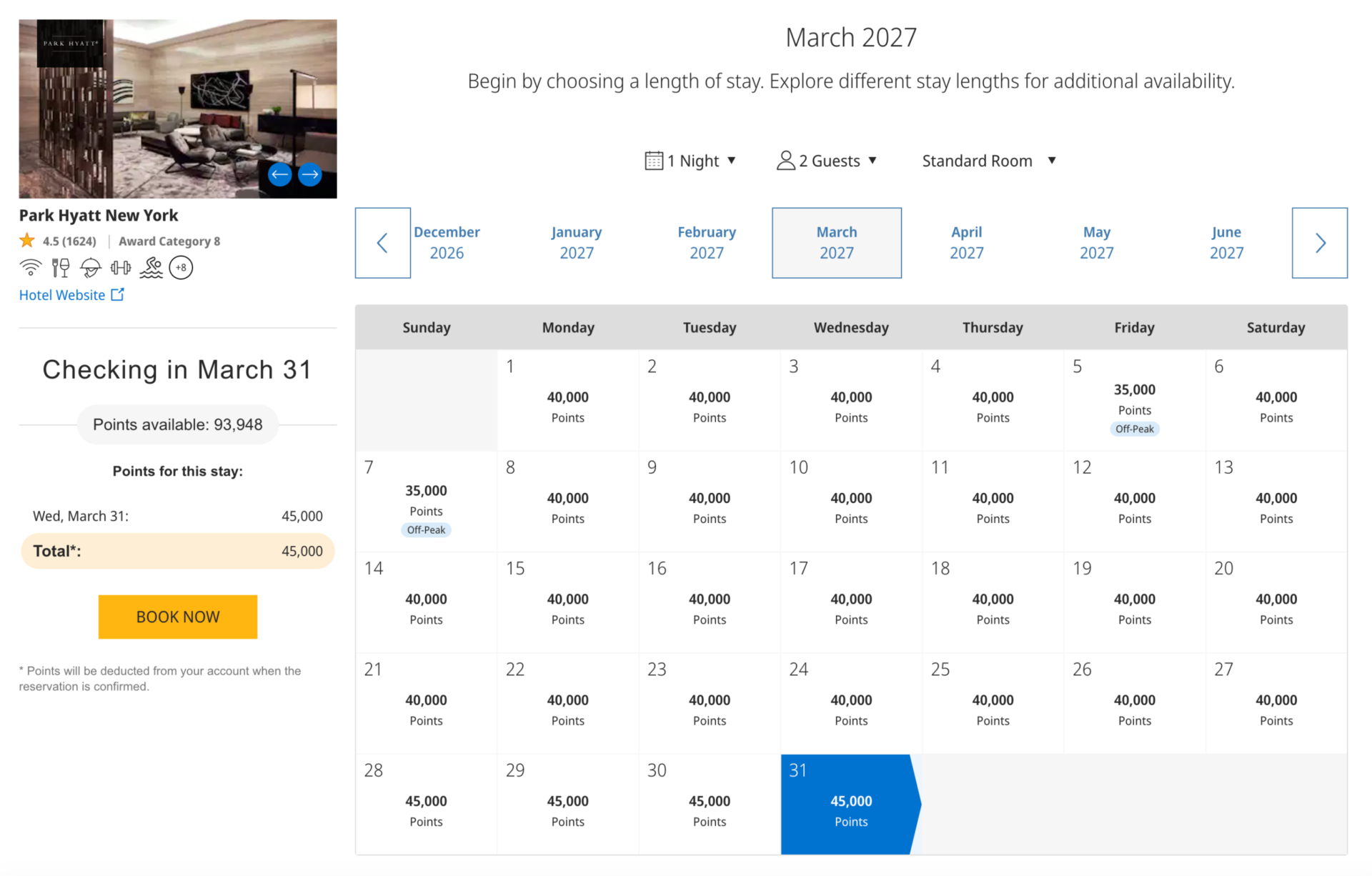
Here’s a snapshot of Hyatt’s old award calendar for a one-night stay at the Park Hyatt New York.
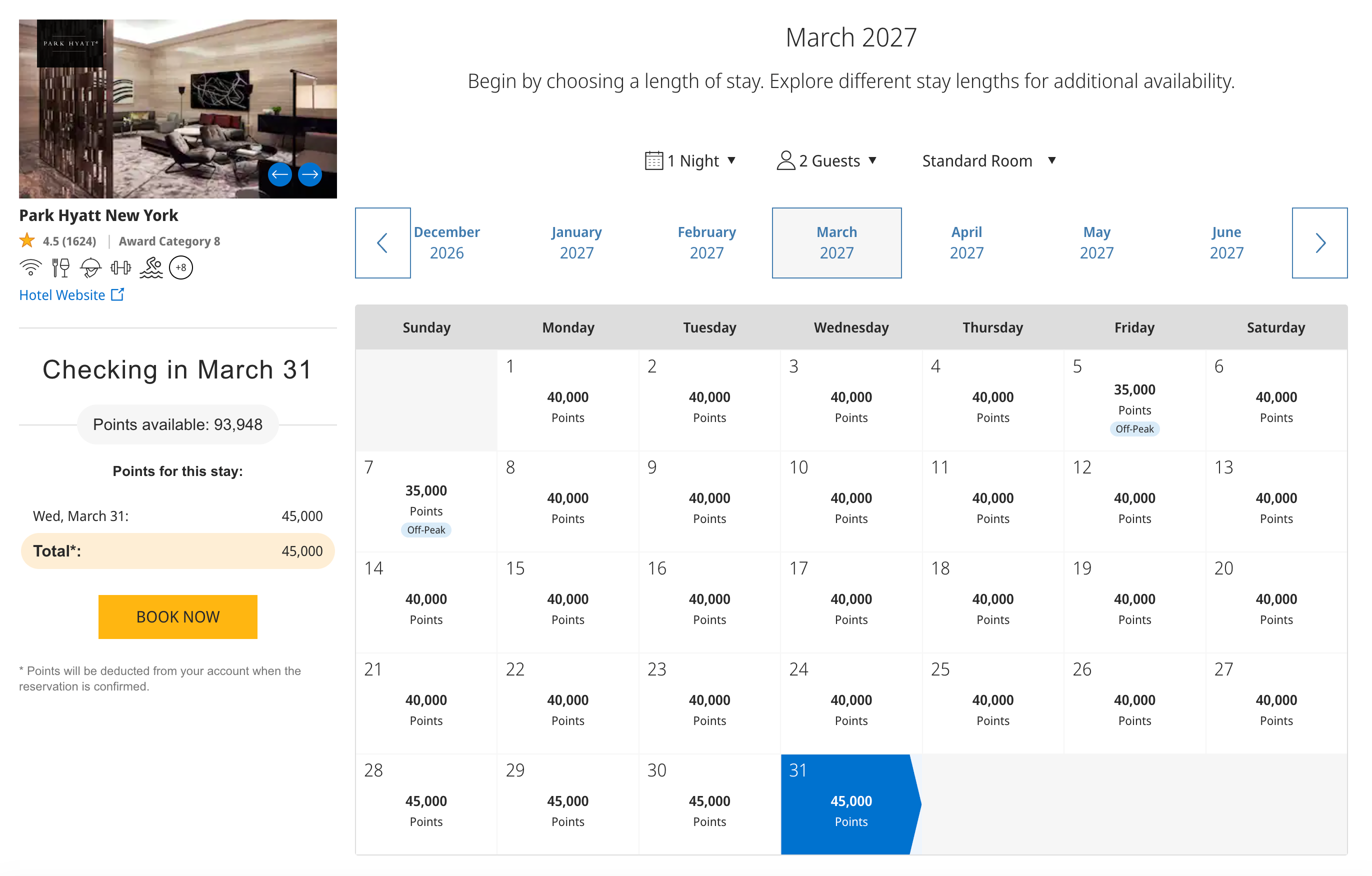
Here’s that same calendar now.
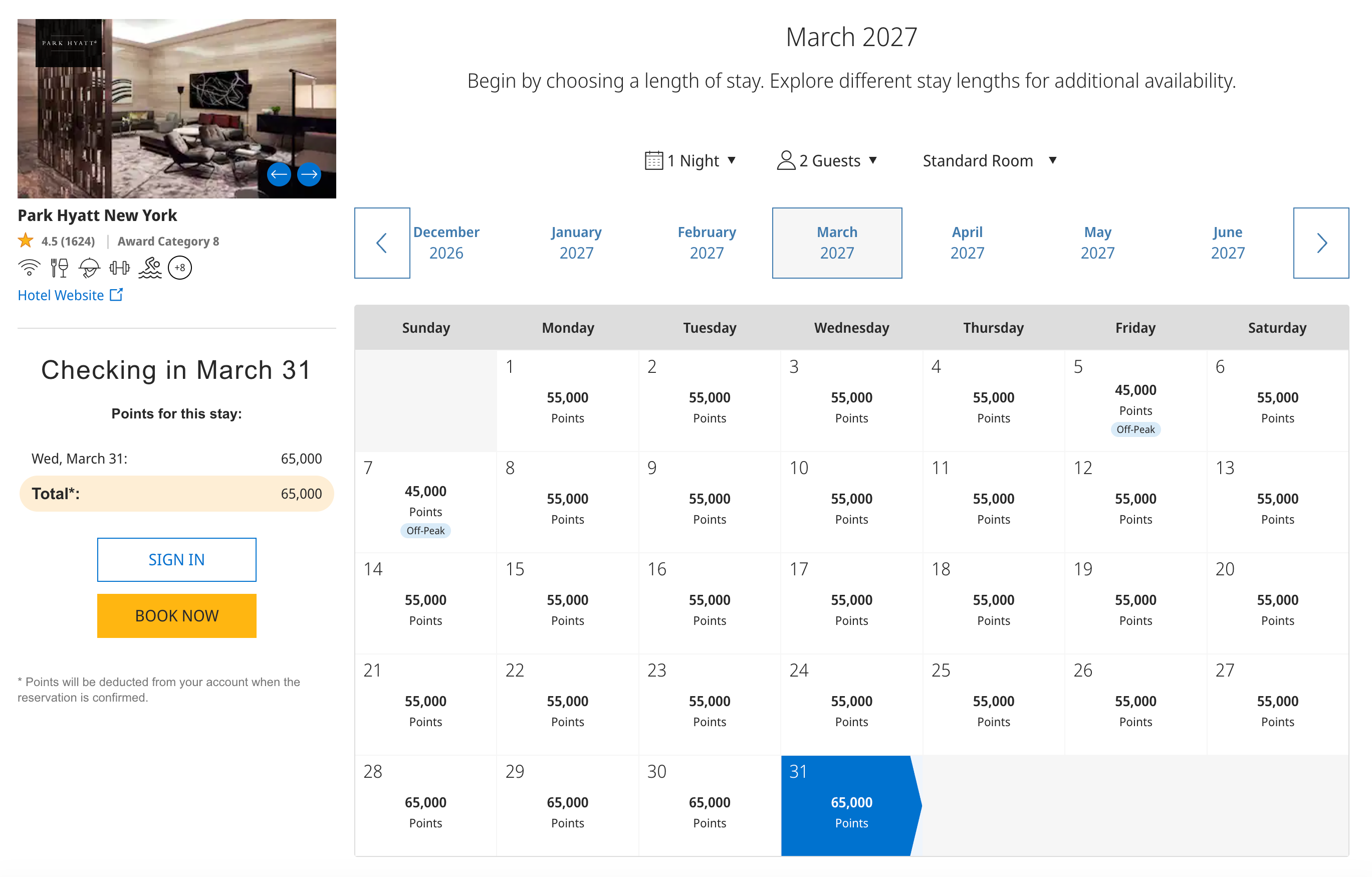
This appears to be a direct conversion compared to the old chart:

Reward your inbox with the TPG Daily newsletter
Join over 700,000 readers for breaking news, in-depth guides and exclusive deals from TPG’s experts
- Low is the new Off Peak, with stays on two dates going from 35,000 points to 45,000 points per night (an increase of 28.57%)
- Moderate is the new Standard, with stays on 25 dates going from 40,000 points to 55,000 points per night (an increase of 37.5%)
- High is the new Peak, with stays on four dates going from 45,000 points to 65,000 points (an increase of 44.4%)
Interestingly, none of these nights are at the new Lowest tier (35,000 points per night) or the Top price (75,000 points per night). However, there’s actually a fair bit of Lowest pricing available across the calendar, as I’m seeing 50 different dates at 35,000 points per night, compared to just five at 75,000.
Some (but not all) stays are now more expensive
To help gauge the depth of the changes, I compiled a list of 10 Hyatt properties I’ve visited over the last year on points (or have booked for the coming months). I pulled award and cash pricing for my upcoming dates just before the new charts went live, and I reran my searches again today.
It’s actually a mixed bag.
| Property | Stay details | Cash price | Old points price | New points price | % change in points |
|---|---|---|---|---|---|
|
July 2026 for two nights |
$1,227.18 |
58,000 |
60,0000 |
3.45% |
|
|
Hyatt Regency Orlando International Airport
|
August 2026 for one night |
$304.88 |
17,000 |
15,000 |
-11.76% |
|
Hyatt Regency Coral Gables
|
Nov. 2026 for one night |
$475.73 |
18,000 |
25,000 |
38.89% |
|
Story Hotel Stockholm Stureplan
|
Nov. 2026 for four nights |
$1,027.61 |
48,000 |
48,000 |
0% |
|
Nov. 2026 for two nights |
$1,990.54 |
80,000 |
110,000 |
37.5% |
|
|
Gild Hall, a Thompson Hotel
|
Dec. 2026 for three nights |
$2,017.05 |
60,000 |
60,000 |
0% |
|
Dec. 2026 for two nights |
$1,127.17 |
58,000 |
60,000 |
3.45% |
|
|
The Beekman, a Thompson Hotel
|
Jan. 2027 for three nights |
$2,080.57 |
63,000 |
75,000 |
19.05% |
|
March 2027 for three nights |
$1,113.03 |
36,000 |
36,000 |
0% |
|
|
March 2027 for four nights |
$4,168.04 |
180,000 |
220,000 |
22.22% |
As you can see, some properties saw large increases — in some cases close to 40% higher than before. Others saw milder increases, while three remained the same. I even had one drop in price, going from Off Peak to the new Lowest tier.
Note that The Beekman was one of the properties that changed categories, moving from Category 6 to 7. As a result, even though the dates are classified as Lowest on the new award chart, it’s still a notable jump.
It has also resulted in lower average redemption values. Within the old charts, these stays had an average value of 2.52 cents per point. Now, it’s just 2.29 cents.
The math on transfers is now more complicated
This new chart has unfortunately added some additional complexity to one of our favorite redemption options here at TPG: transferring rewards points to Hyatt. Both Chase Ultimate Rewards and Bilt allow 1:1 transfers to Hyatt, and every single one of the 10 stays detailed above was made possible (at least in part) by this redemption strategy.
Now, with the new changes in place, this may be a much more complicated endeavor — especially given two notable features within Chase:
- Points Boost, which can push the value of your Ultimate Rewards points via Chase Travel℠ as high as 2 cents apiece
- The fact that Hyatt stays booked via Chase Travel count as loyalty-eligible stays
For example, my two-night stay at the Park Hyatt Chicago cost 58,000 points through Hyatt (29,000 points per night). Now, it’s 60,000 points.
However, that stay costs just 59,581 points via Chase Travel thanks to Points Boost.
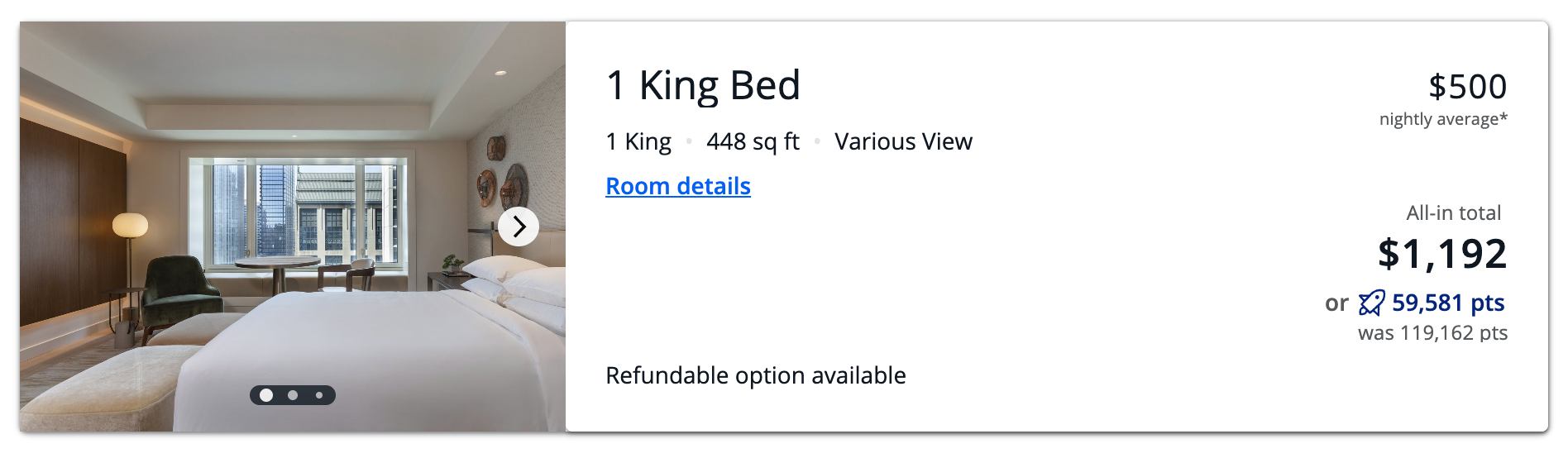
In addition, since it’s part of The Edit, Chase’s luxury collection of hotels, I can use my Chase Sapphire Reserve® (see rates and fees) to enjoy additional on-property benefits. I can even use a combination of points and cash to unlock one of the card’s annual statement credits (up to $500 on prepaid stays of two nights or more at The Edit properties, split up into two $250 credits each year).
Read more: Chase Sapphire Reserve’s The Edit credit: What to know
Finally, this is a loyalty-eligible stay, even if I pay for it with points directly through Chase — so I’ll still earn Hyatt points and enjoy my elite benefits.
In summary, don’t assume that transferring Chase or Bilt points makes sense. You may get a better redemption directly.
Bottom line
The new World of Hyatt award chart has arrived, and our first impressions are a bit of a mixed bag. As expected, higher-end properties are seeing some pretty drastic increases, but some of the properties I checked had milder increases or remained the same.
I hope you were able to snag some advance reservations at top-tier properties over the last several weeks, as it’s likely a more expensive proposition now.
Stay tuned for a more in-depth analysis of this new award chart to help you make the most of your Hyatt points moving forward.

Stacie Harris is a local resident and reporter of the Maple Grove area. Stacie reports on medicine and science for the Maple Grove Report.