17 Protein-Rich Foods To Eat Instead of Having a Protein Shake


Medically reviewed by Kayla Girgen, RD

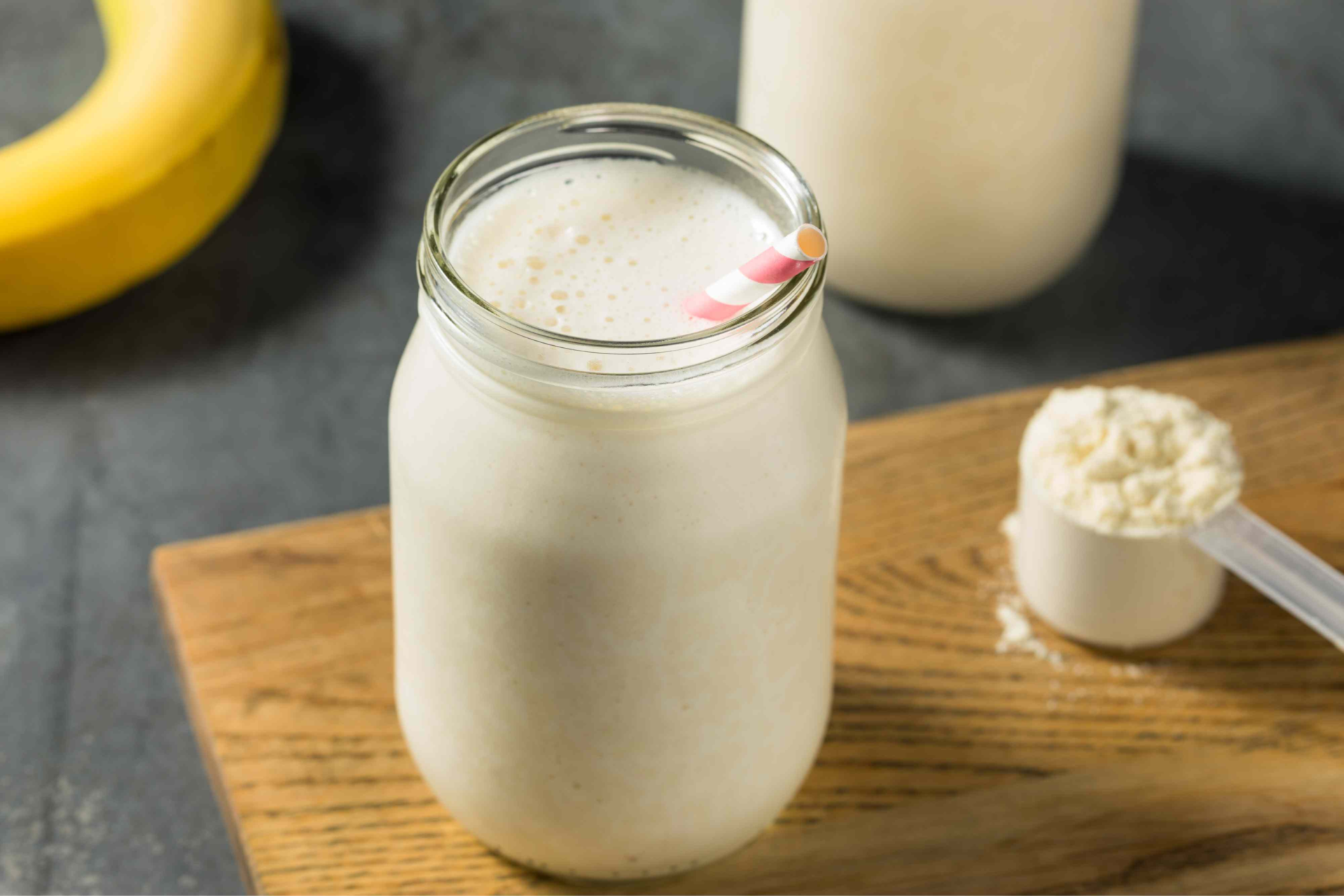
Protein shakes usually have about 15–20 grams of protein, but other foods offer similar amounts or more.Credit: bhofack2 / Getty Images
Protein shakes usually have about 15–20 grams of protein, but other foods offer similar amounts or more.
Credit: bhofack2 / Getty Images
  • Protein is essential for muscle growth, tissue repair, immune function, and many more processes in the body.
  • While protein shakes are a convenient source of protein, foods like cottage cheese, chicken breast, and edamame also offer substantial protein per serving.
  • Aim to include whole foods with protein in each meal to hit your daily needs.

Protein shakes are a quick and easy way to boost your protein intake. Depending on the ingredients, premade and homemade shakes usually contain 15-20 grams of protein. However, many whole foods offer just as much protein—if not more—in addition to essential vitamins, minerals, and nutrients to boost your overall health.

1. Cottage Cheese

Credit: Roman Fernati / Getty Images
  • Protein: 23.3 grams
  • Serving size: 1 cup, large curd

Cottage cheese can be used as a high-protein snack or added to foods like eggs, pancakes, and dips to boost their protein content.

In addition to protein, cottage cheese is rich in vitamins and minerals, like B12, calcium, and selenium.

2. Canned Tuna 

Credit: Ilia Nesolenyi / Getty Images
  • Protein: 20.1 grams
  • Serving size: 3 ounces

Canned tuna is shelf-stable and can be purchased in bulk, so you always have a high-protein option on hand for snacking and preparing easy meals.

Tuna is also low in carbohydrates, making it an excellent option for people following low-carb diets like the keto diet.

3. Chicken Breast

  • Protein: 25.9 grams
  • Serving size: 3 ounces

Chicken breast is one of the best sources of protein you can eat. It's also a good source of essential vitamins and minerals like B vitamins, zinc, and selenium.

Chicken breast can be made into high-protein snacks like chicken salad or used as a protein source for simple, high-protein lunch and dinner recipes. 

4. Shrimp

Credit: Siriporn Supmool / Getty Images
  • Protein: 20.4 grams
  • Serving size: 3 ounces

Shrimp is high in nutrients like vitamin B12, selenium, and astaxanthin, a powerful antioxidant that protects against cellular damage.

It's a great low-carbohydrate, high-protein addition to salads and stir-fries. 

5. Ground Turkey 

Credit: bhofack2 / Getty Images
  • Protein: 23.3 grams
  • Serving size: 3 ounces

Ground turkey is a good source of B vitamins, like B6, which is needed for more than 100 enzymatic reactions in the body. It also contains zinc, which plays an essential role in your immunity.

6. Canned Salmon

Credit: Ilia Nesolenyi / Getty Images
  • Protein: 19.6 grams
  • Serving size: 3 ounces

Salmon is rich in vitamins and minerals like B12, selenium, and potassium, as well as the omega-3 fats docosahexaenoic acid (DHA) and eicosapentaenoic acid (EPA). These help regulate inflammation and support your immunity.

Canned salmon is shelf-stable and more affordable than fresh salmon, making it a good choice for those on a budget. 

7. Greek Yogurt

  • Protein: 25 grams
  • Serving size: 1 container (7 ounces), plain lowfat

Greek yogurt provides more than twice the amount of protein found in regular yogurt, making it a better choice when trying to increase your protein intake.

It's also packed with essential nutrients like calcium, which gives the bones and teeth structure and regulates nerve and muscle function, hormone secretion, and blood vessel dilation.

8. Edamame

Credit: Olga Pankova / Getty Images
  • Protein: 18.4 grams
  • Serving size: 1 cup

Edamame is an excellent option for those on plant-based diets who want an easy source of protein to add to meals and snacks.

It's also high in fiber, which supports and protects gut health, and folate, a B vitamin required for DNA synthesis, cellular division, and the maturation of red blood cells.

9. Seitan

Credit: Gema Alvarez Fernandez / Getty Images
  • Protein: 15 grams
  • Serving size: 3 ounces

Seitan is a plant-based protein source made from gluten, a group of proteins found in wheat. Its chewy, meat-like texture makes it a popular vegan-friendly meat substitute for stir-fries, sandwiches, and other dishes.

10. Navy Beans 

Credit: LauriPatterson / Getty Images
  • Protein: 15 grams
  • Serving size: 1 cup, cooked

Navy beans are one of the best sources of plant-based proteins you can eat. They contain several vitamins and minerals but are especially high in folate, iron, selenium, and magnesium. Magnesium is a mineral needed for blood sugar and blood pressure regulation.

11. Tempeh

Credit: Ika Rakhmawati Hilal / Getty Images
  • Protein: 33.7 grams
  • Serving size: 1 cup

Tempeh is a vegan-friendly protein source made from fermented soybeans. It's also a good source of B vitamins and minerals like iron, folate, and calcium.

Tempeh has a firm, meaty texture and can be used as a plant-based protein in vegetarian and vegan dishes.

12. Protein Bars

Credit: Lyubov Kulikova / Getty Images
  • Protein: 15–20 grams
  • Serving size: 1 bar

Protein bars are portable, easy to eat, and can be enjoyed in place of protein shakes. 

The protein content of protein bars varies, though most contain between 15 and 20 grams per serving. It's important to read nutrition labels to ensure you choose a bar with at least 10 grams of protein per serving.

13. Lentils

Credit: Stanislav Sablin / Getty Images
  • Protein: 17.9 grams
  • Serving size: 1 cup, cooked

Lentils are a nutritional powerhouse, offering fiber, B vitamins, and minerals like magnesium, zinc, iron, and potassium. Fiber is important for gastrointestinal and cardiovascular health.

14. Sardines

Credit: Bartosz Luczak / Getty Images
  • Protein: 22.6 grams
  • Serving size: 1 can (3.75 ounces) 

Sardines are tiny fish that are exceptionally nutritious. They contain several essential vitamins and minerals, like vitamin E, iron, B12, and calcium.

Sardines can be enjoyed on their own as a protein-rich snack or added to salads, soups, pasta, or pizza for a boost of protein. 

15. Chicken Liver

Credit: Candice Bell / Getty Images
  • Protein: 20.8 grams
  • Serving size: 3 ounces 

Organ meats, like chicken liver, are high in protein. Chicken liver also provides critical vitamins and minerals, like B12, vitamin A, iron, and folate.

Try adding chicken liver to salads and stir-fries, substituting it for more common protein sources like turkey, chicken, and steak. 

16. Beef

Credit: SimpleImages / Getty Images
  • Protein: 25.8 grams
  • Serving size: 3 ounces 

Red meat, like beef, is one of the most protein-packed foods. Beef is also rich in vitamins and minerals, like iron.

You can incorporate it into many recipes, including burgers, pasta sauces, and sandwiches.

17. Cod

Credit: Creativ Studio Heinemann / Getty Images
  • Protein: 17.3 grams
  • Serving size: 3 ounces

Cod is a mild-tasting fish that's high in protein. It also provides B vitamins and minerals like selenium and phosphorus, making it an all-around healthy choice.




Source link

Leave a Reply

Subscribe to Our Newsletter

Get our latest articles delivered straight to your inbox. No spam, we promise.

Recent Reviews


What is Power BI Visualization

Regularly our business produces more data on sales, the performance of marketing, interactions of customers, inventory levels, metrics production, levels of staffing, KPIs, costs, etc. Still, there is a problem with massive amounts of data shifting as it is tough to understand the content’s theme. It helps us convert our entire complex data as simple to understand and visually useful compelling information for business, present-day visualization tools, and permits us to maintain our KPIs as more simple and straightforward. It helps combine the data and use AI analytics to display relationships between the market, KPIs, and the world. When we observe the format of our presented data, connections, patterns and insights, it gives life to data to make us experts in the storytelling of hidden insights in our data; these visualizations help users develop business insights effectively with high speed.

Become a Power BI Certified professional by learning this HKR Power BI Online Training !

Why is Power BI visualizations

It is a powerful tool of data sharing and communicating, and it may be helpful in performance demonstration, trends communication, latest strategies impact and more. Its representations work like a practical collaboration tool and contacts and get more value for reports, apps, and journalism. With the help of the best insights, we can make decisions with confidence, and it empowers us to have the arms and knowledge with tools for the right decisions at the proper time. We need to decide to gather the information like the types of data we require and the insights we need.

Power BI Training

  • Master Your Craft
  • Lifetime LMS & Faculty Access
  • 24/7 online expert support
  • Real-world & Project Based Learning

Power BI visualizations types

Visualizations are nothing but the pictorial representation of our data; some general examples are maps, radial gauges, scatter charts, column charts, etc. The given below are some essential types of Power BI visualizations. 

1.Area charts:

These charts have support from online maps along with the area between line and axis. They highlight the change of magnitude and gains attention to the entire value. 

2.Bar and column charts:

These charts are known for the particular value in various categories.

3.Cards:

Cards expose the single fact and data point. It is essential to track our reports and dashboards of power BI like market share, total sale, and opportunities.

4.Combo charts:

These charts help to combine the line charts and column charts into one. It permits us to compare the data quickly. They can maintain two Y axes to look close. For correlation illustration between two measures, these combo charts are the best choice.

Unleash your data potential with Power BI Training in Hyderabad!

5.Decomposition tree:

The visuals of this tree allow us to expose our data across various dimensions. It generates the data automatically and drills it as our dimensions in the required order.

6.Doughnut charts:

They are like pie charts and display the parts’ relationship to the whole, but the main difference is it has space at the centre used for labels or icons.

7.Funnel charts:

They help the visualization process; it includes various items and stages randomly from one location to another.

8.Gauge charts:

They have the circular arc and expose the single value, which calculates the aim’s development. Its purpose is by line through shading, and the value represents the progress displayed as bold in the arc.

9.Key influencers chart:

This chart exposes the essential contributors to choose the value. It is an excellent selection to help us understand the factors that may affect the key metrics. It is like what attracts the users to put a second order and why sales are high in previous times.

10.KPIs:

It is a visual key that communicates the part of progress for measurable aim. The given below are two reasons to prove that KPIs are great.

  • They use it for progress measurements.
  • They are helpful for distance measurement towards the goal.

Top 50 frequently asked Power BI Interview Questions !

11.Line charts: They are used to emphasize the entire shape of the overall series of values.

12.Basic maps: These basic maps associate the quantitative data and category with the spatial location.

14.ArcGIS maps: It is an available choice for themes, locations types, symbol styles, base maps, and reference layers to design the informative map’s visuals. And it is the combination of data layers on a plan to display the deep knowledge of the information in our visual.

15.Choropleth: These charts are patterns used to expose how value varies in proportion in the region. It displays the differences through shading from dark to light. 

Business Intelligence & Analytics, power-bi-visualization-description-0, Business Intelligence & Analytics, power-bi-visualization-description-1

Subscribe to our YouTube channel to get new updates..!

16.Shape maps: they are used to compare the map regions through colour and shape, as shape maps cant display the precise data locations on the map. Its main aim is to display the parts Comparison on the map through various kinds of coding.

17.Matrix: it is a kind of table visual which gives support to a stepped layout; its report creators contain matrices in dashboards to provide users to choose multiple elements in a matrix on the report page.

18.Pie charts: it permits the users to display the relationship of the parts to the whole. It is used for report designers to design a Power App and turn it into the report of Power BI.

19.Q&A visual: they are similar to the experience of Q&A of dashboards. They permit us to ask questions regarding our information through natural language.

20.Ribbon charts: it displays the data according to ranking. They are very effective in rank, showing rank changes through the highest range on top of every period.

21.Scatter and dot plot charts: it always includes two axes’ values to display one numerical group of data, along with another numerical value, vertical axis, and horizontal axis. They show the intersecting points of x and y numerically. It units those two values as a single point. They may explore unevenly or evenly in the horizontal axis based on the data. The dot plot is similar to the scatter chart, but it can categorize the information with the x-axis.

22.Scatter high density: it permits users to design the visuals with high speed, helping for interactions. Its sampling uses an algorithm that removes the overlapping points and makes sure that the complete data set points to expose the visuals. 

Want to know more about Power BI,visit here Power BI Tutorial !

23.Slicers: these charts are standalone, which may be for other visuals filtering on the page. They are available in various formats and designed to permit to choose the single one or many as per the requirement. 

24.Innovative narrative: It is helpful to add the data to reports for the point out trend and essential takeaways and previous explanations. The data help customers to get an idea of data and recognize the crucial findings at high speed.

25.Standalone images: it is a kind of graphics that add to the dashboards.

26.Tables: it is a kind of grid map which includes the related information of logical series in rows and columns; it also maintains the headers along with table rows. They use quantitative comparison, which helps to look at various values in a single category, and the table exposes five multiple values for a single variety.

27.Treemaps: these are a kind of colour charts with rectangular shapes where the values display by size, the rectangles set in the central rectangles. Every rectangles space is allowed measured value and arranged in size from left to right.

28.Waterfall charts: they display the running of absolute added values. It helps understand how important the matter is through the changes that take place.

Power BI Training

Weekday / Weekend Batches

Conclusion: 

The visuals are the best guide for the Power BI; they are based on the data we require to expose. First, we need to understand that visuals’ vocabulary supports the graphics team of financial teams through Power BI. They are used to facilitate the graph’s selection to display the information. Visual language does not need prescribed graphs, but graphs required to  create to experience its benefits for choices to utilize them with data. Another issue with the graphical data representation with which the organizations create dashboards, they are not experts to display the complex data with a non-professional audience.

Related Article:


Source link