United Airlines is throwing its hat in the ring on two popular leisure routes from Cleveland. The carrier on Thursday announced it’s adding nonstop service from Cleveland Hopkins International Airport (CLE) to Miami and Las Vegas.
Both flights will launch later this year.
It’s part of what the Chicago-based airline said will form its largest schedule from the northern Ohio city in about a decade. Keep in mind that United used to operate a hub at CLE, but it wound down in 2014.
Tickets for both routes will go on sale this evening.
United’s new Cleveland service to Las Vegas’ Harry Reid International Airport (LAS) will launch Sept. 24 and operate throughout the year.
Join over 700,000 readers for breaking news, in-depth guides and exclusive deals from TPG’s experts
GABRIELLE BERNARDINI/THE POINTS GUY
Its flights to Miami International Airport (MIA) will be a bit more limited. That route will kick off Dec. 3 and run only during the peak winter season months through early April.
Each route will operate on Mondays, Thursdays, Fridays, Saturdays and Sundays on one of United’s Boeing 737-800s.
“Cleveland is an important market for United, and these flights continue the investment in our route network there by providing the local community with more nonstop and convenient flight options,” Mark Weithofer, United’s managing director of domestic network planning, said in a statement announcing the news.
United operated over 60,000 flights from Cleveland in 2013, according to Cirium data, averaging over 160 daily departures. That included service to both LAS and MIA.
Last year, the carrier operated just over 11,000 flights from the airport, or around 30 per day.
United will have competition on both its Las Vegas and Miami routes: Southwest Airlines and Frontier Airlines both fly CLE-LAS. Frontier and American Airlines fly CLE-MIA.
Related reading:
Editorial disclaimer: Opinions expressed here are the author’s alone, not those of any bank, credit card issuer, airline or hotel chain, and have not been reviewed, approved or otherwise endorsed by any of these entities.
The planning and implementation of network security procedures to preserve the integrity of networks and programs against hacking and illegal access is indeed a subcategory of information/cyber security. It defends the organization’s IT structure and network-accessible services against a wide range of cyber threats, including viruses, Trojan, spyware, spam ware, malware, and more. Network security includes user credentials, internet connectivity, firewalls, backups, and encryption. A network security professional’s goal is to make the system more secure by offering technical assistance using intrusion detection systems, encrypting, firewalls, and digital certificates, among other things.
Wish to make a career in the world of JNCIA? Start with JNCIA Training !
What is Cyber Security?
Cyber security is a broad word that refers to all areas of the internet. It is a subcategory of data security that is concerned with defending the authenticity of systems, devices, and programs against assault, damage, or illegal access from the outside. It refers to a collection of approaches, technologies, and procedures for defending systems and networks from cyber-attacks. It protects networks against unwanted electronic access by putting in place a variety of security mechanisms and controls. All inbound and outbound network traffic is monitored by cyber security professionals to limit the danger of cyber assaults while also protecting the firm from unauthorized system use.
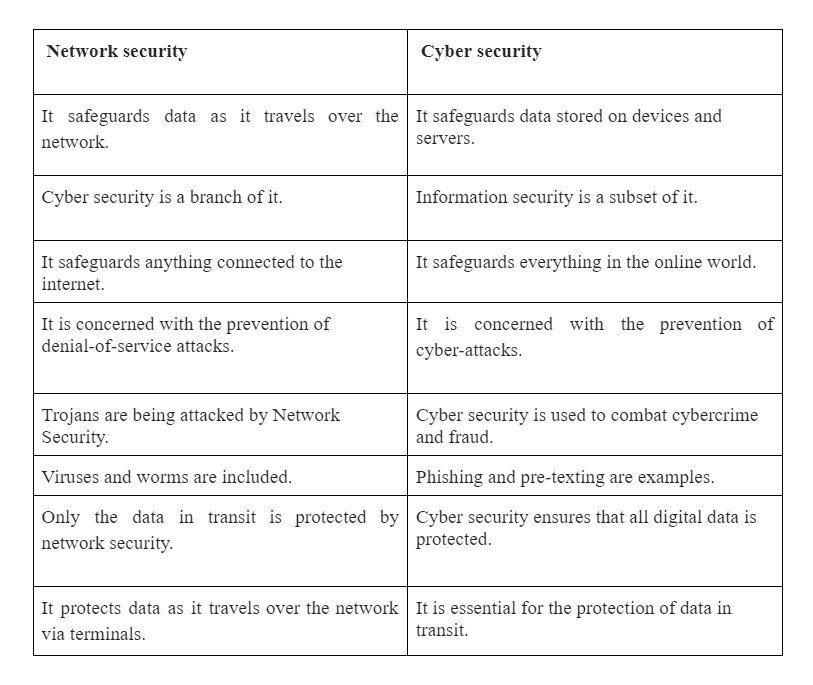
(Network Security vs Cyber security) Difference Between Both
1. Definition
Cyber security is a branch of information security that refers to a set of strategies and methodologies for preventing harm, attack, or illegal access to networks, devices, programs, and data. Cyber security, to put it simply, is the process of defending internet-connected devices and networks against digital threats. The process of safeguarding files and folders in a computer network from misuse, hacking, and illegal access to the system is known as network security. Network security is a subcategory of cyber security that guards against unwanted access to your system and network-accessible resources.
2. Security
While the phrases are interchangeable, they are vastly distinct in nature of security. If you see an organization as a walled castle, network issues are associated with keeping the peace within the castle walls and defending the organization’s sovereignty from network-related threats. Cyber security, on either hand, safeguards a company against external risks such as those posed by the internet. It defends an organization’s systems, networks, and applications against all types of digital attacks, such as phishing, baiting, and so on. The goal of network security is to secure an organization’s IT infrastructure from internet dangers such as viruses.
Network security becomes a component of cyber security, but cyber security is indeed a broad word like data security. While the authenticity of data and programs is the most important factor in both circumstances, cyber security emphasizes threat monitoring and detection to a higher extent. Network security is primarily concerned with protecting an organization’s IT network from the inside, while cyber security is concerned with protecting an organization’s information security technologies (ICT) against cybersecurity threats that exploit system weaknesses. Network security includes firewalls, user names and passwords, backup, and encryption.
If you have any doubts on Cyber Security, then get them clarified from Industry experts on our Cyber Security Tutorial !
Subscribe to our YouTube channel to get new updates..!
4. Security Expertise
Cyber security experts or analysts are those who, by their knowledge and experience of databases, firewalls, network security, and encryption, are fully responsible for defending network infrastructure and related systems. An expert in cyber security control, detection, and recovery is a cyber security professional. A security professional’s primary responsibility is to monitor all inbound and outbound traffic and to collaborate with other departments within the company to manage risk assessment tools and technology. A network security professional’s job includes securing the organization’s IT infrastructure, which contains data assets, financial data, and other confidential data
In brief, cyber security is an important part of information security dealing with data security during retention and transmission, while network security is indeed a subdivision of cyber security concerned with securing an organization’s IT infrastructure and limiting access to it. Both phrases are frequently used interchangeably, with the exception that cyber security is a much larger term, whereas network security is one component of information/cyber security.
To provide the best experiences, we use technologies like cookies to store and/or access device information. Consenting to these technologies will allow us to process data such as browsing behavior or unique IDs on this site. Not consenting or withdrawing consent, may adversely affect certain features and functions.
Functional
Always active
The technical storage or access is strictly necessary for the legitimate purpose of enabling the use of a specific service explicitly requested by the subscriber or user, or for the sole purpose of carrying out the transmission of a communication over an electronic communications network.
Preferences
The technical storage or access is necessary for the legitimate purpose of storing preferences that are not requested by the subscriber or user.
Statistics
The technical storage or access that is used exclusively for statistical purposes.The technical storage or access that is used exclusively for anonymous statistical purposes. Without a subpoena, voluntary compliance on the part of your Internet Service Provider, or additional records from a third party, information stored or retrieved for this purpose alone cannot usually be used to identify you.
Marketing
The technical storage or access is required to create user profiles to send advertising, or to track the user on a website or across several websites for similar marketing purposes.