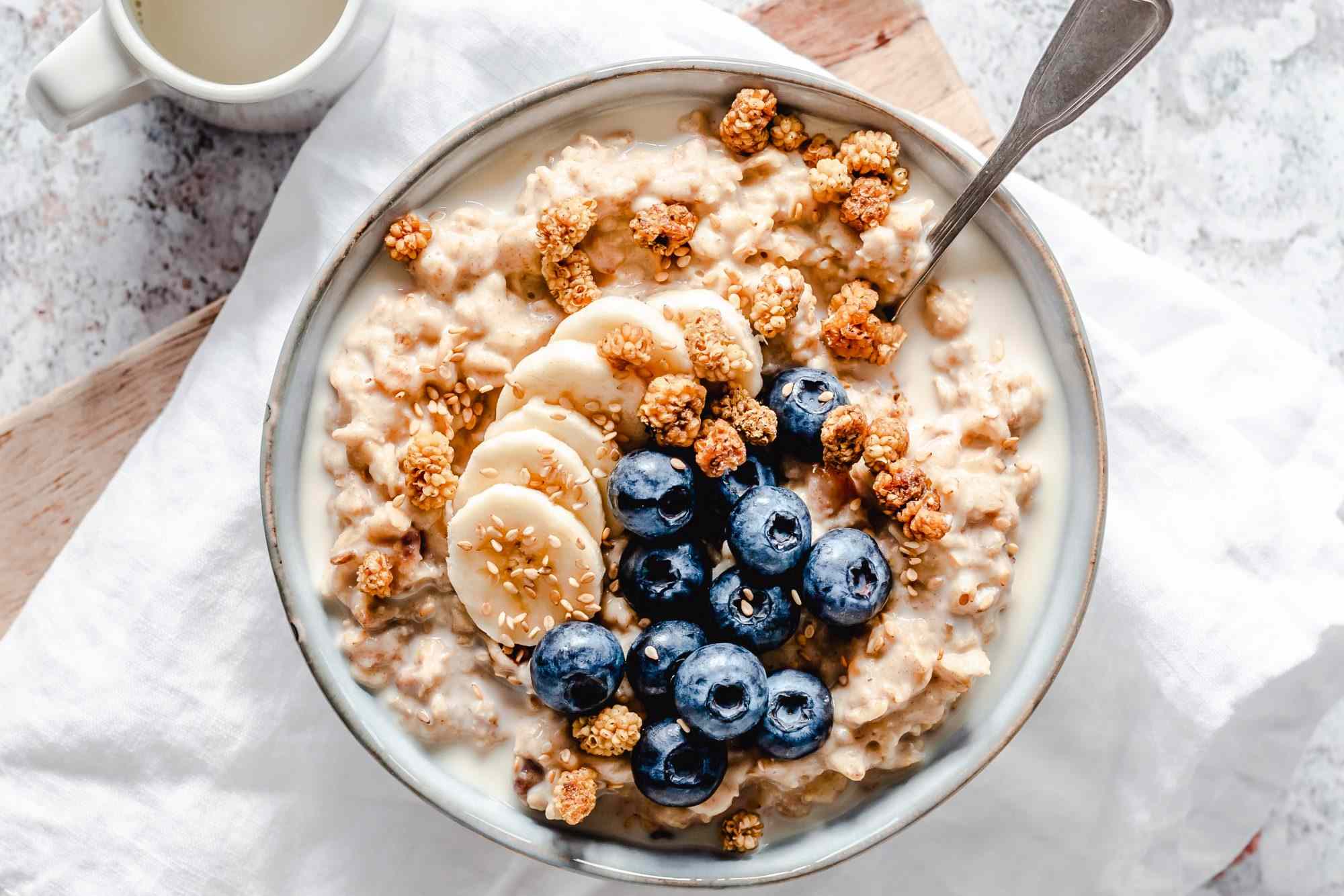
Oats provide fiber that can help support heart health, digestion, and steady blood sugar levels. Credit: OatmealStories/Getty
Oats help manage cholesterol and promote healthy constipation with their beta-glucan fiber.
Eating oats regularly supplies your body with magnesium, iron, zinc, and folate.
People with gluten sensitivities or IBS may avoid oats to prevent digestive discomfort.
Eating oats, scientifically known as Avena sativa, regularly supplies fiber that supports heart and digestive health. They may not be suitable for gluten-sensitive people.
1. Your Heart Health Improves
The gel-like compound beta-glucan in soluble (easily dissolves in water) fiber helps to decrease low-density lipoprotein (LDL) cholesterol. This is the combination of fat and protein that makes up cholesterol in your body.
Decreasing LDL cholesterol, also known as "bad" cholesterol, lowers your risk of heart disease and other cardiovascular conditions.
Beta-glucan in oats also decreases sugar in your digestive tract. In a 2018 study, participants saw a reduction in LDL cholesterol after consuming 3 grams of oat beta-glucans daily.
High magnesium, potassium, and iron levels in oats support heart function. For this reason, oats are often incorporated into heart-healthy diets.
Magnesium is a vitamin not present in high quantities in many other foods. It's essential for transporting magnesium and potassium ions. These ions support your nerves, muscles, and the rhythm of your heartbeat.
2. Your Digestion Gets Better
Oats are a great source of soluble and insoluble fiber. Fiber in oats is especially beneficial for older adults who may have more digestive conditions as they age.
Soluble fiber slows digestion and helps you absorb nutrients. Insoluble fiber enables you to make smooth bowel movements.
Consuming fiber prevents constipation and promotes a healthy gut. Fiber in oats also has prebiotic effects that support helpful gut bacteria, which enhances digestion.
The prebiotics in oats may prevent the development of cancers and cardiovascular conditions.
3. Weight Management Is Easier
Oats are full of fiber, which helps your body feel full sooner. The carbohydrates in oats help your body absorb energy steadily, which prevents you from craving as much sugar throughout the day. This is especially true for meals like oatmeal made from raw oats instead of instant oats.
Protein in oats helps increase your metabolism. By keeping you full and providing energy, the protein in oats can help your body build more lean muscle mass than visceral fat.
However, how full you feel from oats depends on your consumption. Instant oatmeal may not keep you full as long as a meal with rolled oats.
4. Your Blood Sugar Becomes Steadier
Consuming oats may regulate blood sugar. The soluble fiber in oats, particularly the polysaccharide beta-glucan, forms a viscous gel in the digestive tract. It slows glucose (sugar) absorption into the bloodstream.
This gradual release of glucose prevents sharp spikes in blood sugar and insulin levels. If you have type 2 diabetes, integrating oats into your diet can help you manage your blood sugar.
Researchers found that people with diabetes who added more oats to their diets saw a decrease in their hemoglobin A1c (HbA1C). HbA1C is a measure of blood sugar.
What Nutrients Do Oats Offer?
Oats are full of many vitamins and minerals that make it an essential part of a well-rounded diet.
Here is the nutritional breakdown of 1 cup of raw oats:
Calories: 303
Fat: 5 grams (g)
Sodium: 5 milligrams (mg)
Carbohydrates: 54 g
Fiber: 8 g
Added sugars: 0 g
Protein: 10 g
Calcium: 41.6 mg
Iron: 3.4 mg
Selenium: 23.1 microgram (mcg)
Oats are a source of magnesium, iron, zinc, and folate. Selenium is a mineral with antioxidant effects that help prevent cardiovascular conditions and cognitive decline. It may also play a small role in preventing male infertility.
Oats contain avenanthramides—compounds that prevent inflammation. They may help prevent infections, but more research is needed.
Are There Any Risks To Watch Out For?
Gluten in oats can cause side effects in people with celiac disease or a gluten allergy. The compound avenin in oats has similar properties to gluten. Side effects may include bloating, gas, and constipation.
You may have an oat allergy if you have skin rashes or trouble breathing after eating oats. Oats are also commonly produced near wheat products, which may pose a risk to people who are allergic to wheat.
Gluten-free oats are another option to avoid discomfort. Other alternative grains include quinoa, rice, amaranth, and millet. You may have digestive symptoms from food cross-contaminated with gluten if you have gluten sensitivity.
Tips for Adding Oats to Your Diet
Oats are a versatile ingredient that can boost nutrition in many meals. You can eat them for breakfast, as a snack, or as a beverage.
You may store oats in an airtight container to protect them from moisture and insects. For long-term storage, it's best to freeze or refrigerate them.
You can enjoy oats in a variety of ways, including:
Add oats to smoothies.
Use oats in the breading for poultry, fish, or tofu.
Make energy balls using oats, nuts, and dried fruit.
Prepare oat milk by blending soaked oats with cold water (add a few dates and vanilla for sweetness), then straining the oats.
Try different forms of oats, including steel-cut oats and quick oats.
Enjoy oat bran in cereals, breads, and smoothies.
Oats have also been used to treat skin conditions. Colloidal oatmeal is made from ground whole oats, which creates a powdery texture, to treat atopic dermatitis and psoriasis flares. They also treat any roughness in your skin's texture.
User Interface Developers, undoubtedly, belong at the top of the hierarchical chain of the IT industry owing to their complex role and high paying salary. A UI Developer must consider many factors to develop a web application or software. One primary requirement of the job is creativity. A User Interface Developer employs logical thinking and a few psychological concepts to stimulate audio and visual senses to create a software that is understandable, easy to use and pleasing to the eye. The job also includes technical knowledge and skill as the core to designing and developing a software that is not only flawless in design but also informative in the way that it provides the user with the solution he is looking for to deliver the best User Experience.
Below is a curated list of some of the User Interface Developer questions most frequently asked by the interviewers in a UI Developer Interview process, including Markup languages, HTML, Semantic elements, Scripting, Storage and many other questions covering concepts from a Beginner to an Advanced level.
Most Frequently Asked UI Developer Interview Question and Answers
What is the role of a UI Developer?
Ans : UI Developer is responsible for creating functional User Interfaces that are convenient, meet the user’s needs and are easy to access, understand and interact with to receive or give a response.
What is the difference between a UI Developer and a UX Developer?
Ans: UI Developer is mostly responsible with the appearance and design of the app, the aesthetics. Colours, patterns, designs and other elements that make an application appear attractive to the end user. On the other hand, a UX Developer is responsible for the technicalities that ensure the functioning and expected performance of an app to deliver enhanced user experience.
What is the difference between a UI Developer and Front-end Developer?
Ans : The UI Developers focus on making an application user-friendly and engaging while the Front-end Developers test and work on the client-side interface in detail to ensure its proper functioning.
What kind of skills do you think are crucial for a UI Developer?
Ans : UI Developers must possess two sets of skills:
Ans : Page load time can be reduced by trimming down JavaScript parsing, minimizing redirects, and compressing files.
What is HTML?
Ans : The HyperText Markup Language or HTML is a markup language that helps create a basic structure for a webpage to display the required content and other elements.
What is Semantic HTML?
Ans : Semantic HTML or Semantic Markup, are tags that classify the text and separate it from other Semantic elements to clarify the intent of the content in the webpage and the webpage itself.
Explain the difference between the and tags.
Ans : A tag is used to bold the selected words and are mostly for conventional writing formats whereas, the tag stresses on the importance of the words and emphasizes not only the word but also highlights the semantics.
Name at least three position property attributes.
Ans : Absolute, Fixed, Relative, Inherent and Static are position property attributes.
. Explain the differences between the quartet of position properties: Relative, Absolute, Static, and Fixed.
Ans : Static – an undeclared position for an element automatically files the element as static in the CSS. Static positioning is the default position.
Relative – relative elements’ position can be changed from the current position based on the space you mention.
Absolute – an absolute positioning allows the placement of any page element anywhere you want it by using the position attributes to set a location.
Fixed – a fixed page element is rooted to the same spot even when you scroll up or down.
. Explain Web Accessibility.
Ans : Web Accessibility is a feature that enables the differently-abled persons to comprehend, interact, and navigate the web.
. What is JavaScript Hoisting?
Ans : In JavaScript, Hoisting allows all declarations to be moved to the top of the scope before code execution, irrespective of where the functions and variables are declared.
. What is the difference between HTML and XHTML?
Ans : HyperText Markup Language or HTML is SGML based while Extensible HyperText Markup Language XHTML is XML based.All content in the HTML can be put in the body but it needs to be separated into blocks in XHTML. In short, XHTML is more intensive on structure, conditions and format than HTML.
. Explain the difference between Local Storage, Session Storage, and Cookies.
Ans :
Local Storage – Local Storage provides maximum storage and is cleared when a page or private tab is closed but the data does not expire.
Session Storage – In Session Storage, Pages are only stored for the amount of time the browser or tab is open. The data is cleared as soon as the tab or browser is closed.
Cookies – Cookies store activity information on a server for delivering a personalized experience.
. Discuss the differences between a document and a window.
Ans : A Window object is the first object of the DOM hierarchy. A Document object is within the Window object. HTML elements are accessed through the Document object.
. Does HTML require a compiler?
Ans : Compilers are programs that convert a programming language code intomachine code. Considering HTML is a Markup language and not a programming language, it does not require a compiler.
UI Certification Training
Master Your Craft
Lifetime LMS & Faculty Access
24/7 online expert support
Real-world & Project Based Learning
. How do floats work?
Ans : Floats help navigate elements to the sides and generally include one of the following four values:
Inherited – the parent’s float value is inherited by an element.
None – since no value is defined, the element stands at the default value and doesn’t float.
Left – The element floats completely to the left side of the container.
Right – The element floats completely to the right side of the container.
. Name three plugins available in the Bootstrap jQuery plugin library.
Ans : The plugins available in the Bootstrap jQuery plugin library include:
. What CSS class should be employed to span 14 columns on medium-sized screens, and eight columns on large screens?
Ans : The CSS class: class=”col-md-14 col-lg-8” should be used.
. How do you verify if a variable is set in PHP?
Ans : To verify if a variable is set the command !isset($var); can be used.
. When an error is encountered, how do you differentiate between require () and include ()?
Ans : The require () function stops executing the script when an error is encountered but in the include () function the application continues without a fatal error.
. What is a CSS reset? How do you differentiate it from normalize.css?
Ans : CSS Resets remove all the default styling on the elements in the browser while a Normalize CSS does not remove the default styling settings.
. What is an AJAX request, and how can an AJAX request be used?
Ans : Asynchronous Java Script And XML or AJAX requests that provide the user the required data. AJAX calls connect with the servers by using XMLHttpRequests to exchange the data.
. How do you use HTML5 new tags in IE version eight and earlier?
Ans : The new HTML5 tags are not supported by IE7 and IE8. Using HTML5 tags in IE7 or IE8 would cause errors and result in glitches. Instead, html5shiv.js can be used to run the tags in older browsers.
. What are the effects methods used in jQuery?
Ans :Some effects methods used in jQuery include:
show() – the selected elements are displayed by this feature.
hide() – it causes the selected items to be hidden.
toggle() – it is used to check the visibility of the elements and toggles between the show() and hide() for the selected elements.
. List the types of filters in AngularJS.
Ans :The filters used in AngularJS are
number – formats the numeric data
currency – formats numbers into the specified currency
date -formats the date into the prescribed format
uppercase – converts a string into uppercase
lowercase – converts a string into lowercase
filter – filters array in the criteria specified
orderby – arrays are ordered by expressions
Json – formats JavaScript objects into JSON strings
limit – limits an array to a number of elements
. How do you optimize a website’s assets?
Ans : A website’s assets can be optimized in the following ways:
File compression
File concatenation
Offloading assets
CDN hosting
Code refining and reorganizing.
. What does DOCTYPE mean?
Ans :The DOCTYPE determines the HTML type used on a webpage and a browser uses DOCTYPE to determine how the page is to be rendered or displayed.
. Explain the difference between standards mode and quirks mode.
Ans :Standards mode was invented to adapt to the modern HTML and CSS specifications whereas, in Quirks mode, the body element is the primary element. Quirks mode is for older browsers.
. What are the limitations to XHTML pages?
Ans :One major limitation faced by XHTML is the lack of browser support. Many browsers cannot parse XHTML as XML, making it a less used Markup language.
. How to make comments without the text being picked up by the browser?
Ans : Comments starting with “*” and ending with “->” are used to prevent a code from being recognized by the browser.
If you have any doubts on UI Developer, then get them clarified from UI Developer Industry experts on our UI Developer Tutorial !
Subscribe to our YouTube channel to get new updates..!
. What is the difference between linking to an image, website, and an email address?
Ans :
Tags are used to link an image.
The anchor tag is used for hyperlinking and the link must be specified in the href attribute.
The href specification “mailto:send@here.com” is used to link an email address.
. What would you do when a hyperlink or image is displayed incorrectly?
Ans :The following mistakes cause the image or link to be displayed incorrectly:
. What is the syntax difference between a numbered list and a bulleted list?
Ans :Bulleted lists are accompanied by the unordered list
tag. Ordered lists are accompanied by
. What is meant by a responsive website?
Ans :A website that functions at any screen resolution and on any system or device such as PC, mobile, laptop, etc., and adjusts to a readable size and is understandable by a user is a responsive website.
. How do you access a get requests URL parameter with Php?
Ans :To access a get request URL parameter, the Php is: $_GET[“turkey”]
. What are the new elements in HTML?
Ans :The new HTML elements are graphic tags, semantic tags, and multimedia. Semantic tags include figure, header, footer, and mark. Graphic tags include audio and canvas.
. Is JavaScript a case-sensitive language?
Ans :When writing in JavaScript, a developer is required to follow the consistent variables, function names, capitalization of letters, and other identifiers to avoid errors in functioning.
. Explain the layout of HTML in detail.
Ans : HTML layout specifies how the webpage is to be arranged. The HTML5 elements used to define the parts of a webpage are
: it defines the header of a document or a section.
: it defines or specifies a section in the document.
: it defines an independent article.
. Write a JavaScript code to find specific objects in an array of objects.
Ans :Use the JavaScript “find” method. The specific objects can be found by using the code given below:
let customers = [
{ id: 0, name: 'jane' },
{ id: 1, name: 'tim' },
{ id: 2, name: 'maria' }
];
let customer = customers.find(cust => cust.name === 'maria');
console.log(customer);
--> { id: 2, name: 'maria' }
. What are the ways to improve page performance?
Ans. You can follow the following ways to improve the performance of a web page.:-
Always clear cache
Minimize the size of the images
Make the code fit for mobile browsing
Compress HTTP
Reduce redirects
. How can a new variable be declared in PHP equal to the number 5?
Ans. To declare a new variable in PHP equal to the number 5 is $number = 5;
. Define the Semantic element’s importance?
Ans. The below reasons will let you know about the importance of Semantic elements.:-
These elements structure the code and make it more accessible and consistent for users.
If the semantic elements are used by developers, search engines, and other assisting technologies, then the content and the context should be understandable.
Also, the semantic elements enhance the code’s readability, making the developer’s work much easier and quicker.
. Distinguish between the elements Inline, Block, and Inline-block.
Ans.
Inline: The inline elements in HTML do not begin with the new line; instead, they occur in the same line. In this element, we can add some space to the left and right on it instead of adding space to the bottom & top padding to the page. Examples include span, strong, mark, etc.
Inline-block: The inline-block elements are similar to inline elements, but they allow the spaces on all sides.
Block: The element block will always begin with a new line. It fills both the left and right spaces of the web page by adding padding and margins. Examples of block elements include div, p, etc.
. Define CSS.
Ans. CSS means Cascading Style Sheets which describe the web pages’ styles which consist of fonts, colors, layouts, etc. We can also define variations and layouts for different types of screens. Moreover, CSS is also useful for XML-based markup languages apart from HTML.
. Distinguish between HTML Tags and HTML Elements.
Ans. HTML tags define the format of content and its display on the web browser. These tags include the components like content, open, and ending tags. On the other hand, HTML elements inform the web browser how to display the text. Further, these elements will become tags when we use brackets <>.
. What are the key benefits of CSS?
Ans. The following are a few of the many benefits of CSS.
It offers users good control over the web page layout.
The style files under CSS are made independently of the HTML, so the file size will be smaller.
Due to less coding, the files will load much faster. Thus, it increases the website speed.
It offers to format changes easily.
CSS compatible works across devices.
It allows a single CSS to replicate through different web pages, reducing development time.
UI Certification Training
Weekday / Weekend Batches
. What is meant by event bubbling and event capturing?
Ans. Event bubbling is a procedure of event propagation inside the HTML DOM API. As the event is launched, the element bubbles up the DOM tree. Here we call the child node first, then the parent node. On the other hand, event capturing is different from event bubbling. It is the opposite of event bubbling, where the parent node is called first, then the child node.
. Define the use of and tags.
Ans. The tag is an element used to give an Italic look at the text, whereas the tag is an emphasis element that defines the emphasized text.
. What is meant by the CSS Box Model?
Ans. The CSS Box Model is a type of box that wraps the HTML element. It consists of the assets like actual content, borders, margin, padding, etc. It is all about the design and layout that helps develop a web page’s structure and design.
About Author
Kavya works for HKR Trainings institute as a technical writer with diverse experience in many kinds of technology-related content development. She holds a graduate education in the Computer science and Engineering stream. She has cultivated strong technical skills from reading tech blogs and also doing a lot of research related to content. She manages to write great content in many fields like Programming & Frameworks, Enterprise Integration, Web Development, SAP, and Business Process Management (BPM). Connect her on LinkedIn and Twitter.
To provide the best experiences, we use technologies like cookies to store and/or access device information. Consenting to these technologies will allow us to process data such as browsing behavior or unique IDs on this site. Not consenting or withdrawing consent, may adversely affect certain features and functions.
Functional
Always active
The technical storage or access is strictly necessary for the legitimate purpose of enabling the use of a specific service explicitly requested by the subscriber or user, or for the sole purpose of carrying out the transmission of a communication over an electronic communications network.
Preferences
The technical storage or access is necessary for the legitimate purpose of storing preferences that are not requested by the subscriber or user.
Statistics
The technical storage or access that is used exclusively for statistical purposes.The technical storage or access that is used exclusively for anonymous statistical purposes. Without a subpoena, voluntary compliance on the part of your Internet Service Provider, or additional records from a third party, information stored or retrieved for this purpose alone cannot usually be used to identify you.
Marketing
The technical storage or access is required to create user profiles to send advertising, or to track the user on a website or across several websites for similar marketing purposes.

:max_bytes(150000):strip_icc():format(jpeg)/oatmeal-hack-promo-2000-024994dd17e04d179589ca1993b66840.jpg "Creamy oatmeal bowl with banana, blueberries, mulberries and sesame seeds")