The current exercise recommendation for heart health is 2.5 hours a week. Credit: Maskot / Getty Images
A new study suggests exercising far beyond the standard 150-minute weekly recommendation may provide even greater heart health benefits.
Higher amounts of weekly moderate-to-vigorous activity—about 10 hours a week—were linked to substantially lower cardiovascular risk.
Experts say the current guidelines are still a strong goal, and building sustainable exercise habits matters more than chasing an exact number.
For years, the standard exercise recommendation for heart health has been 150 minutes of moderate physical activity per week. But a new study published in the British Journal of Sports Medicine found that getting more moderate-to-vigorous exercise—about 10 hours a week—could result in far better heart benefits, including a 30% lower risk of heart attack and stroke. Is that much exercise really necessary (and viable) for the average adult?
Finding the Optimal Amount of Weekly Exercise for Heart Health
The researchers wanted to find the optimal amount of weekly exercise to reduce the risk of cardiovascular disease, beyond the 150-minute baseline, said Ziheng Ning, PhD, a professor at Macao Polytechnic University and co-author of the new study.
Unlike past research, which only examined physical activity, the new study also accounted for participants’ existing fitness levels using VO2 max, a common measure of aerobic fitness based on how efficiently your body uses oxygen during intense exercise. "Two people may perform the same amount of activity yet have very different cardiovascular risk profiles depending on their fitness level," Ning told Health.
In the new study, about 17,000 participants from the UK Biobank Cohort Study wore devices to track their exercise habits for one week and performed cycling tests to estimate their VO2 max. Researchers used statistical models and hospital records to measure cardiovascular outcomes over eight years, and controlled for factors including age, sex, smoking, alcohol intake, and diet.
Results showed that people who exercised 150 minutes per week had an 8-9% reduced risk of conditions like heart attack, stroke, and atrial fibrillation. Those who exercised more had even greater benefits: a 20% reduced risk for those who exercised 340-370 minutes a week, and a 30% lower risk for those who exercised 560-610 minutes per week—which is three to four times higher than the current recommendation. People with the lowest VO2 max needed to exercise an additional 30-50 minutes to reap the same benefits as those with high fitness levels.
The findings suggest that the current guidelines are the minimum for meaningful heart benefits, "not necessarily the optimal dose," said Sirisha Vadali, MD, a board-certified cardiologist based in Arizona, who is not affiliated with the research.
The study had limitations. Ning noted that the devices used to track exercise aren't always accurate. Participants self-reported their health, smoking status, and alcohol intake, which can present bias. The study also focused primarily on white, able-bodied participants, so results may not translate to other groups.
Additionally, participants who were active were healthier at baseline, S. Imran Zaidi, MD, a cardiologist with Orlando Heart Health and Vascular Institute, told Health. Which raises an important question: "Are people more active because they are healthier, or are they healthier because they are more active?" he said.
Still, Valadi said this is a very important and reassuring study. "It doesn't fundamentally change what we recommend, but it strengthens the message that more movement is generally better," she told Health.
Should You Start Doing 10 Hours of Exercise a Week?
While 10 hours of weekly exercise is a great goal, experts said it's not realistic for everyone. Most people already fail to meet the current minimum recommendation of 150 minutes, often because they work at a desk, have a long commute, and manage a busy schedule. Expanding movement recommendations could also increase the risk of injury, especially for people new to working out.
Instead, the goal is to create sustainable exercise habits, Ning said. Depending on your fitness level, this could mean starting with 150 minutes of moderate exercise per week, such as walking or cycling, or 75 minutes of vigorous exercise per week, like running or HIIT workouts, Zaidi advised.
As your body adjusts to a routine, you can increase weekly exercise time for additional heart health protection. Overall, experts recommend aiming for consistency over intensity, as well as gradual progress and variety.
Selenium is an open-source, most popular web automation testing tool that supports multiple browsers & OS. XPath in Selenium is an XML Path and a syntax useful for locating an element on a web page. Locating any element on the web page uses XML path or XPath expression. Further, XPath in Selenium is useful for navigating through the HTML structure of the web page.
Moreover, XPath uses HTML DOM structure to find any element on a web page for both HTML and XML documents.
The syntax for XPath In Selenium
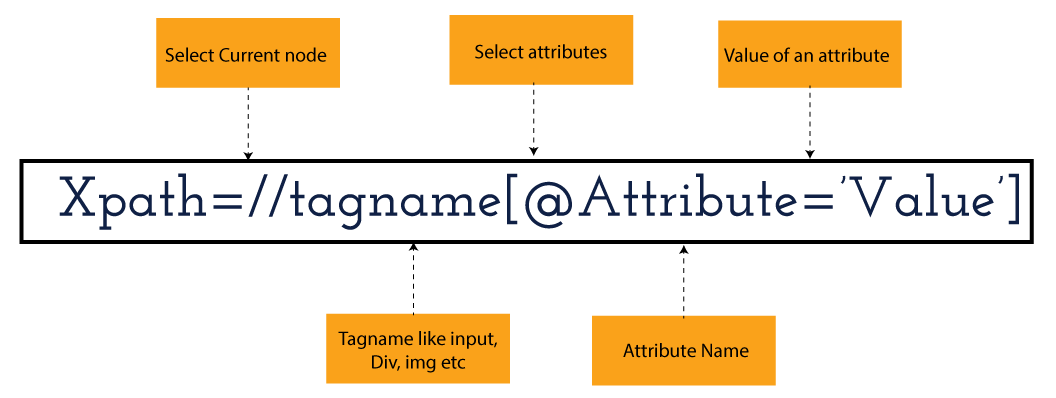
XPath in Selenium holds the element’s location on the web page. The basic syntax for XML Path Selenium is as follows-
Xpath=//tagname[@attribute="value"]
The meaning of each expression in the syntax is-
// : Choose the existing node.
Tagname: Particular node’s tagname.
@: This symbol denotes the “Select” attribute.
Attribute: Node’s attribute name.
Value: Attribute’s Value.
Become a master of Selenium by going through this HKRSelenium Training!
XML Document
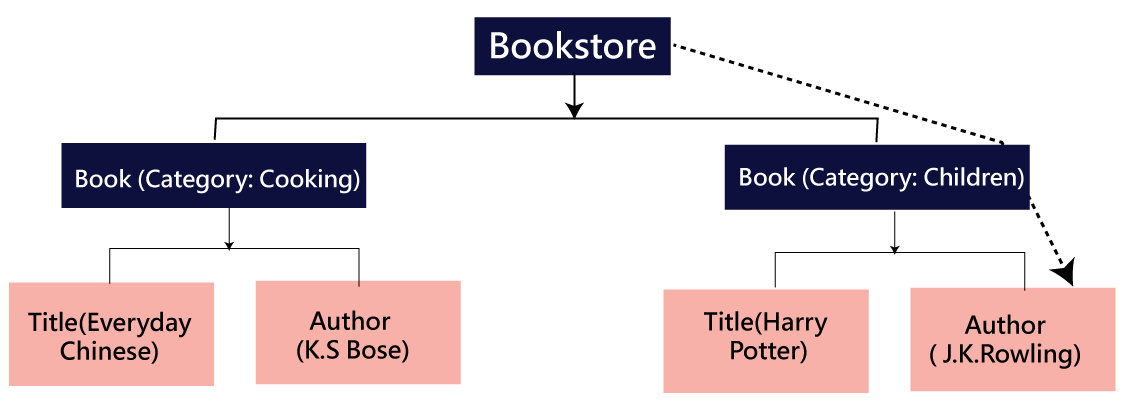
The XML documents are the text files that contain XML data, including elements and other markups, in a sequential package. Further, it can include a wide variety of data such as numbers databases, numbers of a mathematical equation, etc. You can understand XML document with an example:-
Kumar
AK & Co.
032456123
Here, the above code is divided into two parts- Document Prolog & Document Elements. Let us discuss them in brief.
Document Prolog
The document prolog appears at the top of the document, beforE the root document element. It includes XML and Document type declaration.
Document Elements
These major building blocks of XML segregate the document into different sections. Each of these document sections perform a particular purpose. Moreover, you can easily segregate a document into different sections so that search engines can use it. Further, these document elements can be the containers having text and other elements combined.
Types of XPath
Absolute XPath:
Relative XPath:
Absolute XPath
In Selenium, the absolute XPath is the direct path to find the element. This Xpath begins with the “/” (Slash) symbol and helps select the element from the root. The major drawback of this XPath is that if you change the path of the element or attribute, the absolute XPath will fail.
Relative XPath:
The Relative XPath in Selenium begins with the double forward slash “//” symbol and from the middle of the HTML DOM. You can search elements anywhere on the web page as it doesn’t need to write a lengthy Xpath. This XPath is mainly considered as it is not a complete path from the root element.
For example: //input[@id=‘ap_email’]
Suppose You launch Google Chrome and navigate to google.com. Then locate the search bar utilising XPath. By analysing the web element there is an input tag and attributes like class and id. Utilise the tag name and given attributes to create XPath that will locate the search bar.
If you want to Explore more about Selenium? then read our updated article –Selenium Tutorial
Click the Elements tab and press Ctrl + F to open a search box in chromes developers tool. Write XPath string selector and it will try to search based on that criteria. In the image given above, it has an input tag. //input implies tagname. Use the name attribute and pass ‘q’ as its value. It provides XPath expression as shown below:
//input[@name=’q’]
It has focused on the element that implies this specific element was located utilising XPath.
If you want to Explore more about Selenium? then read our updated article –Selenium Tutorial!
Check out our Latest Tutorial video. Register Now Selenium Online Course to Become an expert in Selenium.
Acquire Selenium with jenkins certification by enrolling in the HKR Selenium with jenkins Training program in Hyderabad!
Selenium Certification Training
Master Your Craft
Lifetime LMS & Faculty Access
24/7 online expert support
Real-world & Project Based Learning
XPath Functions
Automation utilizing Selenium is unquestionably an incredible innovation which gives numerous approaches to distinguish an article or component on the website page. Be that as it may, in some cases we do deal with issues in recognizing the articles on a page that have similar credits. Some cases can be: components having similar credits and names or with more than one button with similar name and ids. It’s trying to train selenium to distinguish a specific item on a website page and it is the place where XPath functions to serve as the hero.
Selenium involves different functions. The three of the most broadly utilized functions are given below:
1) Basic XPath
The basic XPath expression selects nodes or a list of many nodes based on various elements or attributes such as ID, Name, ClassName, etc. It selects them from the XML documents. The syntax we can use for the basic XPath is –
Xpath=//input[@name="uid"
2.Contains()
It is a method used in XPath expression when the value of an attribute or element dynamically changes. You can easily find the elements with a partial text using the “Contains” feature in the XPath expression. Now understand this with the below example.:-
Xpath=//*[contains(@type,'sub')]
The above example denotes that the full value of the element type is submitted, but we use the partial text ‘sub’ here to find the element. Thus, in the above example, we tried to find the element by giving a partial text of the attribute “submit”.
3) Using OR & AND
Here, we use two conditions, first or second condition, among which one condition must be “True” to execute it. This method is still applicable if any one or both conditions are “true”. It means that any conditions should be true to find the element. The expression we can use for this is-
Xpath=//*[@type="submit" or @name="btnReset"]
The above XPath expression will help determine whether a single or both conditions are ‘True’.
Similarly, in the “And” XPath expression, also we use two conditions, but both conditions should be “true” to locate the element. If any one of the conditions becomes “false”, then the expression cannot find the element. The syntax we can use for this function is-
Xpath=//input[@type="submit" and @name="btnLogin"]
4) Xpath Starts-with
The function Xpath-Starts-with() in the Xpath functions is useful to find the element whose attribute value changes in some conditions. Here the value changes with the refresh of the page or by performing dynamic actions on the webpage. In this method, the initial text of the attribute should be in parallel to locate the element whose attribute value changes interactively.
Further, you can also find the elements whose attribute value doesn’t change or remain static. You can understand this function’s use by the following example:-
Xpath=//label[starts-with(@id,'message')]
The above syntax shows that two different elements start with the initial id “message”. Here, you can use the Xpath-starts with function to check whose attribute value changes or remains static.
Subscribe to our YouTube channel to get new updates..!
5) XPath Text() Function
In Selenium WebDriver, the function XPath Text() is a built-in function useful to locate elements based on the web element’s text. Using this function, you can find the same text element. Moreover, the elements that you locate must be in a string format.
Xpath=//td[text()='UserID']
Using the above expression having text function, you can locate the element that will show the exact match of the text.
6) XPath axes methods
This method in XPath functions is useful for finding complex or changing elements. However, we can see the following XPath axes methods which we can use:-
a) Following- It is useful to select all the elements in the document of the existing node(). The expression you can use for this method is-
Xpath=//*[@type="text"]//following::input
b) Ancestor- The ancestor axes method is useful to select all the ancestor elements of the existing node, like parents, grandparents, etc. Here, the expression you can use is-
c) Child- This axes method selects all the child elements in the documents’ current node. The expression you can use here is-
Xpath=//*[@id='java_technologies']//child::li
d) Preceding- This method helps select the nodes that come before the existing ones. Here is the example expression:-
Xpath=//*[@type="submit"]//preceding::input
The above expression helps to identify all the input elements before the currently given nodes.
e) Following-sibling- This method helps to select the following siblings of the existing node. All the siblings will be equivalent to the existing node, and the method will find the sibling next to the existing node. Moreover, the syntax you can use here for this method is-
f) Parent- It helps to select the parent from the existing node of the element. The following is the syntax you can use here.
Xpath=//*[@id='rt-feature']//parent::div
Many div(s) match with the parent, but if you want to focus on a specific element. For this you can use the below xpath syntax-
Xpath=//*[@id='rt-feature']//parent::div[1]
g) Self- In this method, it selects the existing node where it selects itself only. That means the node here is the “self”. The expression you can use for self is-
Xpath =//*[@type="password"]//self::input
h) Descendant- It helps to select the descendants of the existing element where it recognizes all the element descendants of the existing element.
Xpath=//*[@id='rt-feature']//descendant::a
Selenium Certification Training
Weekday / Weekend Batches
Conclusion
XPath or an XML Path is used to locate any element or navigate through the HTML structure of a webpage. It is generally used for automation purposes and in cases where it is difficult to find elements using locators like name, class, ID, etc. However, it is the most important among the locators useful in Selenium to identify web elements. Also, it is a handy locator for the testers of web pages.
Thus, learning about XPath in Selenium will help you quickly identify a web element on a web page.
To provide the best experiences, we use technologies like cookies to store and/or access device information. Consenting to these technologies will allow us to process data such as browsing behavior or unique IDs on this site. Not consenting or withdrawing consent, may adversely affect certain features and functions.
Functional
Always active
The technical storage or access is strictly necessary for the legitimate purpose of enabling the use of a specific service explicitly requested by the subscriber or user, or for the sole purpose of carrying out the transmission of a communication over an electronic communications network.
Preferences
The technical storage or access is necessary for the legitimate purpose of storing preferences that are not requested by the subscriber or user.
Statistics
The technical storage or access that is used exclusively for statistical purposes.The technical storage or access that is used exclusively for anonymous statistical purposes. Without a subpoena, voluntary compliance on the part of your Internet Service Provider, or additional records from a third party, information stored or retrieved for this purpose alone cannot usually be used to identify you.
Marketing
The technical storage or access is required to create user profiles to send advertising, or to track the user on a website or across several websites for similar marketing purposes.


:max_bytes(150000):strip_icc():format(jpeg)/Health-GettyImages-598307847-cdbe368277e24b44a29e4ff470eab7ce.png "woman tired from running taking a break")