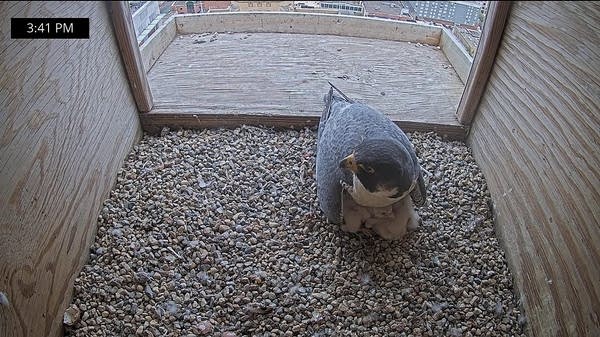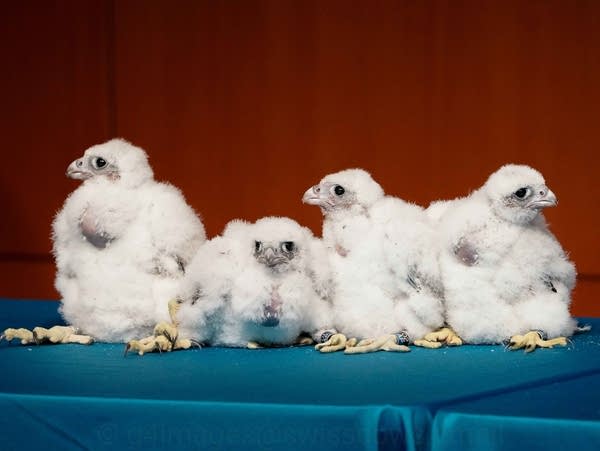
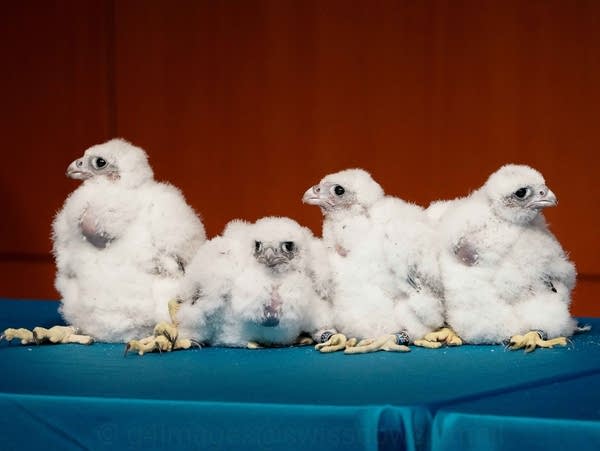
A hospital building in Rochester known for life-saving medical treatment is also home to some fierce airborne predators: Peregrine falcons who live in a rooftop nest, where four fluffy feathered chicks hatched just a few weeks ago.
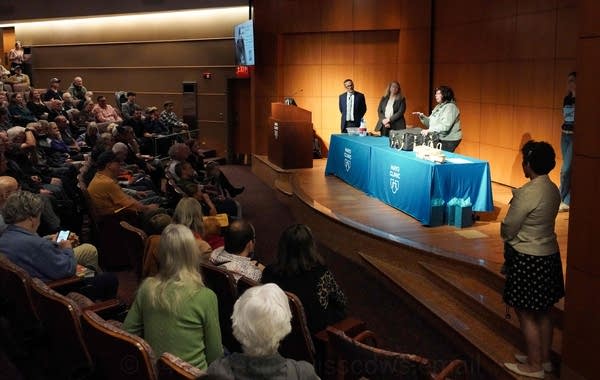
To welcome the falcon hatchlings, hundreds of patients, staff and friends of the Mayo Clinic community gathered recently in Mayo’s Geffen Auditorium, where member of the peregrine falcon recovery team brought the four fledgling birds from their nesting box atop the Mayo building in downtown Rochester.
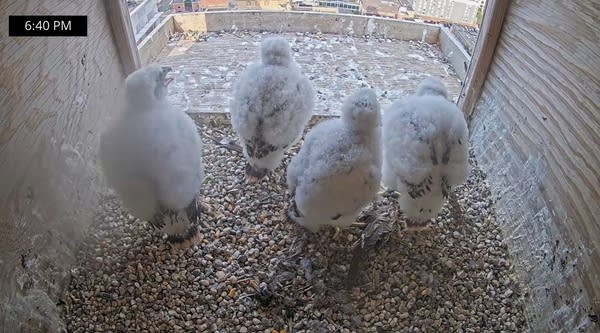
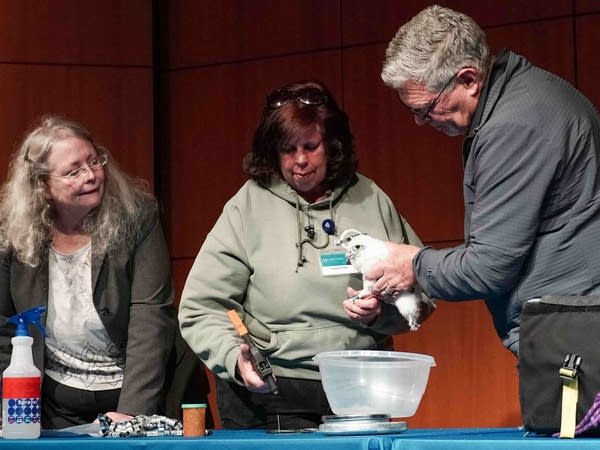
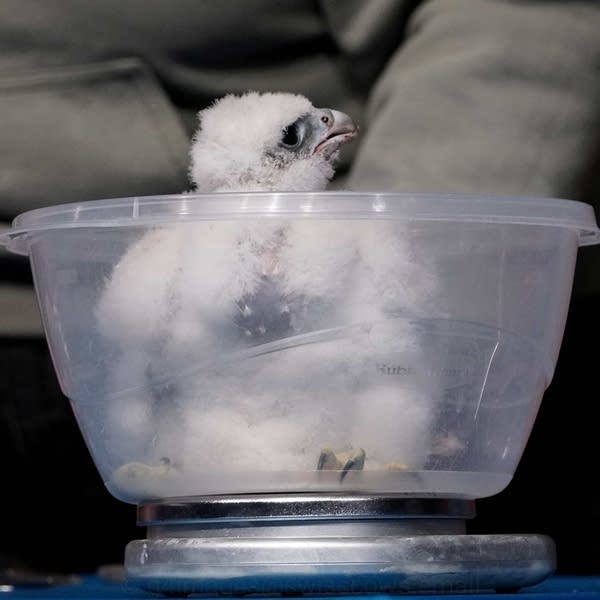
Members of the audience selected names for the three-week-old fluffy white chicks. The chicks were then inspected by biologists to make sure they’re in good health.
Biologists also attached small metal identification bands to their feet so Mayo’s falcon team can track them once they leave the nest.
At the end of the ceremony, the siblings — propped up side by side facing the crowd — received a round of applause with the announcement:
“This is your class of 2026: Belle, Vega, Zephyr and Mylo.”
For almost four decades, the Mayo Clinic has raised peregrine falcons. The world-renowned hospital was first approached by the Peregrine Falcon Recovery Program in the 1980s as a potential release site for young captively-raised birds. Mayo Clinic agreed and, within a few years, the birds had started to return to nest on the roof of the hospital.
The species had been nearly decimated due to widespread use of the pesticide DDT. The toxic chemicals built up in the bird’s bodies, impairing the ability of female falcons to lay healthy eggs. The eggs lacked calcium, making the egg shells too thin and weak for embryos to develop properly.
So few falcon eggs were able to survive until hatching that by the mid 1960s, “peregrines were completely gone east of the Rockies,” said Jackie Fallon, a naturalist and biologist with Mayo Clinic’s falcon program.
Recovery efforts began earnestly in the early 1970s, when an ornithology professor at Cornell University founded the Peregrine Fund, which began successfully breeding the falcons in captivity before releasing the birds of prey into the wild.
“We started releasing them in the early 70s out on the East Coast, and then here in the Midwest in the early 80s,” said Fallon. ”And by 1999, they were fully recovered at a population six to 10 times higher than it was before they even became endangered.”
Although the birds are no longer endangered, the peregrine falcon program at Mayo Clinic is widely beloved by staff, patients and the wider falcon-loving community. There is a 24-hour live web cam set up to watch parental falcons Hattie and Orton raise their young, and televisions all around Mayo Clinic’s campus broadcast the live stream for patients and staff.
Fallon said the video cam has drawn fans from across the world, including many in the United Kingdom and the Middle East. One video clip she posted of the falcons yelling at each other has nearly one million views.
Every time she’s on campus, Fallon said she hears from patients about how meaningful the program is. Some even schedule their appointments to align with the falcon's nesting period.
“A big part of it is, usually, if [a patient is] on campus, it can be a very challenging time,” Fallon said, “but watching the camera takes their mind off a test result, especially if they're long-term patients — waiting for a transplant or [have a] long recovery time. They will sit and watch that camera 24/7. We have patients I've met that come every year and take a redo photo with the live falcon I bring on campus.”
Hattie and Orton are the current resident falcons at the Mayo Clinic, having defended their territory in Rochester from competing falcons since 2016. The Mayo community watched Hattie lay four eggs this year via the live stream and watched the chicks hatch about five weeks later.
At this point, the fledglings are still too young to leave the nest, but in about three weeks, they’ll take their first flight. When old enough and strong enough, the four young falcons will leave the hospital’s rooftop and probably won’t return to Rochester, as falcons are known to migrate thousands of miles.