Best airlines report 2026: Delta tops TPG’s rankings for 8th straight year


Ready or not, summer is here. And the year’s busiest rush at airports comes on the heels of an especially topsy-turvy stretch for air travel.

In the last few months alone, we’ve seen mass security backups, skyrocketing airfare and the biggest collapse of a U.S. airline in decades.

For passengers preparing to book a flight, it has made some questions more important than ever: Which airline is most likely to get you to your destination? Which airline is the most affordable? And which airline is, quite simply, the best?

Once again in 2026, the TPG team set out to answer those questions (and many others) as we crunched the numbers on thousands of datapoints to crown the champion of our annual Best Airlines Report.

And it’s a familiar name in the top spot.

Best Airlines 2026 Overall Winner: Delta Airlines

Delta Air Lines continued its remarkable run atop our airline rankings thanks to its usual sterling on-time record in 2025, along with a standout end-to-end travel experience — from airport lounge to airplane cabin.

What we changed

This year, as passengers have faced surging ticket prices, higher add-on fees and worries about whether geopolitical strife could lead to their flights being canceled, we gave more credit than ever to the price travelers pay, and to the schedule and routes airlines offer.

Here’s how the rankings shook out:
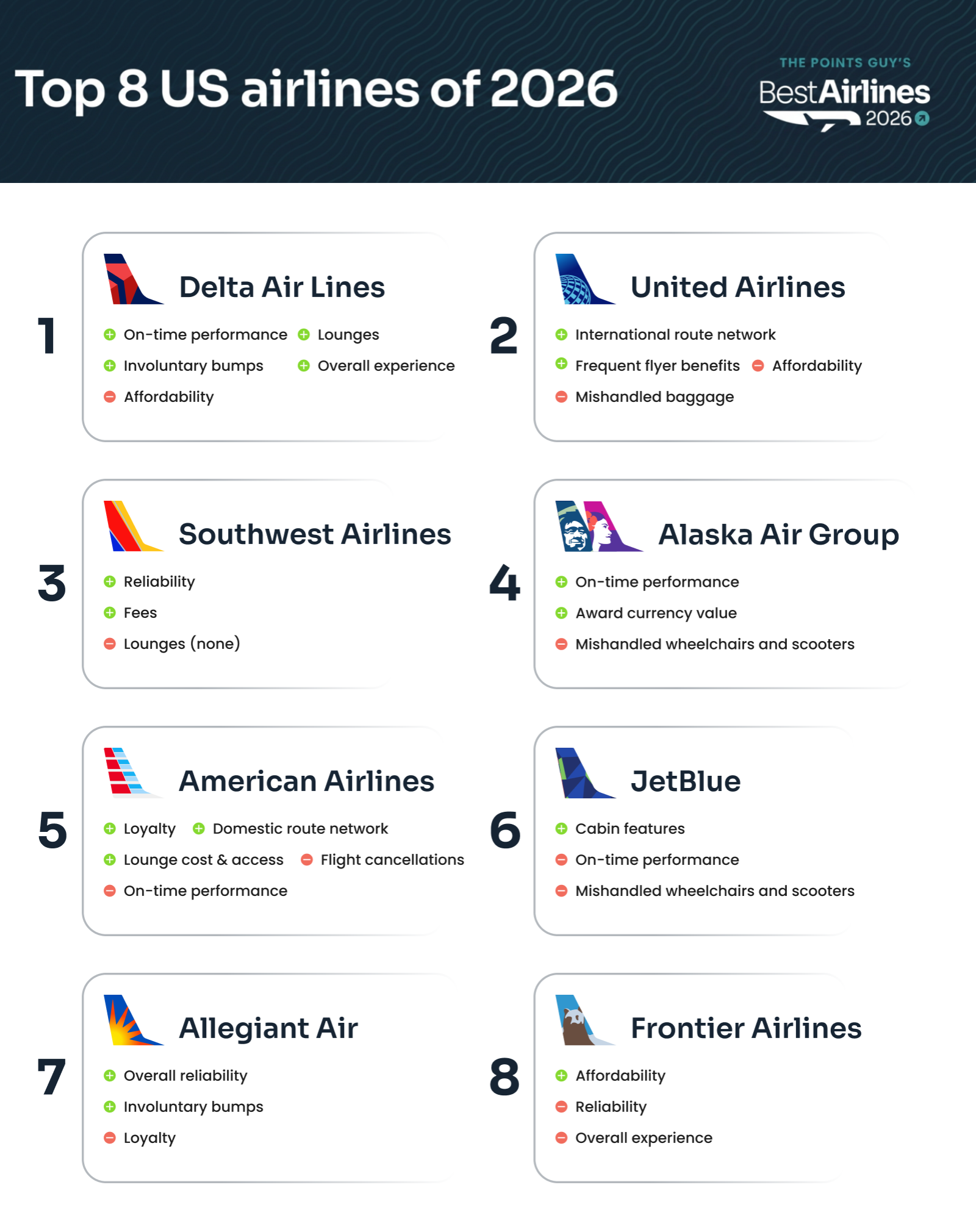
Best Airlines 2026 Overall Rankings: 1. Delta 2. United 3. Southwest 4. Alaska and Hawaiian Airlines 5. American Airlines 6. JetBlue 7. Allegiant 8. Frontier

5 big things to know: TPG’s Best Airlines of 2026

  • Delta wins again: The airline has now topped our airline rankings for the better part of the decade. It’s a testament to the consistent travel experience Delta has maintained, from the hallmark reliability it’s had through the years — to its policies, lounge network and on-board amenities.

Reward your inbox with the TPG Daily newsletter

Join over 700,000 readers for breaking news, in-depth guides and exclusive deals from TPG’s experts

  • A tight leaderboard: It was a photo finish for the next three spots in our rankings. United Airlines, Southwest Airlines and Alaska Air Group (comprised of Alaska Airlines and Hawaiian Airlines) each had a legitimate chance of winning. In fact, our metrics show United could have won if it weren’t for one score that dragged down its report card.
  • Hot and cold: American Airlines might’ve been our biggest “up and down” carrier in this year’s report, turning in the industry’s worst cancellation rate but winning our loyalty category thanks in large part to the strong value of its AAdvantage miles.
  • No more Spirit: In past years, we’ve ranked 10 U.S. carriers. This year, there are only eight listed. We were knee-deep in compiling data for this report when Spirit Airlines collapsed. It left a clear void for travelers: Our analysis shows Spirit was the second-most affordable airline in America last year.
  • Alaska + Hawaiian = Alaska Air Group: While Alaska Airlines and Hawaiian Airlines continue to fly as separate brands after merging in 2024, we evaluated them as one combined airline; this includes using data from their shared Atmos Rewards loyalty program, which is a favorite of points-savvy flyers.
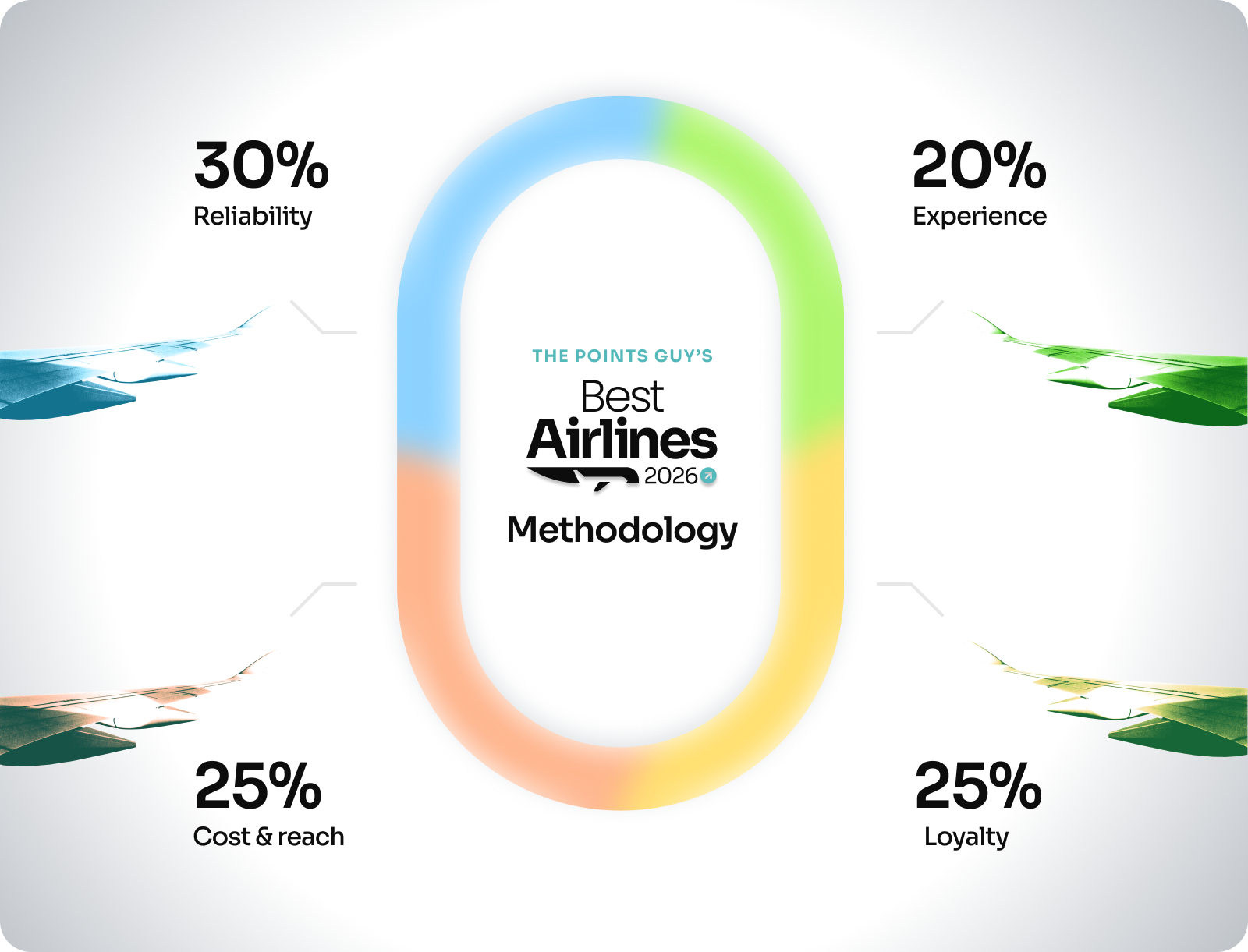
Best Airlines 2026: Methodology Overview Reliability: 30% Experience: 20% Cost and Reach: 25% Loyalty: 25%

Read more: How TPG determines the best airline

Reliability

We weigh reliability more heavily than any other category in our annual airline rankings. This section measures how well each of the largest U.S. airlines accomplishes the basics: getting you (and your belongings) to your destination, and getting you there on time.
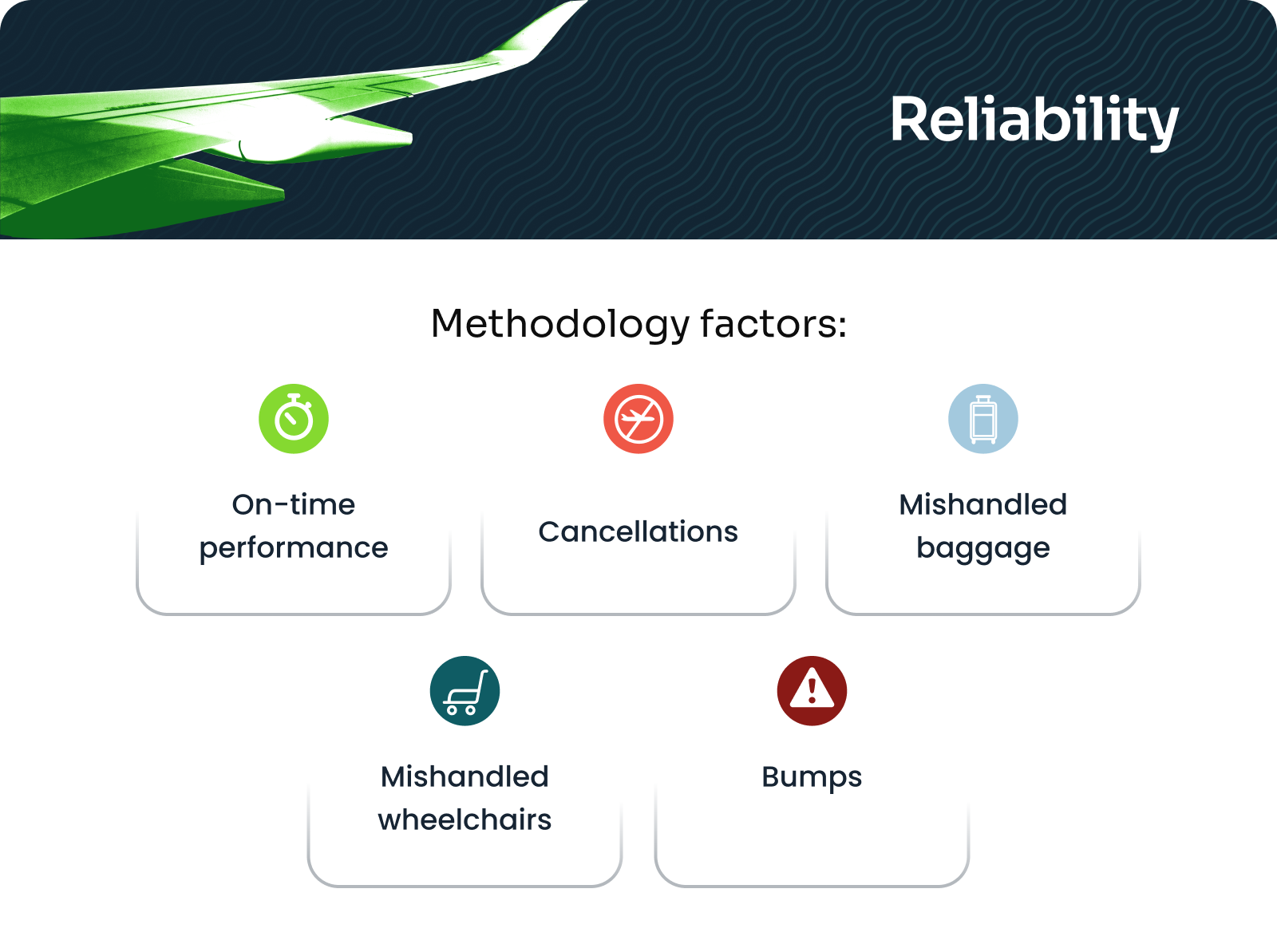
Best Airlines Reliability Methodology Factors: - On-time performance - Cancellations - Mishandled baggage - Mishandled wheelchairs - Involuntary bumps

Congress sure didn’t make things easy for airlines in 2025. Remember that weekslong government shutdown last fall? Airlines were required to cancel flights at many of the nation’s busiest airports.

It showed.

Across the airline industry, flight cancellations in 2025 were up about 15% from 2024, according to U.S. Department of Transportation data.
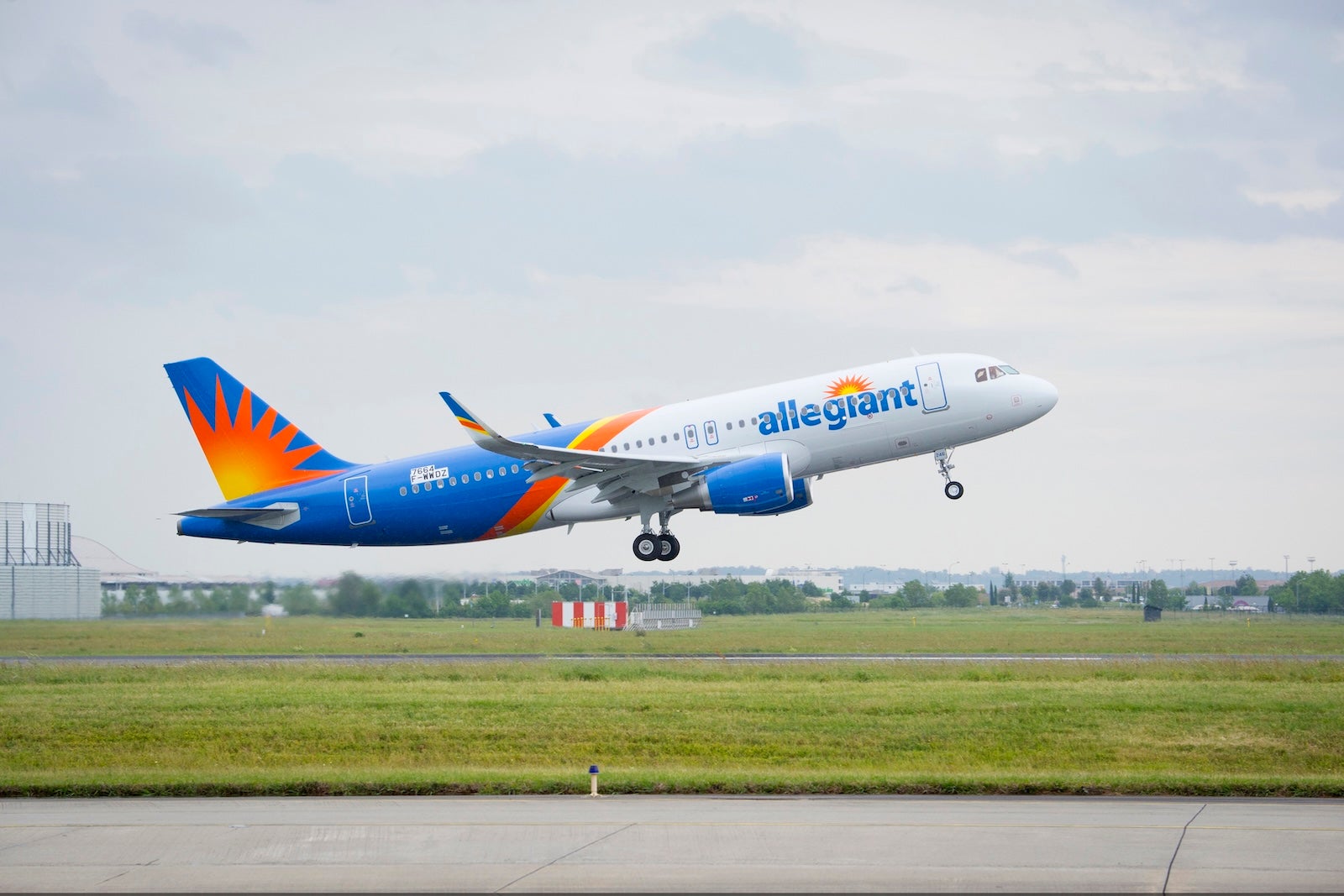
Airplane during takeoff
ALLEGIANT AIR

In the end, three carriers clearly stood ahead of the proverbial “pack” when it came to reliability:

  • Delta, which had standout numbers again in 2025 (despite some slippage more recently).
  • Southwest, whose third-place finish in our rankings was due in large part to its strong operational performance.
  • And Allegiant, the largely unsung budget carrier that won this all-important category.

Known for connecting underserved U.S. cities to popular leisure spots, Allegiant certainly doesn’t have the bells, whistles, big-city service or loyalty program to match its much larger competitors. And, its network is far simpler — nonstop service, no connecting passengers (or bags) to manage.

Still, the airline’s reliability speaks for itself.
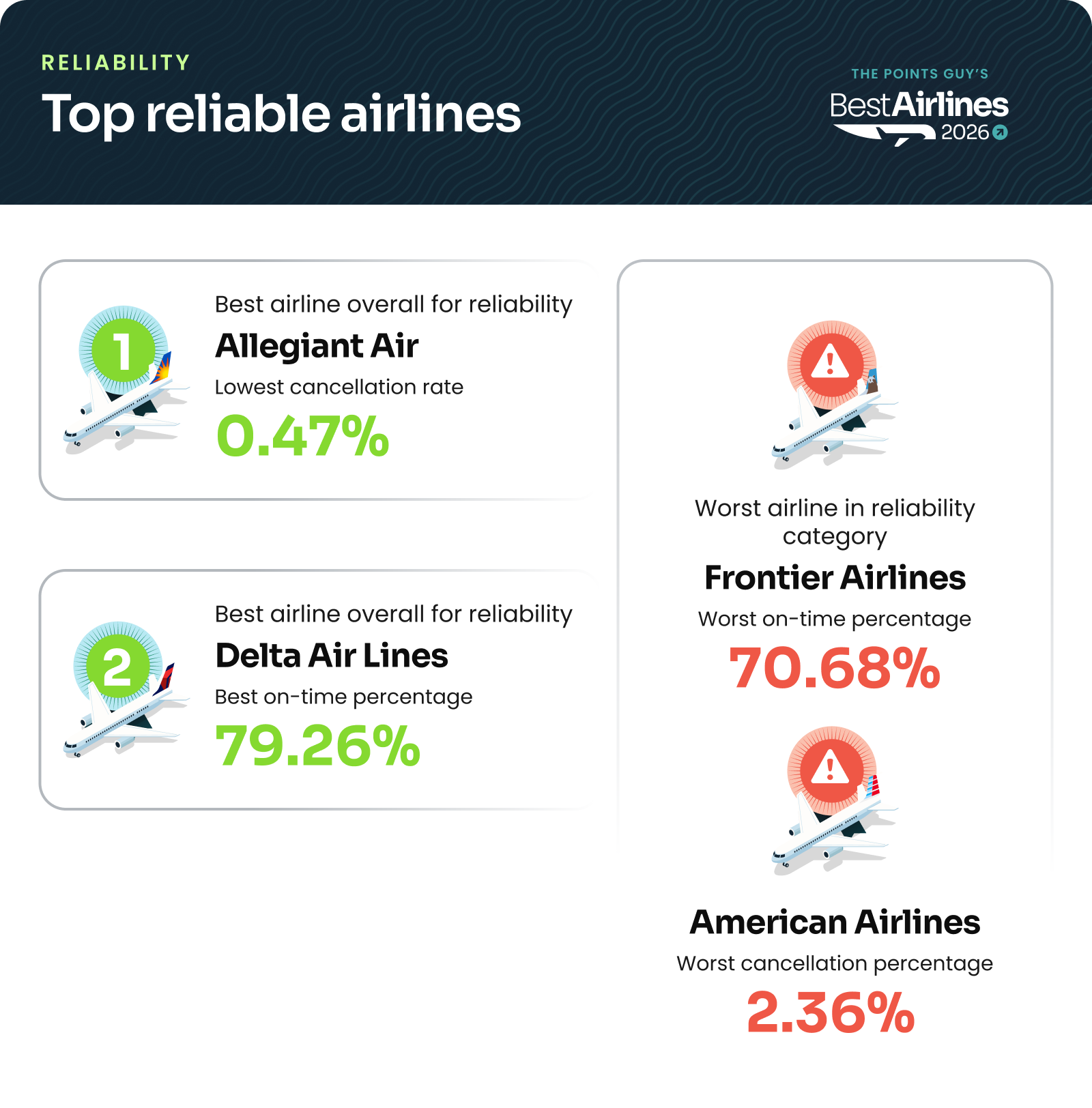
Best airlines report: Most reliable airlines: Allegiant and Delta
Source: U.S. Department of Transportation data.

How the airlines ranked for reliability (30% of overall score):

Rank Airline

Allegiant

Delta

Southwest

Alaska and Hawaiian

JetBlue

United

American

Frontier

Baggage

Think about how a missed three-point shot can lose a game, or how a swing state loss can tip an election.

That might’ve been the story for United in our report this year.

Our data shows that the Chicago-based carrier could have been crowned the best airline in the U.S. this year if it hadn’t turned in the industry’s highest rate of mishandled bags, as reported by the U.S. Department of Transportation.
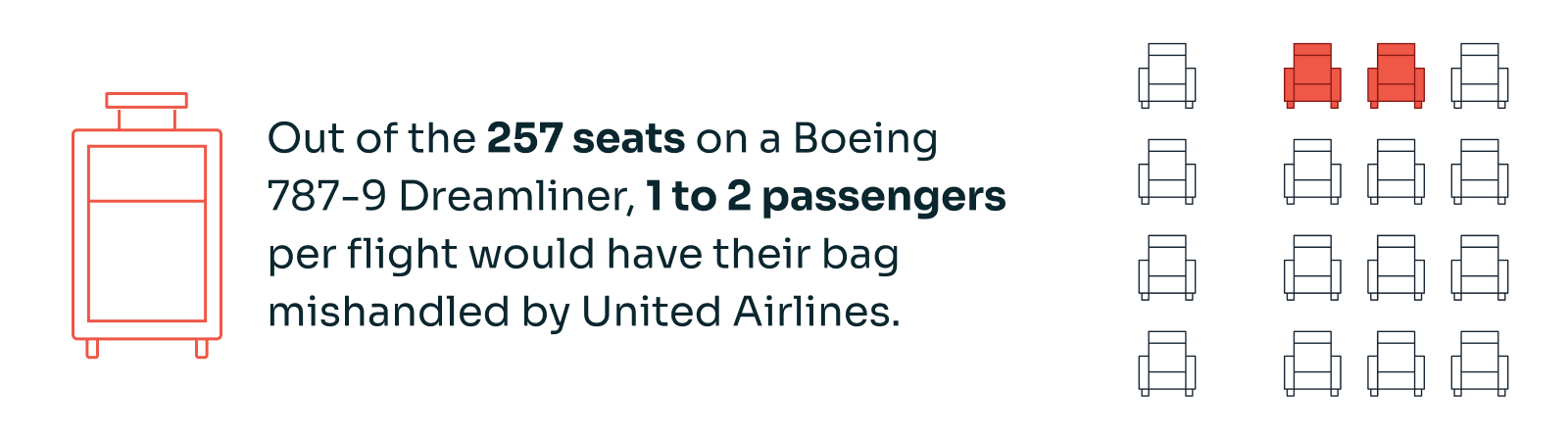
Best Airlines 2026: Out of the 257 seats on a Boeing 787-9 Dreamliner, 1-2 passengers per flight would have their bag mishandled by United Airlines.
Source: U.S. Department of Transportation data. Estimate assumes one checked bag per passenger.

American, which was second-worst in this category, technically mishandled more bags than United did. But American also handled way more total bags overall, DOT data showed — and United mishandled luggage at a higher rate in 2025, a clear opportunity for our overall runner-up going forward.

Read more: Tips for summer travel after flight cancellations hit 3-year high

Handling of wheelchairs, scooters and mobility devices

This year’s champion, Delta, turned in the industry’s lowest rate of mishandled wheelchairs, scooters and mobility devices.

The airline has also been on the front lines, in recent years, of developing new and innovative ways for passengers with disabilities to fly with comfort and dignity.

Involuntary bumps

One of the most striking findings in our report concerned passengers who were involuntarily bumped from a flight.

Keep in mind that this remains a very rare occurrence overall. That said, a couple of U.S. airlines are doing it a lot more than others.

Over the past year, DOT data shows American and Frontier combined to bump more than 22,000 passengers. Delta and Allegiant combined to (involuntarily) bump … zero.
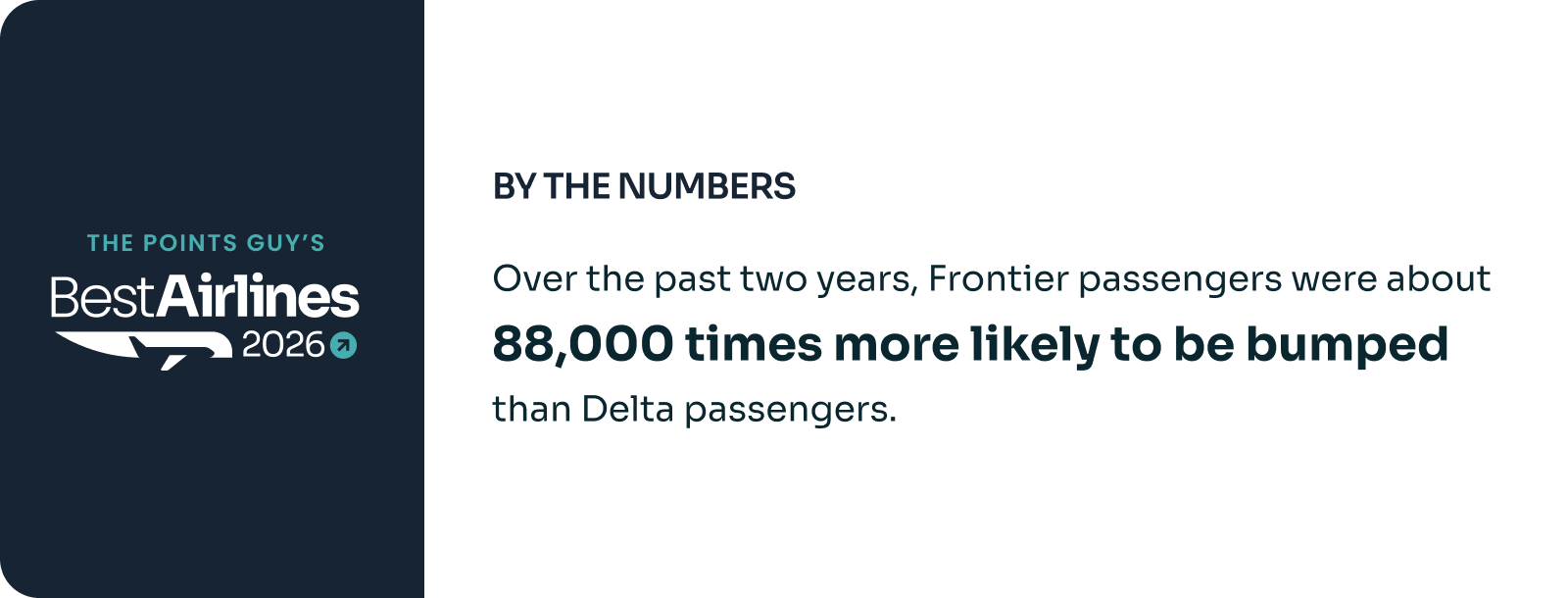
Over the past two years, Frontier passengers were about 88,000 times more likely to be bumped than Delta passengers.
Source: U.S. Department of Transportation involuntary bump data

Some important context: Delta had more voluntary bumps last year than any other airline, which is essentially when an airline incentivizes a passenger to give up their seat.

Last-place again

Frontier has been a perpetual last-place finisher in our rankings, due in large part to its reliability challenges.

Could improvement be on the horizon? The budget airline’s CEO recently declared its past struggles “not acceptable.”

Experience

Our experience category was where Delta’s strength — and consistency — stood front and center.
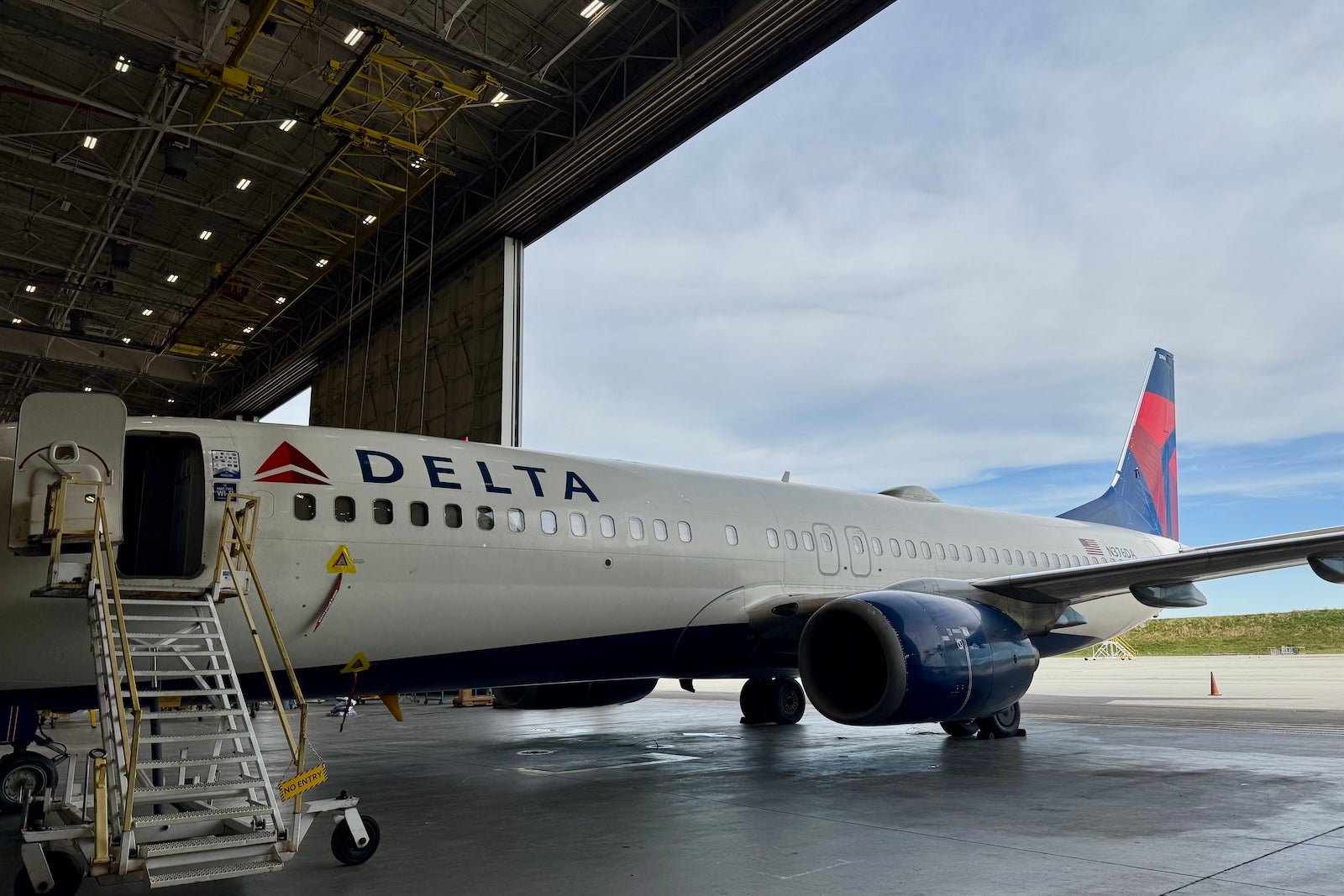
SEAN CUDAHY/THE POINTS GUY

Interestingly, the Atlanta-based carrier didn’t rank first in any of the “experience” metrics we examined. But it was close to the best in each and every one of them.
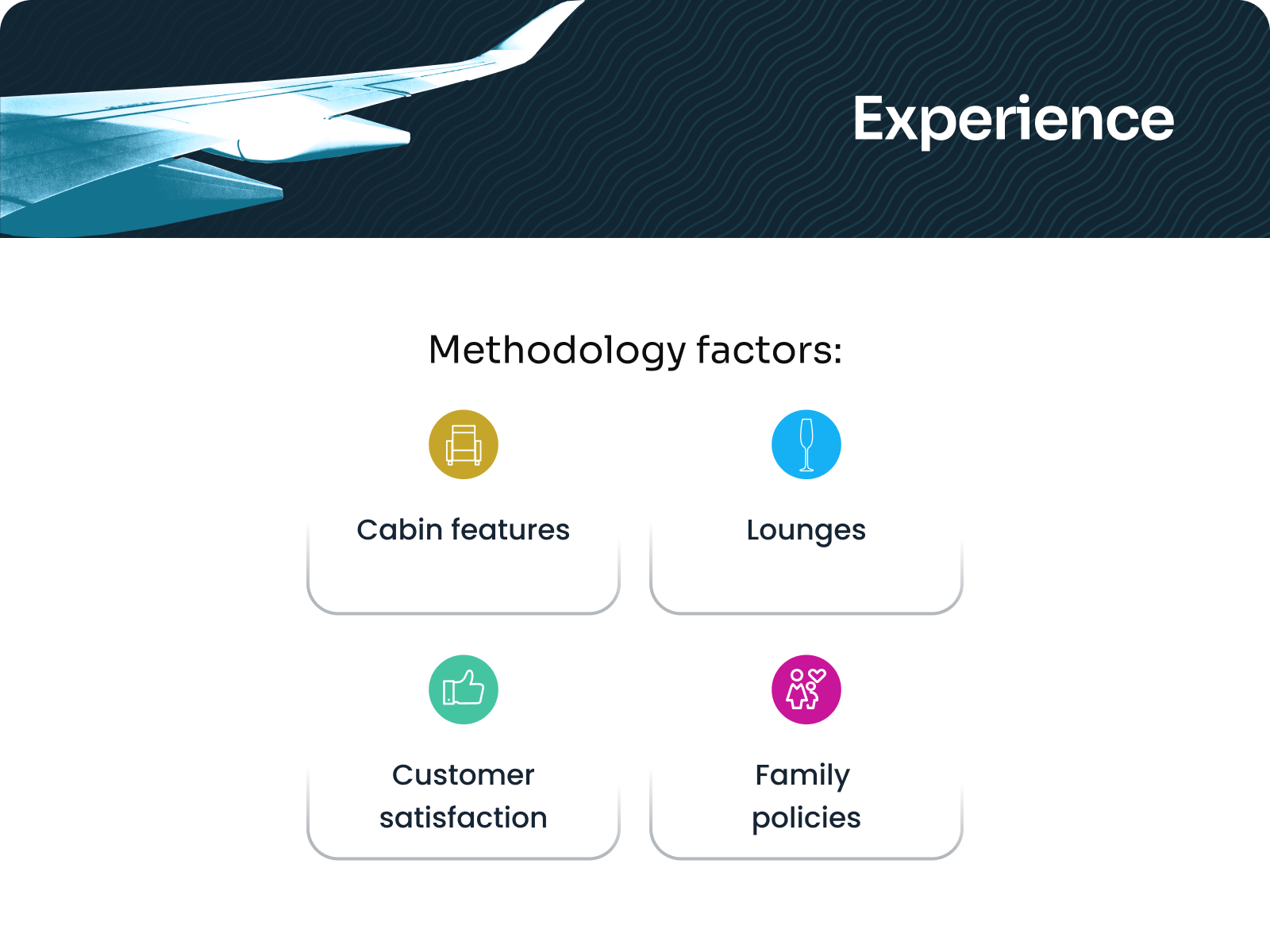
Best Airlines 2026: Experience Methodology Factors - Cabin features - Lounges - Customer satisfaction - Family policies

How the airlines ranked for travel experience (20% of overall score):

Rank Airline

Delta

Alaska and Hawaiian

United

American

JetBlue

Southwest

Allegiant

Frontier

Lounges

This year, we overhauled how we evaluate airlines’ lounges.

We wanted to know which lounge network truly offers travelers the best bang for their buck by looking at access rules, guest policies, and the annual credit card fees required to enter. We also tallied up how many clubs — and partner lounges — each airline has domestically and abroad.

According to our new formula, American’s Admirals Clubs led the way for 2026, followed closely by Delta’s Sky Clubs. The United Club network ranked third.

Read more: Which US airlines offer the best lounge access policies for travelers?

Cabin features

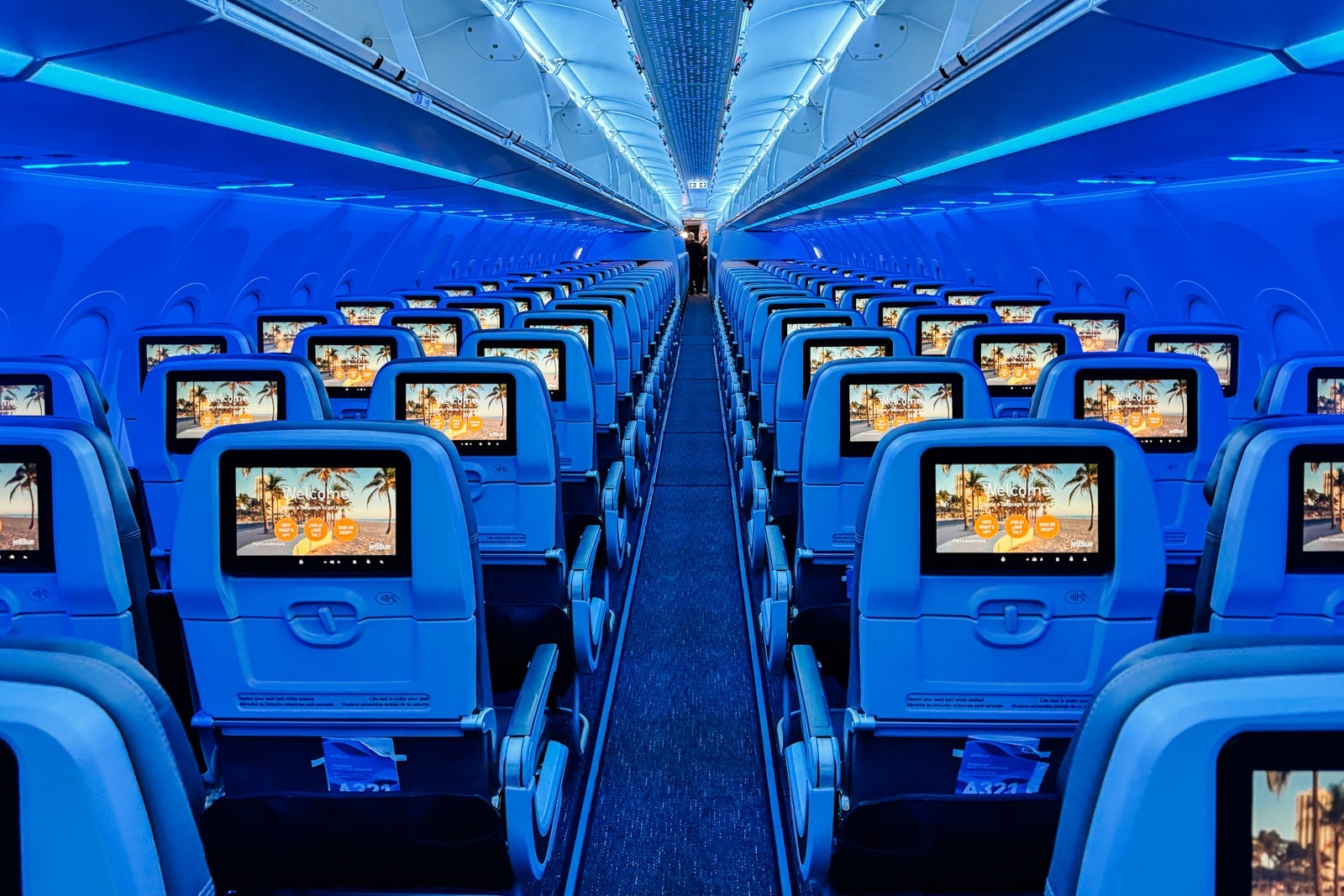
JetBlue continued its long run as the best U.S. airline when it comes to economy cabin features, with its trademark seatback screens and generous legroom in coach.
JORDAN WALLER/THE POINTS GUY

Inflight Wi-Fi

However, JetBlue’s competitors have closed its long-running lead on inflight Wi-Fi. After years of being the only carrier to offer on-board internet for free, most major airlines have slashed Wi-Fi fees as part of what has become the industry’s hottest new loyalty perk.
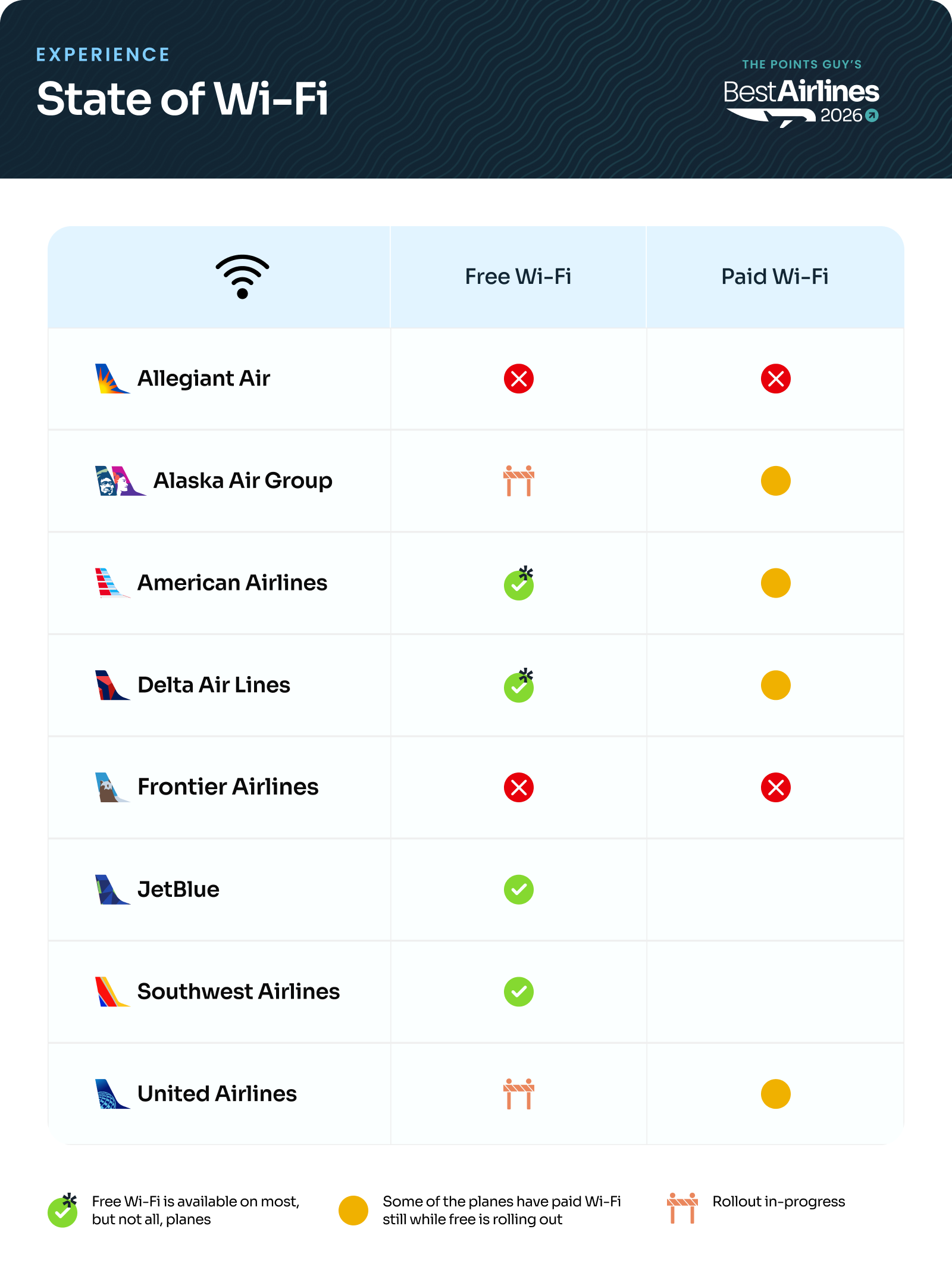
Best Airlines 2026: Wi-Fi Policy Overview
Source: TPG analysis of airline policies.
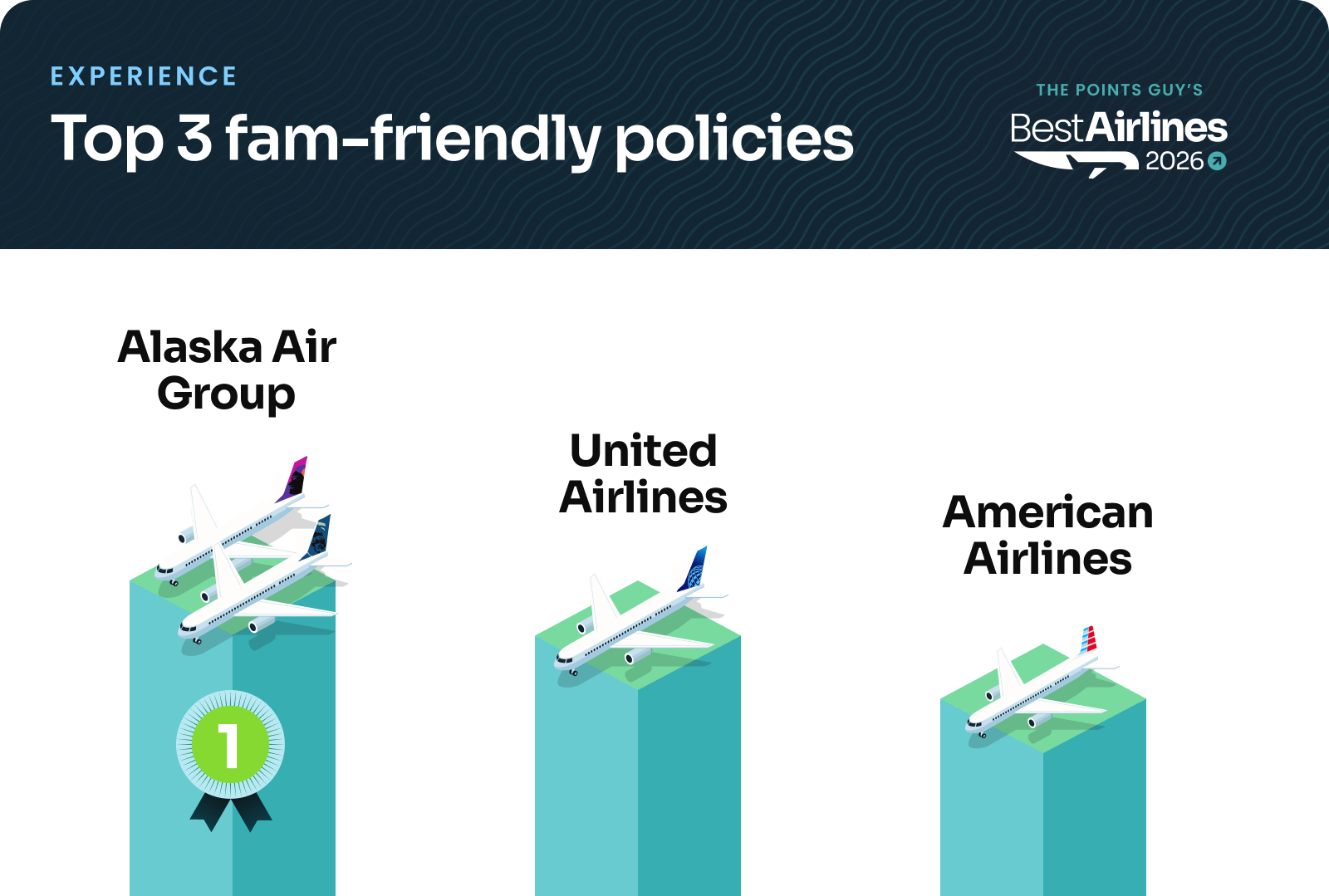
Best Airlines 2026: Top 3 family-friendly policies 1. Alaska and Hawaiian Airlines 2. United 3. American
Source: Individual airline policies. THE POINTS GUY

Cost and reach

What travelers will pay to fly in 2026 is top of mind, as soaring jet fuel costs have led to surging airfare and higher add-on fees.

Meanwhile, geopolitical uncertainty has made nonstop flight options more important than ever.

That’s why our “cost and reach” category counts for more in 2026, and now stands at 25% of an airline’s overall score.
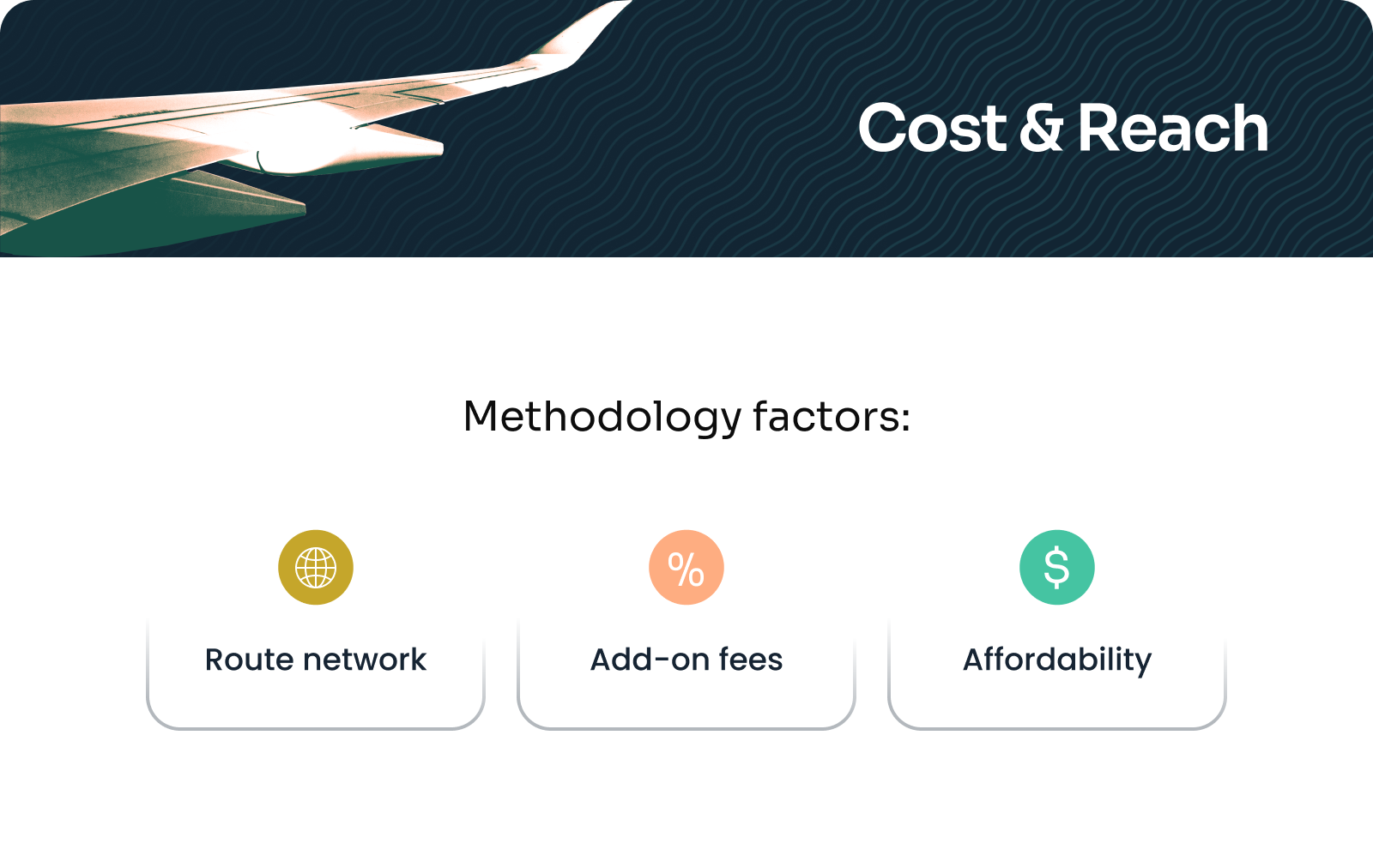
Best Airlines 2026: Cost and Reach Methodology Factors - Route network - Add-on fees - Affordability

Despite ending its popular “bags fly free” policy last year, Southwest again led the way in this category thanks to the strength of its domestic route network and its continued affordability (on fares and overall fees) relative to its peers.

wn new plane 2
SEAN CUDAHY/THE POINTS GUY

How the airlines ranked for cost and reach (25% of overall score):

Rank Airline

Southwest

American

United

Delta

Alaska and Hawaiian

JetBlue

Frontier

Allegiant

Reach

American and United received “silver” and “gold” in our cost and reach category, respectively, thanks primarily to the “reach” portion of this section.

In 2026, we gave credit not just to how many cities an airline touched but also the overall scale of their network (via a key industry statistic known as “Available Seat Miles,” or “ASMs,” for the AvGeeks among us).

American had the most robust domestic network of any carrier in 2026, according to data provided to TPG from aviation analytics firm Cirium.

United, meanwhile, continues to offer the U.S. airline industry’s most expansive (and certainly most creative) international map.
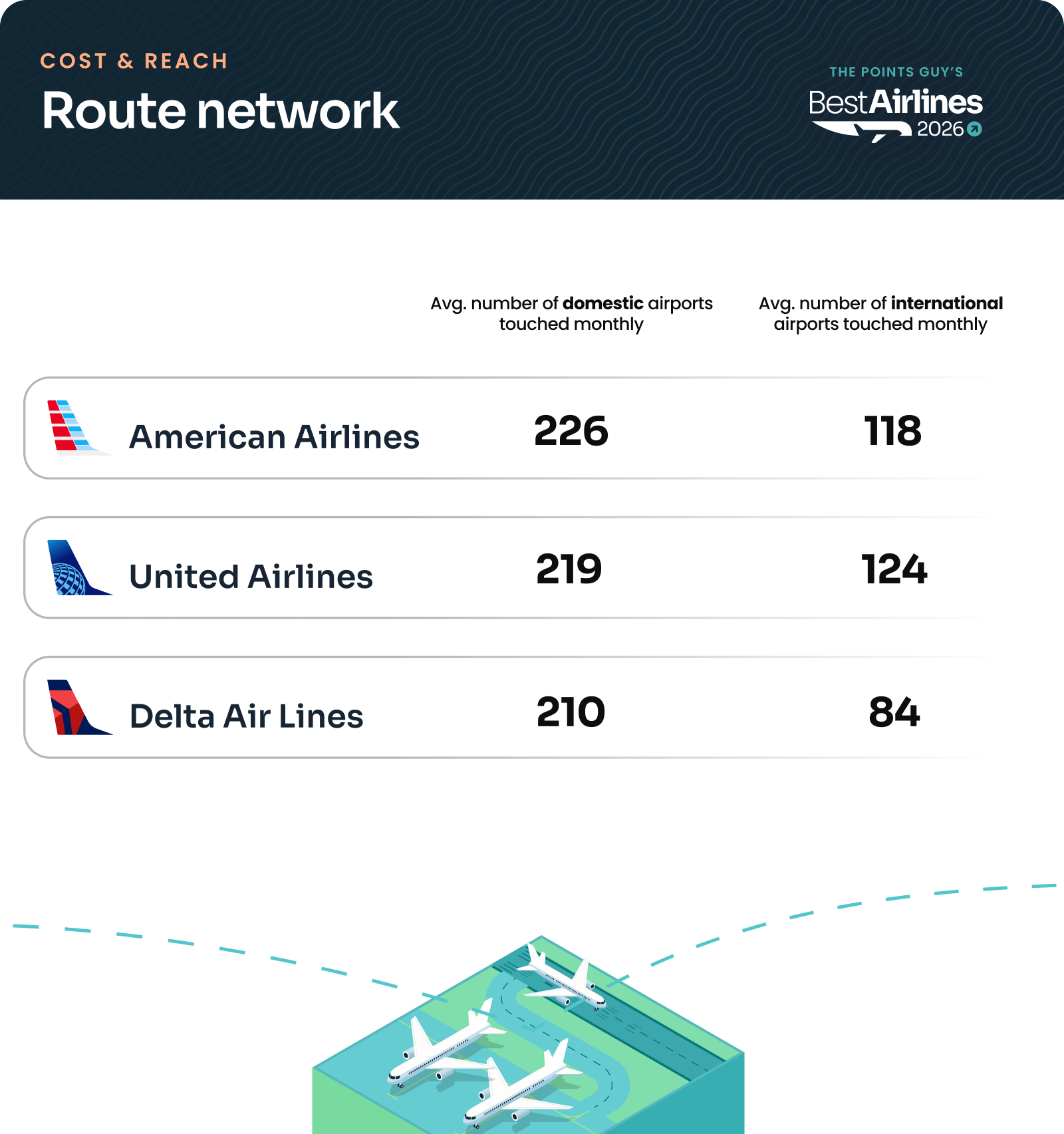
Best Airlines 2026: Route network overview for American, United and Delta.
Source: Cirium. Our “reach” analysis also accounted for ASMs (Available Seat Miles), a key industry metric.

Affordability

If there’s one area where budget airlines shine, it’s affordability.

And despite its challenges elsewhere, our review of federal data shows Frontier offered the most affordable ticket prices in the industry last year.

Here’s the sad part: Spirit was a close second, a sobering reminder of the critical competition that left the airline industry when its planes stopped flying last month.

Delta and United, which have gone all-in on “premium” in recent years, ranked as the two least affordable airlines in 2025.

Ancillary fees

Of course, budget airlines will hit your wallet with their add-on fees. Unsurprisingly, Frontier passengers paid the most for “extras” such as baggage and ticket changes.
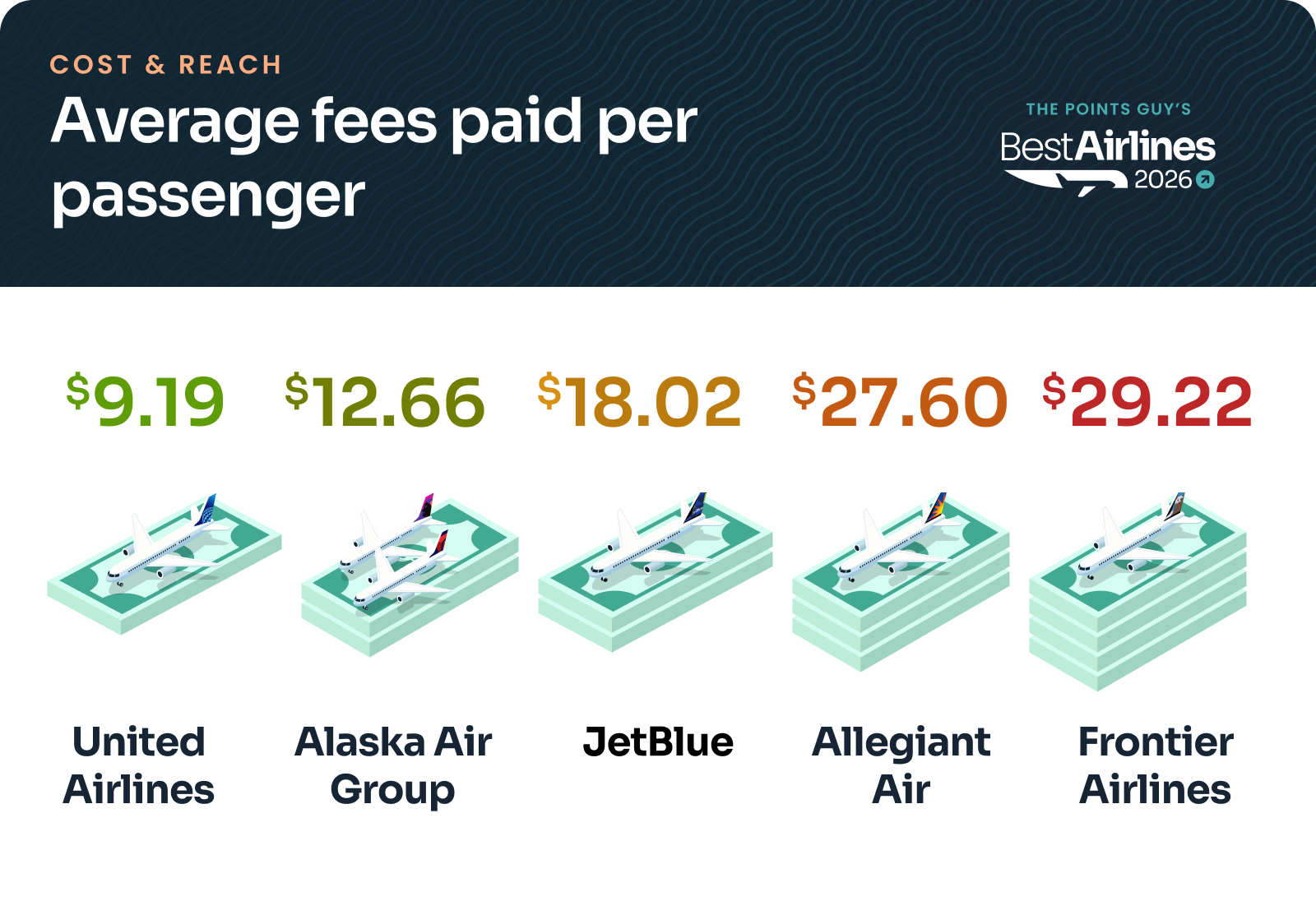
Best Airlines 2026: Average fees paid per passenger United: $9.19 Alaska and Hawaiian: $12.66 JetBlue: $18.02 Allegiant: $27.60 Frontier: $29.22
Source: Bureau of Transportation Statistics data.

It’s worth watching how Southwest ranks in fees next year. The carrier reported only half a year’s worth of bag-fee data to the government, since its baggage fees technically launched in late May 2025.
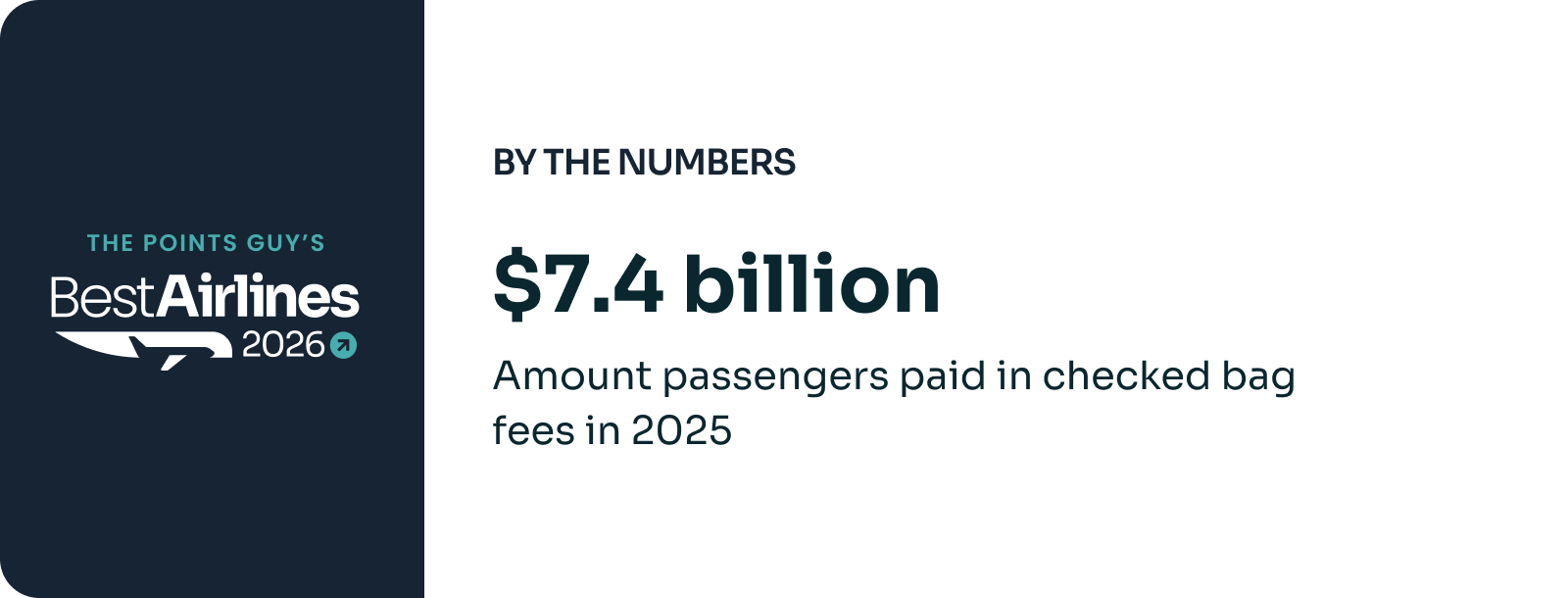
Best Airlines 2026: Passengers paid $7.4 billion in checked bag fees to U.S. airlines in 2025.
Source: Bureau of Transportation Statistics data.

Either way, expect airlines to collect more fees from you this year after nearly every major carrier hiked baggage fees in recent months amid surging jet fuel costs.

Loyalty

Closest to our hearts here at TPG is our annual “loyalty” portion of this report, which pits the major carriers’ points, miles, credit cards and frequent flyer perks against one another.
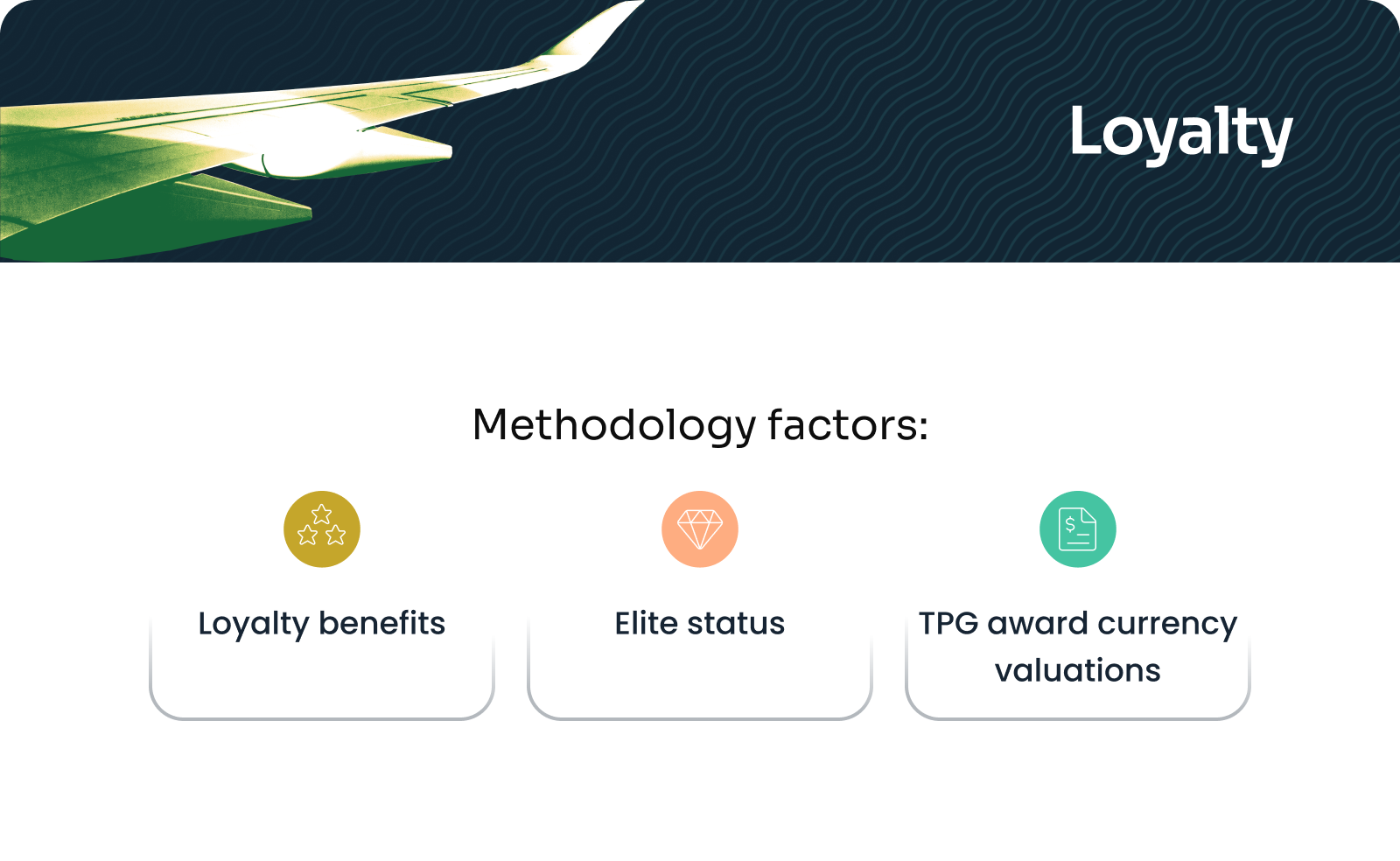
Best Airlines 2026: Loyalty Methodology Factors - Loyalty benefits - Elite status - TPG award currency valuations

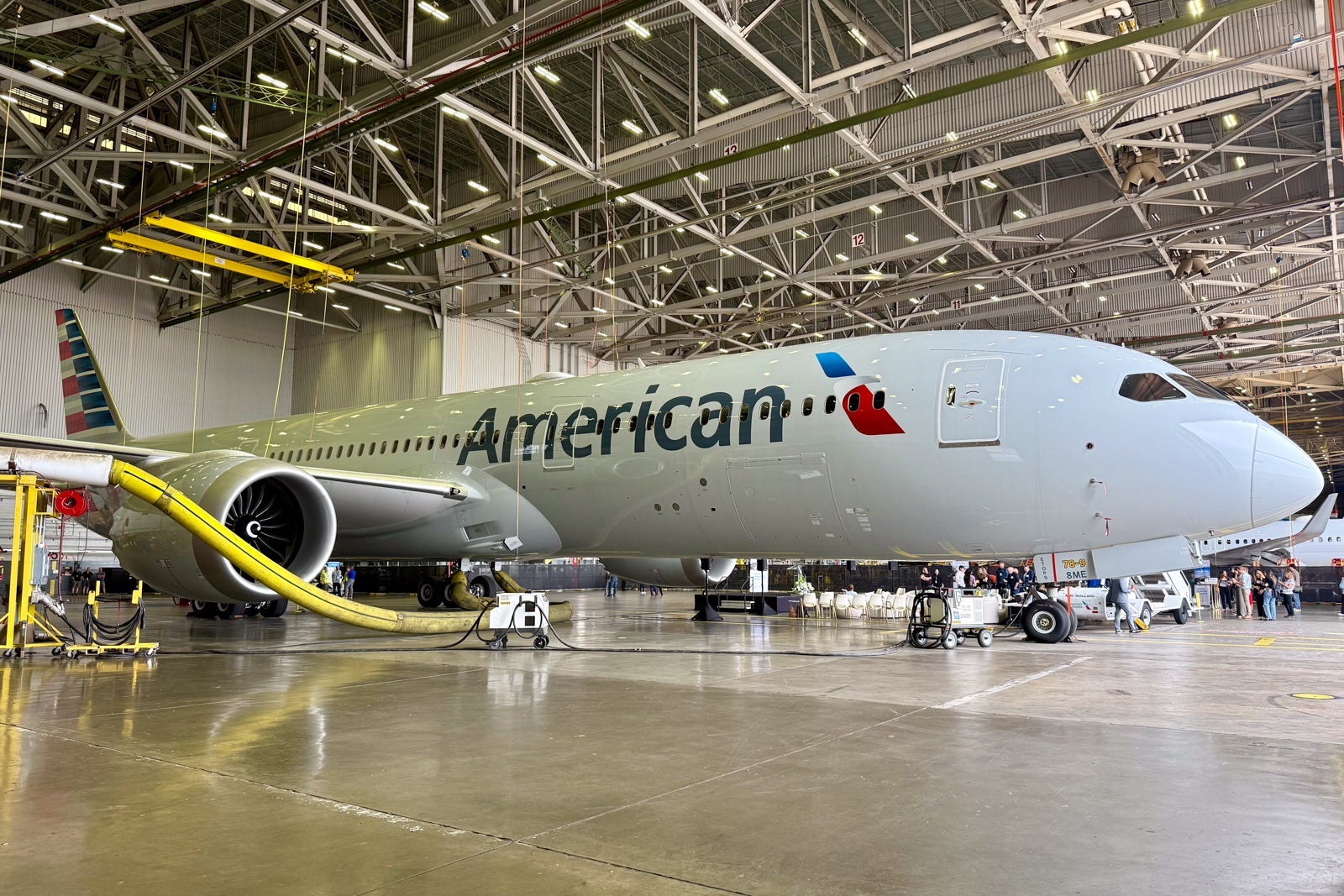
This year, American narrowly edged out United to win this key category for avid travelers.
ZACH GRIFF/THE POINTS GUY

How the airlines ranked for loyalty (25% of overall score):

Ranking Airline

American

United

Alaska and Hawaiian

JetBlue

Delta

Southwest

Frontier

Allegiant

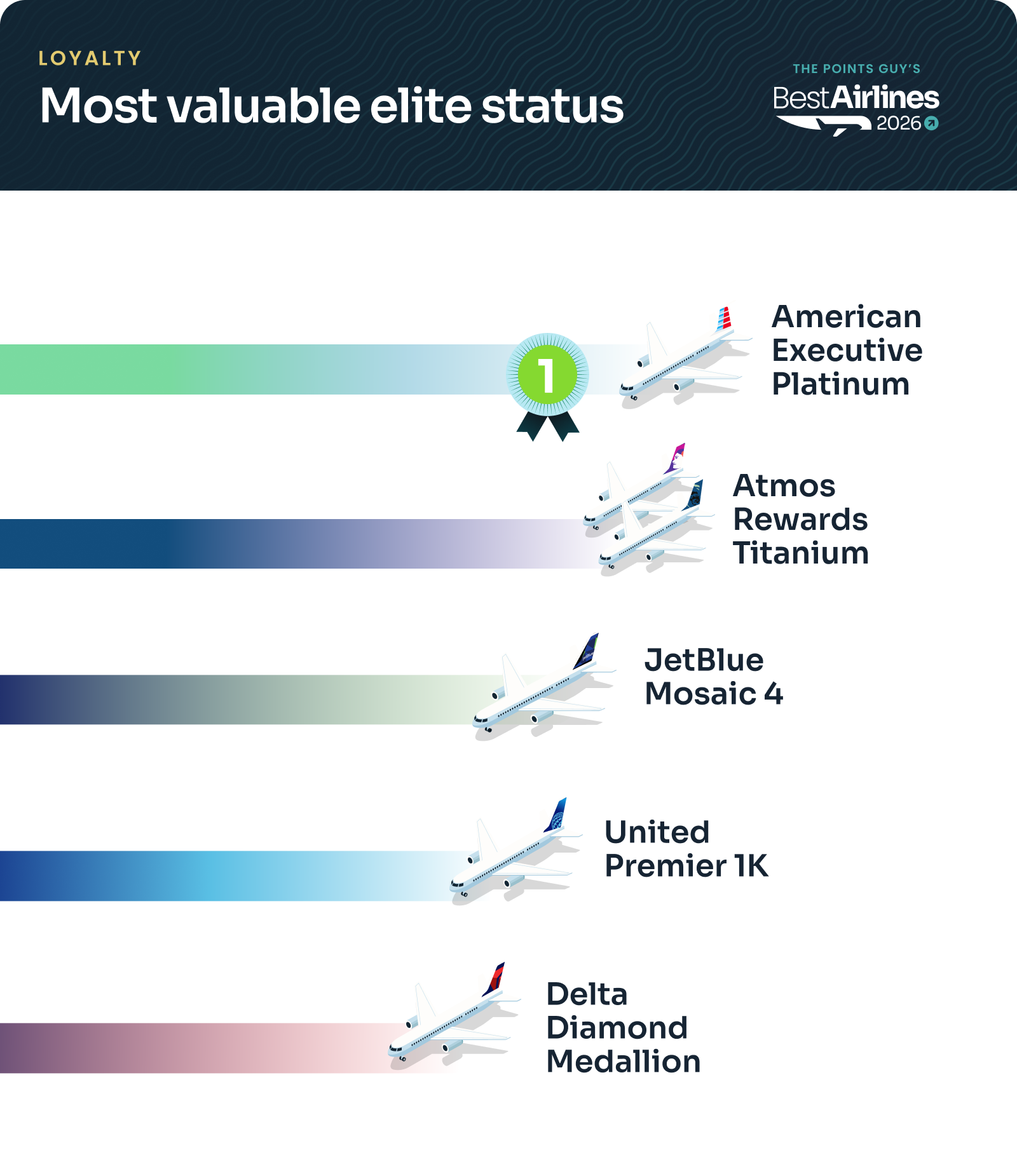
Best Airlines 2026: Most valuable elite status rankings 1. American Executive Platinum 2. Atmos Rewards Titanium 3. JetBlue Mosaic 4 4. United Premier 1K 5. Delta Diamond Medallion
Source: 2026 TPG Awards analysis.

A big reason for American’s win was the value of its AAdvantage miles, which continue to rank at the top of TPG’s monthly valuations.

That said, we continue to see some of the best redemptions in the airline industry through Atmos Rewards, the new shared loyalty program of Alaska and Hawaiian. It’s a valuable program to consider even for travelers who don’t fly with either carrier.
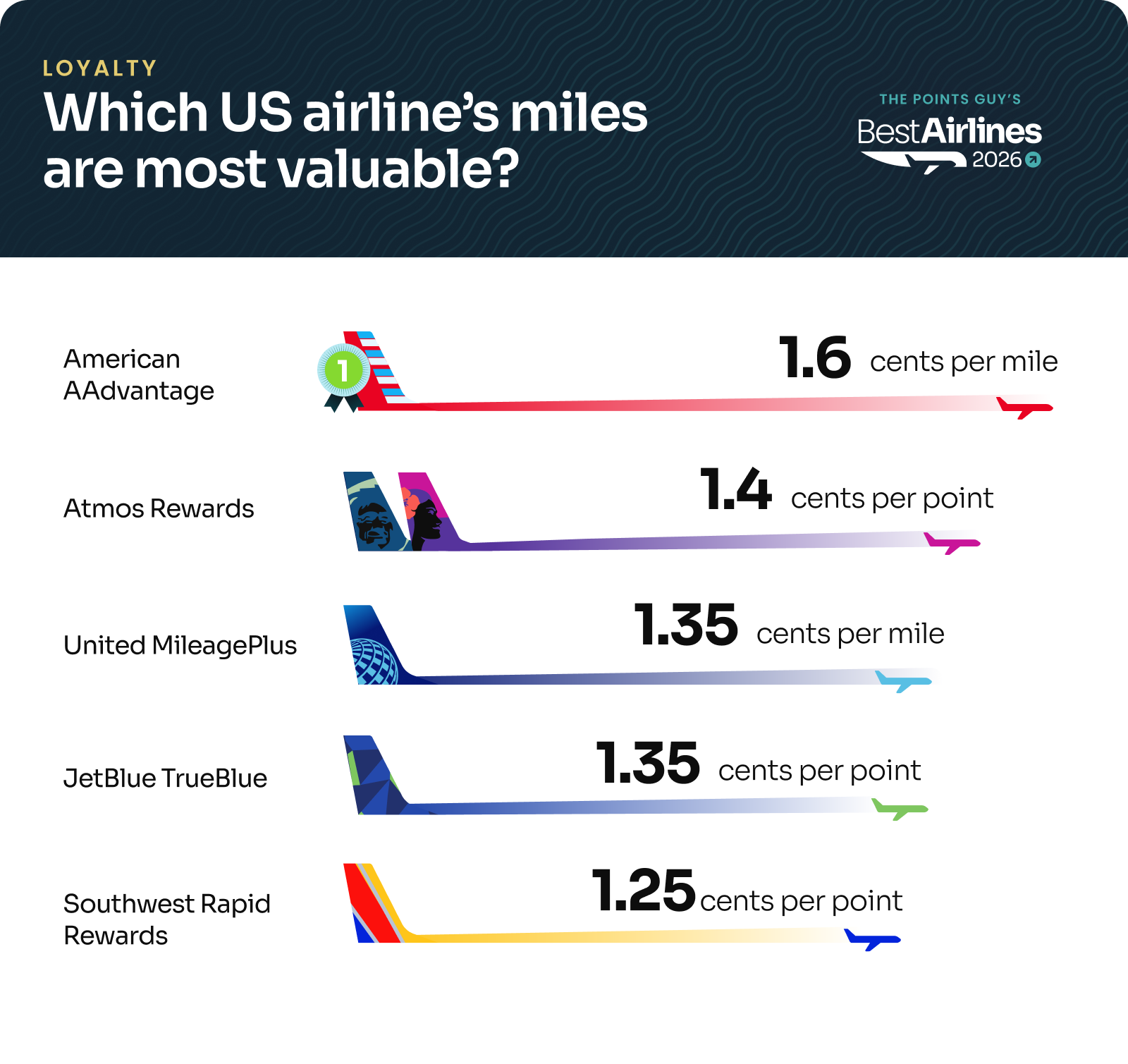
Best Airlines 2026: Which US airline's miles are most valuable? Overview graphic
Source: June 2026 TPG valuations.

The value of miles was one of the weaker categories for our overall winner, Delta; Delta SkyMiles are valued at about 1.2 cents apiece, according to our June valuations.

Frequent flyer

United’s MileagePlus program, meanwhile, led the way when it came to overall frequent flyers perks, thanks in part to the bevy of partners it has through the Star Alliance, such as Air Canada, Singapore Airlines and Turkish Airlines.

Bottom line

Delta has topped TPG’s Best Airlines rankings an incredible eight straight years. It’s a credit to the airline’s long-running operational strength and the end-to-end experience it has created for passengers.

Will the airline extend its winning streak to nine years in 2027?

All signs point to United being a formidable foe once again. If Southwest bolsters its offerings with lounges (as rumored) don’t be surprised if it makes a run at the top spot.

Plus, Delta will likely need to return to its historically strong on-time performance — and overcome a shakier start to 2026 — to hold the mantle as the best U.S. airline in 2027.

But if history is any indication, it will be a force to be reckoned with when we crunch the numbers again in one year.

Related reading:


Source link

Leave a Reply

Subscribe to Our Newsletter

Get our latest articles delivered straight to your inbox. No spam, we promise.

Recent Reviews


Step forward in your career with J2EE Development. J2EE is an open-source platform to develop, deploy and manage web-enabled, multi-tier, server-centric, and component-based enterprise applications. As a result of its robustness and security, organizations prefer to work in a Java environment. The demand for Java professionals is very high. So, we are here to help you in clearing your J2EE interview easily. Our experts have gathered and prepared a list of frequently asked questions. So why late? Lets set started with J2EE interview questions.

Let’s get started!

Most Frequently Asked J2EE Interview Questions 

J2EE basic-level Interview Questions:

What is J2EE?

J2EE refers to Java 2 Enterprise Edition. It is used to develop and deploy web-based multi-tier enterprise applications. The J2EE platform combines a range of services, protocols, and application programming interfaces. The J2EE platform includes the capabilities needed to deliver a comprehensive, secure, stable, and fast Java platform at the enterprise level.

Become a Java Certified professional by learning this HKR JavaTraining

What are the components available in J2EE applications?

The components of the J2EE applications consist of:

  • Web-tier components
  • Business-tier components
  • Client-tier components
  • Enterprise Information System software

What do you understand by J2EE client types?

Following are J2EE client types:

  • Application clients
  • Applets
  • Wireless clients, according to Mobile Information Device Profile (MIDP).
  • Java Web Start-enabled clients, through the Java Web, Start technology.

What is ORM?

ORM refers to Object-Relational mapping. Objects in a Java class that are mapped to tables in a relational database utilizing the metadata which describes the mapping of objects to the database. It acts by converting data from one representation to the other.

What is JSF?

JSF refers to JavaServer Faces. It is a user interface that designs a framework for Java web applications. It provides a set of user interface components that can be reused, a standard for web applications. JSF uses the MVC design pattern. It stores the form data on the server automatically and specifies the date of the form when it is displayed on the client side.

What is the servlet?

Servlets is one of the server-side components which delivers a powerful mechanism for server-side program development. Servlets is a platform-independent server. Servlets are designed with different protocols in mind; The most common one is HTTP protocols. The servlets uses the classes of java packages javax.servlet.http.HttpSession, javax.servlet.http.HttpServletRequest, javax.servlet, javax.servlet.http.HttpServletResponse. All the servlets are required to implement the Servlet interface that defines the methods of the lifecycle.

Java Certification Training

  • Master Your Craft
  • Lifetime LMS & Faculty Access
  • 24/7 online expert support
  • Real-world & Project Based Learning


What is a web component?

Java Server Pages technology and Java Servlet components are the web components. Servlet is a component that receives the request sends responses dynamically. JSP pages run like servlets but provide a more natural way to create static content.

What is Hibernate?

Hibernate is an object-relational mapping tool. In hibernate, HQL is used rather than SQL, which saves developers from spending more time on writing native SQL. It has a great association, polymorphism, inheritance, collection, and compositions. This is a great way to persist in the database using Java objects. Hibernate enables you the ability to express queries based on Java criteria.

What is Hashtable?

Hashtable is the same as HashMap, with the exception that Hashtable is synchronized. Hashtable is a synchronized objects cluster in which duplicate values and null values are not permitted.

Java Certification Training

  • Master Your Craft
  • Lifetime LMS & Faculty Access
  • 24/7 online expert support
  • Real-world & Project Based Learning

) What is a J2EE container?

The interface between the low-level platform and a component with specific features which supports the component is referred to as a container. The application server will maintain control and deliver relevant services through a framework or an interface calls as a container.

J2EE intermediate-level Interview Questions:

) What are structs?

The Struts framework is an MVC architecture that designs large-scale applications. It consists of JSP, Java Servlets, Custom tags, and messages. According to the published standards and the proven design templates, struts help you create a scalable development environment for your application.

) Explain ActionErrors, ActionForm and ActionMapping.

ActionError: ActionErrors is an object that wraps up all the available validation errors. If errors are not found, returns either null or an ActionErrors object with no error message recorded. The default implementation tries to switch to HTTP. Maintaining request parameter mapping and request and return all validation errors if the validation fails; a null or an empty set.

ActionForm: It is a Java bean which brings together one or multiple ActionMappings. A java bean becomes FormBean when extending org.apache.struts.action.ActionForm. The ActionForm object is populated automatically on the server-side with the data entered by the customer from the user interface. ActionForm keeps the session state for the web app.

ActionMapping: When mapping actions, we mention the action class for a specific URL, i.e., the path and various target views, i.e., redirect to which the response to the request will be sent. The ActionMapping is the information which the ActionServlet is aware of regarding mapping a specific request to an instance in a specific Action class. The mapping is passed to the method execute() in the Action class, allowing direct access to that information.

) Explain about MVC on structs?

MVC refers to Model View Controller.

Model: In many applications, the model represents the system’s internal state in the form of one or more JavaBeans. 

View: The view is usually built with JavaServer Pages technology. The controller concentrates on receiving customer requests and generating the next stage of the user interface to a suitable View component. 

Controller: The Controller’s main component in the framework is an ActionServlet class servlet. The definition of an ActionMappings set sets up this servlet.

) What are the differences between .ear, .jar, and .war files.

.jar files: These files have the .jar extension. The .jar files include accessories files such as property files, libraries, and resources.

.war files: These files have the .war extension. The .war file includes HTML,  javascript, JSP, and other files required for web application development.

.ear files: The .ear file includes the application’s EJB modules.

) What is the difference between Save() and Saveorupdate()?

Save(): The purpose of this method in Hibernate is to store an object in the database. It will insert an entry if there is a record, otherwise, it does not.

Saveorupdate():  The purpose of this method in Hibernate is to update the objects with the identifier. If the identifiers are not present, this method will call save(). If the identifier is available, then it will call the update method.

) What is the difference between the load and get method?

load() cannot find the object in the database or cache, an exception is issued, and the load() method will never return null. If the object is not found, the get() method will return null. The load() method can return a proxy in place of a persistent instance, get() does not return a proxy

) What is Spring?

Spring is an open-source lightweight framework for developing enterprise applications which solves the complexity of developing enterprise applications also provides a consistent framework for developing J2EE applications that is primarily based on the inversion of control or dependency injection design model.

) What is authorization?

Authorization is the process of determining access to a method or resource. It is based on determining the security role of the primary for an authentication request. A security role may be described as a logical grouping of users that is defined by the person assembling the application. A deployer matches the security roles for the security identities. Security identities can be groups or principles in the operational environment.

) What is an authorization constraint?

An authorization rule that determines who is allowed to access the collection of web resources is called an authorization constraint.

HKR Trainings Logo

Subscribe to our YouTube channel to get new updates..!

) What is EJB?

EJB refers to Enterprise Java Beans. This is the server-side component that runs in the EJB container and wraps the business logic of the enterprise application.

J2EE Interview Questions for Experienced:

) What is a connector?

The connector is a standard container extension mechanism that delivers connectivity to enterprise information systems. It is unique to an enterprise information system and includes application development tools and a resource adapter for the connectivity of enterprise information systems. The resource adapter is connected to a container by supporting system-level contracts that are defined in the Connector architecture.

) Explain JMS, JTA, and JNDI.

JTA: JTA stands for Java Transaction API. Its purpose is to coordinate and manage transactions across the company’s information system.

JNDI: JNDI stands for Java Naming Directory Interface. This is used to access directory services information.

JMS: JMS stands for Java Messaging Service. Its purpose is to receive and send messages using messaging systems.

) What are EDI and EAI?

EDI: EDI stands for Electronic Data Interchange. It is used to exchange data via the value-added network (VAN) that acts as a means of transmission. The installation of EDI is costly and needs customization by exchanging clients. EDI is also based on X12 standards for exchanging documents.

EAI: EAI stands for Enterprise Application Integration. This makes one or multiple applications into one application and needs that data to be transferred to the suitable system at the correct time. For example, during the integration of accounts and sales systems, it is required for sales to send a sales order for accounting for generating an invoice. In addition, accounting has to send a sales invoice to update the data for the sales professionals. This system automatically manages the transaction through the application and removes human mistakes.

) Explain about J2EE tiers.

J2EE includes the following tier:

Client tier: It stands for the browser from which the server gets the requests. In this tier, the interfaces used are the java application, the HTML browser, a non-java application, or an applet.

Middle Tier: This includes an integration tier, a presentation tier, and a business tier. Within the integration tier, the database objects are created. The UI is created at the presentation tier with the help of JSP. The business logic is written at the business tier with the help of EJB.

Backend: It consists of the Enterprise Information System that is used for storing data.

) What is DCOM?

DCOM refers to Distributed Component Object Model. It employs the Object Remote Procedure Call protocol to handle remote objects. The Object Remote Procedure Call is based on Remote Procedure Call and interacts with the runtime services. DCOM supports more than one interface, and components can be built in different programming languages like C, Java, Visual Basics, etc. DCOM is largely used in the Windows platforms.

) What is JRMP?

JRMP refers to the Java Remote Method protocol. This is the way Remote Method Invocation passes java objects as arguments. As Java depends on the serialization of objects which bring together objects in streams, RMI depends on the JRMP protocol to transfer the objects from one Java Virtual Machine to other.

) What is a Secure Socket Layer?

The technology used for communication between the Web browser and the Web server is referred to as the Secure Socket Layer. Specifically, SSL is a protocol which describes the way algorithms should be used for encryption. The technology creates an encrypted link between the two parties, and this link makes it possible to secure the transmission of sensitive information like credit or debit card information, login credentials, and social security numbers.

) What do you mean by id URL?

URL refers to Uniform Resource Locator. It is the textual reference standard for writing arbitrary information on the World Wide Web. The URL is generally structured as – 

protocol://host/local info

protocol – The protocol allows you to retrieve the object (example: HTTP, FTP)

host – The target host’s Internet name.

local info – A String is sent to the protocol handler on the remote host. In most of the cases, this is a filename with an extension.

) What is the JSP directive?

JSP is the process by which metadata information is provided to web containers regarding the JSP file. This metadata is used by the web container during the translation and compilation stages of the JSP lifecycle.

There are three different kinds of JSP directives:

  • Include directive
  • Page directive
  • Taglib directive

) Explain connection pooling?

Connection pooling is an easy concept that is popular for reusing existing connections. This means that if the object connections are well defined and connected already, they may be reused each time there is a need rather than generating a new one.

) What is a J2EE Module?

It is a piece of software that is made up of one/more J2EE components for that similar container type and a deployment descriptor of that type. Into a J2EE application, modules may be assembled or deployed quickly. 

) What is included in the application client module?

An application module includes the class file and a client deployment descriptor. It will be packaged as a JAR file with the extension .jar.

) What is the web module made up of?

The Web module is made up of 

  • JSP files(Java Server pages) 
  • Graphics Interchange format(GIF) file
  • Hypertext Markup Language(HTML) file
  • Servlets class files 
  • Web deployment descriptor

These files will be packaged as JAR files with the extension .war(Web Archive)

) What is the Enterprise Java Bean module made up of?

The Enterprise Java Bean module is made up of the class files for enterprise beans and the EJB deployment descriptor. These files will be packaged as JAR files with the extension .jar.

) What is the resource adapter module made up of?

The resource adaptor module is made up of Java interfaces, native libraries, classes, resource adaptor deployment description and other documentation. These files will be packaged as JAR files with the extension .rar(resource adapter archive).

) What is meant by an Applet?

It is a component of  J2EE that is commonly executed on the web browser. This  can be executed on a wide range of other devices or applications that accept the applet programming model.

) What do you mean by an applet container?

“Applet container” refers to a container that supports the applet programming model.

) What is meant by a thin Client?

A thin client is a lightweight application interface that will not allow functions like complex business rules execution, database  queries or connection to legacy applications.

) What is meant by deployment descriptor?

The Deployment descriptor is according to Extensible MarkUp Language(XML) that has a .xml extension. It can be used to define the deployment options for a component. J2EE applications and modules have their own deployment descriptors.

) What do you mean by a web container in J2EE?

A web container in J2EE refers to an interface between the low level platform and a component with defined functionality which is intended  to support the functionality.

) What will be the file extension that is used for the Hibernate configuration file and hibernate configuration file?

The file name for the hibernate mapping will be written like filename.hbm.xml.

The file name for the hibernate configuration will be written like filename.hbm.xml.

) How should a Hibernate mapping file in the hibernate configuration file be added?

You can add it quickly using the following code:


) What are the core components of a Multi-tier architecture?

Following are the core components of the Multi tier architecture:

  • Presentation Tier: The presentation is displayed using the front-end component included in this tier.
  • Resource Layer: The database is accessed through the back-end component included in this tier.
  • Business Layer: The business logic of the system is provided by the component included in this tier.

) What do you mean by a backing bean?

Backing bean refers to a Javabeans component that relates to JavaServer Pages and contains JavaServer Faces components. Backing bean outlines the characteristics for the page components as well as methods that process them.

This processing will consist of validation, event handling, processing related to navigation.

) What do you mean by build file?

An XML file with one or more asant targets is referred to as a build file. A target is a list of assignments that a user hopes to complete. A user can specify which target should be executed when asant is started. If no target exists, the  project’s default target is carried out.

Java Certification Training

Weekday / Weekend Batches

) What do you mean by CDATA?

A CDATA is an XML tag that is predefined for character data that denotes “don’t interpret these characters.” It is comparable to parsed character data (PCDATA), in which the usual XML syntax is followed. CDATA sections will be used to display XML syntax examples.

) What is the difference between JDK and JIT?

A cross-platform software development environment called JDK (Java Development Kit) provides diverse collections of libraries and tools needed to develop applets and  Java programmes. It even comprises JRE, which offers tools and libraries that accept the bytecode execution. JDK is required for creating and executing Java programmes. In contrast, JIT stands for Just In Time Compiler, a module that exists inside the JVM (i.e., inside JRE). In order to reduce the time for compilation, and improving speed, JIT compilers are used to compile some of the portions of bytecode that carry out similarly to machine code at the same time.

) What are the primary interfaces of the Hibernate framework?

  • Sessionfactory interface
  • Transaction interface
  • Session Interface
  • Query and Criteria Interface
  • Configuration interface

) How do PATH and CLASSPATH differ from each other in relation to J2EE?

  • The two most important environmental variables utilised by Java platforms are PATH and CLASSPATH.
  • PATH refers to the JDK binaries or native libraries such as java.exe. while, the CLASSPATH variable refers to the Java binaries, like JAR files that include bytecode.
  • Regardless of whether Java is installed on the system or not, PATH is a system-level variable. Where as JVM uses CLASSPATH, which is entirely Java-specific, to load the classes needed by running Java programmes.

) What are the phases of servlet life cycle?

Following are the phases of Servlet lifecycle:

  • Classloading phase: Servlet’s class file (*.class) will be loaded by web container.
  • Instantiation phase: The servlet gets instantiated by calling the default no-arg constructor.
  • Initialize phase: init() method will be called only once in the servlet lifetime. Servlet configuration will be assigned to the servlet.  
  • Request Handling phase: The servlet spends most of its time in this phase. Services to various requests will be provided by calling service().
  • Removal phase: before the Servlet destruction, the destroy() function will be called.  The garbage collection will be carried out later.

Conclusion:

All the above are some of the frequently asked J2EE interview questions gathered by our J2EE Experts. We hope you found these questions helpful. Learning these questions will help you in clearing your interview. If you are searching for any other questions related to J2EE, feel free to comment. We would revert with the answer.

About Author

author-image

As a content writer at HKR trainings, I deliver content on various technologies. I hold my graduation degree in Information technology. I am passionate about helping people understand technology-related content through my easily digestible content. My writings include Data Science, Machine Learning, Artificial Intelligence, Python, Salesforce, Servicenow and etc.

Upcoming Java Certification Training Online classes

Batch starts on
28th Jun 2026
Mon – Fri (18 Days)
Weekend
Timings – 10:30 AM IST
Batch starts on
2nd Jul 2026
Mon & Tue (5 Days)
Weekday
Timings – 08:30 AM IST
Batch starts on
6th Jul 2026
Mon & Tue (5 Days)
Weekday
Timings – 08:30 AM IST


Source link