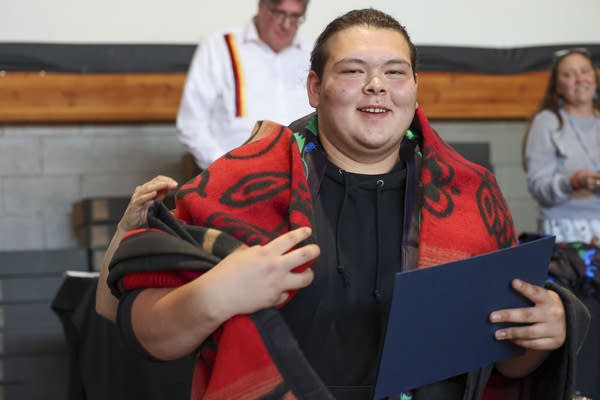
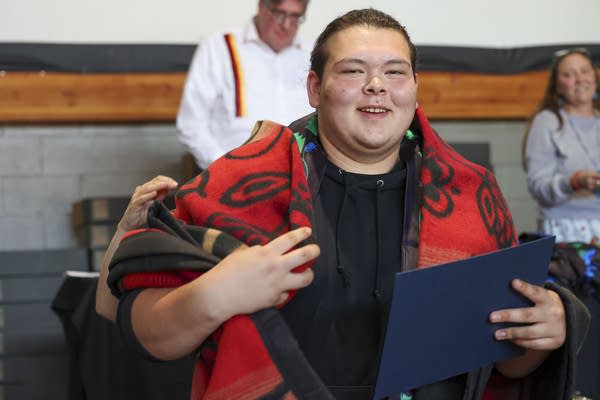
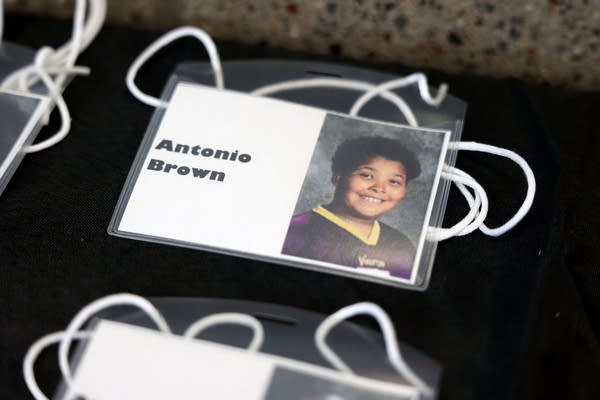
Antonio Brown's high school journey has been a roller coaster ride. And earlier this year, it looked like the 18-year-old senior at Denfeld High School in Duluth might go off the tracks.
Brown struggled early in high school. He skipped class, and he admits he didn’t apply himself. But as he grew more serious about playing basketball and football, he knew he had to keep his grades up.
“It started to become a pride thing, where, like, ‘Oh, I'm not gonna miss a game because of my grades,’" he said of his effort to remain academically eligible to play. As Brown got more serious about school, he began to thrive. He made the honor roll and he was looking at colleges.
But then in February, his Dad was nearly killed in a car accident. He's still recovering in a Twin Cities medical facility.
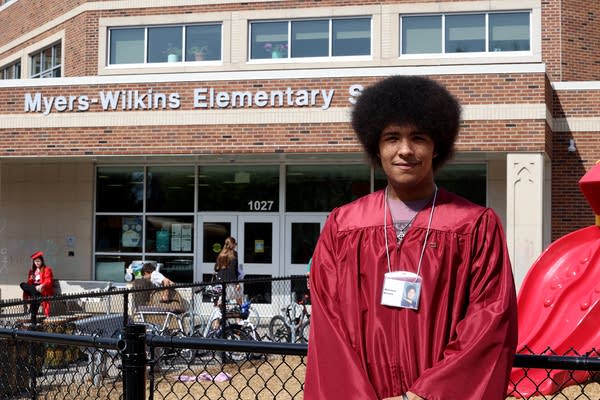
Antonio’s mom died when he was in grade school, and with his father still recovering, that left it up to Brown to take care of himself and his 17-year-old brother Carter.
He had to figure out how to pay the rent and utility bills, how to shop for groceries and how to cook meals, all in the middle of basketball season and while he tried to navigate his way through senior year of high school.
"I really have been forced into this position where I'm just trying to get all this stuff figured out, like how to be an adult,” Brown said.
But after his dad’s car accident, Brown’s grades started to slip. That’s when his basketball coach, Phill Homere, stepped in to help. He organized a GoFundMe for Antonio and Carter Brown that raised nearly $30,000. Even rival teams donated.
But the brothers told Homere they needed someone to help manage the money. They didn’t have a family member they trusted to do it for them.
Homere offered to help. He handles the bills. And he talks to the boys every day to make sure they're getting what they need.
"My Dad passed away when I was at a young age, so I know how tough it is for people not to grow up with a two-adult household,” Homere said. He said helping the Browns became a “calling.”
“I already have kids of my own; but my basketball players, I look at them as my kids,” Homere added. “They need to know that they’ve got loved ones that care about them.”
Building relationships
It's a prime example of what Denfeld Principal Tom Tusken says is the common theme in his school's efforts to raise graduation rates.
"It is 100 percent driven by relationships,” Tusken said. “[That’s] the key that unlocks the door to everything else that follows."
For years, fewer than half of Native American students at Denfeld graduated. That number started to rise a few years ago, and this school year, it jumped 12 points to 74 percent. That’s well ahead of the statewide average for Native students. Native students make up 13 percent of Denfeld’s student body.
For students of two or more races, like Brown — his mom was Native American; his Dad is Black — the rate jumped 15 points to 88 percent.
Tusken attributes those gains to a number of interventions the school has adopted. Each one, he says, plugs another hole in the bucket, preventing students from falling through.
One is called “Check and Connect,” developed by researchers at the University of Minnesota. Students in the program are assigned a mentor who acts as a case manager, monitoring their progress and consistently checking in with them.
“They’re problem solving for those kids all the time,” said Tusken. “They're strong advocates."

Without his mentor and other teachers and school staff with whom he’s become close, Brown doesn't think he'd be graduating. He said they’re the reason he plans to go into education after college.
“They’re so inspirational to me,” Brown said.
Jayden Wise is another graduating senior who credits school staff for keeping him on track.
They “helped a lot with managing work” and gave him somebody he could always talk to, Wise said.
But Wise mostly credits his mom. He said she spent hours helping him study when he struggled with certain subjects, especially math. She convinced him to keep playing football when he wanted to quit. It got to the point where he didn't want to let her down.
"That was probably one of the biggest motivators,” Wise acknowledged. “She's put a lot of time and effort into helping me graduate.”
Next year, Wise plans to attend Crown College in the Twin Cities to play football and to follow his Mom’s career path by pursuing a degree in nursing.
Antonio Brown plans to attend Mesabi Range College on the Iron Range, where he hopes to play basketball and football while studying education. He just learned that he’s earned a local scholarship to help cover tuition and many of his school costs.
‘One kid at a time’
JP Rennquist, who works with American Indian students across Duluth public schools, has known Wise and Brown since they were young boys. "It's beautiful seeing what you've done,” he tells them.
Rennquist says their success motivates him to keep working to help other students. Because despite the recent major gains in Native American graduation rates at Denfeld High School, a quarter of Native students there still are not receiving diplomas.
“I keep a list of the people who aren't graduating,” Rennquist said. “Every one of those kids breaks my heart."
Many of those students face major challenges outside the classroom. Some, like Brown, don’t have one or both parents. Nearly half of Denfeld students qualify for free and reduced-price lunches. Many face trauma at home stemming from mental health and other issues.
“This is literally a battle, one kid at a time, to get them across the stage,” Tusken said.
Graduation is a life-changing event for many of his students. Some are first generation high school graduates. The hope is that a high school diploma will become the expectation for their children, he said.
“But as much as we know that graduation changes the trajectory of lives for our kids that walk that stage, we also know there's a change in the trajectory of lives for kids that do not,” said Tusken.
Denfeld High School has also launched programs geared specifically toward Native American students. A new Indigenous cohort weaves cultural activities into the curriculum. The school posts signs in the Ojibwe language and also flies the flag of the nearby Fond du Lac Band of Lake Superior Chippewa.
"We are trying to represent their culture around them,” said Tusken. “I want kids to come into this building” and see that “somebody cares enough to have that Fond du Lac flag displayed next to a U.S. and Minnesota flag."
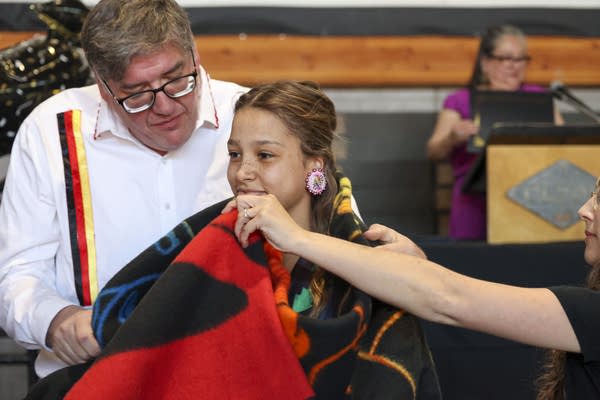
Last week, Duluth schools held a banquet to honor Native American graduates. Loved ones wrapped blankets around their graduating seniors.
"I am so proud of him,” said Jamie Wise, Jayden’s mom, after helping place a blanket around her son’s broad shoulders. “He's an amazing role model for his siblings and his friends,” some of whom she said have struggled to stay in school. “He has pushed them to show up,” she said.
More efforts like that will be needed to keep Denfeld’s graduation rates pushing upwards, school officials say.
Duluth schools, like many across the state, are facing a serious financial shortfall. Officials have proposed $4.2 million in budget cuts for the next school year. Denfeld will likely lose 17 staff positions, Tusken said, including a counselor and one of their Check and Connect mentors.
“We feel like we finally are turning a corner, and now we're faced with significant budget reductions,” Tusken said.
“That's the challenge, is how are we going to do as good and better, with less.”





:max_bytes(150000):strip_icc():format(jpeg)/Health-GettyImages-TypesOfSaunas-f03979ce340d4bfba326fadf6086fd24.jpg "Serene woman relaxing in infrared sauna.")