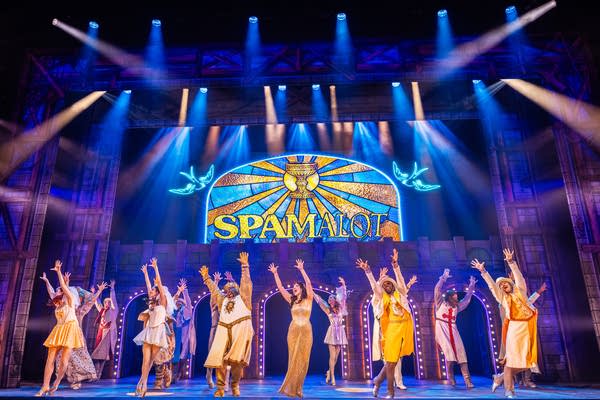
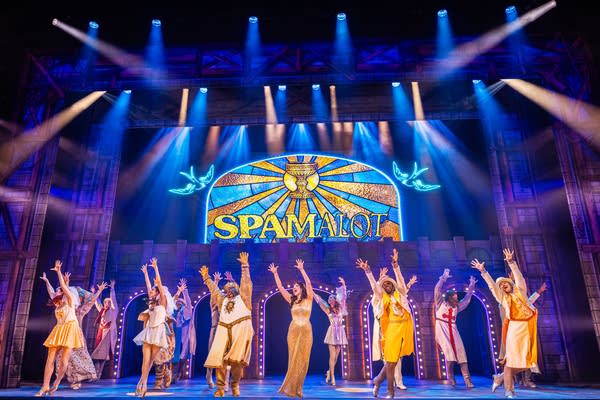
Performers on the stage for Spamalot.

“Spamalot” at the Ordway in St. Paul — Through June 14.

Through their films and sketch comedy show “Flying Circus,” British comedy troupe Monty Python’s absurdist humor and endlessly quotable jokes have developed a cult following across the world. So the question of adapting their best known work, “Monty Python and the Holy Grail,” into a Broadway musical was less of an “if” and more of a “when.”

Spoofing the name of the golden-age musical “Camelot,” Monty Python’s “Spamalot” debuted in 2005 and won the Tony Award for Best Musical. Now on a revival tour, the show includes glitzy dance numbers, and a mix of original music and songs from previous Monty Python projects, yet it still maintains the manic energy and cutting humor people come to expect from giants of British comedy. (Jacob Aloi)

“Ole and Lena’s Wedding” at Boat Club Productions in Duluth — Through June 20

If you’ve lived in Minnesota for any amount of time, you’re likely aware of “Ole and Lena” jokes. They often poke fun at Midwestern and Scandinavian traditions, and usually end with a punchline at the expense of the titular husband and wife. Due to their ubiquity, they pop up everywhere from restaurant names to merchandise –and even theater.

Boat Club Productions, a dinner theater in Duluth, is producing “Ole and Lena’s Wedding.” Rather than a usual play, however, the show is immersive, with audience members treated to a reception meal after “attending” the wedding of Minnesota’s favorite couple—as the producers told FOX 21 in a recent interview. While the run of “Ole and Lena’s Wedding” is only a couple of weeks, Boat Club Productions is gearing up for two more productions later this year: “Church Basement Ladies” in the fall—another play that leans heavily into Midwestern culture—and the musical “Come From Away” in the winter. (Jacob Aloi)

“The Wizard of Oz” on 35mm at the Heights Theater in Columbia Heights — June 13 & 15

Minnesota has a few favorite sons: Bob Dylan, Prince, Paul Bunyan. But you’d be hard-pressed to find a more beloved daughter of the north woods than Judy Garland. After all, there’s a whole museum dedicated to her in her birthplace of Grand Rapids—which was central to a national true crime story involving the ruby slippers she wore in her most iconic role. For two special screenings, Minnesota audiences will have the opportunity to soak up Garland’s turn in Technicolor, as a certain Kansas farm girl, in glorious 35mm—the way God intended one of the greatest musical movies to be seen. (Jacob Aloi)

Mohanad Elshieky at Cedar Cultural Center in Minneapolis — June 12

If your social media algorithm is anything like mine, you’ve been seeing quite a bit of Mohanad Elshieky as of late, and it’s a delight. Story goes that the Libyan comedian, who is based in Brooklyn, got his start doing comedy as the host of a twice-weekly political call-in radio show in Benghazi during the Libyan Revolution in 2011, that is, until someone burned down the radio station. In 2014, Elshieky moved to Portland, Ore., and the U.S. granted him asylum in 2018. Since then, Elshieky has worked for “Full Frontal with Samantha Bee” and appeared on “Conan” and “The Late Show with Stephen Colbert” (RIP to all three shows).

Elshieky performs a deceptively laid-back style of comedy, with a mellow demeanor commenting on everything from growing up Muslim (“I read the Bible sometimes just to see what the competition is up to”), being kidnapped in his home country (“I love drama”) to Tesla-driving Lyft drivers (“I will never understand because like, do you have money or not?!”). Elsheiky performs 7 p.m. Friday, June 12, at Cedar Cultural Center. Cedar Cultural Center will also host a June 13 screening of the documentary “Dinkytown: A Tale of a Legendary Village,” which looks at 150 years of the university neighborhood. (Alex V. Cipolle)

“Prairie Dreams: A Trail of Quilts” at Frontenac State Park — June 13

The bluffs are alive with … the color of quilts! For this unique, one-day only event, more than 120 artist-made quilts will line a trail from 10 a.m. to 5 p.m. Saturday, June 13, at Frontenac State Park along the Mississippi River just southeast of Red Wing. The Frontenac State Park Association put out a call to regional artists to submit quilts that “present prairie-inspired dreams,” from “a story passed down through generations, a dream of regeneration for future generations or simply the day dreams of looking at clouds scudding across the sky while listening to the sound of meadowlarks as one walks a trail.” Visitors can come talk to quilters along the trail and vote on their favorite quilt. (Alex V. Cipolle)

“Pearl Fantasy Festival” Interact’s 30th Anniversary in St. Paul — June 13

The campus for Interact Center for the Visual and Performing Arts celebrates 30 years supporting contemporary artists living with disabilities, including artists such as Janice Essick, Lucy Picasso, Michael Engebretson and Victor Van, who this spring became the first Interact artist to have work purchased by the Walker Art Center. The Pearl Fantasy Festival, which runs 1 to 4 p.m. Saturday, will feature live music, performances, a puppet parade and two new exhibitions highlighting the work of all 70 Interact visual artists. (Alex V. Cipolle)




Source link

Leave a Reply

Subscribe to Our Newsletter

Get our latest articles delivered straight to your inbox. No spam, we promise.

Recent Reviews


Python Serialization – Table of Content

Serialization in Python

Serialization in python is a process to serialize data in a species that is user-friendly, human-readable, and easily inspected. There are two very common python serialization libraries that serialize data objects in python. They are ‘HDF5’ and ‘Pickle’ which take dictionaries as well as Tensorflow models for storage purposes and transmission.

Become a Python Certified professional  by learning this HKR Python Training !

Why Python Serialization?

The serialization process allows the python user to send, receive and save his data alongside maintaining the original structure also. The user finds it very useful to save a certain kind of data in the database so that he can reuse it later whenever it is needed. It can also be used to transmit data on a server network and the user can access it on any system later on.

The process of serialization is also very helpful for projects related to data science. For instance, the process of dataset preprocessing can be very time-consuming, hence preprocessing is done just once that too before saving the data on the disk. It is preferred that the user performs preprocessing each time he uses it. It also eliminates memory limitation problems for big data too which is heavy for loading in the memory as a single piece. So when the data is split into smaller chunks, the user is able to load every single chunk for preprocessing, and he can then save the outputs to the disk, removing all the data chunks from the memory.

Python Serialization: Text Based

The process of textual serialization means serializing the data in some specific format that is easy to understand, human-readable as well as easily inspected. Formats which are text-based are mainly language agnostic and they can be formed with the help of any language related to programming.

JSON is a standard format that is used to exchange data between servers and web clients. JSON is known to serialize the objects in a plain text file format and allow for easy visual identification to the user. JSON stores the objects in the form of key-value pairs, just like a dictionary in Python. JSON is a built-in library in python which makes it a breeze for the user to work with JSON. 

It is very easy to perform JSON serialization just like creating a JSON file and dumping the object. This is done with the help of the dump() method. This method has two arguments which are:  

  • The object user is serializing
  • File which will store the serialized object.

Python JSON has two main functions which it works with:

  • dump(): This function helps to convert a Python object into JSON format
  • Loads(): This function helps to convert the JSON string back into a Python object.

The table below will show the conversion of the python data type into a JSON type:

dict-object

List, tuple- array

str- String

True- true

Int, float- Number

False- false

None- null

Check out our Python Spark sample resumes and take your career to the next level!

Python Training Certification

  • Master Your Craft
  • Lifetime LMS & Faculty Access
  • 24/7 online expert support
  • Real-world & Project Based Learning

YAML

YAML is not a Markup Language but it is actually a parent set of JSON made in a way to be more comprehensible to the user. The most important and distinguishing feature of YAML is the capacity to create references for other objects in the same file. Another most important advantage is that it is possible to write comments in python. This feature has proved very useful to work with the configuration files also.

Python Serialization: Binary Formats

It is not possible for binary formats in serialization to be human-readable; however they are faster in general and also require much lesser space than text-based counterparts. Let us see some very popular binary formats below:

Pickle

It is a very popular format for python serialization. It is used to serialize almost all the Python object types. Pickle is considered to be an original serialization format used for Python, hence when a user plans to serialize objects in python that he expects to share and he must use with many other languages used for programming, he has to be mindful of the issues such as cross-compatibility. Similarly, pickle works in the same way for various Python versions. The user cannot unpickle a file present in the XXX version, which he picked in the python ZZZ version. So by doing such unnecessary changes, the execution of malicious code gets tough.

Let us see an example below and understand how pickling is performed in python:


import pickle


class example_class:

    x_number = 10

    x_string = "Welcome to the tutorial"

    x_list = [10, 20, 30]

    x_dict = {"Heya": "x", "How": 5, "you": [10, 20, 30]}

    x_tuple = (2, 3)


my_object = example_class()


my_pickled_object = pickle.dumps(my_object)  

print(f"This would be pickled object:\n{my_pickled_object}\n")


my_object.a_dict = None


my_unpickled_object = pickle.loads(my_pickled_object) 

print(

    f"The dictionary of unpickled object is:\n{my_unpickled_object.a_dict}\n")


 Output

This would be pickled object:

b'\x80\x04\x95!\x00\x00\x00\x00\x00\x00\x00\x8c\x08__main__\x94\x8c\rexample_class\x94\x93\x94)\x81\x94.'


Traceback (most recent call last):

  File "", line 19, in

AttributeError: 'example_class' object has no attribute 'a_dict'

Enroll in our Python training in Singapore program today and elevate your skills!

HKR Trainings Logo

Subscribe to our YouTube channel to get new updates..!

Module Interface for Pickling and Unpickling

The data format is always Python-specific for the pickle module. That is why it is always important to write the essentially required code when the user is performing the process of serialization or deserialization. dumps() is the Python function that is used to serialize an object hierarchy whereas loads() is the function that is used to de-serialize the same.

Pickle Protocols

Protocols in pickle act like the convention measures to deconstruct and construct the python objects. There are in total of 5 protocols that a user can use in pickling. Whenever a user uses a higher protocol version, he will need the latest version of Python to obtain the highly compatible as well as readable pickle.

Protocol version 0: This version is readable by humans. It is compatible to use with data and interfaces from the older python versions.
Protocol version 1: It is known to be an old binary format. Just like protocol version 0, it is also compatible with older python versions.
Protocol version 2: It came into effect during the release of python version 2.3. This version is well known for providing new styles in picking.
Protocol version 3: This version was discovered during the release of python version 3.0. It is famous for supporting byte objects however the major drawback with this version is it gets unpicked by python version 2.0
Protocol version 4: This version was discovered during the release of python version 3.4. This is able to support large objects and various different objects can be picked too. It is also famous for supporting data optimization.

         If you have any doubts on Python, then get them clarified from python Industry experts on our Python Community

Numpy

It is a very popular python library used by the user to work with large and multidimensional arrays as well as matrices. It stands for numerical python. They are open source and free to use but slow to process. NumPy arrays can be stored in one continuous place in the memory; however this same is not possible for lists. Processes can therefore access as well as manipulate the arrays very efficiently.

Let us see an example below and understand how the Numpy library is used in python:


import numpy as np

arr = np.array( [[ 10, 20, 30],

[ 40, 20, 50]] )


print("The type of array is: ", type(arr))


print("The no of dimensions are: ", arr.ndim)


print("The shape of the array is: ", arr.shape)


print("The size of the array is: ", arr.size)


print("Array stores elements of the type: ", arr.dtype)


 Output

The type of array is:  <class 'numpy.ndarray'>

The no of dimensions are:  2

The shape of the array is:  (2, 3)

The size of the array is:  6

Array stores elements of the type:  int64

   Top 50 frequently asked Python interview Question and answers !

Python Training Certification

Weekday / Weekend Batches

Conclusion

Serialization is a process that aims at simplifying the data storage methods for a data scientist. Serialization in Python is one of the most important features that ease the data conversion interface of the data. In this article, we have talked about why we need serialization. The serialization process allows the python user to send, receive and save his data alongside maintaining the original structure also. The user finds it very useful to save a certain kind of data in the database so that he can reuse it later whenever it is needed. 

We have also discussed JSON and YAML in python. Then we talked about binary formats of python serialization which are pickle and NumPy. In this sub-topic, we will also have a glance at module instances of pickling and unpickling along with pickle protocols. Now we will be discussing some frequently asked questions by the developers and will give solutions for them.

Related Articles


Source link