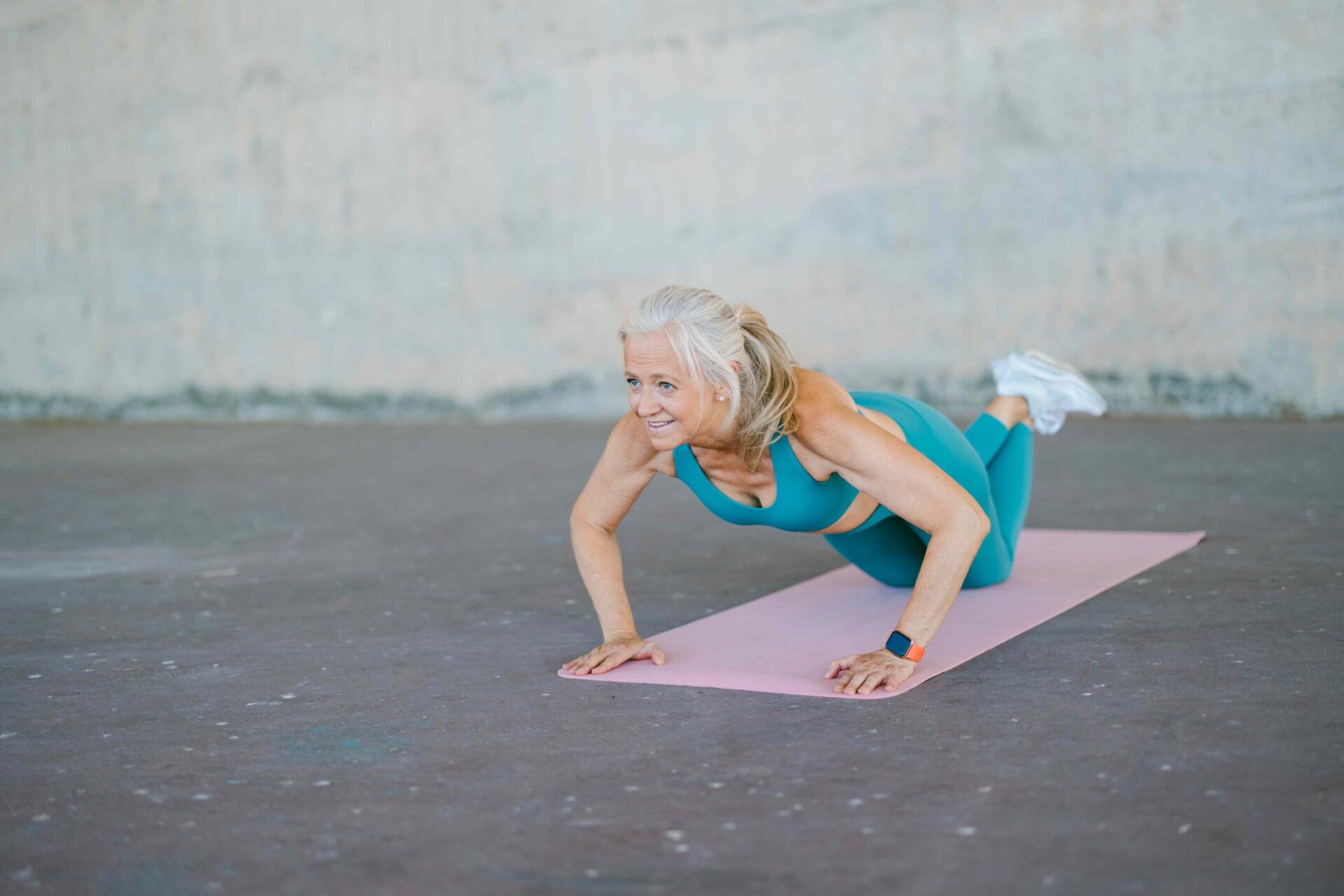
:max_bytes(150000):strip_icc():format(jpeg)/Health-GettyImages-1598818214-b5d21ce1644b479c8f0172bb2a57ae2b.jpg "A woman doing knee pushups on a yoga mat outdoors")
Credit: Israel Sebastian / Getty Images
- Bodyweight exercises are movements that use your body’s weight to resist gravity and build muscle. No free weights are required.
- Push-ups, squats, and dead bugs are examples of bodyweight exercises that can help you maintain and build muscle as you age.
- If some of the movements are too difficult for you, there are ways to modify them to make them doable.
Free weights are an excellent tool for building strength as you age, but you can still make progress using bodyweight exercises. For these exercises, progressive overload is what drives strength gains, and as long as you are doing more sets, reps, slowing down your tempo, improving your range of motion, and choosing more challenging variations, you can keep building strength even without weights.
1. Push Up
The push-up is one of the best bodyweight exercises for building upper-body strength. It targets the chest, shoulders, triceps, and core, making it a highly efficient movement for anyone looking to maintain muscle after 50.
To do a push-up:
- Start in a high plank position with your hands slightly wider than shoulder-width apart.
- Brace your core to keep your torso flat and bend your elbows to lower your chest toward the floor.
- Press through your palms to return to the starting position once you get close to the floor.
Tip: You can do these from your knees if the regular version is too challenging.
2. Pull-Up (Band-Supported)
Pull-ups are one of the most effective bodyweight exercises for strengthening the back, shoulders, arms, core, and grip. They are especially valuable as you age because they train pulling strength, which supports posture. These are incredibly hard to do at first without assistance, so it’s best to use a band to offload some of your weight. As you get stronger, you can remove the band.
To do a pull-up with a band:
- Loop a resistance band around a pull-up bar and place one foot or knee inside the band.
- Grip the bar with your hands slightly wider than shoulder-width apart.
- Brace your core, pull your shoulder blades down, and pull your chest toward the bar.
- Pause briefly at the top, then lower yourself with control until your arms are straight.
3. Split Squat
The split squat is a powerful lower-body exercise that targets the quadriceps, glutes, hamstrings, and calves. Because it trains one leg at a time, it can also help improve balance, coordination, and stability. As you age, these abilities are especially important to prevent falls and support everyday activities like climbing stairs, stepping off curbs, and getting up from the floor.
Split squats also allow you to build lower-body muscle without needing heavy weights.
To do a split squat:
- Stand with one foot forward and the other on a chair behind you.
- Keep your torso tall and bend your front knee (put 90% of your weight in this leg) to lower your back knee toward the floor.
- Press through your front foot to return to standing.
- Complete all reps on one side, then switch legs.
4. Squat
The squat is a foundational bodyweight exercise that builds strength in the legs, glutes, hips, and core. It also mimics a movement pattern you use every day, like when you sit in a chair or pick up something from the floor.
To do a squat:
- Stand with your feet about shoulder-width apart, pointing straight.
- Brace your core, push your hips back, and bend your knees to lower into a squat.
- Keep your chest lifted and your weight pressing through your mid-foot.
- Once you approach parallel, stand back up, making sure to prevent the knees from collapsing inward.
Tip: If a full squat feels difficult, start with a chair squat. Sit back toward a chair, lightly tap your hips to the seat, then stand back up. As you get stronger, use a lower chair or remove the chair altogether. Either way, the steps above apply.
5. Dead Bug
The dead bug is great for strengthening your deep core muscles. A strong core supports your spine, improves posture, and helps you transfer force more efficiently during exercises like push-ups, squats, and split squats. Unlike crunches or sit-ups, the dead bug trains your core to resist movement, which can help protect your lower back, a common weak point as you age.
To do a dead bug:
- Lie on your back with your arms extended toward the ceiling and your knees bent at 90 degrees.
- Keeping your core tight and your back pressed on the floor beneath you, slowly lower your opposite arm and leg toward the floor, then return to the starting position.
- Repeat on the other side, slowly going back and forth each rep.
What To Keep in Mind About Body-Weight Training
It’s important to note that at some point, you may be limited by how many sets or reps you can do with a bodyweight exercise since your body mass remains constant. That means that, unlike dumbbells or barbells, you cannot simply add five pounds to the movement. That said, bodyweight training is still an effective, accessible way to build muscle, improve joint stability, and maintain functional strength after 50.
The key is choosing exercises that work multiple muscle groups, can be modified for your current fitness level, and allow for gradual progression over time.