Rural MN sanctuary is home to lions, tigers, wildcats


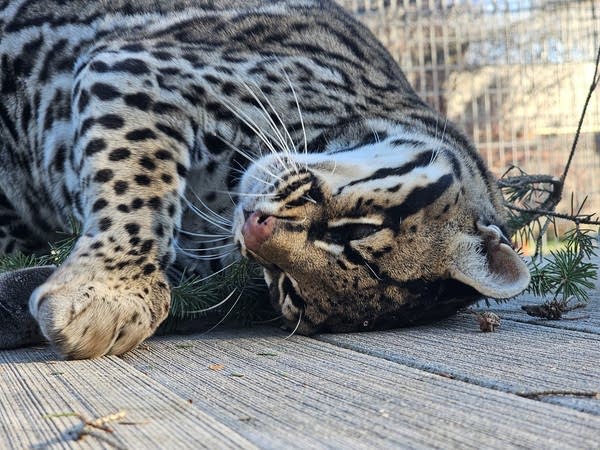
An ocelot rolls over on a deck.

The summer sun warms the grassy fields and woodlands at The Wildcat Sanctuary in rural Sandstone.

Rio the Ocelot has just woken up from a post-lunch nap and is slowly sauntering around her enclosure, probably deciding where to snooze next. She recently turned 27 years old and is the oldest of her kind in human care.

“She is definitely still a spunky old lady,” said Elyse Donnelly, animal care manager. In the wild, she would have likely lived to be about 10 years old.

Because she was raised in captivity, Rio would not be able to survive if released into the wild. She has lived in close proximity to humans her entire life, first as part of a species survival plan where she was used for breeding, then in a Texas zoo that closed down a couple of years ago. About two years ago, she was rescued and moved to The Wildcat Sanctuary.
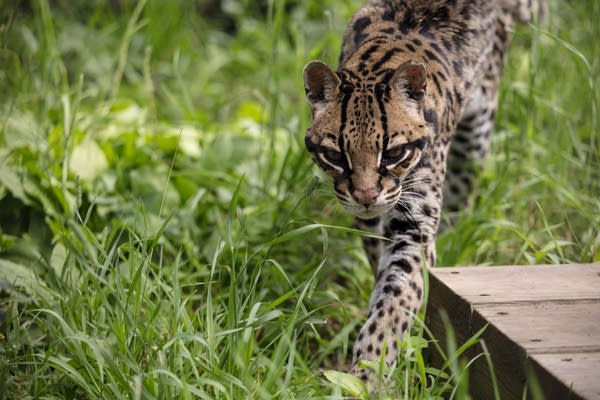
An ocelot moves through the grass.
Rio the ocelot pictured on July 11.
Courtesy of The Wildcat Sanctuary

Donnelly says the 25-pound cat may be getting old, but she still likes to climb around inside her enclosure and she’s very vocal, often “talking” to her caretakers in a low, guttural meow when she wants attention.

“She is an ocelot, they do like to be up high, but we needed to make things flatter, not quite as round for gripping, because her strength just isn't what it used to be,” said Donnelly.

The cats are kept in outdoor enclosures based on their size to make sure both big and small cats have room to run and climb around in the grass, and the sanctuary tailors their enclosure based on their personality and health and exercise needs as well. Rio’s caretakers have lowered objects in her enclosure to make it easier and safer for her to climb.
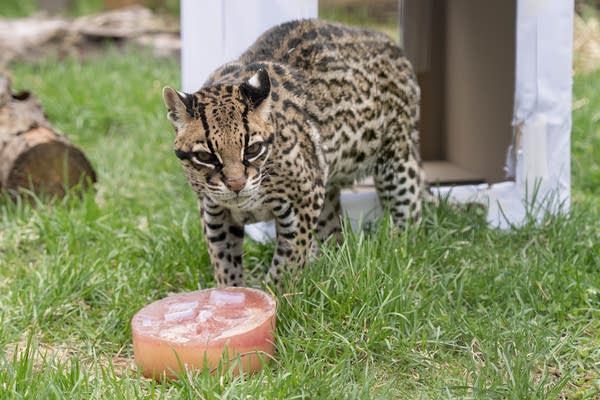
An ocelot moves through the grass.
Rio the ocelot enjoys a birthday "bloodsicle," made from frozen blood and chicken parts, taken May 16.
Courtesy of The Wildcat Sanctuary

Additionally, every cat has access to an indoor, air-conditioned room connected to their outdoor enclosure they can use to escape the summer heat.

“It's much nicer than sitting outside, especially with her age. As they get older, it can be harder,” said Donnelly.

Rio is just one of more than 150 wildcats that call this sanctuary home. The cats all come from varying backgrounds. Some of them have been abused, kept in tiny cages, declawed, or defanged, while others, like Rio, have been treated with more kindness.

One of the tigers, Indy, was taken in after her owner attempted to sell her on Facebook Marketplace.

A tiger stands in a grassy field.
Indy the Bengal tiger standing in a grassy field in her enclosure. She was brought to the sanctuary in May 2023.
Courtesy of The Wildcat Sanctuary

“At first, of course, we were like, that, that can't be real. Who would list a tiger cub on Facebook Marketplace?” said Donnelly, a bit incredulously. “We have so many stories like that. You wouldn't believe it.”

The one common trait that they all share is that they cannot survive in the wild.

“They've always been in contact with people, they've never learned from a mom how to take care of themselves, how to hunt, where to go for appropriate shelter, even what is their environment and taking them out there would be a death sentence for them,” said Donnelly.

A sanctuary for animals

The Wildcat Sanctuary is the only facility in the Midwest that cares exclusively for wildcats, and it accredited by the Global Federation of Animal Sanctuaries.

“What that really means is we don't buy, breed, trade, or sell. We are simply a home for life,” said Tammy Thies, founder and executive director of the sanctuary.

Another thing that separates the Sanctuary from zoos and many other refuges is that it is closed to visitors. There are no visitors buying tickets, tours or shopping at gift shops to supplement their income.

“We really try to keep it quiet for the cats, but we know our donors want to see how the cats are living and how they're helping the cats, so we do live posts on Instagram, Facebook all the time,” said Thies.

Unlike zoos, which can receive funding from the government through grants and taxes, the sanctuary, which costs about $3.7 million a year to operate, receives no funding from the state or federal government, even though they often help take in animals related to animal trafficking investigations.
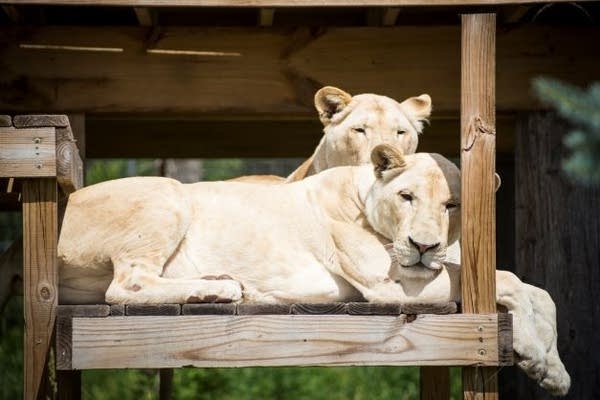
Two lions sit together
White Lionesses Alana and Aurora lie next to each other inside their enclosure.
Courtesy of The Wildcat Sanctuary

In some cases, the sanctuary will hold animals embroiled in active criminal and civil legal cases until they are resolved.

For example, when white lioness Alana and her sister Aurora both came to the sanctuary in 2021, the sanctuary was prohibited from sharing photos or videos of them.

The cats were connected to the “Tiger King” controversy, a Netflix documentary centered around Joseph Maldonado-Passage, an exotic zoo owner using the pseudonym “Joe Exotic.”

Maldonado-Passage is currently in prison for wildlife trafficking as well as attempting to pay two men to murder Carole Baskin, an animal rights activist and owner of the Big Cat Rescue in Florida.
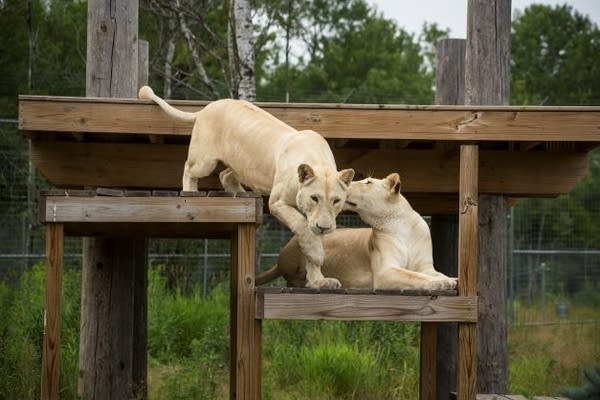
Two white lionesses walk along a large structure.
White lionesses Alana and Aurora were brought to the sanctuary in early 2021.
Courtesy of The Wildcat Sanctuary

When the lions were seized by federal authorities, Alana and Aurora were in the possession of Jeff and Lauren Lowe, who were allegedly keeping them in inhumane conditions, according to the Department of Justice.

While the legal proceedings in cases like this can drag on for months or even years, the sanctuary continues to care for the animals, but cannot disclose that they are there. The animals can’t be photographed or used for fundraising.

Most of the time the sanctuary does not receive any compensation for holding the cats in “witness protection” cats until the case is resolved.

So, The Wildcat Sanctuary is almost entirely funded by donations from the public.

A Boost from Hollywood Legend Tippi Hedren

Thies didn’t start out planning to dedicate her life to rescuing these fascinating animals, in fact, she came about his career in a roundabout. After graduating from the University of St. Thomas in St. Paul, Thies began a career in advertising. She was rising the corporate ladder with Coca-Cola in Atlanta, when she fell in love with two Bengal tiger cubs named Titan and Tango, and soon after she began volunteering at a organizations that worked with wildlife.

However, she found that many of the places she gave her time to were also breeding and selling the animals for profit. One place was holding baby cougars in metal corn cribs cut in half, creating small 8 x 12 foot enclosures. She reached a breaking point when one of the facilities she previously worked at planned to put down a Bengal tiger who refused to be put on a leash.
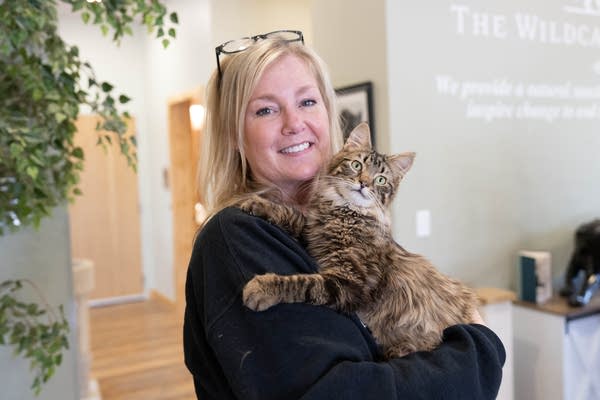
A woman holding a cat
The sanctuary is home to more than just wildcats. Founder and executive director of the sanctuary Tammy Theis, holds Teaspoon, one of a few domestic cats living in the sanctuary as an office pet.
Courtesy of The Wildcat Refuge

Thies quickly made a call to the Shambala Preserve in Acton, Calif., which was started by legendary Hollywood actress and Minnesota native Tippi Hedren, who was best known for films like Alfred Hitchcock’s “The Birds” and “Marnie.”

Although Hedren was willing to help, it turned out to be too late and the big cat had already been euthanized.

Both Thies and Hedren were furious.

Thies couldn’t stand the thought of seeing what had happened to that Bengal tiger happen to more big cats, so she began investing more of her time and money helping to get more animals in similar situations turned over to no-kill sanctuaries.

However, as she know Hedren better, the famous actress urged to get do even more.

“She convinced me that more sanctuaries like ours needed to exist if we were going to start closing down people that were exploiting the animals.”

A Bengal tiger looks at the camera.
The sanctuary’s first rescued animal was a Bengal tiger named Meme who was being mistreated by her owner and used for breeding
Courtesy of The Wildcat Sanctuary

Hedren didn’t sugarcoat anything and said it would not be easy to start a sanctuary, but it would be the only surefire way of helping the cats she held dear.

“She was a wealth of information, and she was very humble,” said Thies. “She kind of really made me think about sustainability and making sure that the sanctuary surpasses me.”

In 1999, Theis opened The Wildcat Sanctuary on a couple of acres outside of Atlanta. It soon became clear to her that she wouldn’t have enough space for the necessary wildcat habitat. So Thies returned home to Minnesota, bought some land outside of the town of Sandstone, about 90 miles north of the Twin Cities, and established the now 40-acre wildcat sanctuary.

She founded and grew the small nonprofit organization that runs the sanctuary, which has provided a safe, final home to over 350 cats so far, and Thies has no plans to stop taking in need of a new, safe home anytime soon.




Source link

Leave a Reply

Subscribe to Our Newsletter

Get our latest articles delivered straight to your inbox. No spam, we promise.

Recent Reviews


Being a founder is awesome. And it also really sucks.

It’s a huge amount of stress, disappointment and uncertainty, with little appreciation or guidance.

It’s perfectly normal to find yourself questioning what it all means.

I’ve been there myself… questioning whether the sleepless nights and stress was worth it. And now, I’m often the person founders turn to when they do the same.

In this essay, I wanted to talk about happiness, purpose, and how to get more of it when you’re constantly living in survival mode.

Three Types of Happiness

Martin Seligman, the father of positive psychology, describes three distinct paths to happiness: the pleasant life, the engaged life, and the meaningful life.

  • The pleasant life is about pleasure—closing a deal, hitting a milestone, getting some great customer feedback. As a founder, there’ll be phases where pleasure is hard to come by. Clearly, you can’t build a founder life on pleasure alone.
  • The engaged life is about flow—the state when you’re fully absorbed in solving a hard problem. Most founders have this in spades early on, but as their companies grow, their role can evolve away from flow. Being out of flow is often a signal you need to redesign your role.
  • The meaningful life is about purpose—the sense that what you’re doing matters. Unlike pleasure and engagement, meaning doesn’t require things to be going well. It sustains you through the hard times, not just in spite of them.

So when times are hard, meaning is what we can return to. Unlike pleasure and engagement, meaning is up to you.

And it’s work you can start right now.

How to Make Meaning

So how do you actually build meaning, even when you can barely see past next week? A meaningful life has three components:

  • A meaningful future
  • A meaningful past
  • A meaningful present

Creating meaning in each is an act of creativity. It’s an active process in which you assign meaning to things.

If you aren’t intentional about this, your brain will assign meaning for you. And if you’re not feeling great, your brain will come up with interpretations that match and then reinforce the negative feelings.

What I’m about to share with you is the process I run through when my clients start questioning themselves, and what they’re building.

1. A Meaningful Future

In Man’s Search for Meaning, Viktor Frankl documented the atrocities of the concentration camps. He writes:

“Any attempt to restore a man’s inner strength in the camp had first to succeed in showing him some future goal.”

A lot of modern therapy fixates on the past. But Frankl realised that getting clear on our future goal is even more powerful.

When it comes to founders, they often have goals… but unless you’re fully pumped, your goals need refinement. 

I commonly see three issues with a founder’s goals:

  • They have too many goals. We accumulate goals over time, but we rarely sit down and remove goals. For example, you had goals when you were 18 years old. Most of these have been parked, but some might still be guiding you now.
  • The goal isn’t big enough. For most founders, the more ambitious the goal, the more energy it unlocks. Just increasing the size of the goal can act as a powerful clarifying force for what matters.
  • The goal isn’t framed by its meaning. It’s the difference between ‘I want to make $100M’ versus ‘I want to help 10,000 customers avoid what happened to me’. One is financial, the other is personal.

Refining and reconnecting to your primary goal is critical for building a life of meaning.

Questions to work through:

  • What’s the biggest and most exciting goal you can dream up?
  • If that was your primary goal, what other goals stop being relevant?
  • What people or person could the bigger goal attract that would make it achieving it easier?

2. A Meaningful Past

Being a founder can sometimes feel like a full-contact sport. You can get hurt, through disappointment, bad luck, and even betrayal. That’s why painful events in the past need to be treated like a wound.

When we don’t process the past, unhelpful stories we tell ourselves to protect our ego can cause havoc in the present.

Treating the past means framing every single thing that happened in two ways:

  • A win: an accomplishment that we can celebrate.
  • A lesson: a failure that we learn from, that we can celebrate.

We leave everything else behind. If, for some reason, we can’t let something go, it means we haven’t learned something important from it. As my mentor used to tell me: failures will be repeated until learned.

This work can be done separately, but it’s even more powerful to do it in the context of a big goal. This way, the wins and lessons can be aligned to the vision that truly excites us.

Questions to work through:

  • What is the meaning of what you’ve been through?
  • How did those experiences serve you?
  • Where are they failing to serve you today?

3. A Meaningful Present

Here’s the thing: the future and the past don’t physically exist. They’re tools to help us act in the present.

Often, clarifying the meaning of a bigger future and a happier past makes changing the present obvious and necessary.

As founders, it’s easy to be driven entirely by the past: old goals, old activities, old habits. This stops us from growing. And a lack of growth is one of the fastest paths to feeling meaningless.

Most founders I work with don’t need to do more. They need the courage to do less.

Growth often requires us to:

  • Start doing something we haven’t done before
  • Stop doing something we’ve already mastered
  • Double down on getting even better at some things

The meaningful present is about making these changes — aligning how you spend your time with the future you’ve defined and the lessons you’ve drawn from the past.

Questions to work through:

  • What is the biggest bottleneck to making the big goal viable?
  • What do you need to stop doing—even if there’s a cost involved?
  • What do you need to delegate?

Happiness Isn’t Always Happy

A meaningful life isn’t always smiles and rainbows. It comes with difficulty, sacrifice, and discomfort. But it’s the thing that keeps you going when pleasure and engagement can’t.

If you’re a founder questioning what it all means, the answer isn’t to push harder or to quit. It’s to invest time in making meaning.

Start with the future. Let it reshape the past. And then rebuild the present around what actually matters.

Related Reading: 


Originally published on March 11th, 2026


How do top founders actually scale?

I’ve coached CEOs for 10,000+ hours—here’s what works.
Join 17,000+ founders learning how to scale with clarity.

Unsubscribe any time.


Source link