
Great hotel, not-so-great stay: Here’s what didn’t work at The Bellagio


The Bellagio is a legendary hotel in the heart of the Las Vegas Strip, but I recently had a somewhat disappointing stay there.

After posting a room tour I did while at the hotel — the only post of mine to ever go “viral” on Instagram — a lot of Bellagio fans were not happy with my mild disappointment, so I wanted to explain the experience here in a bit more detail.

Here’s what we look for at The Points Guy when it comes to a great hotel stay — and why The Bellagio Resort and Casino didn’t quite fit the bill this time.

Related: These are the hotel openings TPG is most excited for in 2026

About the hotel

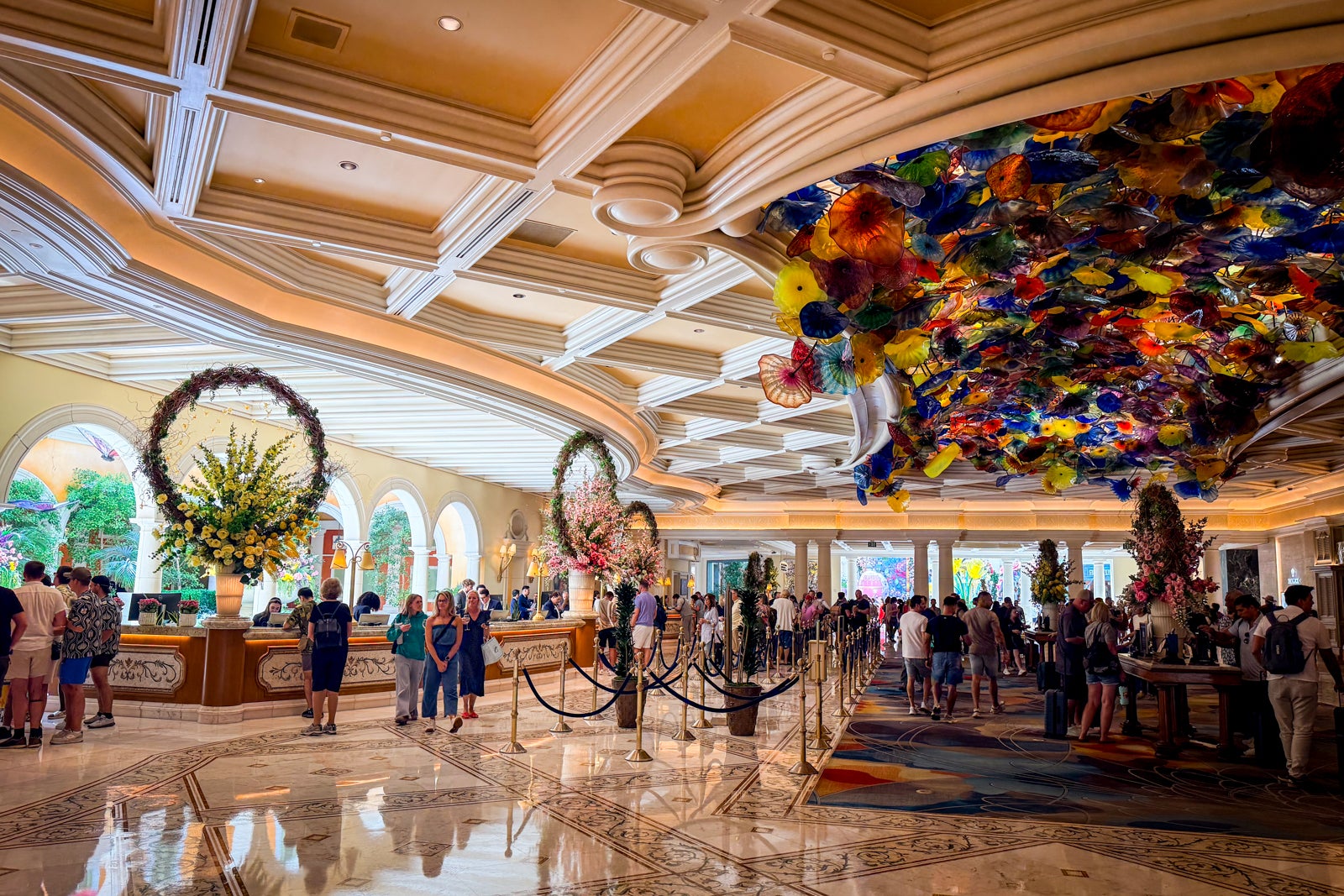
The Bellagio is a world-famous hotel in the center of the Vegas action. It’s probably best known for its incredible fountains located right on the Strip. The lobby features a spectacular ceiling sculpture by the artist Dale Chihuly.

CLINT HENDERSON/THE POINTS GUY

The lobby is also where you’ll find an iconic 14,000-square-foot botanical garden and conservatory.

CLINT HENDERSON/THE POINTS GUY

And that’s not all the hotel has going for it — it was also renovated a few years ago (TPG’s own Summer Hull loved the updated room she stayed in, in 2021.)

Booking through Home Away From Home

During my recent visit, I stayed in a renovated room on a high-up floor, and indeed, my room itself was fine.

The problems, though, mostly stemmed from my expectations, since I booked through Bilt’s new Home Away From Home portfolio, which comes with several important perks (or it’s supposed to).

Reward your inbox with the TPG Daily newsletter

Join over 700,000 readers for breaking news, in-depth guides and exclusive deals from TPG’s experts
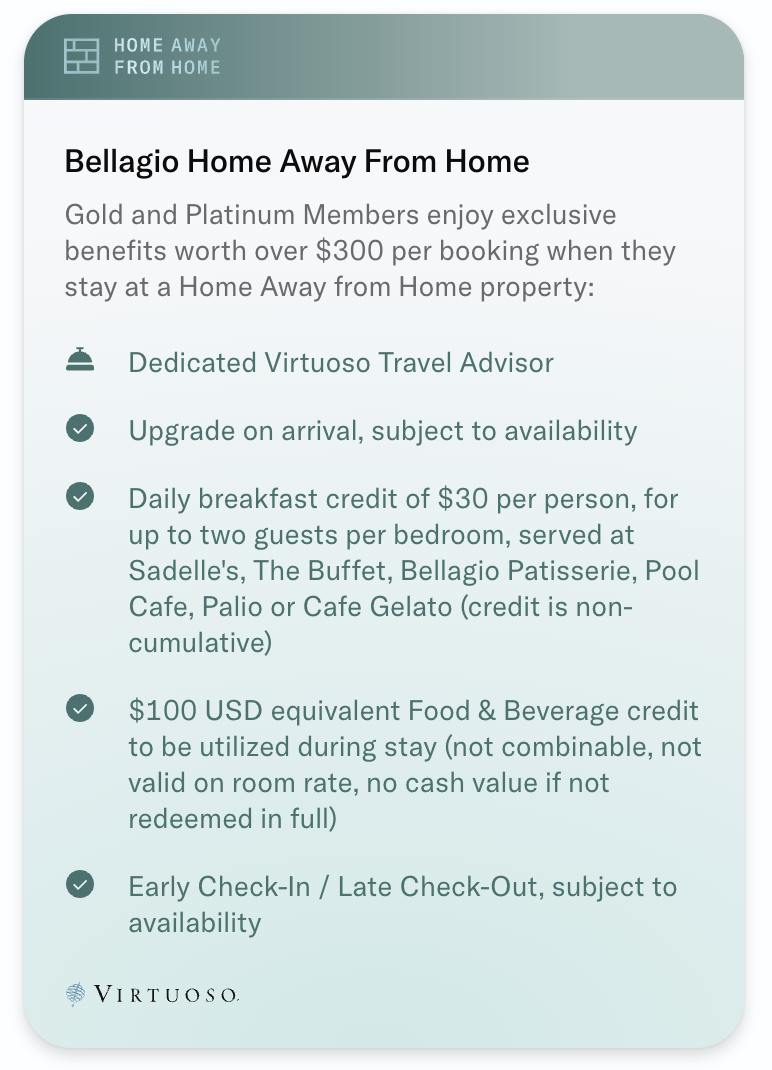
Bilt Home Away from Home perks at Bellagio.
Bilt Home Away from Home perks at Bellagio. BILT

These perks include:

  • Early check-in
  • Late checkout
  • Daily breakfast for two (up to $30 breakfast per person at Sadelle’s, The Buffet, Bellagio Patisserie, Pool Cafe, Patio or Cafe Bellagio)
  • $100 food-and-beverage property credit
  • Space-available upgrade

Here’s what didn’t work and what could’ve gone better

No upgrade
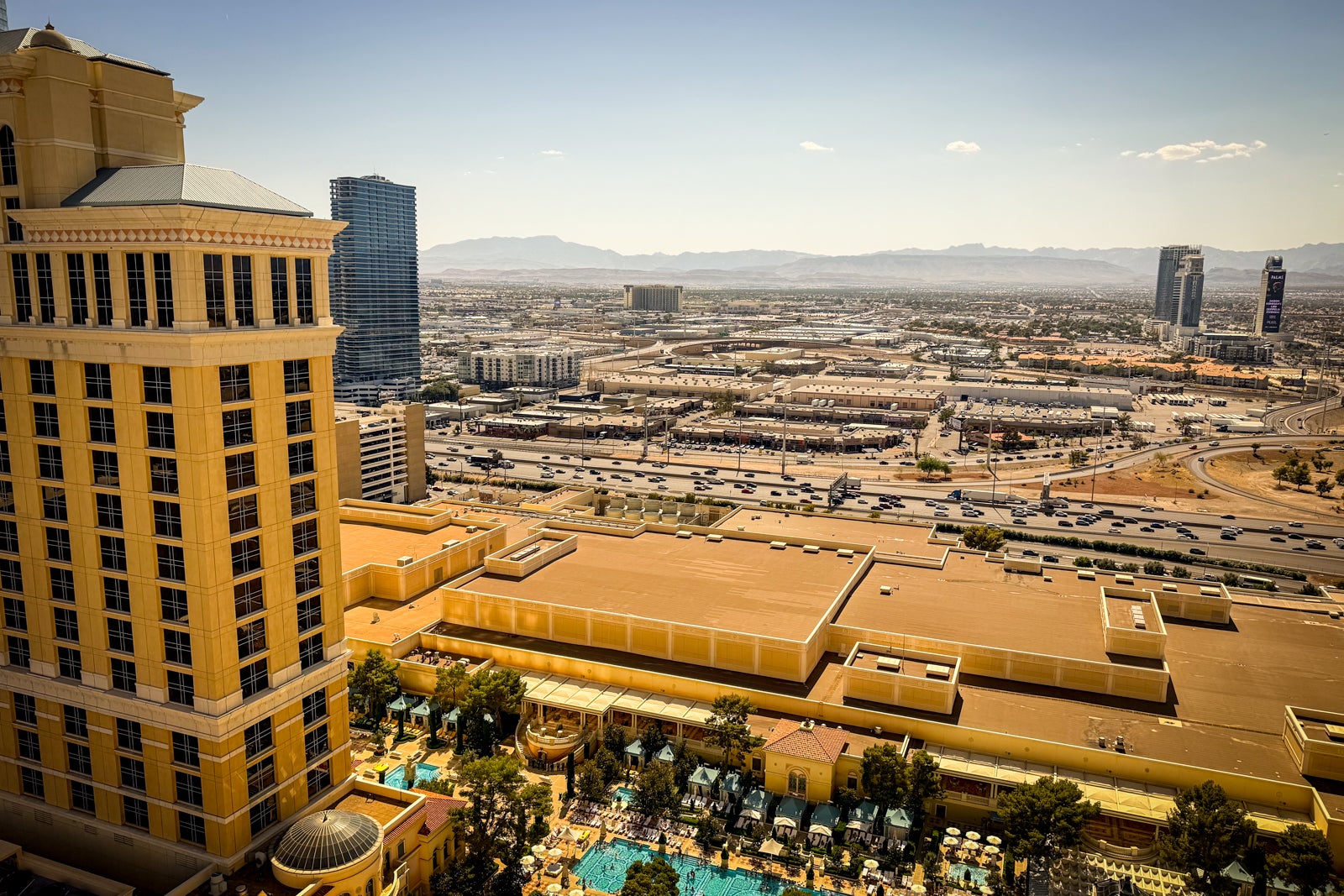
CLINT HENDERSON/THE POINTS GUY

Bilt Home Away From Home states that upgrades are subject to availability; unfortunately, I didn’t get one.

I booked a “1 Premier, King, View, 1 bed,” which I would have assumed would have a great view, but it left much to be desired. Room 28033 looked out over the back of the hotel. While I did have a view of some of the swimming pools, I did not have a view of the Strip or the Bellagio Fountain. Instead, I looked out on Interstate 15.

Between this disappointing view and no available upgrades, this was a bummer.

Ignored concierge requests

The hotel says that guests are able to text the concierge service number for assistance 24/7. However, I made multiple attempts to get a response to a request for help getting tickets to a show. There was no reply until they reminded me I needed to checkout by 11 a.m.
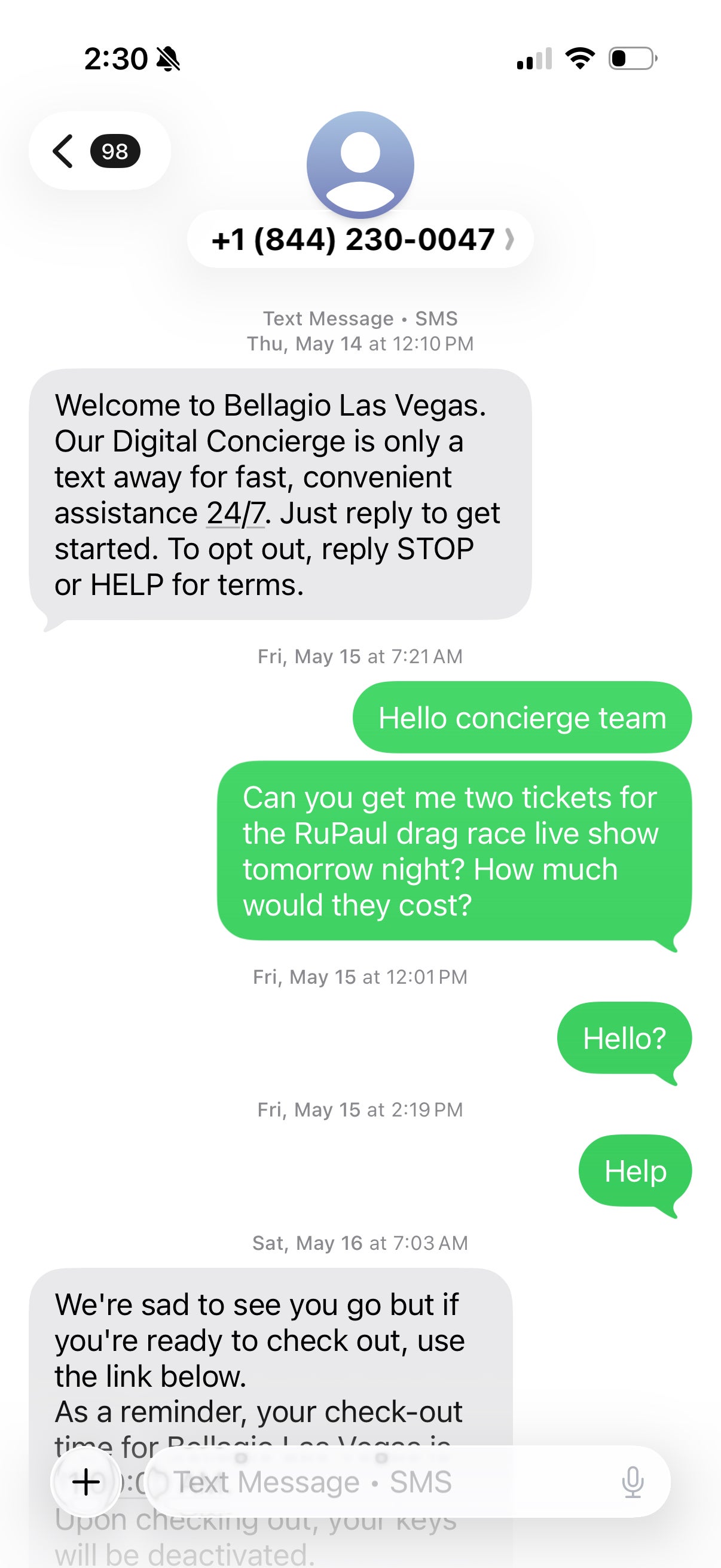
Text thread from hotel.
Text thread from hotel. BELLAGIO

Unstable WiFi

There’s no excuse for bad WiFi these days in any hotel. Sadly, the WiFi at Bellagio was not great. I had trouble getting anything to stream, and Zoom calls weren’t great either.

Refused late checkout

One of the benefits that I was counting on using was late checkout. It is supposed to come with my booking via Bilt, but no dice. I called the front desk to confirm this benefit, and the receptionist said they didn’t do late checkout after noon, which was confusing. It was especially annoying because I was moving hotels, and I couldn’t check into my next hotel until 3 p.m.

The stay was expensive
CLINT HENDERSON/THE POINTS GUY

My biggest gripe is that staying at The Bellagio was very expensive. I paid $769.86 for two nights, after a $100 credit for using Bilt Cash to book through the Bilt portal. It would have been $870 for two nights, including the $50-per-night resort fee. Thankfully, I also got a good statement credit from Bilt.

The Bilt Palladium Card(see rates and fees) gives you a $400 Bilt Travel portal statement credit each year for hotel bookings made through the portal. You get $200 to use every six months.

If I had paid the full, nearly $900 out of pocket for two nights at the Bellagio, I would have been even more disappointed.

I will say that there were several large conventions in town during my visit, so maybe I was just unlucky on some of the issues.

What I loved
RYAN SMITH/THE POINTS GUY
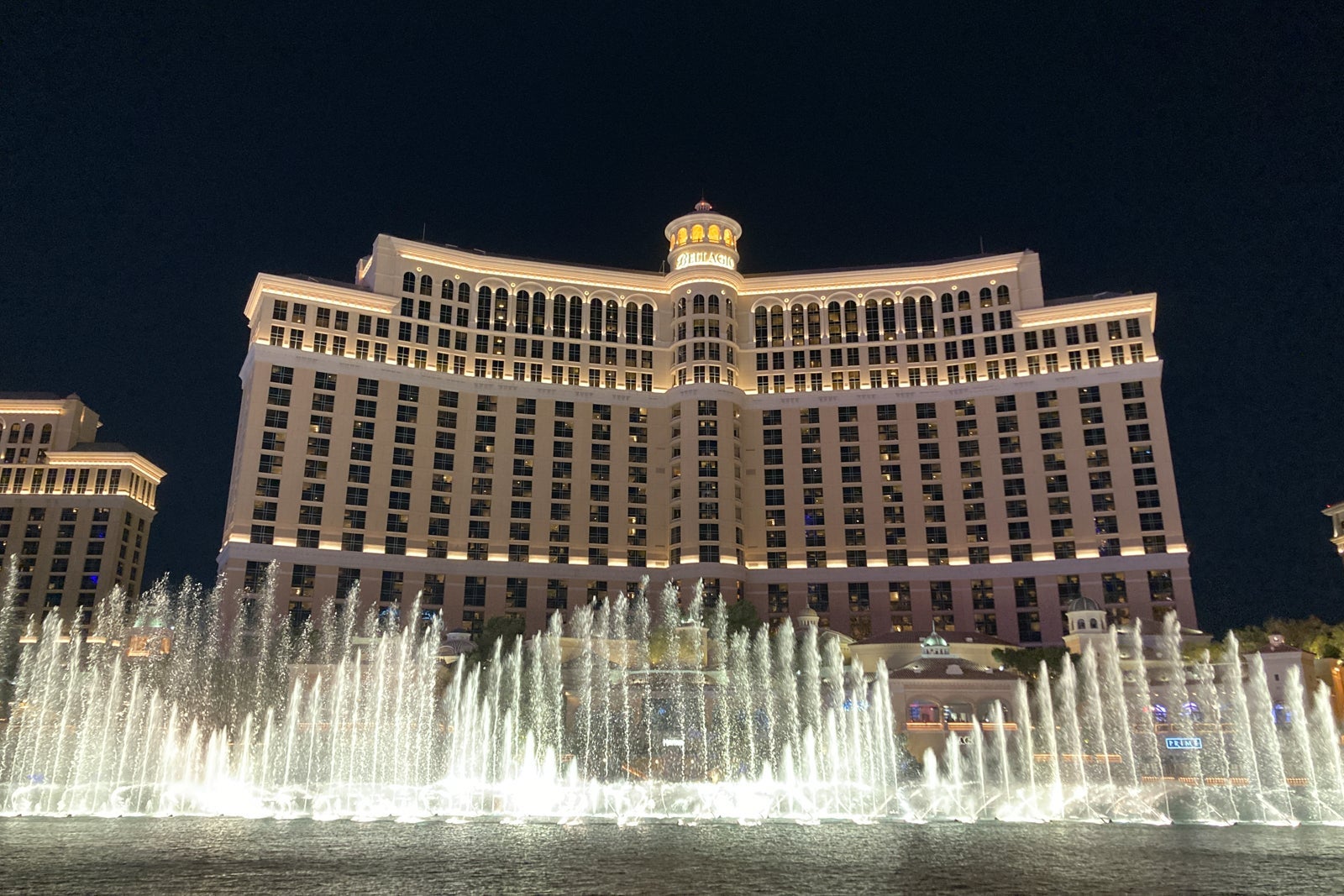
  • Of course, the best things about the Bellagio are the location and the stunning fountains in front. Even if you’re not staying there, you can enjoy the display. There’s a show every thirty minutes in the afternoons and then every 15 minutes at night.
  • There are plentiful food and beverage options at the hotel, which is convenient. For example, my Home Away From Home booking via Bilt included a $100 F&B credit at the resort. I also got a daily $30 credit for breakfast. I counted more than 15 dining options. And best of all, there were no issues using those credits on my bill at the end of my stay.
  • The hotel has an incredible casino, as you’d expect, and there is a great shopping mall attached to the hotel. You are also in the center of the action. It sits between Caesars Palace and Aria, and many of the biggest attractions in Vegas are within walking distance (go see Drag Race Live at the Flamingo).
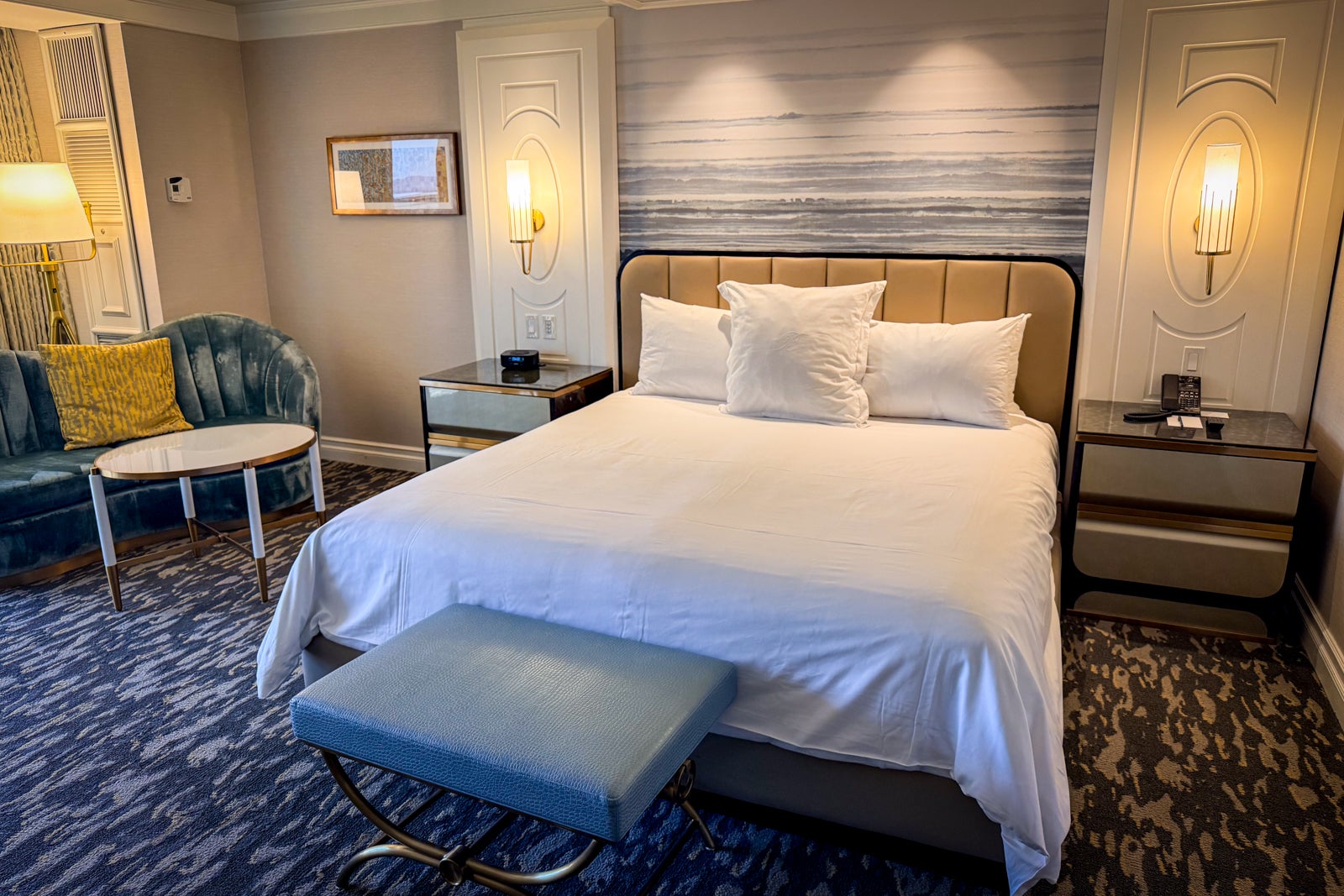
  • The renovated rooms are pretty nice, if you can score one with a decent view.

Bottom line
CLINT HENDERSON/THE POINTS GUY

No shade to The Bellagio, but the poor Wi-Fi, a lack of promised benefits, unreliable customer service and high prices made for a less-than-stellar combination.

Despite my disappointment, I would stay again if the price was right. I appreciated being able to use some of my Bilt credits for the stay, and I like the renovated rooms.

I think the key is to set some realistic expectations about what you get if you book via a third-party like Bilt Home Away from Home or American Express Amex Fine Hotels + Resorts.

And maybe don’t go during a major conference in Las Vegas.

Related reading:


Source link

Leave a Reply

Subscribe to Our Newsletter

Get our latest articles delivered straight to your inbox. No spam, we promise.

Recent Reviews


QlikView Mapping – Table of content

What is QlikView Mapping?

QlikView Mapping is incidentally creating a table (mapping table) utilizing information or field values from prior tables from various models and sources. The mapping tables are put away in QlikView’s memory just till the content is implemented and from that point forward, it is naturally removed. Mapping makes a table with arranged information fields and values whose script can be availed in various manners via statements or as functions (Rename Field, MapSubstring(), ApplyMap(), Map… Using and so forth) You can supplant field names or esteems during content execution utilizing mapping.

A Mapping table is made to plan the column values among two tables. It is also known as a Lookup table, that is simply used to search for a value from some other table. There are numerous functions accessible in this Mapping strategy to deal with the database table mapping. Mapping tables or Mapping load fills in as a choice to Join statements in the data set. The lookup value and the mapping value are the two columns in the mapping table. Mapping Tables are transitory tables as they are naturally taken out from the information model before the end of the implementation of the content. 

Start learning QlikView Online Course from hkrtrainings to make a bright career in the world of Qlikview!

QlikView Mapping Load Statement

The Mapping Load statement is utilized to stack fields and values into a newly made mapping table in QlikView. 

Syntax

Mapping(loadstatement | selectstatement)

The term Mapping is utilized as a prefix to LOAD or SELECT proclamations directing the framework to save the stacked fields in the mapping table. A mapping table includes two columns of which, the first includes values for examination (as a kind of reference point) and second includes the outcome or wanted values dependent on the correlation. For example, when country codes are used as the reference section and second resultant column is  nation names. The nation codes will be supplanted by the comparing nation names upon content implementation.

Example for mapping load in QlikView,

// Load mapping table of country codes:

MapCountry:

mapping LOAD * 

Inline [

CountryCode, Country

Sw, Sweden

Ind, India

Chn, China

Ity, Italy,

Cnd, Canada

Dk, Denmark

No, Norway

];

Along these lines, this will stack a mapping table called MapCountry which has two columns, Country and CountryCode. The elements of the given mapping tables can be utilized in turn by planning statements and other operations like ApplyMap. 

Qlikview Training Certification

  • Master Your Craft
  • Lifetime LMS & Faculty Access
  • 24/7 online expert support
  • Real-world & Project Based Learning

QlikView ApplyMap Function

The QlikView ApplyMap() function brings content from a current mapping table. It also maps the outcome of an expression to a current field from the mapping table. 

Syntax

ApplyMap(‘map_name’, expression [ , default_mapping ] )

Here, map_name is the name given to the pre-existing mapping table. The expression is the field whose outcome must be mapped to a mapping table field. default_mapping is the value, whenever referenced will be returned if there is no match of the field esteems from the current mapping table. The worth is returned all things considered in the output table, if not referenced.

Get ahead in your career with our QlikView Tutorial!

Example of Qlikview ApplyMap Function

Allow us to improve comprehension of this by the assistance of an example. Consider the one with a similar nation code example as we utilized in the mapping load area.

// Load list of store managers, mapping country code to country

StoreManagers:

LOAD *, 

ApplyMap(‘MapCountry’, CountryCode,’Others’) As Country

Inline [

CountryCode, StoreManager

Sw, John Dalton

Cnd, Mary Robins

Ity, Andrea Russo 

Arg, Harry Gibson 

Dk, William Gilbert

Ind, Indrani Sen

No, Daniel Larsen

Rom, Emilia Mark];

// We don’t need the CountryCode anymore

Drop Field ‘CountryCode’;

The resultant table will look as given below.

From this table, the name of the nation relating to the nation code composed next to the store supervisor name is mapped into the last table utilizing an applymap function. Likewise, those nations (like Arg and Rom) for which there were no reference country names in the table “MapCountry” are composed as “Others”. 

Business Intelligence & Analytics, qlikview-mapping-description-0, Business Intelligence & Analytics, qlikview-mapping-description-1

Subscribe to our YouTube channel to get new updates..!

Benefit of utilizing Mapping table and ApplyMap Function: 

  • Aids in dodging joins in QlikView. 
  • Aids in diminishing tables from the data model to simplify it, productive and justifiable. 
  • Mapping Table is only there during load. 
  • Missing rows can be dealt with by its third parameter  consequently aids in taking care of the null qualities and utilized in information integrity in ApplyMap Function.
  • It disregards the duplicate rows in the table. 
  • We can utilize composite keys as a critical column in the table. 
  • We can make different maps from a similar table. 
  • It saves processor time and memory. 
  • It cleans the information by eliminating the information disparities.

QlikView Architecture

QlikView is developed with a totally different way to deal with information disclosure than other conventional platforms. It doesn’t initially assemble an inquiry and afterward bring the outcome dependent on the query. It structures relationships between various data objects when it is stacked and prompts the client to investigate the information in any capacity. The information drill down ways can occur toward any path as long as the information is accessible and related. A client can assume a part in making the connection between information components utilizing information modeling approach accessible in QlikView.

Qlikview Mapping Architecture

QlikView’s architecture comprises a front end to picturize the prepared information and a back end to give the security and distribution component for QlikView client records. The image given above portrays the inside working of QlikView. 

Front End

Front end in QlikView can be defined as a browser oriented access point for reviewing the QlikView archives. It includes the QlikView Server, that is fundamentally utilized by the Business clients to get to already made Business Intelligence reports via a web or intranet URL. Business clients investigate and interface with information utilizing this front end and determine decisions about the information. They team up with different clients on a given arrangement of reports by sharing bits of knowledge and investigating information together, continuously or offline. These client archives are in the configuration .qvw, which can be put away in the windows OS as an independent record. The QlikView server in it deals with the customer server correspondence between the client and QlikView backend framework.

Back End 

The QlikView backend comprises QlikView publisher and QlikView desktop. The QlikView desktop can be considered as a wizard-driven Windows environ, that has the highlights to stack and change information from its source. Its simplified element is utilized to make the GUI format of the reports which gets noticeable in the frontend. The record types that are made by the QlikView desktop are put away with an extension of .qvw. These are the documents which are given to the QlikView server in the front end, that serves the clients with other records. .qvw documents can be adjusted to store the information only records, called as .qvd records. They are records that include just the information and not the GUI parts. The QlikView publisher is utilized as a circulation service to convey the .qvw reports among different QlikView servers and clients. It manages the approval and access advantages. It does the immediate stacking of information from the data sources by utilizing the association strings characterized in the .qvw records.

Highlights of QlikView planning 

Some significant highlights of QlikView planning are: 

  • It is like the query function where a field esteem is utilized as a source of reference to another field existing in the mapping table and returns a coordinating outcome. 
  • A mapping table is always made by Mapping Load or Mapping Select prior to applying a Map work. 
  • A mapping table stays briefly in the memory of QlikView till the next time content implementation is finished. It is exited once a content is executed. 
  • The transitory mapping table doesn’t influence the fundamental information tables put away in-memory of QlikView. 
  • Any mapping table can be reviewed and reutilised in a content however many occasions as a client needs. 
  • The principal field is known as a key and the subsequent field or column is alluded to as mapped value ALWAYS. 
  • All the planning necessities can be done in a solitary script.

Qlikview Training Certification

Weekday / Weekend Batches

Conclusion

The blog dealt with QlikView mapping with QlikView ApplyMap() and mapping load. We get to know more about mapping, how to make mapping tables utilizing the Mapping Select statements or Mapping Load lastly and how to utilize mapping via the ApplyMap() work.

Other Related Articles:


Source link