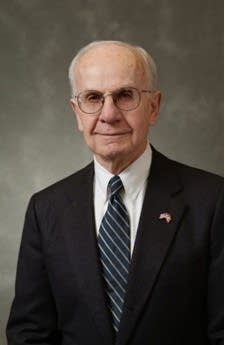
One of Minnesota’s longest-serving federal judges has died. David Doty would have turned 97 years old on Tuesday. He was best known for his rulings in thorny labor disputes between pro football players and the NFL.
Doty had been working as a private attorney for a quarter century when President Ronald Reagan tapped him to fill the seat of retired judge Miles Lord. After a protracted confirmation process, Doty was about to give up. But his fortunes changed during a 1987 ski trip when he got an unexpected phone call.
“It was the president. And he said I’ve got an appointment here for the district judge in Minnesota. You still want to do it? I go ‘oh yes sir.’ And he said OK I’ll sign it. Hung up, and that was that.”
Doty recounted that moment a few months later in an interview with Robert Stein, his University of Minnesota Law School classmate in the class of 1961 who later became dean.
As a new judge, Doty said he relied on his clerks to analyze arguments and draft orders. Randall Kahnke, now an attorney in Minneapolis, clerked for Doty from 1989-91. He says the judge’s time as a Marine Corps captain in the 1950s shaped his public service ethic and the day-to-day practicalities of managing hundreds of cases.
But Kahnke says Doty was no drill sergeant and knew that the law isn’t abstract.
“He understood that the law, at its heart, ultimately is about affecting the lives of human beings. Cases ultimately affect the lives of individual people, and he never lost sight of that,” Kahnke said.
One of Doty’s first major trials was of 1980s cocaine kingpin Ralph “Plukey” Duke, who is serving life in prison. Doty sentenced Duke’s co-defendant Serena Nunn to nearly 16 years.
A decade later, the judge was among those who petitioned President Bill Clinton to commute Nunn’s sentence over an evidentiary error. In 2000, Doty told MPR News that federal law required him to impose a long sentence, something he did not want to do because of Nunn’s young age and lack of a criminal record.
“A few months would have been very sufficient,” Doty said. “And if she could come out and show that she was rehabilitated and carry on as a good citizen. That should be the end of it. That’s the whole process, the way it should work.”
Nunn later became an attorney and received a full pardon from President Barack Obama.
Criminal cases are a big part of every judge’s life. But Doty is best known for his two decades handling disputes between the NFL and its players. After initially siding with the league, Doty allowed players to sue over the NFL’s restrictive free agency rules.
When a jury struck down a limited free agency system in 1992, Doty issued rulings that helped clear the way for players to move more freely between teams. Philadelphia Eagles defensive end Reggie White later led a class-action lawsuit that brought a better deal for players and salary caps for owners concerned about payroll costs.
Chief Judge Patrick Schiltz said in an interview with MPR News on Monday that Doty could have retired decades ago with his full salary. As a senior judge, Doty had the option to limit his caseload, but still kept a full docket.
“There was never a time in his life when he didn’t work and work hard,” Schiltz said. “He loved the legal work. He loved being in the courtroom. Even at 95 or 96, his lunch schedule, dinner schedule, golf schedule, was way, way busier than mine.”
Schiltz said that he never had any concerns about Doty’s mental acuity. His quick wit and intellect never wavered either in the courtroom or chatting with friends.
Schiltz added that Doty remained in good health until he broke two bones in a fall after exercising and was “completely at peace” that his long life was nearing its end.
Asked in the 1987 interview about the power of his position as a federal judge, Doty recounted his time in the Marines as commander of a nuclear artillery platoon, and made an analogy to the weapons he said he was grateful to have never launched.
“I think the power that’s there, that’s never used, is sometimes more important than the power that’s used,” Doty said. “And I think as a federal district court judge, I’m trying as hard as I can to never overuse the power that I know the judge has.”
Doty said he felt that it was important for him to give back to society through service, whether as a Marine or a judge, and that he hoped to build a reputation for dispensing justice with courtesy and compassion.