

I’m the type of traveler who will plan an entire trip around great meals.
I love experiencing destinations and cultures through their food, so whether I’m at home or on the road, dining out is one of my biggest expenses.
Dining out has only gotten more expensive in recent years. Fortunately, several of the travel rewards cards I carry offer dining statement credits that not only save me money on meals throughout the year but also help offset their annual fees.
Here are some of the cards I keep in my wallet specifically for their dining statement credits (among other reasons) and how I make sure to maximize them.
For upscale date nights: Chase Sapphire Reserve
The Chase Sapphire Reserve® (see rates and fees) gets a lot of attention for its numerous travel perks, but it also has an extremely valuable dining benefit.
Cardholders can earn up to $300 in statement credits each calendar year split into two biannual credits of up to $150 each from January-June and July-December when using their card to pay for meals at Sapphire Reserve Exclusive Tables restaurants on OpenTable (no prepayment, payment or reservation through OpenTable is required).

The program just started last year, but there are already eligible restaurants in dozens of U.S. cities.
My husband and I used one of these credits last fall at the fancy French-Californian bistro, Jeune et Jolie, in the coastal hamlet of Carlsbad, just north of San Diego. We used our first credit of 2026 at the one-Michelin-star Thai restaurant, Anajak, near our home in L.A.
Both were fabulous, and the $150 statement credit made the experience even sweeter.

Reward your inbox with the TPG Daily newsletter
Join over 700,000 readers for breaking news, in-depth guides and exclusive deals from TPG’s experts
I also make a point of using this benefit for restaurants I’d already planned to visit, rather than choosing one simply because it’s eligible. That’s how I make sure the credit saves me real money instead of encouraging extra spending.
Related: Chase Sapphire Reserve review: A premium card for power travelers
Delicious savings for foodies: The Amex Gold
The American Express® Gold Card charges a considerable annual fee of $325 (see rates and fees), but I make up for that value just from the card’s dining perks.
Specifically, the card offers:
- Up to $100 in annual statement credits on dining at eligible U.S. Resy restaurants when you use your card to pay; up to $50 from January-June and up to $50 from July-December.
- Up to $120 in annual statement credits (up to $10 per month) at Grubhub (including Seamless), Buffalo Wild Wings, Five Guys, The Cheesecake Factory and Wonder.
- Up to $120 in Uber Cash ($10 per month) for U.S. Uber and Uber Eats orders†
- Up to $84 per calendar year (up to $7 per month) in statement credits for U.S. Dunkin’ purchases.
Also, in celebration of the Amex Gold’s 60th anniversary, Amex is including a one-time statement credit of up to $96 for an annual Uber One membership (enroll by Oct. 30).
Those four benefits alone amount to $424 in annual value I can use, $520 if you include the one-time Uber One membership.
Enrollment is required for all benefits.
†Uber Cash will only be deposited into one Uber account when you add the Amex Gold as a payment method and redeem with any Amex card.

I live in Los Angeles and regularly book restaurants through Resy, so that credit comes and goes before I even realize it most of the time. Most recently, I used it at an Italian restaurant, Funke in Beverly Hills, for my husband’s birthday. Because I knew we were getting $50 off the final tally, we splurged on a few desserts.
My husband and I also regularly order from our favorite local Thai and Mediterranean restaurants on Grubhub and get up to $10 in statement credits every month.
I’ll admit, I don’t always get to a Dunkin’ to use that credit, but I do love popping in for a coffee when I see one.
Finally, although I sometimes use the card’s Uber credit for rides, more often than not, I’ll actually just put it toward an order from a great sandwich shop near me called Ggiata, which serves heaping subs. The bonus is that my order is usually delivered by a cute robot!
Related: American Express Gold Card review: The best card for foodies
Modest savings month after month: Marriott Bonvoy Brilliant Amex
I recently applied for the Marriott Bonvoy Brilliant® American Express® Card during a recent limited-time elevated welcome offer (no longer available). I was wowed by the bonus points I could earn as well as the card’s robust set of benefits, which just happen to include up to $300 in dining statement credits each year.
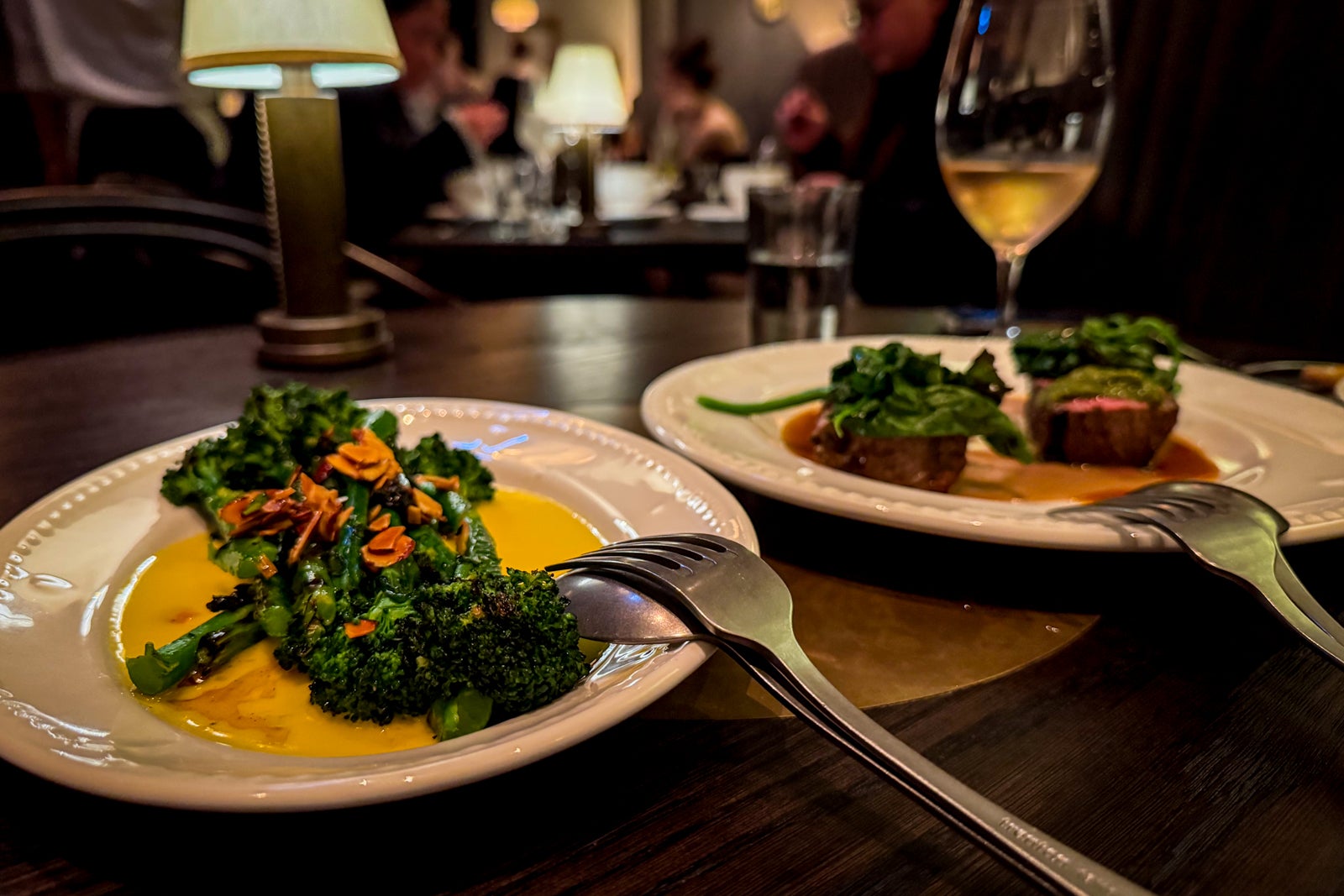
This is one of the easiest credits for me to maximize because I simply leave the card in my wallet and use it for one inexpensive restaurant purchase every month. I don’t have to change my spending habits; I just have to remember which card to use.
Cardholders can earn up to $25 in statement credits toward eligible restaurant purchases worldwide each calendar month. That’s up to $300 in annual statement credits over 12 months, which is nearly half the card’s $695 annual fee (see rates and fees).
Best part is I plan to get even more value than that thanks to the perks I’ll receive with the automatic Marriott Bonvoy Platinum status.
Related: Marriott Bonvoy Brilliant Amex review: Marriott’s most premium card
Takeout and dining in: Citi/AAdvantage Executive
I love the Citi® / AAdvantage® Executive World Elite Mastercard® (see rates and fees) specifically because it provides complimentary Admirals Club membership and opportunities to boost your elite status.

But even I sometimes forget that this card also offers a statement credit of up to $10 per monthly billing statement on eligible Grubhub purchases, totaling up to $120 per year.
Fortunately, because we already order through Grubhub regularly, remembering to use the credit usually doesn’t require changing our routine. Combined with my Amex Gold’s up to $10 monthly dining statement credit (which can be used with Grubhub), we receive up to $240 each year toward food delivery we’d be ordering anyway.
Related: Citi/AAdvantage Executive World Elite Mastercard review: Complimentary Admirals Club membership
One card I’m considering for even bigger dining savings
While I don’t currently carry the American Express Platinum Card®, I’m thinking about getting it because of its benefits bonanza, one of which is up to $400 in statement credits per year when dining at eligible U.S. Resy restaurants.

Cardholders get up to $100 in statement credits each quarter when using their card to pay at eligible U.S. restaurants affiliated with Resy (enrollment required). Simply pay with your Amex Platinum at an eligible U.S. Resy restaurant; no reservation is required.
So if you dine out at Resy restaurants, this can be a huge savings.
I’m personally considering whether I’ll maximize this card’s other benefits before applying, but the Resy credit alone has me thinking about it.
Related: Amex Platinum Card review: Steep annual fee but loads of new perks to match
Bottom line
There’s no doubt that dining out has gotten more expensive lately. Fortunately, I save more than $1,000 each year on restaurants and food delivery without changing my habits.
While some credits are easy to use, others require monthly tracking. Still, given the value these perks offer for my specific needs, as well as the other benefits these cards offer, I plan to keep them in my wallet for the time being.
If you’re considering a card with dining credits, I’d recommend focusing less on the dollar amount and more on whether you’ll actually use the benefit. The best statement credit is the one you don’t have to go out of your way to redeem.
Related: Monthly checklist: Credit card perks and benefits you should be using
For rates and fees of the Amex Gold card, click here.
For rates and fees of the Marriott Bonvoy Brilliant Amex, click here.

Stacie Harris is a local resident and reporter of the Maple Grove area. Stacie reports on medicine and science for the Maple Grove Report.



:max_bytes(150000):strip_icc():format(jpeg)/Health-GettyImages-2205062854-9484b16053c94d48bdb4180b9b2f70f9.jpg "A bowl of smooth peanut butter next to scattered peanuts on a dark surface")