Azure IoT Edge Overview | Step by Step Guide to Learn Edge Modules


Microsoft Azure IoT Edge empowers the simple management and integration of Internet of Things (IoT) application areas that incorporate Microsoft Azure cloud services with on-premises computer equipment and service providers.

Microsoft Azure IoT Edge would’ve been comprised of the IoT Edge Runtime, which would have been installed on a computer or device. Such devices also might run Windows or Linux and require Docker to be configured. Eventually, the Azure IoT Edge Runtime utilizes Docker to run IoT Edge Modules on the device, with a connection to Microsoft Azure IoT Hub dictating which components to incorporate and implement.

Become a master of IoT by going through this HKR IoT Online Training!

Azure IoT Edge Module:

With Azure IoT Edge, cloud compute abilities are propelled back to answer on edge devices via the use of IoT Edge Modules. An Edge Module is the lowest level of compute managed by IoT Edge Runtime. These modules could include Azure services like Azure Stream Analytics, or they could contain your own domain-specific module code required by your IoT Edge solution.

The development, construction, and deployment of  the IoT Edge modules has been divided into various logical steps:

  • Creating an IoT Edge Module – An IoT Edge Module will be created by writing it in any supported language such as C#, C, or others. (Some modules, such as those for running Azure services on IoT Edge, are prebuilt by Microsoft.)
  • Module Build as well as Deployment to Docker Registry – The Module would be designed and implemented to the Docker Registry, includingDocker Hub. The IoT Edge Runtime could then be equipped to retrieve an Module image within a Docker Registry and implement it to each or even various IoT Edge devices.
  • Manage Device and Module Identities in Azure IoT IoT Hub – A device identity for the IoT Edge Device will be been built and managed in Azure IoT Hub One such device identity also included IoT Edge Module Ideologies in each of the Edge Modules implemented to the device, as well as module configurations to each other.
  • Install and activate the IoT Edge Runtime on your device(s) – The IoT Edge Device and the installed IoT Edge Runtime are set up to connect to the cloud via Azure IoT Hub or Azure Device Provisioning Service. When the device connects to Azure IoT Hub, it will automatically retrieve the device identity as well as any configured IoT Edge Module Identities and then begin running.

IMAGE

Such steps to use the Device Identity and Edge Module Identifications to handle and configure the Azure IoT Edge Device(s) inside of Azure IoT Hub provide such a method for wirelessly managing Azure IoT Edge Devices. Merely reorganize the dimensional case or Edge Module Identities within Azure IoT Hub to start making upkeep or setup changes to the Azure IoT Edge Devices, and the updates are applied.Furthermore, Edge Devices are verified and approved remotely, making it just as simple to revoke a device’s access or retire older devices.

Microsoft Azure Certification Training

  • Master Your Craft
  • Lifetime LMS & Faculty Access
  • 24/7 online expert support
  • Real-world & Project Based Learning

Azure IOT Edge Offline Capabilities:

One advantage of using Edge Compute in an IoT solution is that it keeps the solution running even when the device(s) are disconnected or experiencing high network latency. Azure IoT Edge enables you to run custom code as well as Azure services on the local IoT Edge Device(s) that are part of a larger IoT solution.

The Edge Compute resources built with Azure IoT Edge that are locally connected have several advantages for any IoT solution:

  • Lower Latency Decisions – Because domain logic and even Azure services (such as Stream Analytics or Azure Functions) can run on-premises with an Azure IoT Edge Device, the solution can make decisions and take actions much more quickly and with lower latency.The interactions no longer have to make a round trip into Azure and back.
  • Offline Capability: The IoT Edge Device can operate while disconnected from Azure IoT Hub for a short period of time or for an extended period of time
  • Data Synchronization: With Azure IoT Edge’s offline capabilities, the IoT Edge Runtime will automatically save all IoT telemetry events on local device storage and then transmit that data to Azure IoT Hub when connectivity is restored. The length of time data is stored on the device (also known as Time-to-Live) can be customized for your IoT solution.
  • Lower Bandwidth usage: By leveraging Edge Compute to do even more computation for an IoT solution, less data and IoT device telemetry must be sent to the cloud. Furthermore, processing the data on-premises with Azure IoT Edge enables aggregates or overviews of the telemetry to be conveyed to the Azure IoT Edge when all telemetry events do not need to be sent to or stored in the cloud.

frequently asked IoT Interview questions and Answers !!

HKR Trainings Logo

Subscribe to our YouTube channel to get new updates..!

Many Technology devices benefit from all of Azure IoT Edge’s ability. This is true whether the IoT Device also has sensors immediately mailing telemetry to Azure IoT Hub or if the IoT Edge Device is implemented as an IoT Gateway connected to various other IoT Sensor Devices.

Low latency, offline, and low network abilities, for instance, can greatly benefit industrial IoT scenarios. If large equipment can fail, having caused millions in damage or even serious bodily harm, and being allowed to achieve a specific objective with less latency is a great advantage!

Related Article: Future Scope of IoT

Microsoft Azure Certification Training

Weekday / Weekend Batches

Conclusion:

In the above blog post we discussed the Azure IoT Edge in a more detailed way. If You have any queries please drop them in the comments section, we will consider them and get back to you.

Related Course:

Adobe creative cloud training


Source link

Leave a Reply

Subscribe to Our Newsletter

Get our latest articles delivered straight to your inbox. No spam, we promise.

Recent Reviews


Informatica Architecture:

The architecture of Informatica is service-oriented (SOA). A service-oriented architecture is a collection of services which interact with one another. It could be a basic data transfer or two or even more services coordinating the same action throughout this interaction.

Informatica growth is dependent on component-based development techniques. To achieve the desired result, this technique employs predefined components and functional departments with their associated functionalities.

Become a Informatica Certified professional by learning this HKR Informatica Online Training !

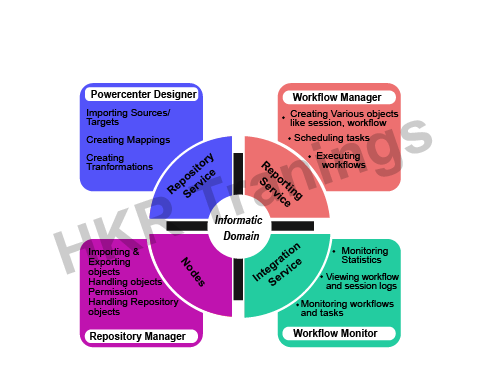
PowerCenter is built using element methodology. The process of constructing a dataflow from source to target involves the use of various components, which is known as transformation.The Informatica ETL tool includes the following services and components:

Informatica Architecture

  • Repository Service: This service is in charge of keeping Informatica metadata and providing access to that to other services.
  • Integration Service: This service facilitates the transfer of data from sources to targets.
  • Reporting Service: This service is in charge of producing reports.
  • Nodes: This is really a software device used to carry out the aforementioned services.
  • Informatica Designer: It is responsible for creating mappings between source and target.
  • Workflow Manager: It’s being used to generate workflows as well as other tasks, as well as to execute them.
  • Workflow Monitor: It’s being used to keep track of how workflows are being executed.
  • Repository Manager: This application is used to handle the objects inside the repository.

Informatica ODBC

Informatica Certification Training

  • Master Your Craft
  • Lifetime LMS & Faculty Access
  • 24/7 online expert support
  • Real-world & Project Based Learning

Informatica Domain:

Informatica Domain

  • The Informatica domain serves as the primary administrative division.
  • Informatica is made up of nodes and services. Premised on administration requirements and design architecture, these nodes and services are organised into folders or subfolders.
  • The Informatica administrator’s Console web page creates a domain that resembles a folder. We could indeed generate a node with the services inside this folder.
  • A node is a logical depiction of a machine in the Informatica domain. In Informatica, all services and processes run within the domain. A single domain can contain multiple nodes. A gateway node receives client requests and routes them to the appropriate service.
  • The domain offers two types of services, including:
  • It handles domain operations including such logging, authentication, and authorization. It manages users and groups and runs the application services on the nodes.
  • Application Services: These are server-specific services like repository services, reporting services, as well as integration services. Depending on the configuration, the application service can run on multiple nodes.

Node:A node seems to be a reasonable analysis of a machine in a domain, and a domain has various hubs. We could indeed create hubs, such as mix administration, to run application administrations.

PowerCenter Repository:A relational database, such as SQL Server, Oracle, or Sybase, serves as the PowerCenter repository. And the repository services are in charge of maintaining these databases. The metadata is stored in the database tables.


Informatica client tools are classified into three types:

  • Informatica designer
  • Workflow manager for Informatica
  • Informatica workflow supervisor

Informatica is often used to handle the repository and provides repository services. The repository services only handle one request per repository. However, we can run it on multiple nodes to improve performance.

Because of its version control mechanism, we can keep different versions of the same objects. Also, disregard multiple users who are modifying the same object at the same time.This three-state is present in the objects created in the repository, such as:

  • As per Informatica, valid objects have the correct syntax. And it is used to carry out the workflow.
  • Invalid objects do not adhere to the standard or rules. During the object’s save in Informatica, these objects checked whether the syntax and properties were valid or not.
  • Affected: The affected object’s child objects are invalid.
HKR Trainings Logo

Subscribe to our YouTube channel to get new updates..!

PowerCenter Repository Service:

The PowerCenter repository service is a separate multi-step process. It enables customers to modify the metadata in the store. It accepts metadata requests from the respectful benefit in order to run work processes.

And the repository service keeps PowerCenter customers’ connections to the PowerCenter vault up to date. It inserts the metadata into the archive and keeps it up to date. It can maintain consistency within the archive metadata.

Domain Configuration:

The domain is a necessary fundamental administrative control in the Informatica ETL tool. It is a visible entity that offers a variety of services such as repository service, integration service, and various nodes. The Informatica admin console is used to configure the domain. In addition, web browsers are used to launch the console.

Connectivity of the PowerCenter Client and Server:

Client-side machines have PowerCenter client tools installed. Workflow manager, PowerCenter designer, repository manager, and workflow monitor are examples of development tools.

All mapping as well as objects created in these client tools are stored in the Informatica repository, which is located on the Informatica server. As a result, client tools must be network-connected to the server.

In addition, the PowerCenter client connects to the sources and targets in order to import metadata and structure definitions. As a result, it maintains connectivity to the source or target systems.

  • TCP/IP protocols are used by the PowerCenter client to connect to the integration and repository services.
  • And the PowerCenter client connects to the source or target using ODBC drivers.

Top 30 frequently asked Informatica Interview Questions !

Repository Service:

The repository service runs in multiple threads. It keeps the PowerCenter clients and the PowerCenter repository connected.The repository service has access to the repository’s metadata and can retrieve, insert, and update it. It also ensures consistency within the repository metadata.

Integration Service:

In Informatica, the integration service serves as an execution engine. It aids in the execution of tasks created in Informatica. The integration service operates in the following ways:

  • A workflow is carried out by a user.
  • Informatica directs the integration service to carry out the workflow.
  • The integration service then retrieves workflow details from the repository.
  • The integration service initiates the execution of the tasks contained within the workflow.
  • Following implementation, the task condition is modified, such as Succeeded, Failed, or Aborted.
  • The session log as well as workflow log are then granted.
  • This service transfers data from the source systems to the target systems.
  • The integration service combines information from diverse sources.

Informatica Certification Training

Weekday / Weekend Batches

Conclusion:

In the above blog post we had discussed informatica, informatica architecture in depth. Had any doubts stop your queries in the comments section to get them resolved. Happy learning!

Related Articles:


Source link