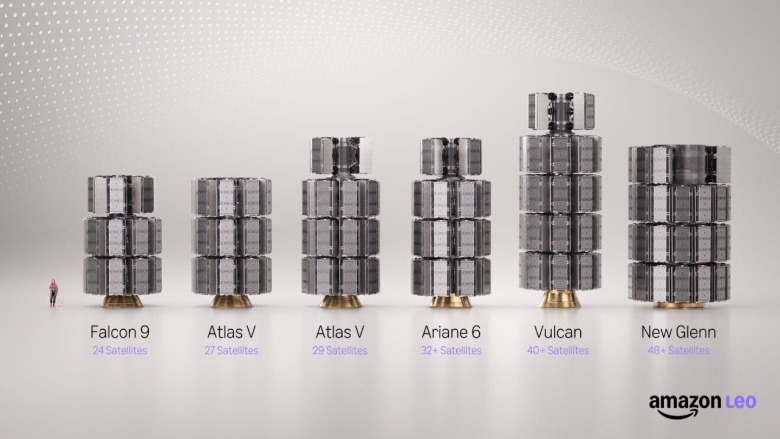
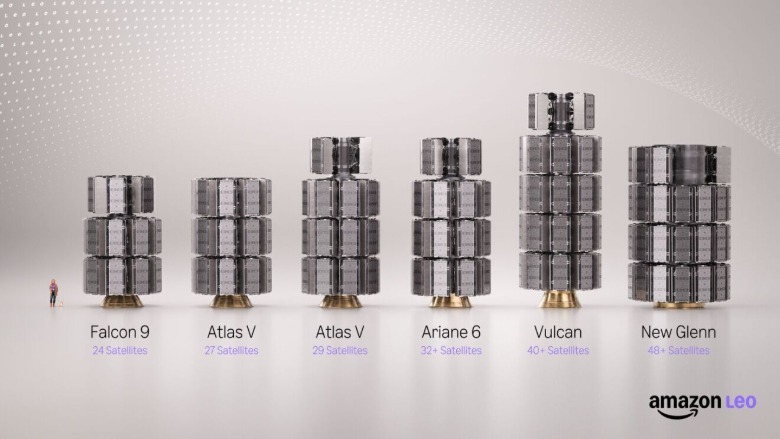
A United Launch Alliance (ULA) Atlas V rocket left for space in the early hours of July 2, bringing 29 Amazon Leo satellites with it. Amazon says the rocket has successfully deployed the satellites and that it has already established contact with them in orbit, as well as ensured that they were in working condition. All that remains is raising the satellites to their assigned operational altitude of 392 miles, after which, Leo will be ready to begin providing customers access to its satellite broadband service.
This ULA launch, which took off from Florida’s Cape Canaveral Space Force Station, brings the total number of operational Leo satellites to over 390. That’s “enough to support continuous service across initial latitudes,” said Amazon Leo VP Chris Weber. After putting 224 Leo satellites in space, this is the Atlas V’s rocket last mission for the project, as well. The next Leo mission will be using ULA’s heavy-lift Vulcan vehicle, which can carry more than 40 satellites for every launch and can fly more frequently, allowing Amazon to expand the service’s coverage and capacity more quickly.
Last few launches were big for @AmazonLeo – bringing us to 390+ satellites deployed, enough to support continuous service across initial latitudes.
Still lots of work ahead – including raising all these new satellites to their assigned altitude – but we’ve completed enough… pic.twitter.com/UZb404fXRq
“With hundreds of flight-ready satellites standing by at the Cape and a new, dedicated vertical integration facility ready to support Leo Vulcan 1 and subsequent missions, we have a clear path to increase launch and deployment cadence, helping us quickly expand network coverage following an initial service rollout later this year,” said Melissa Wuerl, Amazon Leo Director of Launch Systems.
Of course, with only 390 or so satellites in space, Leo still has a monumental to climb to be able to catch up to Starlink. SpaceX’s Starlink, after all, has more than 10,000 satellites currently providing its customers’ satellite broadband needs. In addition to launching satellites on ULA’s Vulcan rockets, Amazon also plans to use Blue Origin’s New Glenn vehicle, which can carry more than 48 satellites at once. New Glenn’s launchpad exploded during a hotfire test in May, delaying all missions that were planning to use the rocket. But Blue Origin, which was also founded by Jeff Bezos, has been building a new launchpad in earnest, so that it can launch New Glenn flights by the end of the year.
The architecture of Informatica is service-oriented (SOA). A service-oriented architecture is a collection of services which interact with one another. It could be a basic data transfer or two or even more services coordinating the same action throughout this interaction.
Informatica growth is dependent on component-based development techniques. To achieve the desired result, this technique employs predefined components and functional departments with their associated functionalities.
PowerCenter is built using element methodology. The process of constructing a dataflow from source to target involves the use of various components, which is known as transformation.The Informatica ETL tool includes the following services and components:
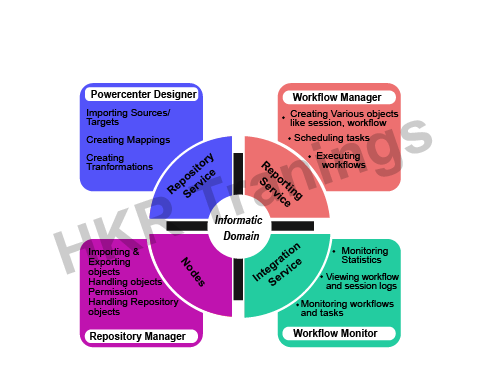
Repository Service: This service is in charge of keeping Informatica metadata and providing access to that to other services.
Integration Service: This service facilitates the transfer of data from sources to targets.
Reporting Service: This service is in charge of producing reports.
Nodes: This is really a software device used to carry out the aforementioned services.
Informatica Designer: It is responsible for creating mappings between source and target.
Workflow Manager: It’s being used to generate workflows as well as other tasks, as well as to execute them.
Workflow Monitor: It’s being used to keep track of how workflows are being executed.
Repository Manager: This application is used to handle the objects inside the repository.
Informatica Certification Training
Master Your Craft
Lifetime LMS & Faculty Access
24/7 online expert support
Real-world & Project Based Learning
Informatica Domain:
The Informatica domain serves as the primary administrative division.
Informatica is made up of nodes and services. Premised on administration requirements and design architecture, these nodes and services are organised into folders or subfolders.
The Informatica administrator’s Console web page creates a domain that resembles a folder. We could indeed generate a node with the services inside this folder.
A node is a logical depiction of a machine in the Informatica domain. In Informatica, all services and processes run within the domain. A single domain can contain multiple nodes. A gateway node receives client requests and routes them to the appropriate service.
The domain offers two types of services, including:
It handles domain operations including such logging, authentication, and authorization. It manages users and groups and runs the application services on the nodes.
Application Services: These are server-specific services like repository services, reporting services, as well as integration services. Depending on the configuration, the application service can run on multiple nodes.
Node:A node seems to be a reasonable analysis of a machine in a domain, and a domain has various hubs. We could indeed create hubs, such as mix administration, to run application administrations.
PowerCenter Repository:A relational database, such as SQL Server, Oracle, or Sybase, serves as the PowerCenter repository. And the repository services are in charge of maintaining these databases. The metadata is stored in the database tables.
Informatica client tools are classified into three types:
Informatica designer
Workflow manager for Informatica
Informatica workflow supervisor
Informatica is often used to handle the repository and provides repository services. The repository services only handle one request per repository. However, we can run it on multiple nodes to improve performance.
Because of its version control mechanism, we can keep different versions of the same objects. Also, disregard multiple users who are modifying the same object at the same time.This three-state is present in the objects created in the repository, such as:
As per Informatica, valid objects have the correct syntax. And it is used to carry out the workflow.
Invalid objects do not adhere to the standard or rules. During the object’s save in Informatica, these objects checked whether the syntax and properties were valid or not.
Affected: The affected object’s child objects are invalid.
Subscribe to our YouTube channel to get new updates..!
PowerCenter Repository Service:
The PowerCenter repository service is a separate multi-step process. It enables customers to modify the metadata in the store. It accepts metadata requests from the respectful benefit in order to run work processes.
And the repository service keeps PowerCenter customers’ connections to the PowerCenter vault up to date. It inserts the metadata into the archive and keeps it up to date. It can maintain consistency within the archive metadata.
Domain Configuration:
The domain is a necessary fundamental administrative control in the Informatica ETL tool. It is a visible entity that offers a variety of services such as repository service, integration service, and various nodes. The Informatica admin console is used to configure the domain. In addition, web browsers are used to launch the console.
Connectivity of the PowerCenter Client and Server:
Client-side machines have PowerCenter client tools installed. Workflow manager, PowerCenter designer, repository manager, and workflow monitor are examples of development tools.
All mapping as well as objects created in these client tools are stored in the Informatica repository, which is located on the Informatica server. As a result, client tools must be network-connected to the server.
In addition, the PowerCenter client connects to the sources and targets in order to import metadata and structure definitions. As a result, it maintains connectivity to the source or target systems.
TCP/IP protocols are used by the PowerCenter client to connect to the integration and repository services.
And the PowerCenter client connects to the source or target using ODBC drivers.
The repository service runs in multiple threads. It keeps the PowerCenter clients and the PowerCenter repository connected.The repository service has access to the repository’s metadata and can retrieve, insert, and update it. It also ensures consistency within the repository metadata.
Integration Service:
In Informatica, the integration service serves as an execution engine. It aids in the execution of tasks created in Informatica. The integration service operates in the following ways:
A workflow is carried out by a user.
Informatica directs the integration service to carry out the workflow.
The integration service then retrieves workflow details from the repository.
The integration service initiates the execution of the tasks contained within the workflow.
Following implementation, the task condition is modified, such as Succeeded, Failed, or Aborted.
The session log as well as workflow log are then granted.
This service transfers data from the source systems to the target systems.
The integration service combines information from diverse sources.
Informatica Certification Training
Weekday / Weekend Batches
Conclusion:
In the above blog post we had discussed informatica, informatica architecture in depth. Had any doubts stop your queries in the comments section to get them resolved. Happy learning!
To provide the best experiences, we use technologies like cookies to store and/or access device information. Consenting to these technologies will allow us to process data such as browsing behavior or unique IDs on this site. Not consenting or withdrawing consent, may adversely affect certain features and functions.
Functional
Always active
The technical storage or access is strictly necessary for the legitimate purpose of enabling the use of a specific service explicitly requested by the subscriber or user, or for the sole purpose of carrying out the transmission of a communication over an electronic communications network.
Preferences
The technical storage or access is necessary for the legitimate purpose of storing preferences that are not requested by the subscriber or user.
Statistics
The technical storage or access that is used exclusively for statistical purposes.The technical storage or access that is used exclusively for anonymous statistical purposes. Without a subpoena, voluntary compliance on the part of your Internet Service Provider, or additional records from a third party, information stored or retrieved for this purpose alone cannot usually be used to identify you.
Marketing
The technical storage or access is required to create user profiles to send advertising, or to track the user on a website or across several websites for similar marketing purposes.


 Amazon