:max_bytes(150000):strip_icc():format(jpeg)/Health-GettyImages-730141503-def6173bc8344c749766bc4138ad4f05.jpg "Person performing a yoga pose in a studio")
Credit: Jessica Peterson / Getty Images
- Mobility and core strength decline with age, but purposeful exercise can help.
- A 10-minute circuit—which includes cat-cows, Supermans, and glute bridge marches—may help improve your range of motion and core strength.
- Women in their 60s should aim for consistency over perfection to achieve long-term strength and mobility goals.
As we get older, our mobility and muscle mass decline. Minor losses can begin as early as your 30s, though they start to accelerate for women after menopause and again after age 70.
Luckily, regular exercise and core training can help preserve mobility, build strength, improve balance, and reduce the risk of falling as you age. And you can reap these benefits without revamping your entire fitness routine—especially for women in their 60s, spending just 10 minutes per day on a handful of simple drills and exercises can help.
10-Minute Core and Mobility Workout
This circuit is a mix of static and dynamic stretches, mobility drills, and core strengtheners. You can perform all six movements in a row, spending 30–90 seconds on each one—or, you can pick just a few that work for you, depending on your fitness level or how much time you have.
1. Cat-Cow
A yoga class staple, the cat-cow is a dynamic stretch that relieves pressure in the spine while actively engaging the core muscles.
Here’s how to do it:
- Start on your hands and knees, with your shoulders stacked over your wrists and your hips directly above your knees. Your back should be flat, your neck in a neutral position.
- On an inhale, slowly lift your tailbone and the crown of your head upward, drawing your shoulder blades together to open your chest. Allow your spine to arch and your belly to drop. This is the “cow” part of the movement.
- As you exhale, draw your belly button in toward your spine and bring your chin to your chest. Allow your spine to round to complete the “cat” movement.
- As you breathe, continue to flow back and forth between the “cow” and “cat” postures.
2. Hip Flexor Stretch
Most adults spend a significant portion of their day sitting down—this can tighten the hip flexor muscles, leading to stiffness and pain. Stretching the hips helps offset some of these negative effects of sitting, and some research indicates it may help alleviate lower back pain in older adults.
Here’s how to do a kneeling hip flexor stretch:
- Start in a half-kneeling position with your right knee on the ground and your left foot placed on the ground in front of you.
- Keeping your back flat, chest up, and core engaged, shift forward until you feel a deep stretch in the front of your hip. Hold for 30 seconds.
- Repeat on the opposite side.
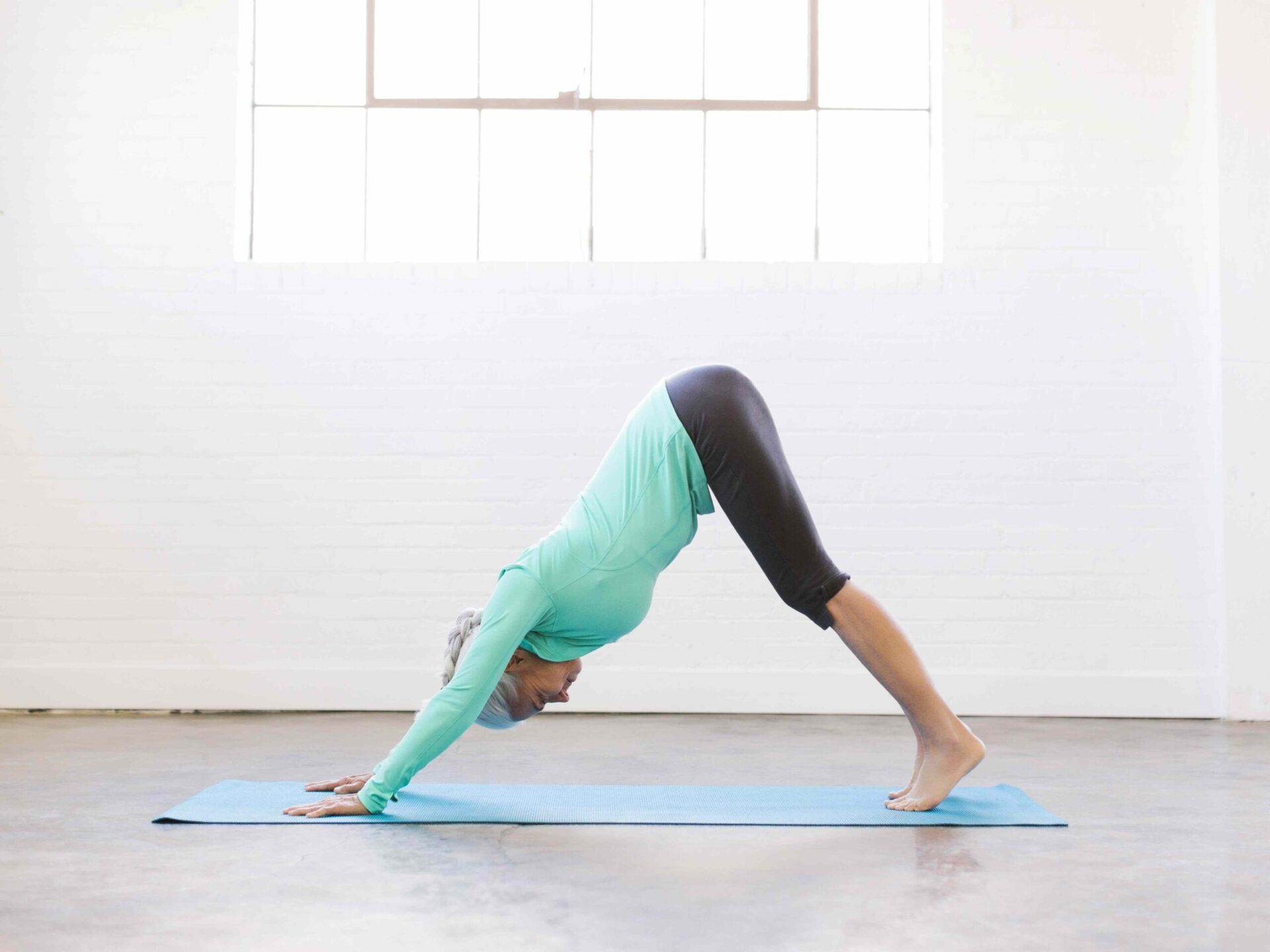
3. Plank to Downward-Facing Dog
Flowing between a plank and a downward-facing dog engages all the major muscle groups—especially the core—while dynamically stretching your shoulders, back, and legs. Essentially, it’s the perfect exercise.
However, this full-body movement can be slightly difficult—if you find it hard to hold a plank, lower your knees to the ground.
Here’s how to do it:
- Start in a high plank position with your shoulders and elbows stacked over your wrists, and your feet hip-width apart. Keep your back flat so that your body forms a straight line from your head to your heels.
- Pushing through your palms, lift your hips and draw your chest toward your thighs to form an upside-down “V” shape. Push your heels toward the ground until you feel a deep stretch in the backs of the legs, chest, and shoulders. Hold for a breath.
- Lower your hips back down and bring your chest forward to return to a plank position. Hold for a breath.
- Continue to slowly flow between plank and downward-facing dog.
4. Superman
Holding the Superman position demands deep core strength. But it also forces the body out of the hunched, forward-leaning position that we tend to spend too much time in, thanks to computer keyboards and handheld devices.
Here’s how to do a Superman:
- Lie face down on the floor with your arms extended in front of you, palms facing down.
- Squeeze your glutes and your shoulder blades together as you lift your arms and legs off the ground. Look forward and try to elongate your body.
- Hold for 3–5 seconds, then slowly lower your limbs to the ground.
- Rest for a few seconds, then repeat.
5. Glute Bridge March
Your core is more than just your abs—it includes your glutes and hips, too. Glute bridges are a great way to get these muscles fired up.
You can turn things up a notch by “marching” while you’re in the position, but even just holding a glute bridge helps build core strength while also stretching the hip flexors and quads.
Here’s how to do it:
- Lie on your back with your arms at your sides, your knees bent, and your feet on the ground in front of your glutes.
- Push through your feet and lift your butt off the ground so that your hips are fully extended. Hold here in a glute bridge.
- To add in marching, draw your right knee up and toward your chest as you keep your hips lifted.
- Return your right foot to the ground, then repeat with your left leg.
- Continue alternating in a marching motion.
6. Open Book

The open book movement helps promote greater mobility for your thoracic spine, or your mid-back. This is essential for maintaining good posture and stability.
Here’s how to do an open book stretch:
- Lie on the left side of your body with your arms extended in front of you and your knees bent at a 90° angle. Make sure your arms and legs are stacked. Tuck your pelvis to prevent your lower back from arching, and rest your head on the ground.
- Keeping your lower body stationary, slowly rotate your trunk to the right as you open your right arm, chest, and shoulders, placing the back of your right hand on the ground. Follow your right hand with your eyes.
- Pause briefly in the “open book” position, then rotate back toward the starting position and re-stack your arms.
- Repeat for multiple reps, then switch sides.
Tips for Incorporating Core and Mobility Work Into Your Fitness Routine
Maintaining core strength and mobility requires consistency, especially as you get older. To make this 10-minute circuit a habit, consider the following:
- Use it as a daily warm-up: This quick routine is a great warm-up for a daily walk, a strength-training workout, or whatever else you have going on in your day. Besides improving range of motion and building core strength, these movements prime the body for other activities.
- Use the time you have: Something is better than nothing, so if you’re short on time, try to accomplish just one or two exercises. You can choose what’s best for you based on how you’re feeling. If you have a stiff spine and five minutes of free time, try doing a few rounds of cat-cows or open books, for example.
- Don’t wait until you’re hurting: Yes, strengthening your core can help with back pain. Stretching your hip flexors can loosen up stiff hips. But you shouldn’t wait until you’re hurting to prioritize core strength and mobility—taking a proactive approach can help you move better now and potentially avoid future problems.