HHS abandons threat to withhold funding over trans care


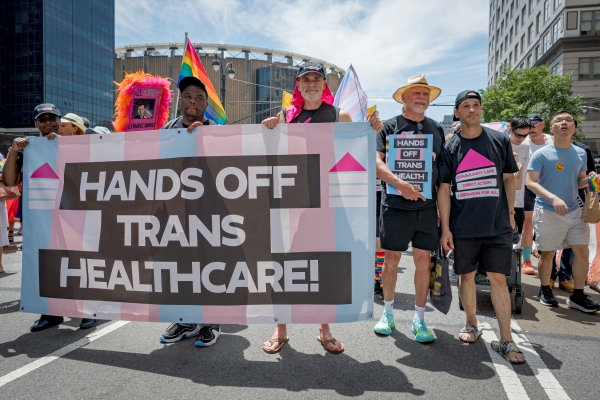
Several people carry a large banner that says

Several people carry a large banner that says "Hands off trans healthcare" as they walk down a city street. Another person has a small sign that says the same thing.
Protestors rally for healthcare for transgender people at a march in June 2025 in Manhattan. NPR has learned the Trump administration shelved a plan to cut off all Medicare and Medicaid funding to any hospital that provided gender-affirming care to minors.
Erik McGregor | LightRocket via Getty Images

For new discoveries, everyday mysteries, and the science behind the headlines, follow NPR's Short Wave podcast .

The Trump administration is abandoning its most aggressive attempt to end gender-affirming care for youth nationally, according to an official document obtained by NPR.

The document shows that the Department of Health and Human Services will not be finalizing a proposed rule that would have blocked all Medicaid and Medicare funding for hospitals that provide pediatric gender-affirming care.

The Centers for Medicare and Medicaid Services told NPR in a statement: “CMS does not comment on future rulemaking or speculate on potential actions. The Trump Administration rejects ideologically driven surgical interventions on vulnerable children.”

(Surgery is very rare among transgender people under age 18, and the rule applied to all gender-affirming care, which is mainly therapy and medications for children.)

A ‘victory’ for trans rights, but not a ‘retreat’ by HHS

The fact that the Trump administration is backing off from this action is “a victory for people who are defending the rights and interests of trans people,” says Sam Bagenstos, a professor at Michigan Law who served as general counsel at HHS under the Biden administration. “But I don't think it indicates a more general retreat from the aggressive posture of the Trump administration.”

Bagenstos notes that this type of leverage — a “conditions of participation”" rule for the Medicare and Medicaid program — has historically been used by HHS to compel states and hospitals to meet basic health and safety standards. Things like “making sure that you have stockpiles of certain kinds of equipment, making sure that you have certain kinds of emergency protocols, making sure that you have certain staffing ratios,” he explains.

The proposed rule was unprecedented, Bagenstos says, because it instead would have prohibited certain kinds of treatments for a certain population. He says it seemed unlawful in a variety of ways. For one, “it violates the Medicare Act, which says that Medicare and Medicaid can't be used to control the practice of medicine within the state — states get to regulate the practice of medicine,” Bagenstos says.

Medical groups opposed the change

Normally, HHS would propose a rule, accept public comment for 60 days, and then finalize the rule so that it could take effect. In this case, after proposing the rule in December and receiving more than 30,000 comments, the administration is abandoning the rule. At least in the next year, it will not be finalized and will not take effect.

The American Medical Association and the Children's Hospital Association both submitted comments urging the agency to rescind or withdraw the proposed rule. Major U.S. medical groups say that puberty blockers and sex hormones are safe and can be effective for transgender young people.

Even so, gender-affirming care for youth is banned in 27 states after a flurry of laws passed over the last several years. In the remaining 23 states, many hospital clinics that offer gender-affirming care have continued to operate, while others have shuttered in the past year citing pressure from the Trump administration.

That pressure has come in the form of this proposed rule, another rule that would bar federal Medicaid reimbursement for transgender pediatric patients, and a declaration from Health Secretary Robert F. Kennedy Jr. that aimed to redefine the standard of care. (Interestingly, the press release issued when those actions were unveiled in December is now missing from the HHS website, as is the Kennedy declaration document.)

The Medicaid rule is currently in the final stage of review and appears to be on track to take effect in the coming weeks. A coalition of Democratic-led states sued over the so-called Kennedy declaration and succeeded in blocking it in federal court in Oregon. The Trump administration has not appealed that decision so far.

Protesters hold sigs that say, "Children cannot consent to puberty blockers" and "Gender ideology does not belong in schools."
Protesters who are against gender-affirming care for young people gathered outside Boston Children's Hospital in Sept. 2022.
Carlin Stiehl for The Boston Globe | Getty Images

At the same time, the Department of Justice has issued administrative and criminal subpoenas to hospitals seeking full personal medical files for transgender youth and employment files for their medical providers, although many of those attempts have been blocked in court so far. The Trump administration has also reached settlements with hospitals in Texas and Ohio that involved establishing “detransition” clinics.

And last month, when the Supreme Court allowed states to bar young transgender girls from sports, the White House issued a press release saying that the decision “Bolsters President Trump's Push to Eliminate Transgender Insanity.” The release listed actions targeting transgender people across the federal government, from passport markers to military service to research funding.

Will hospitals that ended care for trans youth restart it?

While the Trump administration does not appear to be backing down from anti-transgender actions broadly, its decision not to finalize its most aggressive healthcare rule is significant, says Katie Keith, director of the Health Policy and the Law Initiative at Georgetown University who also worked in the Biden administration. Those other efforts are not nearly as durable as a finalized rule that takes effect, she notes.

The decision of the Trump administration not to finalize this rule “should give hospitals more confidence to either resume or continue offering the care,” she says. Because the rule was never in effect, “I would argue that they should have been doing this all along anyway.”

Kellan Baker agrees. He's a senior adviser for health policy at the Movement Advancement Project think tank, which focuses on LGBTQ issues. “This administration may have checked itself in one of the most extreme expressions of its agenda and I think people should take solace in that,” he says. “But at the same time, this administration is continuing to show that its ultimate goal is eliminating health care for trans people and that it is apparently prepared to use almost any means necessary to do so.”

The Medicare and Medicaid rule could theoretically be revived at some point, since it has not been formally withdrawn. An entry in the Trump administration's recent unified agenda sets a final action date for the proposed rule as December 2028, just before President Trump leaves office.

Copyright 2026, NPR


Source link

Leave a Reply

Subscribe to Our Newsletter

Get our latest articles delivered straight to your inbox. No spam, we promise.

Recent Reviews


After 10 years of homeownership, I’ve had my fair share of pricey expenses.

Washing machine won’t complete a wash cycle? That’ll be $330 for the labor and part swap. Fireplace won’t stay lit? Goodbye $460 for the cleaning and inspection — plus another $900 for a new pilot light.

Then there are the never-ending water heater issues that seem to cost me $1,000-plus every other year.

Unexpected financial hits are par for the course when it comes to owning a home. But with the right strategy, they can also create opportunities.

In fact, a major home renovation is the exact reason I recently added both the Chase Sapphire Reserve® (see rates and fees) and the United Club℠ Card (see rates and fees) to my wallet.

With thousands of dollars in spending on the horizon, I realized I could use those unavoidable expenses to earn enough points and miles for a bucket-list business-class trip.

Here’s how I’ve handled home expenses so far — and why I’ve changed my strategy now.

My original card strategy for home expenses

Because I prefer travel rewards cards that earn points and miles over cash-back, I added the Capital One Venture X Rewards Credit Card to my wallet shortly after becoming a homeowner.

The card offered perks I knew I’d use — including a $300 annual Capital One travel credit applied to bookings made through the Capital One Travel portal and lounge access at my two home airports — plus a simple earning structure that works well for everyday spending.

Reward your inbox with the TPG Daily newsletter

Join over 700,000 readers for breaking news, in-depth guides and exclusive deals from TPG’s experts

GABRIELLE BERNARDINI/THE POINTS GUY

You’ll earn:

  • 10 miles per dollar spent on hotels and rental cars booked through Capital One Travel
  • 5 miles per dollar spent on flights and vacation rentals booked through Capital One Travel
  • 2 miles per dollar spent on all other purchases

The last earning rate for all other purchases is what particularly caught my eye, as this catch-all category for everyday expenses offers more miles per dollar than what you’ll get with many other general travel cards.

While I knew I’d take advantage of it for pet-related purchases and other items rarely included as an elevated earning rate category, I also liked having a reliable card for large home-related expenses, from annual maintenance to unexpected repairs.

Related: 9 things you didn’t know you could pay for with a credit card

Why I’ve recently reevaluated my approach

Relying on my Venture X for home-related purchases for the past few years has served me well so far.

In fact, I’ve racked up enough miles to cover several nights of a weeklong stay at the Fairmont Royal Pavilion in Barbados and partially cover an upcoming five-night stay at Amansara in Cambodia, both through Capital One’s “cover travel purchases” fixed-value redemption option.

ALL ACCOR

Knowing I was about to begin a major home renovation project in the form of a top-to-bottom, start-from-scratch refresh of my kitchen alongside significant updates to my living room, it seemed like the perfect time to add another card to my wallet.

I knew a few appliance purchases would easily satisfy a welcome-bonus spending requirement, so it felt like the perfect time to open a new premium credit card.

Naturally, the Chase Sapphire Reserve® became a front-runner, thanks to its current best-ever welcome offer of 150,000 bonus points after spending $6,000 on purchases in the first three months from account opening.

Young Asian woman shopping for home decor and household necessities in a homeware store, looking at bedding sets on a shelf
D3SIGN/GETTY IMAGES

While I already have the Chase Sapphire Preferred® Card (see rates and fees) — and the Sapphire Reserve’s high $795 annual fee requires careful planning with spending to justify — thanks to Chase’s updated Sapphire bonus rules, I was eligible for the Reserve’s welcome offer, making the decision much easier.

Two bonuses are better than one

Since I’d owned most of my furniture for a decade, replacing it alongside the renovation suddenly made sense. I wanted my home decor to match the new cabinetry, stone, paint and appliances I’ve selected.

That’s when I realized I could potentially earn a second limited-time welcome bonus, too.

Ultimately, I stumbled upon the United Club℠ Card.

At the time I applied, the card was offering the opportunity to earn 100,000 bonus miles and 3,000 Premier qualifying points after spending $5,000 on purchases in the first three months from account opening (no longer available).

A United Airlines plane on final descent into Washington Dulles International Airport (IAD). SEAN CUDAHY/THE POINTS GUY

Since United has a major presence at Dulles International Airport (IAD), a hub I use frequently, the card caught my attention quickly despite the United Club Card’s high $695 annual fee.

Then, things really clicked.

If I successfully earn both bonuses, I’d earn at least 100,000 miles with the United Club Card and 150,000 points with the Sapphire Reserve, the latter of which I could transfer to United MileagePlus, a Chase transfer partner, for a whopping total of 250,000 miles.

Say no more. Within days of coming to that realization, I applied for both cards.

Related: Can you pay your rent or mortgage with a credit card? Everything you need to know

How I plan on spending the bulk of points

It didn’t take long to meet the spending requirement for my United Club Card‘s welcome offer. Just 24 hours after receiving the card in the mail, I purchased five new appliances. Within days, the offer’s 3,000 PQPs appeared in my MileagePlus account, and after my first billing cycle, the 100,000 miles were deposited.

BOB KRIST/GETTY IMAGES

Once I earn the 150,000 points with my Chase Sapphire Reserve and transfer them to my MileagePlus account, I have big plans for how I’ll use the bulk of the miles.

After visiting Asia for the first time this year, I already have my sights set on another new continent for 2027: South America.

As an architecture buff and lover of far-flung destinations that haven’t been spoiled by overtourism, I’ve long wanted to visit Easter Island.

Rapa Nui, as it’s known locally, is one of the world’s most remote inhabited islands and can only be reached by air from Santiago, Chile, or via select world cruise itineraries.

A world cruise is out of reach for me, so instead, I’ll fly from D.C. to Easter Island, with connections in Houston and Santiago, to finally see the island’s iconic moai in person.

United miles won’t cover the Santiago-to-Easter Island segment on LATAM, but they can cover the rest of the itinerary, including a nine-plus-hour business-class flight from Houston to Santiago. With the trip priced at nearly $11,500 in cash, it’s exactly the kind of redemption that makes my home renovation spending feel worthwhile.

Related: Turn miles into adventure: How to travel to South America with Alaska Airlines miles

Bottom line

Homeownership comes with plenty to celebrate — and plenty of expenses.

While there’s no way around the cost of maintaining and upgrading a home, there are ways to get more value from that spending.

In my case, a major renovation project is helping turn thousands of dollars in home expenses into a dream trip to Easter Island that would have otherwise been out of reach.

Related: How my travel credit cards keep me on the go within a modest budget


Source link