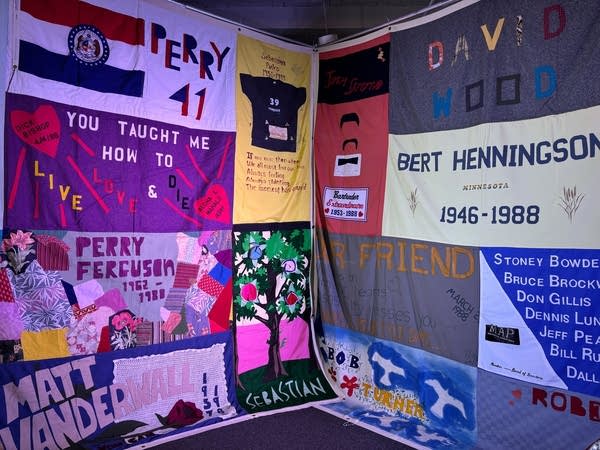
In 1982, the first person was diagnosed with AIDS in Minnesota. Bruce Brockway was a gay activist who helped start the Minnesota AIDS Project and was publisher of the Twin Cities’ first LGBTQ+ newspaper. He died from an AIDS-related brain lymphoma in 1984.
He is among the many whose loved ones honored with a panel of the AIDS Memorial Quilt. The entire quilt, which is housed at the National Aids Memorial in San Francisco, has roughly 50,000 panels dedicated to more than 110,000 people who died from AIDS-related complications. The idea was conceived in 1985 by activist Cleve Jones and first sewed in 1987. It is regarded as the largest folk art project in the world.
Through June 14, two panels will be on display at Queermunity in Minneapolis, an LGTBQ+ community space in Uptown. The panels have three quilts dedicated to Minnesotans. Community volunteers will sit daily with the panels to answer questions from the public.
Reece Gray is on the development team for the Aliveness Project. He said it has always been a dream for the Aliveness community to bring part of the quilt home, and, considering the Trump administration recently proposed cutting funding for HIV prevention, it was key to remind people about the AIDS crisis.
In February, Minnesota sued the U.S. Centers for Disease Control and Prevention after they cut millions to public health grants here, including to HIV prevention.
“I think right now it is important to remember how not long ago these panels were made,” Gray said. “This is still such a present loss, and we can find ourselves in a position where we will need to make panels again if we lose this money at the hands of the Trump administration.”
Hilary Otey, one of the co-founders for Queermunity, said they are hoping residents sit with the quilt and learn more about local and national LGBTQ+ history.
The quilts on display are dedicated to Matt Vanderwall, Bert Henningson and several members of the Minnesota AIDS Project, including Brockway. The Aliveness Project requested panels with the most Minnesotans on them.
Vanderwall’s quilt was made by his partner Randy Hornstine in Minneapolis and has a long stem rose and a quote at the bottom: “I Can — You Can.”
Henningson’s quilt was also made by his partner, Dick Hanson, and features pieces of wheat with “Minnesota” in rainbow letters. The couple were featured in the prominent St. Paul Pioneer Press series in 1987 “AIDS in the Heartland,” which reported at the time that they both had AIDS and lived on a farm south of Glenwood.
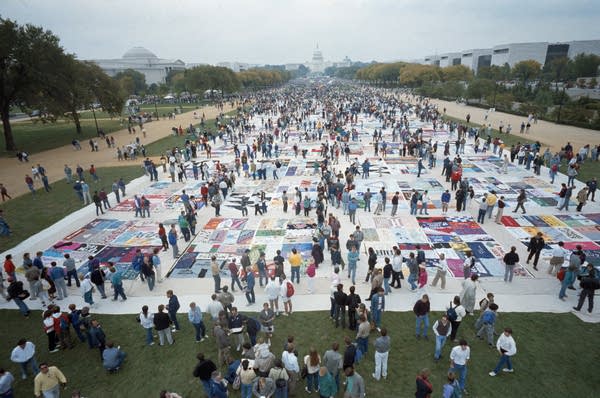
State Sen. Scott Dibble, DFL-Minneapolis, remembers being at the first showing of the quilt at the National Mall in Washington D.C. in 1987. Dibble helped make several quilts, having friends who had died from AIDS-related complications. He said he regularly participated in protests and advocated with the DFL for better healthcare for LGBTQ+ people before being elected to serve as senator.
“We knew that what was killing us was homophobia and the closet. It was easy to marginalize us and demean us and blame us for what we were experiencing. So we knew we had to come out. We knew we had to stand up for ourselves, provide for ourselves but demand better of our democracy, of our governmental political leaders and of our institutions,” he said.
Dibble was also at the Metrodome when the AIDS quilt came to Minnesota in 1988 for a 20-city tour. Over 1,000 volunteers worked for two days to display 109 quilts representing 3,488 people.
“It was just an incredible time, and a really beautiful thing,” Dibble said about working on the quilt. “I mean, I am fighting off tears right now, because I can remember just being completely devastated, at the same time affirmed and edified by the experience of seeing the quilts on the mall and in our own hometown.”
Queermunity is open for those who want to view the quilt on Mondays and Tuesdays 8 a.m. to 5 p.m., Wednesdays through Fridays 8 a.m. to 8 p.m. and Saturdays and Sundays 10 a.m. to 8 p.m.