With the opening of Amoh, a Luxury Collection Resort, Rhodes, there are now more ways than ever to visit this iconic Greek island on points.
Amoh marks the third Marriott Bonvoy property on Rhodes and the debut of Marriott’s Luxury Collection on the island. The Luxury Collection has properties in other Greek destinations, including Athens, Santorini, Mykonos, Crete and Paros.
MARRIOTT
Located in Pefki on the eastern side of the island, Amoh is a few minutes’ drive from the picturesque, car-free village of Lindos and its Acropolis ruins. The resort is situated between Kavos Beach and a Hellenistic-Roman limestone quarry — which served as inspiration for some of the hotel’s decor. Around the property, sculptural stone elements sourced from the quarry give a nod to the island’s heritage.
The hotel’s design, curated by London firm Studio Lost, “is deeply informed by Greece’s enduring stonework traditions and artisanal craftmanship,” according to a statement released by Marriott about the property. Think: natural stone, pottery, wood and muted earth tones.
Amoh consists of 197 rooms and suites, including a Rhoda Presidential Suite with its own private pool and terrace.
MARRIOTT
With eight restaurants and bars on the property, guests are guaranteed not to go hungry. The dining scene varies but focuses on locally inspired fare: Lithos Main Restaurant offers European cuisine with a Mediterranean twist, while Cava di Pietra serves Italian classics and Kymata dishes up Greek seafood. There’s also a pool bar and a beach bar with light bites, as well as a patisserie concocting artisanal Greek pastries and ice creams.
Reward your inbox with the TPG Daily newsletter
Join over 700,000 readers for breaking news, in-depth guides and exclusive deals from TPG’s experts
Guests can further explore the island’s culinary traditions with the brand’s signature Epicurean Moments, which include an olive tasting and sunset aperitivos.
A resort property, Amoh offers all the amenities you would need for a restful Greek getaway, including a fitness center, tennis courts, indoor and outdoor pools and a spa — where the treatment menu leans on traditional Greek ingredients like olive oil, Cretan raki and mineral salts. Guests can also enjoy two private beaches, Kavos Beach and Kymata Beach, both within walking distance of the resort.
Amoh, a Luxury Collection Resort, Rhodes is open seasonally from April through October, with nightly rates starting around $500 or 76,000 Marriott Bonvoy points.
Cloud modernization is when the current business establishment applications, architecture, and data sources are developed, renovated, and transferred into an environment and infrastructure that is based on the cloud. This whole ordeal is a multistage process.
In general, when we talk about digital transformation in businesses, it comes with improved efficiency, lower costs, better security, and compliance. However, a lot of businesses associate digital transformation with cloud migration, and yet it is so much more. On the path of transforming companies in their cloud journey is modernization. It is fundamental in unlocking the maximum potential of innovative cloud technology. The question now is of importance.
Why is Cloud Modernization Important?
For legacy architectures, surpassing the direct process of migration may be an intimidating change.
We have all heard the phrase – if it ain’t broke, don’t fix it! Sometimes it is said because of the fear of change in the mind. Any inherited system cannot go on functioning forever, but if it is amended, as is needed for modernization, the concern of innumerable harm it could cause the business operations rises if it breaks.
Moving an on-premises application to the cloud is enticing initially. But both financially and with respect to time, it doesn’t fully utilize what the cloud has to offer. Furthermore, even if the application can be transferred to the cloud, it may not function properly once it is there. It is necessary to perform a proper cloud migration and the related update.
Strategies of Cloud Modernization
When upgrading applications and information to the cloud, these strategies need caution and carefulness. Those strategies are mentioned below.
Evaluate and Highlight the Workload
Carrying out the full inventory of the data and applications gives insights into identifying the order of modernization priority, from highest to lowest, which is critical for the business.
Select the correct cloud strategy & create cloud governance
Selecting a suitable cloud strategy is important. According to the needs of the business, a suitable strategy for the cloud can be decided. Further, creating clear regulations for cloud resource and access control, defining roles and duties for all actions, and applying the best practices in security to safeguard critical data.
Automation of Deployment and Management
This is the time to shift to a DevOps model, as it is a customary practice for the development of cloud, while deploying the automation tools.
Constant monitoring and improvement
The cloud resources can be unsteady; therefore, they need unvarying monitoring and tracking. It also needs upgrading and changing accordingly.
Benefits that Cloud Modernization Offers
Among its various benefits, cloud modernization offers –
Swiftness
The new products and services can be brought into the market swiftly through cloud solutions. The cloud brings a broad range of pre-constructed tools and services that organizations can quickly develop and implement new apps across a collection of devices. The time-to-market is reduced here, and it also helps businesses to remain ambitious.
Security
Cloud deployers offer effective protection of apps and data, as their investment in security is great. These suppliers provide different security services, like identity and access management, encryption, and network security.
Adaptability
Being adaptable allows them to adjust swiftly or expand their resources depending on the needs and the circumstances. This allows the business to meet the ever-changing demands and dodge the cost and trouble that comes with it. This adaptability allows the companies to grow without causing distress over infrastructure constraints.
Costs
By cutting down the need to maintain on-site tools and architecture, it can help lower costs. On a pay-per-use basis, the cloud allows companies to only pay for the services they need. Businesses can benefit from this model as there are no additional expenses, since there is no usage. Tool-based infrastructure, in contrast, needs payment from companies whether or not it is used.
Flexibility
It is simpler for companies with this technology to combine technology into their operations. This can be done by allowing them to achieve flexible and remote working arrangements. Along with getting employees to maintain a healthy work-life balance, this advantage can be a godsend for appealing and retaining top talent. Because of its adaptability, the cloud is a great option for businesses trying to bring in new methods of operation.
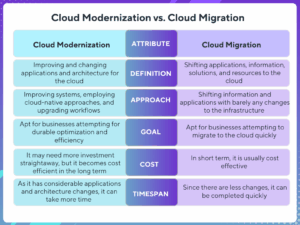
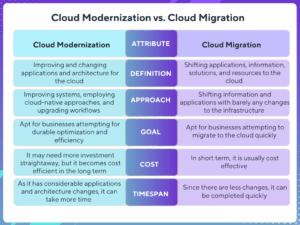
Cloud Modernization vs. Cloud Migration
Cloud modernization and cloud migration are the two most crucial strategies for businesses that can utilize the cloud. They are different in their purview and approach. We compare them below.
Parting Words to Keep in Mind
As businesses come to adjust to the requirements of today’s world, cloud modernization provides a calculated avenue to better efficiency, flexibility, and enhanced business speed. By encompassing the latest cloud technologies, businesses can upgrade their cloud architecture, obtaining better performance and cost savings.
This transformation allows businesses to improve their cloud migration and modernization strategies and efforts, restructure operations, and nurture innovation. By engaging in a strong cloud modernization strategy, companies can ensure they stay motivated to compete and prepare for forthcoming obstacles.
Finally, utilizing cloud-native solutions and services enables businesses to obtain important long-term advantages, including improved outputs and growth.
To provide the best experiences, we use technologies like cookies to store and/or access device information. Consenting to these technologies will allow us to process data such as browsing behavior or unique IDs on this site. Not consenting or withdrawing consent, may adversely affect certain features and functions.
Functional
Always active
The technical storage or access is strictly necessary for the legitimate purpose of enabling the use of a specific service explicitly requested by the subscriber or user, or for the sole purpose of carrying out the transmission of a communication over an electronic communications network.
Preferences
The technical storage or access is necessary for the legitimate purpose of storing preferences that are not requested by the subscriber or user.
Statistics
The technical storage or access that is used exclusively for statistical purposes.The technical storage or access that is used exclusively for anonymous statistical purposes. Without a subpoena, voluntary compliance on the part of your Internet Service Provider, or additional records from a third party, information stored or retrieved for this purpose alone cannot usually be used to identify you.
Marketing
The technical storage or access is required to create user profiles to send advertising, or to track the user on a website or across several websites for similar marketing purposes.