Atmos Rewards Business Card review: Big value for $95


The Atmos™ Rewards Visa Signature® Business Card doesn’t get nearly as much attention as it should.

With a modest $95 annual fee, a valuable annual Companion Fare, and strong Alaska Airlines and Hawaiian Airlines perks, this card can easily pay for itself if you fly either carrier even a few times per year. Having held all Alaska and Hawaiian cobranded credit cards at various points over the years, I personally find Atmos Rewards points to be among the most valuable airline rewards available, thanks to the program’s excellent partner award pricing.

If you’re a business owner who regularly flies Alaska or Hawaiian, this card deserves serious consideration. Card rating*: ⭐⭐⭐⭐

*Card rating is based on the opinion of TPG’s editors and is not influenced by the card issuer.

Atmos Rewards Business Card: The basics

Before diving deeper, here’s a quick snapshot of what the Atmos Rewards Business Card offers:

  • Annual fee: $95 ($70 for the company and $25 per card).
  • Welcome offer: Earn 80,000 bonus points and a $99 Companion Fare (plus taxes and fees from $23) after spending $5,000 on purchases within the first 90 days from opening your account.
  • Rewards currency: Atmos Rewards points, redeemable on Alaska Airlines, Hawaiian Airlines and Oneworld (and select nonalliance) partners.
  • Key perks: Free checked bag, preferred boarding and an annual Companion Fare (plus taxes and fees from $23; after $6,000 in spending each anniversary year).
  • Best for: Alaska and Hawaiian loyalists who want airline perks without a premium annual fee.

This is a cobranded airline card, not a card that earns flexible transferable rewards. Its value comes from airline perks and strong partner award pricing, not top-tier everyday earning rates.

Atmos Rewards Business Card pros and cons

Pros Cons

  • Valuable points
  • Free checked bag
  • Preferred boarding
  • Reasonable annual fee
  • No foreign transaction fees
  • Inflight and lounge discounts

  • Weak everyday earning rates
  • No complimentary lounge access
  • Limited value if you don’t fly Alaska or Hawaiian
  • Must meet a minimum spending requirement for a Companion Fare each year

Atmos Rewards Business Card benefits

For a $95 annual fee, the Atmos Rewards Business Card delivers meaningful airline perks that can quickly offset the cost.

Annual Companion Fare

The Companion Fare is this card’s headline benefit. It allows you to book a second passenger on the same round-trip economy ticket for $99 (plus taxes and fees from $23).

Reward your inbox with the TPG Daily newsletter

Join over 700,000 readers for breaking news, in-depth guides and exclusive deals from TPG’s experts

You receive:

  • One Companion Fare as part of the current welcome offer
  • Another Companion Fare each anniversary year after $6,000 in spending

Alaska Hawaiian planes on the tarmac
ERIC THAYER/BLOOMBERG/GETTY IMAGES

Importantly:

  • It’s not valid for award travel.
  • You need to pay with your Alaska card.
  • The cardholder does not need to travel.
  • Both passengers are eligible for upgrades.
  • Both passengers earn Atmos Rewards points.

Used strategically on a longer domestic route or a flight to Hawaii, this benefit can save several hundred dollars on a single booking. For many business owners, that alone justifies the annual fee.

Other Alaska and Hawaiian travel perks

Beyond the Companion Fare, the card also offers several airline-specific perks that can help you save money and improve your travel experience. I’ve generally found Alaska to offer one of the more pleasant flying experiences among U.S. airlines, with cabin crews that are consistently friendly and service that feels more personal than that of many competitors.

If you regularly check bags, the free-checked-bag benefit alone can add up quickly. When you pay for your flight with the card, you and up to six guests on the same reservation receive a free checked bag on Alaska Airlines and Hawaiian Airlines flights. That’s at least $60 in savings per person on round-trip domestic itineraries.

You’ll also receive preferred boarding when you use the card to pay for your ticket, helping you secure overhead bin space on full flights.

Furthermore, you’ll receive 20% back on Alaska and Hawaiian inflight purchases, including food, beverages and Wi-Fi. That said, Alaska plans to install free Starlink Wi-Fi across its fleet by early 2027. Given that, the Wi-Fi portion of this benefit has limited long-term value. Until the rollout is complete, it can still provide meaningful savings depending on how often you travel.

Alaska Airlines lounge at Los Angeles International Airport (LAX). BENJI STAWSKI/THE POINTS GUY

Finally, you’ll also receive $100 off an Alaska Lounge+ membership annually. While this is not complimentary lounge access, it can help offset the cost if you were already considering a membership.

If you’re looking for Alaska lounge passes, the Atmos™ Rewards Summit Visa Infinite® credit card offers two per quarter.

Elite status from spending

If you’re working toward elite status, this card can help.

You’ll earn 1 status point for every $3 in purchases, with no cap. That makes this card a useful supplement to flight activity.

No foreign transaction fees

For international business travel, it’s helpful that the card charges no foreign transaction fees.

How to earn and use your rewards

How effectively you earn and redeem Atmos Rewards points will play a major role in the value you get from this card.

How you earn

With the Atmos Rewards Business Card, you’ll earn:

  • 3 points per dollar spent on eligible Alaska Airlines and Hawaiian Airlines purchases
  • 2 points per dollar spent at electric vehicle charging and gas stations, on local transit (including ride-hailing services), and on shipping purchases
  • 1 point per dollar spent on all other eligible purchases

Based on TPG’s April 2026 valuations, that works out to:

  • 4.2% back on Alaska Airlines and Hawaiian Airlines purchases
  • 2.8% back in select business categories
  • 1.4% back on everything else
ERIC ROSEN/THE POINTS GUY

Those returns are solid for a cobranded airline card, though other business cards offer stronger returns on general spending.

If you have an eligible Bank of America small-business account, you’ll receive a 10% bonus on points earned, which boosts your effective return across all categories.

How you redeem

For domestic Alaska Airlines and Hawaiian Airlines economy flights, you’ll typically redeem between 4,500 and 17,500 points each way. That can provide solid value.

But where Atmos Rewards points truly stand out is in long-haul premium-cabin partner awards. Several partner sweet spots price from 75,000 points one-way in business class, including from the U.S. to:

  • Asia on Cathay Pacific
  • Oceania on Fiji Airways
  • Australia or New Zealand on American Airlines or Qantas

Seeing multiple regions with rates at the same 75,000-point level makes the program especially compelling for aspirational redemptions. On eligible partner awards, you can also add a free stopover in places like Fiji, Hong Kong and Sydney.
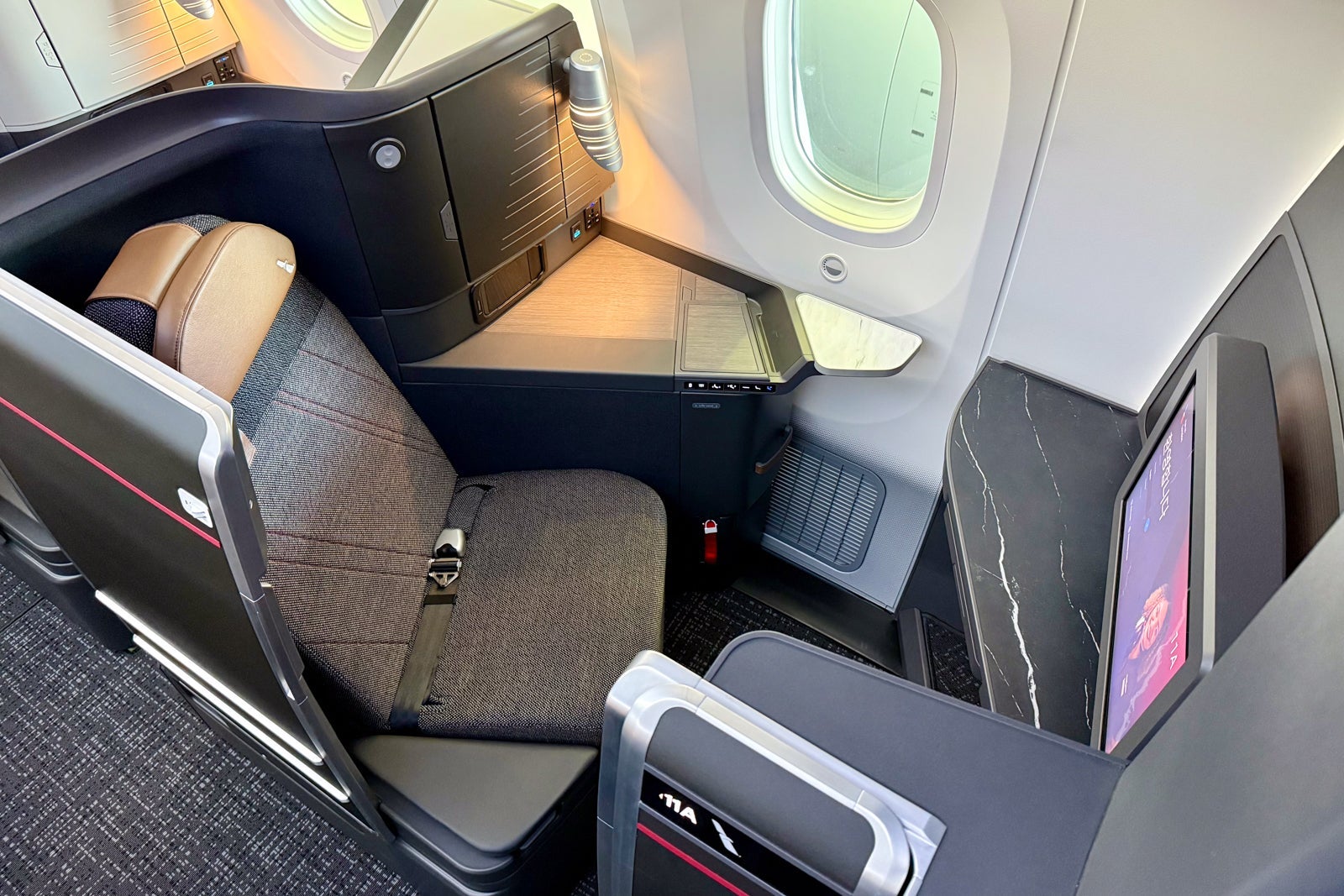
American Airlines Boeing 787-9P Flagship Suites Tour
ZACH GRIFF/THE POINTS GUY

Atmos Rewards points are my favorite airline currency to collect. I recently redeemed 70,000 points (plus $18 in taxes and fees) for a one-way business-class ticket from Los Angeles to Madrid. That redemption delivered outsize value compared to the $2,100 cash fare. If you’re willing to learn partner award pricing, the upside here is significant.

Where the Atmos Rewards Business Card falls short

In my view, the Atmos Rewards Business Card only makes sense for a specific type of traveler.

If you don’t fly Alaska or Hawaiian regularly, most of its core benefits lose their value.

There’s no automatic lounge access, no premium statement credits and no standout earning multipliers outside select bonus categories.

The annual Companion Fare is powerful but only if you actually use it. If you won’t reach the $6,000 in annual spending required to unlock it or don’t plan to travel with a companion, the long-term value decreases.

To maximize rewards on general business spending, other cards offer higher returns.

Atmos Rewards Business vs. Atmos Rewards Ascent

If you’re considering the Atmos Rewards Business Card, it may also be worth looking at the Atmos™ Rewards Ascent Visa Signature® credit card, the consumer version of the card.

The two products are very similar, offering comparable earning rates on Alaska Airlines and Hawaiian Airlines purchases, along with shared perks like a free checked bag and the ability to earn an annual Companion Fare after meeting spending requirements.

Man using a laptop and smart phone while holding a credit card
MSTUDIOIMAGES/GETTY IMAGES

The main differences come down to eligibility and a few bonus categories. The business card offers bonus rewards on shipping purchases, while the Ascent card earns bonus points on cable and select streaming services.

If you have a small business or a qualifying side income, the Atmos Rewards Business Card may be the better fit. Otherwise, the Atmos Rewards Ascent offers many of the same rewards and perks for personal cardholders.

Related: Atmos Rewards Ascent vs. Business: Which $95 Alaska-Hawaiian card should you get?

Is the Atmos Rewards Business Card worth it?

If you fly Alaska or Hawaiian a few times per year and can maximize the Companion Fare, I think the Atmos Rewards Business Card is well worth its $95 annual fee. But if you want flexible rewards or premium travel perks, you’ll likely find better options elsewhere.

When to apply for the Atmos Rewards Business Card

Timing your application can make a difference to the value you receive in the first year.

The current welcome offer allows you to earn 80,000 bonus points and a Companion Fare ($99 fare plus taxes and fees from $23) after spending $5,000 on purchases in the first 90 days from account opening.
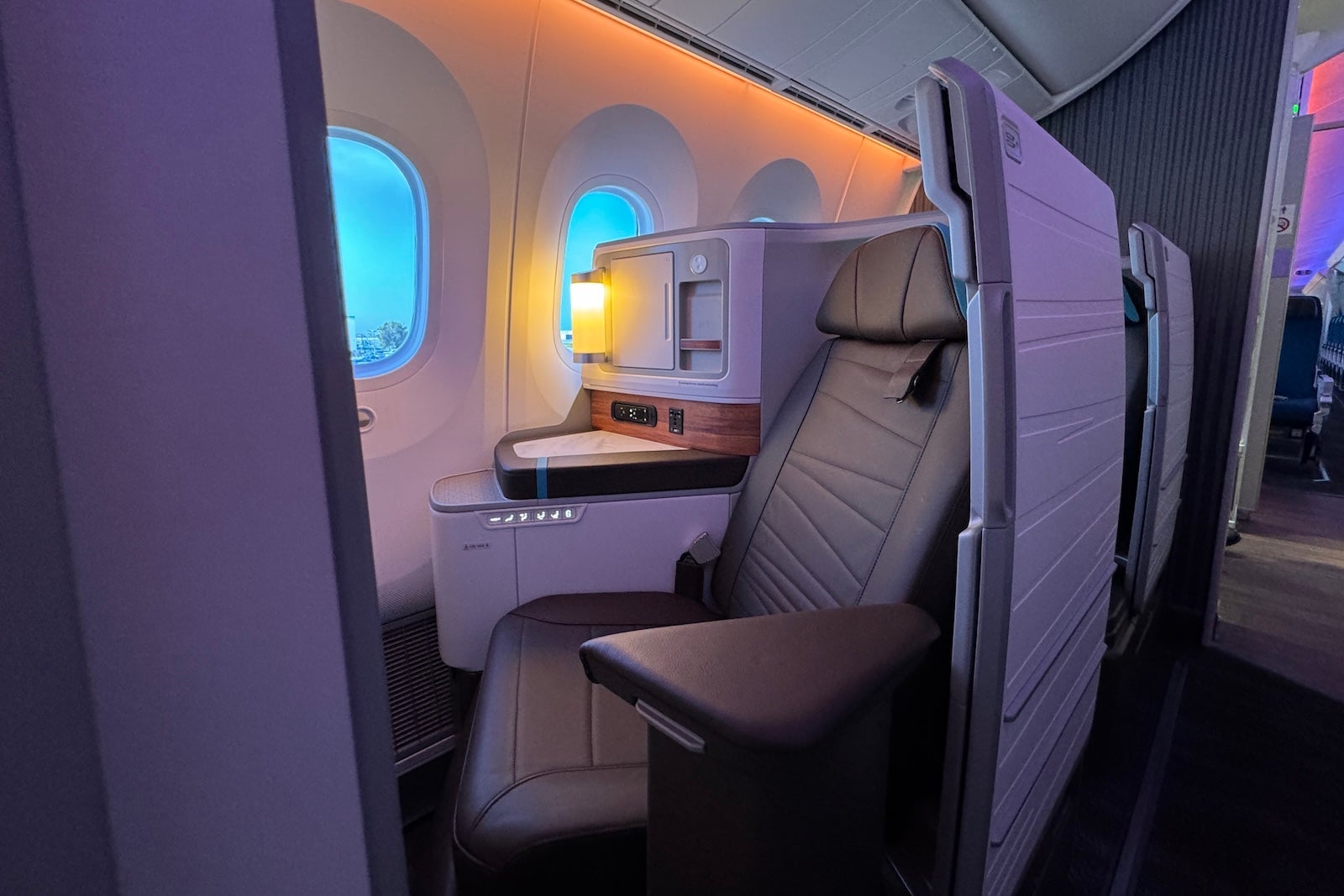
Hawaiian Airlines 787 interior
A business-class suite on a Hawaiian Airlines Boeing 787 Dreamliner, soon to be branded Alaska Airlines. ERIC ROSEN/THE POINTS GUY

Now is an excellent time to apply for this card, as the current offer matches the highest bonus we’ve seen recently, last available in October 2025.

If you have upcoming business expenses that will comfortably meet the spending requirement, this represents one of the best opportunities we’ve seen to apply.

Some applicants report that Bank of America strongly favors customers who already have a banking relationship with the issuer, such as a checking or savings account, though this isn’t a formal requirement and approvals still largely depend on your overall credit profile.

Other cards to consider if you don’t want the Atmos Rewards Business Card

If this card isn’t the right fit for your business, consider these alternatives:

For additional options, check out our full list of the best business cards.

Related: The power of the Chase Trifecta: Maximize your earnings with 3 cards

Bottom line

The Atmos Rewards Business Card is a strong under-the-radar choice for business owners who regularly fly Alaska Airlines or Hawaiian Airlines.

Between the free-checked-bag benefit, preferred boarding and the valuable annual Companion Fare, this card can easily pay for itself year after year. In my view, the real upside comes from Atmos Rewards partner redemptions that can deliver excellent value if you know where to look.

If you’re loyal to these airlines, this is one of the easiest airline business cards to justify keeping in the long term.


Apply here: Atmos Rewards Business Card


Source link

Leave a Reply

Subscribe to Our Newsletter

Get our latest articles delivered straight to your inbox. No spam, we promise.

Recent Reviews


Salesforce Vlocity Tutorial – Table of Content

What exactly is Vlocity?

Vlocity (Salesforce Sectors) provides pre-built Salesforce solutions to meet the needs of specific industries which require CRMs that are significantly customized beyond Salesforce’s out-of-the-box state. Vlocity, which was founded in 2014, swiftly established itself as an “industrial cloud” pioneer, receiving 3 Forbes Cloud 100 honors in 2017, 2018, & 2019. What factors aided them in achieving such quick success?

What is Vlocity

Vlocity applications (based on the Salesforce platform) provide multichannel sales, advertising, servicing, and CPQ solutions to specific industries like Communications, Health coverage, Energy and Utilities, Financial Services, Multimedia, Healthcare, and Public Sector.  The secret to success is straightforward. Companies profit from pre-built flows and procedures that would otherwise take several months (& millions) to construct custom.  Salesforce purchased Vlocity in 2020. Salesforce has been able to include Vlocity’s industry-specific CRM systems in its current Salesforce Industries offerings as a result of the acquisition. Vlocity’s creator David Schmaier maintained his position as CEO of Salesforce Enterprises, a corporate unit in charge of establishing clouds for new verticals, following the rebranding.

What is Salesforce Industries, and what does it do?

Salesforce had a step up on the latest vertical solutions after acquiring Vlocity. In general, the 12 existing industry clouds are making progress inside the Vlocity apps. These add to Salesforce’s existing data model and give out-of-the-box services which reflect their industry’s language.

Two often used “clouds” are, for example:

Organizations gain all the tools and apps they need to develop subscription services, handle orders, quotations, and contracts in an agile manner with Media and Communications Clouds.

Financial Services Cloud: Provides a consolidated system with a unified customer’s perspective of their policy, financial information, and claims to support the banking, financial advisory, and insurance markets.

Marketing, sales, commercial agility, and also operating efficiency, are all enhanced by these clouds, which reduce time to value.

Salesforce Industries

What is Salesforce Vlocity, and how does it work?

Salesforce Vlocity is the hottest innovation on the Salesforce platform, which is the industry’s leading provider of industry-specific solutions and software. It stands out as a worldwide forerunner in Customer Relationship Marketing, transforming the total customer experience (CX) (CRM). Vlocity also aids in the comprehension of the CMT, healthcare, and insurance realms. Salesforce Vlocity also has a lot more to offer, such as Lightning Web Omnichannel processes, Integration processes, Vlocity Actions,  Tracking services, Data Migration, and so on. Salesforce Vlocity also improves CPQ and guided selling. Salesforce Vlocity is a trailblazer, enabling a slew of top and up-and-coming businesses to achieve their goals through its Omnichannel processes.

Become a Salesforce Vlocity Certified professional by learning this HKR Salesforce vlocity training !
 

Salesforce Vlocity Training

  • Master Your Craft
  • Lifetime LMS & Faculty Access
  • 24/7 online expert support
  • Real-world & Project Based Learning

What are the different Salesforce Vlocity components?

  • Vlocity Insurance– To process all components of the insurance, Vlocity employs Microservice Architecture. Financial Service Cloud is intended to function with Vlocity Insurance.
  • Vlocity Media& Entertainment– This section contains a comprehensive industry solution for ad sales and subscriber sales in order to strengthen consumer and owner relationships.
  • Industry Cloud for Communications in Vlocity Communications aids in providing a consistent and individualized client experience.
  • Vlocity Health– Companies could use a Vlocity specialized device called Vlocity Health to run all of the sections relating to the health industry.
  • Vlocity Energy & Utilities is responsible for a number of industry-specific apps that allow the sale & service of a wide range of commodities and non-commodities.

Vlocity Benefits Salesforce in What Ways?

As a result of this collaboration, industry-specific solutions have become a key component of the platform’s capabilities. Salesforce has improved its adaptability over time, seeking to meet any industry issue. Nonetheless, one stumbling block remains unsolved: IT complexity. Consider a company with a complex IT stack, including some in-house applications. It will take a long time and a lot of money to replace it with a centralized platform. To enable end-to-end business processes, consultants and developers must customize the system, align, and merge apps. 

This is where Vlocity comes in. Vlocity adds enterprise product catalogs (EPCs), customer relationship management (CRM), order processing, and digital commerce to Salesforce, and also pre-built methods and new models. The software is developed in strict accordance with industry standards established by organizations such as the TM Forum as well as the MAF. As a result, businesses are able to go live more quickly. They teach their employees and may eventually be self-sufficient, saving money on consultants and developers.

Top 30 salesforce Vlocity Interview questions & answers for freshers & experienced professionals

Cloud Technologies, salesforce-vlocity-tutorial-description-2, Cloud Technologies, salesforce-vlocity-tutorial-description-3

Subscribe to our YouTube channel to get new updates..!

Overview of OmniStudio

OmniStudio is a modular framework that allows you to easily develop Salesforce flows and solutions using standard click-based components. 

OmniStudio

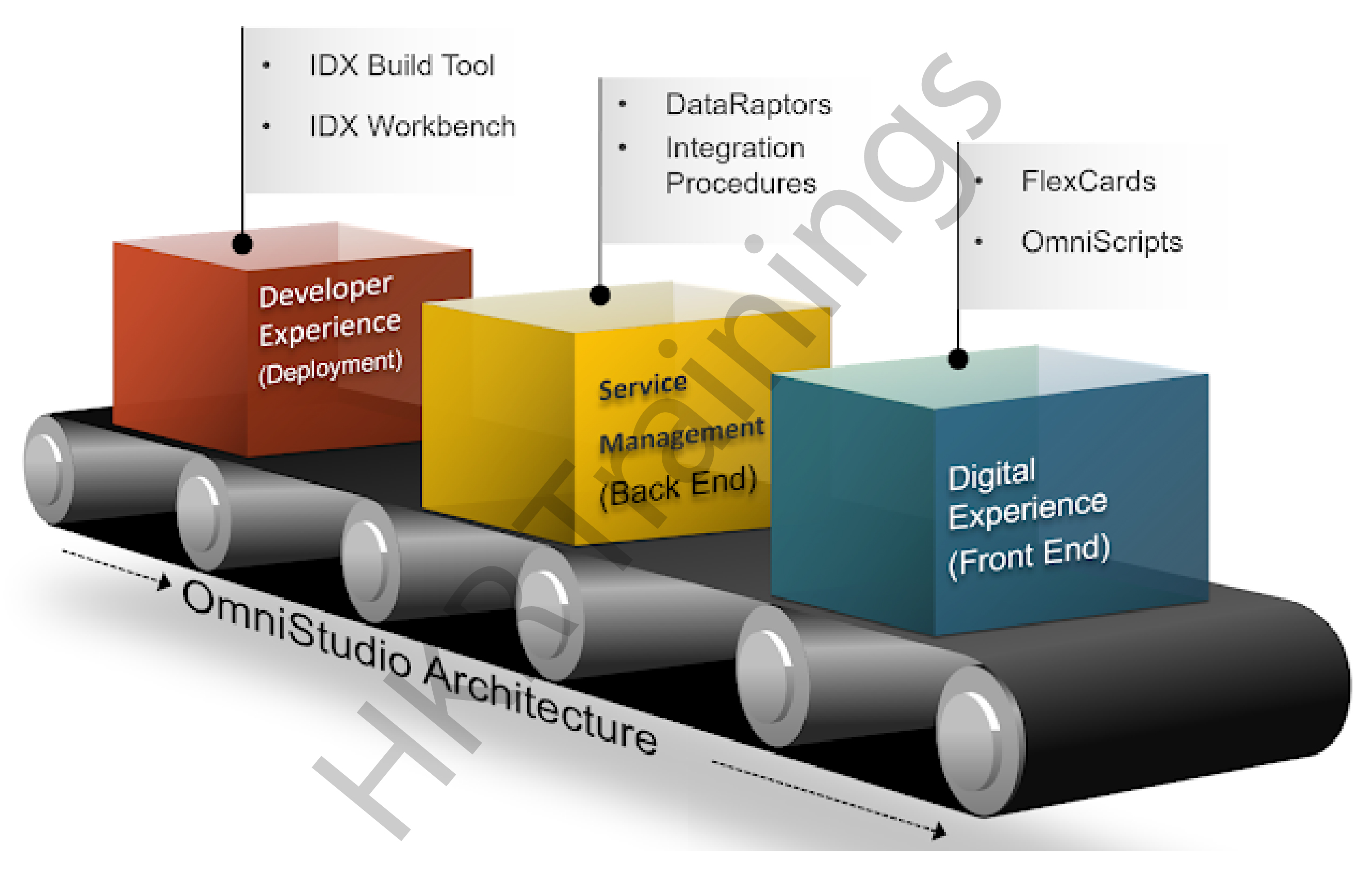
The architecture of OmniStudio is made up of three layers:

Digital Experimentation : 

This is the User Interface Engine. It contains all of the user interface elements that can be selected and dragged toward the action area. We must choose the appropriate component depending on business requirements. The back-end layer’s entry point is this layer. To conduct any operation, simply connect the back-end components to the components. This UI Engine gets separated into two categories once more:

FlexCards :

Flexcard is an alternative if you really want to display multiple data in less space. Flex cards have been used to display data at a glance. This is a drag-and-drop tool that allows you to quickly configure, preview, and troubleshoot a screen. FlexCards present and summarise contextual information and actions from Salesforce and third-party platforms.

Omniscripts : 

OmniScript is being used to give users a guided path through the business processes. That implies you can show multiple screens in a row. We may create pages quickly and effortlessly with the assistance of OmniScript, which is a drag-and-drop application. This is also entirely programmable, allowing it to be tailored to specific requirements. Another omniscript can be called from one omniscript. You may use OmniScripts to create sales, service pathways, and other business operations.

Service Management : 

Backend logic & data are handled by this layer. By using integrations, Service Management may read and write data via Salesforce and other external sources.

It is divided into two sections:

1. OmniStudio Dataraptors :

DataRaptors are used to retrieve, transform, and update information. They are used to perform data-related operations such as reading, writing, and transforming data from external sources. There are four parts to DataraptorsOmniStudio Dataraptors

  • DataRaptor Turbo Extract: As the name implies, this program is used to extract information from a data object. This component has the most efficient data retrieval speed. This option should be used if the need on your page would be to return just a single item.
  • DataRaptor Extract: Most of the time, we need to work with several objects on a page; in this situation, vlocity gives us this alternative. Use DataRaptor Extract to return many objects.
  • DataRaptor Load: This component is used to update the information in Salesforce.
  • DataRaptor Transform: Whenever your data isn’t solely in Salesforce and you’d like to retrieve it and display it in Omniscript/flex cards, use DataRaptor Transform.

2. OmniStudio Integration Procedures

To carry out such tasks, this instrument is quick and dependable. You can use Integration Procedures to retrieve data from third-party services.

Developer Experience

OmniStudio Data packs can be managed with the IDX Build Tool. IDX Workbench seems to be a desktop program for transferring Salesforce information and Data packs. In conclusion, like custom programming, OmniStudio provides simple shortcuts and greater reuse chances for adapting the industry-oriented solution to your specific needs.

However, there are several disadvantages to be aware of right now:

  • Many clouds are combined within one common functionality by industries. As a result, it’s difficult to tell if a certain feature is part of the current implementation.
  • Since all clouds & APIs receive information in one bundle, updates do not even have a defined structure.
  • Errors and platform constraints have limited support.
  • Vlocity’s data model and functionalities are best suited for enterprises at the enterprise level. Some argue that it’s inappropriate again for the SMB market, because not only does it need a greater budget, but it also leaves small-medium firms with capabilities they don’t want and won’t utilize.

Do you want to learn more about Salesforce Vlocity? Watch this Demo video now:


What are FlexCard Actions?

FlexCard Actions can be used to start or modify an OmniScript, connect to a website page or app, show a flyout, launch an event, or change the values of data fields. FlexCards can do the following actions:

  • Card — Load, modify data source, or erase cards at the card level. 
  • Event
    Custom — To alert the main FlexCard of an occurrence, fire a Custom Event.
    PubSub — To alert another element on a website or app of an event, fire a PubSub Event.
  • Flyout – In a modal or popover, show extra details from such a child card, OmniScript, as well as a custom Lightning web component (LWC).
  • Navigate — Choose a targeted URL or a PageReference type that allows you to navigate inside Lightning Experience, across Communities, to another website.
  • OmniScript — Use the FlexCard to launch an OmniScript.
  • Update OmniScript – Update an OmniScript from a FlexCard incorporated as a customized Lightning web component inside an OmniScript.
  • OmniScript Action – Update any OmniScript from a FlexCard integrated as a customized Lightning web component in an OmniScript A reusable OmniStudio Action can be used to launch OmniScripts, elements, websites, or external programs. The same OmniScript can be launched from numerous FlexCards using an OmniStudio Action.

Salesforce Vlocity Training

Weekday / Weekend Batches

Conclusion

To summarise, Vlocity achieved a breakthrough by offering businesses such an architectural foundation tailored to their industry. Salesforce’s acquisition signaled the company’s transition to industry-specific products that are easier to tailor and onboard users. For such a quicker digital transformation journey, firms can use the current Salesforce Industry clouds, which offer a configurable data model and a reliable version with reusable solutions. 


Source link