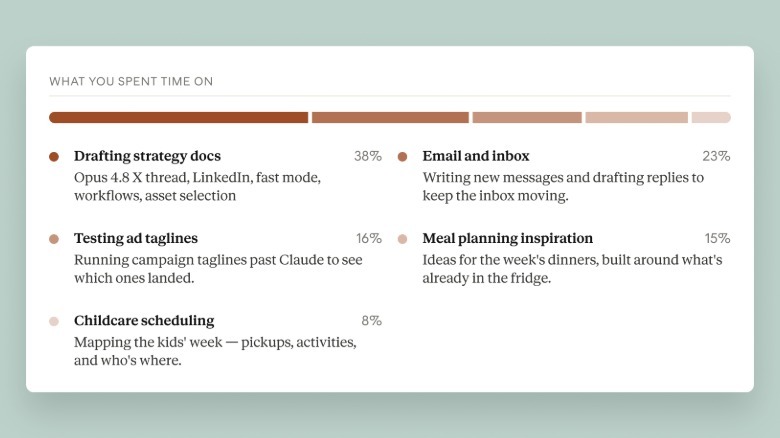

The internet loves a good usage dashboard, and today Anthropic is releasing one for Claude designed to help you “reflect” on the time you’ve spent with its chatbot. Think of the new feature as something of a cross between Spotify Wrapped and Apple’s Screen Time tool. You can generate your first report by opening Claude’s settings menu and navigating to the new “Reflect” tab. For now, the dashboard is only available through the Claude web client and desktop app.
At the top, you’ll see a paragraph-long summary of your recent conversations with the chatbot. By default, Claude will collate your last month of interactions, but you can also see your last three, six or 12 months of usage. Under that, the interface lists your most active day, peak hour and total chats over your selected time period, with a visual representation just below. In the future, you’ll also be able to see how much time you’ve spent chatting with Claude, but for now that metric isn’t available. If you continue scrolling, there’s a toggle to configure break reminders and time limits. You can independently set these of the Reflect interface by navigating to the “Time and focus” tab, and dismiss the nudges if you’re in the middle of something.
 Anthropic
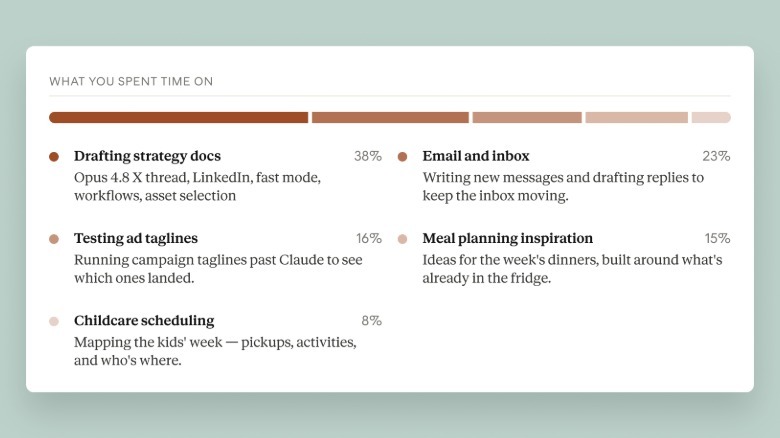
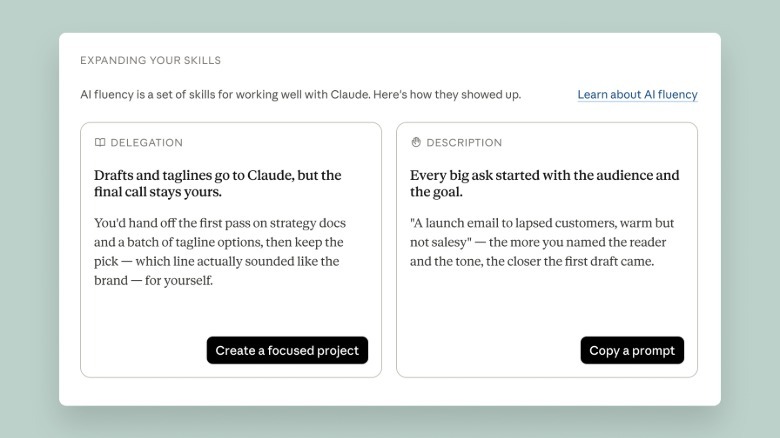
Further down, there’s a breakdown of topics you’ve discussed with Claude, with a percentage assigned to the ones you bring up most often. If you’ve been following along with the screenshots, all of this should feel broadly familiar. The penultimate section does things a bit differently, offering a set of AI “fluency” recommendations designed to streamline your usage of Claude, which are grouped around guidelines Anthropic co-created with a group of academics. For example, if Claude finds you frequently re-establish the same or similar context when you go to write a question or request, it will recommend you use its Projects feature to group your prompts together, so that you don’t need to repeat yourself so often.
For a more specific example, I’ve been working on a story about inference costs — the amount of AI labs like Anthropic pay for their trained models to process data — and I’ve turned to Claude a few times to track down statements from executives like Dario Amodei and Sam Altman. Based on that usage, the Reflect dashboard recommended creating a custom fact-checking skill for Claude. When I went ahead with that suggestion, the chatbot devised a text template to ensure it would always list its source for a claim, as well as its confidence in the information it had found alongside any caveats. I’ll admit I found the template helpful, and it wasn’t something I would have thought to ask Claude to do on its own.
 Anthropic
According to Ryn Linthicum, Anthropic’s head of wellbeing policy, Reflect came out of a study the company’s Societal Impacts team recently completed where participants expressed a mixture of optimism and anxiety around Claude and other AI products. “We were really intentional about building [the dashboard] with an eye toward how we can upskill people’s usage of Claude, not in a way that encourages them to spend more time with it, but instead enables them to get more efficient at meeting their goals, and hopefully get off of Claude or preserve the things that they want to think about,” Linthicum told Engadget.
Linthicum says part of the reason the dashboard doesn’t currently display the exact amount of time you’ve used Claude is because it wasn’t a metric Anthropic had been tracking internally, due to it being something the product team “didn’t want to maximize.” Looking forward, they note Anthropic plans to surface that information for users so they can use it alongside the usage management settings. In the future, the dashboard will also be available mobile, and reflect your usage there.
Anthropic is releasing Reflect in beta today. Notably, the company is making the feature available to Free accounts, in addition to Pro and Max subscribers.

Stephan is the sports journalist for the Maple Grove Report.