

Competing approaches color DFL Senate convention race


Two politicians speak at different events.

Jim Drake sat to the side at a recent campaign event for U.S. Rep. Angie Craig. Drake came to the event undecided in Minnesota’s Senate race and hoping for clarity.

“I tend to lean, you know, maybe a little more progressive, maybe more than Angie does,” Drake said. The Arden Hills voter says agenda isn't the only thing on his mind.

“It’s the electability and the track record that make me come back here,” he said. “Those are really important to me. Those are the first things I want done, is to get a Democrat elected in the fall.”

Drake said at the early May event that he wasn’t ready to commit his vote in the between Craig and Lt. Gov. Peggy Flanagan.

Whether his sentiment is shared will be on display at the DFL state convention this weekend in Rochester. The Senate showdown has top billing during a weekend in which U.S. Sen. Amy Klobuchar is expected to find few obstacles in the way of the Democratic endorsement for an open governor’s office.

On Saturday, DFL delegates will decide on a Senate endorsement — and who they feel can carry the party message to victory this fall.

There are some similarities between the two. The stories of their childhoods, which they incorporate into their campaign stops, have parallels.

They were both raised by single mothers. Both spent some time as children on food assistance. Flanagan talks about having lived in Section 8 housing; Craig talks about living in a mobile home park.

“These are the programs that helped my mom care for me and to afford it all. And I'm here because of those investments, not in spite of them,” Flanagan said.

“So, this fight that we're in at this moment in time, it is personal,” Craig said, reflecting on her childhood.
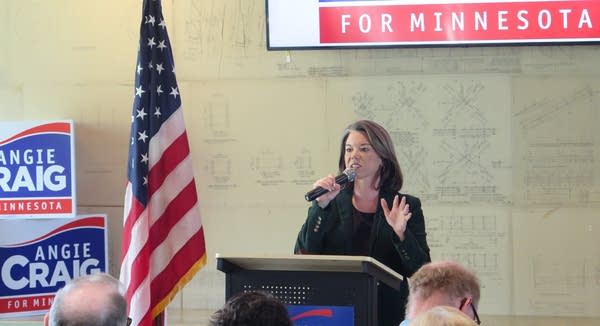
A woman speaks from a podium
U.S. Rep. Angie Craig speaks to supporters at an event for her U.S. Senate campaign at Malcolm Yards in Minneapolis on May 8.
Peter Cox | MPR News

In many ways, there is plenty of crossover in issue positions at the center of their campaigns. Both highlight how they’ll focus on improving healthcare access, ending corruption, emphasizing affordability and protecting voting and civil rights.

But the differences are clear in both their approaches and philosophies.

Flanagan’s political journey can be traced back to the politics of the late Sen. Paul Wellstone. She worked for Wellstone Action, a group that sprang up after his death to train progressive political activists and candidates. She says Wellstone, an unapologetically progressive U.S. senator, greatly informed her approach.

Craig’s political career took root in the 2nd Congressional District, a swing district that had been in Republican hands for nearly two decades until she took office in 2019. To win there, she had to win over centrist and some Republican voters, which she’s done. She’s worked across the aisle and voted with Republicans from time to time, which is part of her pitch to voters.

Flanagan has hammered Craig’s backing of the Laken Riley Act, which Flanagan said set the stage for the Immigration and Customs Enforcement actions seen in Minnesota over the winter. Craig said in March that she regrets supporting that law.

Meanwhile, Craig has been going after Flanagan for the human service provider fraud that led to millions of dollars in payments to fraudulent providers. Craig said Flanagan and the Walz administration did not do enough to stop it from happening. Flanagan has said the administration has taken many steps to address the issue.

Craig stresses how Democrats need more than their hardcore base to succeed.

“The only way we win is by extending a hand, by meeting people where they are, by bringing more people into or back into the fold, and folks, I know how to do that,” Craig told an audience at Malcolm Yards in Minneapolis earlier this month.

Flanagan says voters are tired of timidly pushing for small changes.

“Everywhere I go, they're sick and tired of Democrats bending to Republicans fighting from a defensive crouch, nibbling around the edges, or governing by sternly worded letter,” Flanagan told a crowd at a recent rally. “We need senators with the heart of Minnesota and the backbone of Bernie Sanders.”

A woman speaks on stage
Lt. Gov. Peggy Flanagan campaigns for U.S. Senate at John Marshall High School in Rochester on May 2. Flanagan is taking on U.S. Rep. Angie Craig for the DFL endorsement for the Senate race.
Peter Cox | MPR News

The Vermont senator and progressive kingmaker headlined a recent rally for Flanagan — also in Rochester. About 1,300 people showed up for what was called the “Fighting Oligarchy Tour.”

Sanders plugged his agenda over a 50-minute speech and left the stage with a final pitch.

“We're going to create a government that works for all of us, and one way to do that is making sure that Peggy Flanagan is the next U.S. senator from Minnesota,” he said.

Flanagan has racked up other endorsements from well-known liberals. That includes Sens. Elizabeth Warren and Tina Smith, whose seat is up for grabs in Minnesota.

One prominent Democrat withholding his endorsement for now is Gov. Tim Walz. Despite having his longtime second-in-command in the running, he’s remaining neutral. He won’t even be in Rochester, saying he has a scheduling conflict and thinks it’s time for him to step off the stage.

Pressed on MPR’s Politics Friday why he isn’t backing Flanagan after twice sharing a ticket with her, Walz said he has connections to both candidates.

“It’s also a dear friend in Angie Craig, who I encouraged to run for Congress and tried to support. I think we have two incredibly talented women,” he said. “I think it's important not to have the past, which is me, have a thumb on what the future is going to look like.”
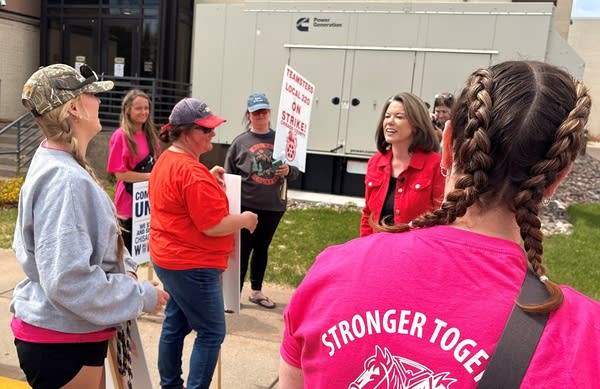
A woman greets a crowd
U.S. Rep. Angie Craig speaks to striking Chisago County employees on May 8.
Peter Cox | MPR News

In early May, Craig joined a union picket line of striking Chisago County workers in Center City, an exurban town where Republicans usually dominate. It's the kind of place she isn't shy about going.

“My commitment to you is that I will always protect the right to organize and collectively bargain in this country, and that I will always show up on the damn picket line with you,” she said.

Craig has racked up substantially more money. But her haul often draws criticism from Flanagan, who emphasizes that she won't take money from corporate-connected political funds.

“If billionaires and big corporations can buy this seat, it will tell politicians everywhere that playing it safe is what gets rewarded,” Flanagan said.

Craig underscores how expensive the race will get as national Republicans eye Minnesota as a pickup target. She says she knows what a tough race takes.

“I've had $50 million spent against me by Republicans over the last 10 years, while I've been fighting every single election cycle to hold my seat in the second district and help Democrats hold the House majority,” Craig said.

The convention probably won't end the Craig-Flanagan contest. An August primary is possible to decide the nominee.

Multiple DFL candidates are vying for an open state auditor spot — another choice for delegates this weekend.

Sen. Amy Klobuchar waves after a ribbon cutting ceremony, holding a piece of ribbon.
U.S. Sen. Amy Klobuchar holds a piece of the ribbon from the ribbon cutting celebrating healthcare company Solventum's new research and development hub in Eagan, Wednesday, April 1, 2026.
Cait Kelley | MPR News

Meanwhile, Klobuchar is the clear favorite to wrap up the party's backing for governor, but could face some skepticism from the more progressive wings of the party.

There are several challengers also looking for the DFL nod, but none that have Klobuchar’s name recognition or history in the state.

Klobuchar has a significant fundraising advantage over all of the Republicans seeking their party’s nomination. A low-strain endorsement and primary contest would allow her to conserve money and get organized for the fall campaign while the GOP field needs narrowing.

She’s likely to pick a running mate either before or at the convention.

Incumbent Attorney General Keith Ellison faces one DFL challenger, Dave Madgett, who served as a judge advocate general in the Air Force and has been in private practice for nearly two decades.

Incumbent Secretary of State Steve Simon is so far running unopposed for the DFL endorsement as he tries for a fourth term.

The DFL convention in Rochester begins Friday and runs through Sunday. The GOP convention in Duluth also begins Friday.



Source link

Leave a Reply

Subscribe to Our Newsletter

Get our latest articles delivered straight to your inbox. No spam, we promise.

Recent Reviews


Are you struggling to find out the best source to learn the SAP HANA interview questions? I think you are at the right place to learn and explore the knowledge in the SAP HANA module. SAP HANA is one of the popular enterprise resources planning functional modules and designed to work using programming codes. HKR’s frequently designed SAP HANA interview questions help you to gain valuable knowledge and crack the interviews. So let’s get our journey with the SAP HANA interview questions topic.

Most Frequently Asked SAP HANA Interview Questions and Answers

Basic SAP HANA Interview Questions

What is SAP HANA?

Ans: SAP HANA is a high-performance business analytical application tool and supports an in-memory computing engine. SAP HANA is a type of ERP functional module which contains a front-end modeling studio that can be used for server management application developments and load controlling methods.

  Become a SAP Hana Certified professional by learning this HKR SAP Hana Training 

Why is SAP HANA a unique model?

Ans: SAP HANA is considered as a unique ERP tool in many possible ways. The reasons are as follows;

  • SAP HANA is the first-ever technology used for handling both OLTP and OLAP application processing methods.
  • SAP HANA supports the query processing environment for both structured and unstructured data sets. This can be used in relational database tables and structured data sets.
  • This tool contains a multi-core process engine used to process the data sets parallelly. The parallel process can be done using different columns of the same database tables.
  • Using a column database set, this tool optimizes the different data structures and very easy to store large amounts of compressed data sets.

Mention the two types of relational data stored in SAP HANA?

Ans: The two types of relational data stored in SAP HANA are;

What is the role of the persistence layer in the SAP HANA model?

Ans: As I said earlier, the SAP HANA ERP tool contains an in-memory management engine that helps the user to access the data directly without any backups. The persistence layer avoids the risk of losing important data in case of any sudden power cut off or hardware failure. This layer is also called as a savior because it stores all the important data sets in the hardware without causing any accuracy.

Mention the components used in SAP HANA technology?

Ans: SAP HANA is nothing but a collection of different tools and technologies. So there are 4 major components are available which collectively make the SAP HANA technology such as,

  • SAP HANA DB (database sets)
  • SAP HANA studio
  • SAP HANA application cloud
  • SAP HANA appliances.

Name the platforms which support SAP HANA?

Ans: SAP HANA supports the following various platforms;

1. Microsoft Windows VISTA versions 7, 8 servers 2008 (32-bit memory)

2. Microsoft windows operating system versions 7,8,10 servers’ 2008/R2 (memory 64-bits)

3. SUSE LINUX operating server (SLES) version 11 (memory 64-bits)

4. Red Hat Enterprise Server (RHEL) version 6 (64-bit memory)

5. MAC operating system OS X Mavericks version 10.9.

What is the modeling studio in SAP HANA?

Ans: The modeling studio is a building block of SAP HANA technology which performs the operations like;

  • Helps to declare which table can store the data in HANA, firstly it will get the meta-data and perform the data replication process.
  • Manages the data service task to add the data from SAP business warehouse and other application systems.
  • Manages the ERP instance system connection, the current version of ERP software does not support this instant connection.
  • Self-modeling can be done and allows users to use data services.
  • Offers essential licenses for SAP business operation data services.

List the compressions techniques of SAP HANA technology?

Ans: There are three compression techniques available in SAP HANA technology such as;

1. Run-length encoding

2. Cluster encoding

3. Dictionary encoding.

What is the latency?

Ans: In SAP HANA, Latency means the time length for data replication from various data sources to the target machine.

. What are the different building blocks used in the SAP HANA environment?

Ans: The fundamental components of the SAP HANA environment included are;

1. In-memory computing engine.

2. Database (Replication agent and replication server)

3. SAP business objects BI 4 (designer tools, data server designers, and data servers, etc.)

4. SAP HANA studio (Eclipse-based tool)

5. Clients.

Intermediate SAP HANA Interview questions

. Mention the role of the replication server?

Ans: The main function of the replication server is to manage the table data replication as well as table metadata from the multiple data sources.

SAP Hana Training Certification

  • Master Your Craft
  • Lifetime LMS & Faculty Access
  • 24/7 online expert support
  • Real-world & Project Based Learning


. List the architectural components used in SAP HANA?

Ans: The SAP HANA architecture consists of different components that make the system architecture.

  • Index system server
  • Name server system
  • Pre-processor server system
  • SAP HANA model studio repository
  • XS engine system.

. Name the components of an Index server?

Ans: The following are the important components of the index server;

1. Relational data engine

2. Connection and session manager

3. Planning engine system

4. Calc engine system

5. Persistence layer

. Explain sizing in SAP HANA?

Ans: Sizing in SAP HANA defines the hardware requirements for a specific SAP HANA installation process. Hardware components are considered as important for sizing parts of System CPU memory or RAM and hard disk requirements. The very tough task here is that estimate the size of the SAP HANA server that will be best suited for the user’s requirements.

Sizing in SAP HANA can be performed in three ways;

1. Using the quick sizer tool

2. Using the DB script

3. Using the ABAP report.

. Define the rows and Column storage in SAP HANA?

Ans: 

Row Storage: 

A row storage is a store that saves a series of records that includes the field of a single row within a table. It is a way to store data horizontally, similar to the data storage inside traditional disk DBs. 

Column Storage

Column Storage represents storing data vertically, where data is compressed into the columns. It helps to optimize read-write data operations and enhances the performance of the SAP HANA platform.

. How can you avoid unnecessary information from being stored in SAP HANA?

Ans: Users can avoid storing the unnecessary data being stored in SAP HANA just by pausing the replication to stop the scheme-related jobs.

. Explain how SQL statements can be processed?

Ans: In the SAP HANA database, each SQL statement can be implemented with the references to the transaction. Frequently the new session can be allotted to the new SQL transaction.

. What are the different perspectives in the SAP HANA studio?

Ans: The following are the some commonly used perspectives as follows;

  • The SAP HANA administration console
  • The SAP HANA modeler control
  • Application server development
  • Life cycle management in SAP server
  • SAP HANA development
  • ABAP module development
  • Business warehouse (BW) modeling.

. Define the SAP HANA system Monitor?

Ans: The SAP HANA monitor in the studio can be used to perform tasks like administering and monitor the system’s performance and availability of SAP HANA architectural components. Also, users can access the SAP HANA system’s details, configurations, and the services offered by different SAP HANA components. SAP HANA system monitor can also be used to monitor several database aspects like alerts, trace disk, log disks, data disk, memory, data volume, and disk space, etc.

Related Article, SAP S/4 HANA Overview

. What are the three types of information views?

Ans: The following are the three types of information views such as;

  • Attribute View
  • Analytic View
  • Calculation view.
HKR Trainings Logo

Subscribe to our YouTube channel to get new updates..!


. What are the types of SAP HANA engines?

Ans: The following are the three types of SAP HANA engines such as;

  • Join engine
  • OLAP engine
  • Calculation engine.

Advanced SAP HANA Interview Questions

. Mention the types of packages used in SAP HANA?

Ans: The packages in SAP HANA are nothing but folders which holds modeling related database objects. We call it a package because it contains all the information related to modeling studio in a complete package wise and later we can use it for transition purposes (Import/Export) purposes. This information may be of type information view, Sub-package details, analytical privilege, and procedures.

There are two types of packages used in SAP HANA,

1. Structural package

2. Non-structural package.

. What are Schemas in SAP HANA?

Ans: The schemas are a type of database element of the system which resides in the catalog node of the SAP HANA model. The relational SAP HANA database can be divided into sub-databases within the SAP HANA nodes. Schemas are like a container that contains information like element details, objects, or relational database details.

. Differences between OLAP and relation connection to the SAP HANA?

Ans: Let me explain the major differences between OLAP and relation connection are as follows;

Relation connection: Relation connection can be used when there is a need to access the conventional database tables. Relational connections can be created via IDT or UDT semantic layers.

OLAP: The OLAP connection is used to access multidimensional data cubes and it also establishes the direct connection to the SAP HANA business layer of the database model to the relational connection. These connections help users to connect to the database tables or information views in the SAP HANA.


. Define referential join in SAP HANA?

Ans: The referential join in SAP HANA is a default join type in data modeling. This join is almost similar to an inner join. The only difference is that referential integrity can be formed when you are using referential join otherwise it cannot be formed. Referential join can be formed between a fact table and a master data table.

. What are the SAP HANA business objects reporting tools?

Ans: The following are the business objects reporting tools in SAP HANA such as;

  •       SAP Lumina
  •       Web Intelligence
  •       Design studio
  •       SAP crystal reports
  •       Universe designers
  •       Dashboard designer.

. Difference between catalog and content node?

Ans: 

The catalog node acts as a database directory for the SAP HANA model and also holds the structured information about the physical objects.

The content node contains information about the design-time repository data objects and also holds the packages such as attributes, views, calculation, and analytical views.

SAP Hana Training Certification

Weekday / Weekend Batches


. Mention the different ways to create a table in SAP HANA?

Ans: There are two possible ways to create a table in SAP HANA;

  1. Command-line method
  2. GUI based methods

SAP HANA Tutorials for beginners get started with your SAP carrier 

. What are the types of connecting drivers used by SAP HANA reporting tools?

Ans: The SAP HANA uses the four types of connecting drivers such as,

  1. ODBO (OLE DB used for OLAP)
  2. ODBC driver
  3. JDBC driver
  4. BICS driver

. What is the transformation rule in the SAP HANA module?

Ans. These rules in SAP HANA are the rules and regulations applicable to managing source tables. These rules are also helpful in executing all the jobs on the table. Moreover, a few rules in this regard also benefit the replication process.

sight:

In this article, I have tried my best to explain the important SAP HANA interview questions with answers. SAP HANA is a type of ERP functional module and is mainly used in business processing applications. These interview questions with answers will help you to learn and crack any kind of complex interview. 

About Author

author-image

Kavya works for HKR Trainings institute as a technical writer with diverse experience in many kinds of technology-related content development. She holds a graduate education in the Computer science and Engineering stream. She has cultivated strong technical skills from reading tech blogs and also doing a lot of research related to content. She manages to write great content in many fields like Programming & Frameworks, Enterprise Integration, Web Development, SAP, and Business Process Management (BPM). Connect her on LinkedIn and Twitter.

Upcoming SAP Hana Training Certification Online classes

Batch starts on
31st May 2026
Mon – Fri (18 Days)
Weekend
Timings – 10:30 AM IST
Batch starts on
4th Jun 2026
Mon & Tue (5 Days)
Weekday
Timings – 08:30 AM IST
Batch starts on
8th Jun 2026
Mon & Tue (5 Days)
Weekday
Timings – 08:30 AM IST


Source link