Delta One business class to Europe for 115000 SkyMiles


If you have Delta SkyMiles or American Express Membership Rewards points and are looking to fly to Europe in lie-flat comfort this summer for the price of a cup of coffee plus miles, stop what you are doing right now and listen up.

Delta’s dynamic award pricing means one-way business-class flights to Europe are usually at least 300,000 miles per person (and can be closer to 500,000 miles on peak dates and routes).

That’s why seeing outstanding award availability on peak summer dates and routes right now for just 115,000 SkyMiles is such a great deal, especially since Delta has low taxes and fees and no surcharges, while other programs add hundreds of dollars to the cost of award redemptions to Europe.

Here’s how to book a summer vacation to Europe right now.

Related: British Airways is hiking fees on award tickets

Man and woman at Bernini fountain in beautifully deserted Piazza Navona, Rome, Italy
KATHRIN ZIEGLER/GETTY IMAGES

Deal basics

At a glance: Delta One business class to Europe

Delta

Wide open from Delta hubs and other U.S. cities to Delta destinations across France, Spain, Italy, the United Kingdom, Belgium, Portugal, Switzerland, Ireland and Germany

Directly through the Delta website

115,000 Delta SkyMiles plus $5.60 in taxes and fees, one-way in Delta One business class

From mid-June until late August 2026

Just how good is this availability? A quick search of Seats.aero, our favorite tool for finding the best award availability in seconds, revealed an incredible 4,071 itineraries this summer between the United States and Europe in Delta One business class, all at the 115,000 SkyMiles rate.

You might think this low price applies only to shorter flights from the Northeast to the edge of Western Europe, which are typically under seven hours.

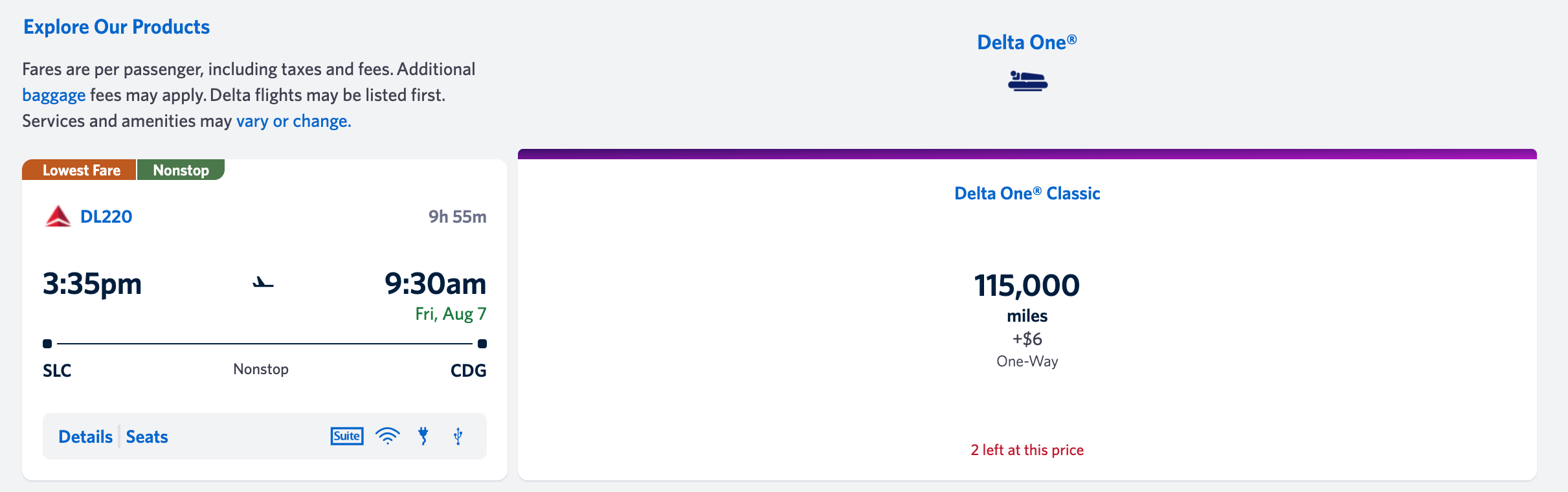
How does nonstop on the 10-hour flight from Salt Lake City International Airport (SLC) to Paris-Charles de Gaulle Airport (CDG) for just 115,000 Delta SkyMiles and $5.60 per person in August sound?
Delta screenshot
DELTA

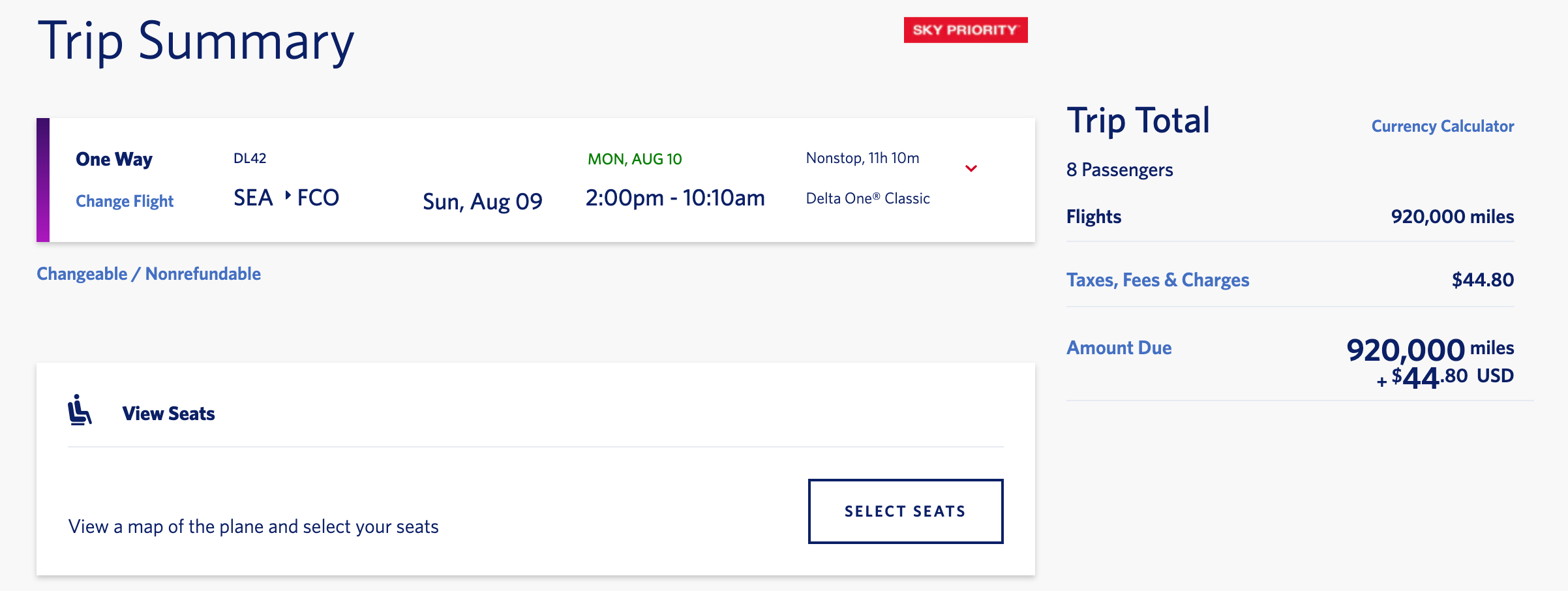
Or an incredible eight seats (yes, eight) on the same nonstop 11-hour Delta One flight from Seattle-Tacoma International Airport (SEA) to Rome Fiumicino Leonardo da Vinci Airport (FCO) for just 115,000 SkyMiles plus $5.60 in taxes and fees per person?

Reward your inbox with the TPG Daily newsletter

Join over 700,000 readers for breaking news, in-depth guides and exclusive deals from TPG’s experts
Delta screenshot
DELTA

Flights back from Europe to the U.S. right now start from 205,000 SkyMiles in business class, so you may wish to consider Delta’s premium economy instead for a better deal, given that these are daytime flights and less need for a flat bed. These start at 92,000 SkyMiles this summer, depending on the route.

How to earn Delta SkyMiles

It’s easy to earn SkyMiles with the right credit card; in fact, some of these cards are offering limited-time increased welcome offers that would earn you enough SkyMiles to book this deal:

You can also transfer American Express Membership Rewards points to Delta SkyMiles at a 1:1 rate.
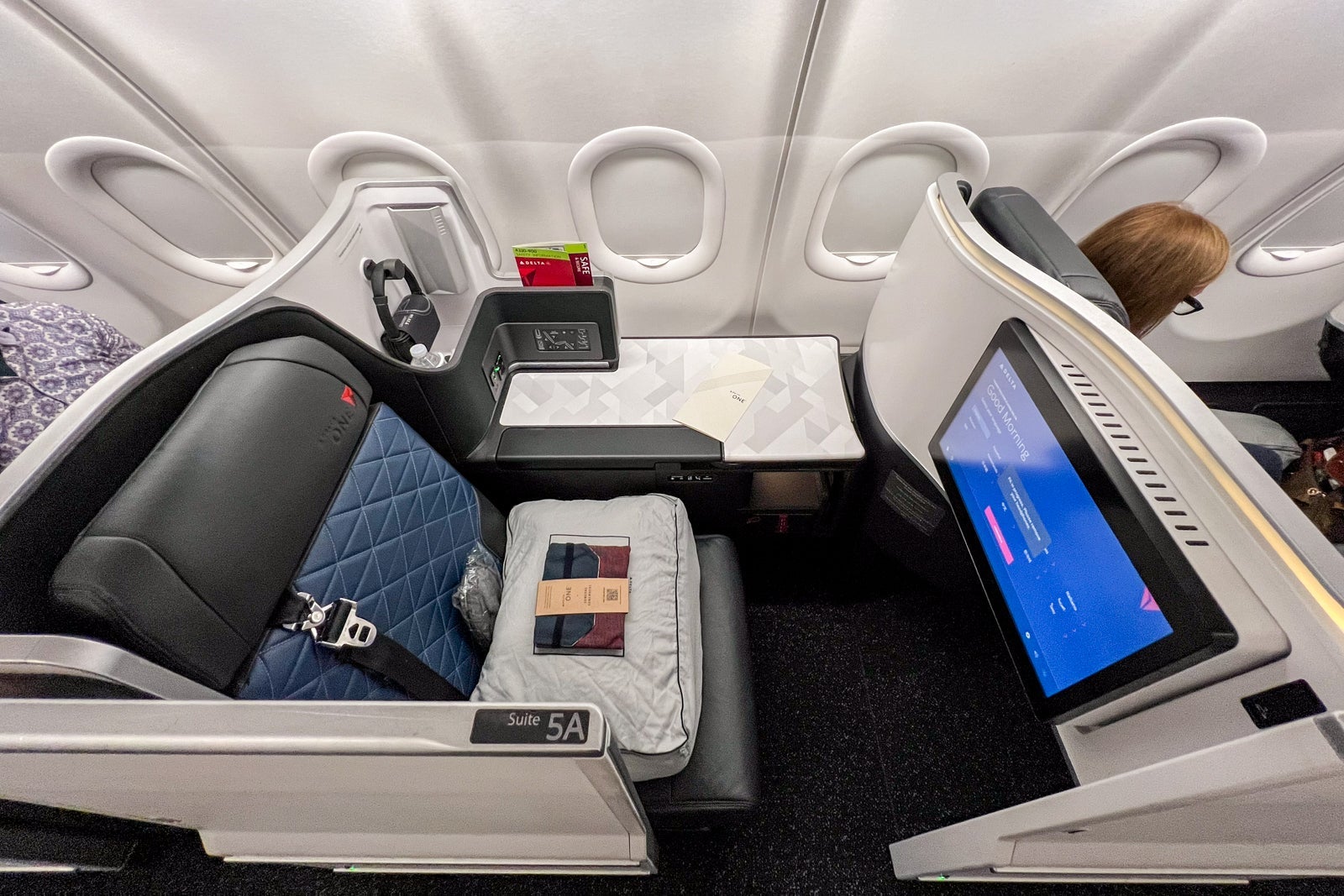
Delta One seat
ERIC ROSEN/THE POINTS GUY

Bottom line

If you’re looking for a sign to book a trip to Europe this summer, this is it.

It’s been a long time since we’ve seen Delta One flights to Europe priced this low through the SkyMiles program, and to have thousands of options across peak summer dates is just the cherry on top.

Why not take the whole family to Italy or Spain next month?

We don’t know how long these fantastic prices will last, so we recommend booking immediately if you want to enjoy a lie-flat seat to Europe this year for the price of a cup of coffee plus SkyMiles or Amex points.

Related reading:


Source link

Leave a Reply

Subscribe to Our Newsletter

Get our latest articles delivered straight to your inbox. No spam, we promise.

Recent Reviews


Fortinet vs Palo Alto – Table of Content

In this blog, let us compare Fortinet and Palo Alto and understand their similarities and dissimilarities and their pros and cons. So Let’s get into it.

Palo Alto Network’s next-generation firewall monitors all the traffic, which includes content, applications, and threats, and connects it to the user, irrespective of where or type of device is. The NGFWs of the company are available in specially designed hardware devices between the PA-200 series and the high-end PA-7000 series, including a 100 Gbps threat prevention throughput and as virtual devices supporting a variety of cloud-based environments.

Fortinet, a next-generation firewall, provides complete visibility to users, applications, devices, and network threats, decreasing complexity and enhancing overall security posture. The devices of the company are vacant with several 100GbE interfaces for delivering scalable, high-speed security services.

       To gain in-depth knowledge with practical experience in Fortinet, Then explore HKR’s Fortinet Certification Course!

Recent Developments:

Palo Alto has just released version 8.1 of the PAN-OS OS, by the addition of over 60 new features, With increased granular control over SaaS applications and extended SSL decryption capabilities.

Fortinet has now released version 6.0 of its FortiOS OS by adding improved management and analysis, unified access, advanced threat protection, expanded multi-cloud support, and extensive support for IoT, emails, web applications, and endpoint security.

Fortinet Training

  • Master Your Craft
  • Lifetime LMS & Faculty Access
  • 24/7 online expert support
  • Real-world & Project Based Learning

Analysis:

According to Gartner, WildFire sandboxing option from Palo Alto is one of the top firewall providers. Its Application Command Center enables it to understand the flows and risks of the application quickly. Disadvantages include stable large and infrequent releases, along with prices and performance during the management of a wide range of devices. However, the researchers claim that users generally declare great satisfaction and loyalty.

According to Gartner, when performance or price is highly valued in the assessment, Fortinet is tough to beat. The company has a robust firewall, including high-quality hardware, visibility, reporting, and easy deployment. Yet Fortinet often ranks second in terms of other major competitors when it comes to technical assessments where basic features such as VPN, intrusion prevention, application control, management, and Sandboxing are highly weighted, and the lack of direct support from vendors is a disadvantage to large companies.

                                                                                                         Lets’s get started with Fortinet Tutorial online!

Next-Generation Firewall Product ratings and comparison: 

Below is eSecurity Planet’s perspective on some of the key features of Palo Alto and Fortinet.

Performance: 

Both of them, Palo Alto and Fortinet, rock in terms of performance. Palo Alto overcame every firewall tested in NSS Labs with a performance of 7888 Mbps, whereas Fortinet’s 6753 Mbps was impressive for a cost-effective solution.

Security: 

In terms of security, both vendors Palo Alto and Fortinet excel. FortiGate 500E from Fortinet got a 99.3% security efficiency rating from NSS Labs in recently published test results, while PA-5220 from Palo Alto received a rating of 98.7%.

Implementation and Management: 

Fortinet users usually report a better time. A Fortinet client summarized the situation in the following terms: “It is simple to understand, provides excellent data and is affordable.” Palo Alto users may experience greater complexity but praise many features of the product.

                                                                                                            [Related Blog: Fortinet Firewall]

, Cyber Security & SIEM Tools, fortinet-vs-palo-alto-description-0, , Cyber Security & SIEM Tools, fortinet-vs-palo-alto-description-1

Subscribe to our YouTube channel to get new updates..!

Value: 

The $2.00 TCO of Fortinet per protected Mbps defeated competition in NSS assessments, whereas the $7 TCO from Palo Alto came fifth out of 10 tested solutions.

Cloud features: 

Palo Alto was one step ahead here. Controlling cloud apps and visibility are a particular strength. However, Fortinet is making greater investments in its virtual firewall features.

Support: 

Palo Alto leads due to direct support from vendors, whereas Fortinet customers depend to a large extent on the quality of their partner channel. The stability of the rare major updates to Palo Alto is a complaint, whereas Fortinet users point out that firmware updates and new functionality can be of uneven quality.

Deployment:

Palo Alto NGFWs come in the form of hardware devices (PA series), along with the VM series to be used within a cloud or virtualized environment. Fortinet NGFWs are available in the form of a virtual machine, appliance and cloud, using the same solution that is available on the highest-performing public cloud platforms.

Pricing: 

Palo Alto Networks provides an extensive range of NGFW options. The latest released appliances of the company PA-5280, PA-3200, and PA-220R in terms of pricing varies between $2,900 and $200,000, whereas the PA-220 base price is $1,000. The 220 delivers a VPN speed of 100 Mbps and 64,000 sessions; the 5280 offers a VPN speed of 24 Gbps and 64 million sessions.  PA-5220 that NSS tests costs approximately $70,000, with additional support packages.

The entry-level appliances of Fortinet start at about $500, and high-end corporate rates may reach $350,000 for the 7060E-8. Pricing consists of the basic pricing of hardware and services that include FortiCare support options and FortiGuard subscription licenses. Hardware and services may be purchased individually or on a package basis. Cloud and Virtual machine offerings are based on a similar pricing model. 500E tested by NSS is priced between $5,000 and $22,000, based on the level of guarantee and support. 

Fortinet Training

Weekday / Weekend Batches

Conclusion:

Palo Alto and Fortinet firewalls are rated very well by users and analysts, and when independently tested, however, there is a difference between these two in terms of cost, performance, and features. Fortinet cannot meet users’ expectations, whose most important criteria are performance or price, whereas Palo Alto costs more. But Palo Alto often gets appraisals from buyers with the highest overall rating due to its advanced features. 

NSS Labs considered Fortinet to be the highest value of the firewalls tested (based on the total cost of ownership $2 per protected Mbps), While ensuring robust security and performance. Palo Alto firewalls cost more money, but clients say they compensate with their capabilities to satisfy performance needs within production environments, along with its cloud capabilities and support. It is thus up to the buyer’s needs and budget to decide between the two.

Other Blogs:


Source link