
Donors gave during ICE surge, but evictions are rising


A person helps transport berries

When Kate Eubank showed up to Minneapolis City Hall in January to advocate a statewide eviction moratorium, she thought of a five-year-old boy at her daughter’s school.

Eubank had brought the boy a Christmas present three weeks earlier as his parents hid from the ICE agents roaming Minneapolis streets. Soon after, the boy’s father was taken at a bus stop, his mother lost her job and the family missed a rent payment.

Parents at the school then scrounged up the money to help the family avoid eviction.

It was Eubank’s first time speaking at City Hall. “We are at the limits of our capacity as neighbors and as family,” she said, leaning into the microphone while a scrum of cable news cameras faced her. “We can’t do enough and we can’t do it alone.”

That feeling mounted for months, as Eubank and hundreds of other Minnesotans reached into their pocketbooks to keep their neighbors housed. When grassroots funding dropped off, many organizers continued pressing local government leaders for intervention even as national attention faded.

For months, the government’s response was muted. Gov. Tim Walz would not impose an eviction moratorium. The Minneapolis City Council passed $3.8 million in rental assistance, but Mayor Jacob Frey vetoed measures to temporarily extend the grace period before an eviction.

Then in May, organizers notched an unexpected political win, securing $40 million in emergency rental assistance from the state. It represents a fourfold increase in the amount the state spends on that form of homelessness prevention in a typical year. But to the small army of neighborhood organizers striving to prevent evictions, the ICE surge exposed a deeper crisis the state is poorly positioned to address.


A child looks over a shoulder
S, who immigrated to the U.S. from a refugee camp in Chad in 2023, and her one-year-old niece in Minneapolis on Jan. 27. The family arrived legally as refugees and are awaiting their green cards to process.
Ben Hovland | MPR News
Federal agents outside a house
In February, community members filled the sidewalks, blowing whistles and filming federal agents with their phones.
Jamie Kelter Davis for The New York Times

DFL State Rep. Michael Howard largely credits the rent movement for pressuring lawmakers to match their herculean lift.

At least $14 million in grassroots donations have been distributed since January, according to Yusra Murad, an organizer affiliated with the rent-fund coalition Keep Minnesota Housed. That figure, based on a tally of 40 rent funds, represents only part of the total raised, excluding donations from charitable foundations and other crowdfunding efforts.

Howard, who co-chairs the House housing committee, said that “Minnesotans were leading in their own neighborhoods and then they took that same fight to the legislature. It really did prove pivotal.” He said lawmakers should learn from the system that Minnesotans built to provide far more rental assistance far more quickly.

“I heard more about the system failure of rental assistance during Operation Metro Surge than I ever have before, and I have heard about that for years,” Howard said. “We should feel pressure as government to be as responsive as we’ve seen folks at the community level.”

Alexandria Gomez, a substitute teacher, was among the thousands of Minnesotans who mobilized to support neighbors who were at risk if they left their homes.

She started the Phillips Community Free Store in 2020, sharing free produce and hygiene products outside of a volunteer-run bike shop in south Minneapolis. This January, while running food deliveries to families in hiding, she started getting questions about rent support.

Gomez and her fellow organizers quickly became experts on the resources available from the city and the county — and on the system’s limitations.

There were income restrictions. Confusing forms. Timelines that prevented residents from asking for help until they were almost over the edge. On top of it all, there wasn’t enough aid available, and people, many fearful of sharing information with the government, needed immediate help.

Gomez started a GoFundMe soon after Renee Good was killed, charting a system that skipped the usual requirements. If people said they needed help, she helped them. She was able to quickly identify who needed support, thanks to the network that persisted from 2020.


A woman poses for a portrait
Local organizer Alexandria Gomez, 37, of Minneapolis, poses for a portrait near her home on May 8.
Caroline Yang for The New York Times
A mosaic cross bearing a photo of Renee Macklin Good
A mosaic cross bearing a photo of Renee Good is displayed at a memorial honoring her on Feb. 4 in Minneapolis.
Kerem Yücel | MPR News

Leaders on each neighborhood block identified the needs in their area. She gave them cashier’s checks, which they passed along to families in hiding when rent was due.

Her efforts yielded more than $1.5 million in rent assistance, helping hundreds of families in the Phillips neighborhood stay in their homes.

Across the state, many other new rent funds worked in similar ways, as Minnesotans created a patchwork safety net together.

That community effort seems to have had a meaningful impact on eviction filings.

Last year, Minnesota hit a state record for the most evictions filed. In January and February, however, filings were slightly lower than the previous year, according to HOMELine, a nonprofit tenant advocacy group that tracks eviction data. Eric Hauge, a co-executive director at HOMELine, said mutual aid “absolutely kept filings artificially lower.”

But eviction filings are now again on track to exceed last year’s high. And grassroots donations have dwindled since Operation Metro Surge wound down, forcing many groups to shut down and shuffle renters to those that remain.

Now that the state aid has passed, it will probably reach local providers between July and September, according to the Minnesota Housing Finance Agency.

“It’s too little, too late,” Gomez said of the state funding. “I don’t think it’s really going to scratch the surface of the need — especially considering we’ve only been helping people who are impacted by Metro Surge.”

For low-income renters alone, the state’s own research outlines a $350 million need for annual emergency rental assistance. When the federal government exacerbated that need, philanthropic foundations were slow to respond, with one notable exception: John Wilson, who grew up as a renter with an intimate view of housing precarity. He got rich after his company patented a cancer innovation, and started a foundation that has distributed more than $23 million to local rent groups as of June 11.

When the Wilson Foundation joined the rent movement in late February, Wilson tapped into a network of trusted mutual aid groups — allowing him to move at a speed unusual in the foundation world. Wilson said things seemed better than they were in March, but the amount of rent support requested has not diminished.

At La Viña church in Burnsville, Pastor Miguel Aviles is acutely aware of how urgent the need created by the ICE surge remains in his community. Legal fees, outstanding bills and health costs are mounting, and many households are missing breadwinners. At the peak of Operation Metro Surge, he continued to lead his majority-Latino congregation in person, even when he feared he or his wife might be caught up in the seemingly indiscriminate sweeps. But he received the highest volume of calls for rent help in May and June, months after officials announced the end to the federal operation.

Aviles is celebrating the state rent relief win, but he’s not expecting the aid to reach many of the families he has been supporting.

As of June 5, the church has distributed more than $1.2 million in rent aid, helping more than 1,000 people. Many would not qualify for typical rent relief programs, Aviles said, because they are not named on an official lease and are renting from family or friends. “We know these cases are real and most agencies are ignoring these cases,” he said. “And these people are going to be out in the streets.”


Two people pose for a photo
Pastor Miguel Aviles and his wife, Rosie Aviles, at their church, La Viña Comunidad Cristiana in Burnsville on May 8.
Caroline Yang for The New York Times
A food distribution site
The scene at La Vina Comunidad Cristiana church's food distribution site in Burnsville on May 11 as volunteers prepare for pick-up.
Caroline Yang for The New York Times

Mutual aid is “putting the whole system on its head,” said Hauge of HOMELine. “And I think it does speak directly to the need for structural change.”

The struggle for noncitizens to access housing aid could get worse. In addition to wide cuts to food, health care benefits and much federal funding to the state, the Trump administration wants to disqualify citizens and legal residents who live with undocumented family members from receiving housing assistance or accessing public housing.

Anna Stamborski, a lead organizer of Neighbors Helping Neighbors — one of the largest mutual aid networks that formed in response to the ICE surge — said communities need to stay organized in the face of threats like these.

Although state funding is on the way, Stamborski and other rent organizers are disillusioned that the local government didn’t heed their most urgent demand: a delay in evictions when losing shelter meant potential violence with armed agents outside.


A woman poses for a photo
Anna Stamborski, 33, of Minneapolis, poses for a portrait in her home on May 12.
Caroline Yang for The New York Times
A woman brings clothes to a donation site
Anna Stamborski, 33, of Minneapolis, brings clothes to donate to People's Closet at George Floyd Square on May 12.
Caroline Yang for The New York Times

At the peak of the surge, it was not intervention from philanthropy, the government or corporations that reached those thrust into crisis, Stamborski said. It was those who built relationships and infrastructure with their neighbors. That’s the work Stamborski hopes will continue, as she foresees a long-term fight ahead.

“Churches know exactly who this rent relief is going for. Schools know exactly who these families are that need help with rent. Neighborhoods know exactly who those people are that they’re organizing within their neighborhoods,” Stamborski said. “There’s beauty in relationships and proximity.”

This article was published as part of a collaboration between The New York Times’s Headway Initiative and Minnesota Public Radio, focused on covering housing in Minnesota. This reporting is supported by the Stavros Niarchos Foundation (SNF), with the Local Media Foundation serving as a fiscal sponsor. Funders have no control over the selection, focus of stories or the editing process and do not review stories before publication. The Times retains full editorial control of the Headway initiative.




Source link

Leave a Reply

Subscribe to Our Newsletter

Get our latest articles delivered straight to your inbox. No spam, we promise.

Recent Reviews


The McLaughlin Group

There was a sketch on Saturday Night Live where Dana Carvey played news talk show host John McLaughlin.

The recurring gag was that McLaughlin would ask the guests a serious political question, each would give a thoughtful answer, and McLaughlin would shout “WRONG!”

I think about that a lot when I’m doing deposition preparation with clients in trade secrets lawsuits.

Let’s go over some common ways defendants in trade secrets lawsuits go wrong in their depositions. We’ll use our old hypothetical friend Dawn Davis as an example

1. Are the things defined as “confidential information” or “trade secrets” in the agreement actually confidential or secret?

Like most employment agreements, Dawn’s agreement with Paula Payne Windows includes a confidentiality agreement.

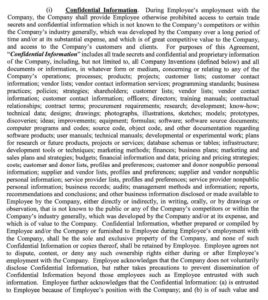
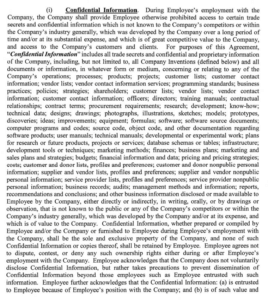
The definition of “confidential information” looks something like this:

The deposition questions about it go something like this:

Q: Can you take a look at the definition of the company’s “confidential information and trade secrets” in your agreement? Do you see that? 

A: Yes.

Q: You signed this agreement, right?

A: Yes, I signed it.

Q: So you agree that the things listed in this definition are the company’s confidential information, right?

A: Right.

WRONG!

What a difference a single letter can make.

If the question was “you agreed that the things listed in the definition are the company’s confidential information,” then yes would be an acceptable answer. That’s because generally, if you sign an agreement, you agreed to what’s in it.

But just because you signed the agreement doesn’t mean you now agree with every statement in the agreement.

See the distinction?

Yes, you may have agreed to what’s in the agreement by signing it, but just because the agreement says something is true doesn’t make it true.

Especially when it comes to a definition of “confidential information” or “trade secrets.”

The problem with this definition—and most definitions of confidential information in such agreements—is that it is both too vague and too broad.

These are slightly different things.

The definition is vague, or “indefinite,” because it is not clear what is included and what is not. For example, the definition refers to the company’s “processes” and “policies.” Which processes and policies? All of them, or just the “confidential” ones? And which ones are confidential?

Let’s say Paula Payne Windows has a process for prospecting for new customers: search on the internet for the kind of companies that buy windows, find the contact information for the person there responsible for buying windows, cold call that person, then make a note in the company’s CRM system to follow up later.

That’s a process, but is it a confidential process? Of course not. Everybody has a process like this. It’s no secret.

Is that process included in the contract’s definition of “confidential information”? It’s hard to say.

But you could read the definition literally to mean that all of the company’s processes are included in the definition of confidential information. And that brings up the second problem: the definition is overbroad.

The definition is overbroad because on its face it includes things that are not confidential.

An agreement that defines all of the company’s information as confidential would be unreasonable and unenforceable. It would be a de facto non-compete.

When you understand these two problems, you can answer deposition questions more accurately.

Q: So you agree that the things listed in this definition are the company’s confidential information, right?  

A: Not necessarily.

Q: Why not?

A: Well, first, I’m not even sure what this definition means. And second, it has things in it that are obviously not confidential information.

Q: Like what?

A: Like “processes” and “policies.” If that means all of the company’s processes and policies, then it includes things that are obviously not a secret. 

This answer won’t make the questioning lawyer happy, but you’re not there to make friends.

2. Is a customer list a trade secret?

Suppose when Dawn Davis left Paula Payne Windows, she took an Excel spreadsheet showing all her sales from the previous year, including the names of the customers. Dawn says she needed the list because the company owed her commissions, but Paula Payne Windows says the spreadsheet is a confidential customer list.

So the deposition questioning goes like this:

Q: You’re not a lawyer, are you?

 A: No.

 Q: Ok, I’m not asking for a legal opinion or anything, but do you see this definition of “trade secrets” from the Texas Uniform Trade Secrets Act?

A: Yes.

Q: The definition includes “list of actual or potential customers,” right?

A: Yes, I see that.  

Q: [in the most casual tone possible] Ok, so you understand a customer list is a trade secret, right?”

A: Yes, I understand that.

WRONG!

Perhaps we can forgive Dawn for making this mistake. I have seen licensed lawyers make this very argument to judges. “Your Honor, the definition of trade secrets in TUTSA specifically includes customer lists, so my client’s customer list is a trade secret.”

But the argument is wrong, for two reasons.

First, if you look at the whole definition of a trade secret, there’s a very important word: “if.”

A customer list is included in the list of types of things that can be a trade secret, if the rest of the elements of the definition are met (like “independent economic value”).

The first problem with the deposition question was that it ignored this important “if.”

The second problem with the argument is that it just defies common sense.

Think about it. Suppose Dawn’s spreadsheet lists just five customers, who happen to be the biggest homebuilders in her sales territory. There’s no way that’s a trade secret. All the competitors in that area know who those customers are.

If you want to know more, I cover this issue in more detail at my blog post When Is a Customer List a Trade Secret. I even cite court cases. But you get the idea.

Now that Dawn is armed with the knowledge that a customer list isn’t automatically a trade secret, let’s give her another crack at the deposition question:

Q: Ok, so you understand a customer list is a trade secret, right?”

A: No.  

Q: But it says that right there in the definition, doesn’t it? 

A: It says customer list, but there’s more to the definition.

Q: So you don’t think your customer list is a trade secret? 

A: No. Everybody in our industry knows who those customers are.

Now that we’ve avoided that confusion, let’s look at another category of information that can be a trade secret but isn’t necessarily a trade secret: prices.

3. Are the company’s prices trade secrets?

After customer lists, the next most common type of alleged “trade secret” is prices. I cover this at my blog post The Price Undercutting Theory in Trade Secrets Litigation.

Here’s how the lawyer for Paula Payne Windows might try to set it up in Dawn’s deposition:

Q: Are you working for Real Cheap Windows now?

A: Yes.

Q: Let’s say a competitor calls you up and asks you for the prices you’re charging customers this week, would you tell him?

A: Uh . . . I don’t think that has ever happened.

Q: But if it did, would you tell them?

A: I mean, I don’t think so.

Q: Why not?

A: Well it’s none of their business.

Q: And if they knew your prices they could offer the same customers lower prices, right?

A: That could happen.

Q: Can your competitors just do a Google search and find your prices?

A: No.  

Q: Right, so the prices your company charges its customers are confidential, right?

A: Yeah, I guess so.

WRONG!  

Don’t let this happen in your deposition

Everything leading up to the last question is fine, but are the prices really a secret?

Nine times out of ten, the answer will be no, at least in my experience and opinion.

That’s because in the vast majority of cases, there’s nothing to stop the customers from telling one competitor what another competitor is charging.

In fact, in many industries, it’s common for customers to do so. “Hey, Fred, Bubba’s Oilfield Supply says it can get me those frac valves for five thousand apiece this week, can you beat that?”

Unless the company has a nondisclosure agreement with the customer that says the customer must keep the company’s prices confidential, I don’t see how the company can genuinely claim the prices are a secret, or that it took the required “reasonable measures” to keep the prices secret.

Keep in mind, this is just my opinion. But it is usually correct.

Knowing that, here’s a better way for Dawn to answer deposition questions about prices:

Q: So the prices your company charges its customers are confidential, right?  

A: No.

Q: They’re not confidential? Are you saying you would just give them out to your competitors?

A: I didn’t say that.

Q: Well, if the prices aren’t confidential, why wouldn’t you share them?

A: They can easily go and ask my customer for the prices, and I can’t stop the customer from telling them. But that doesn’t mean it’s my job to help them.

So, those prices on the spreadsheet Dawn took from Paula Payne Windows, maybe they’re not so secret.

That, of course, does not mean it was a good idea for Dawn to take the spreadsheet.

4. What does the forensics show?

It’s a bad idea for departing employees to take or keep any company documents.

With the exception of their agreements with the company, which I think are generally fair game for an employee to keep. But generally, don’t take company documents when you leave!

There are multiple reasons for this, but maybe the most important one is that whatever documents the employee takes, those will be the documents the company claims contain its alleged “trade secrets” in the subsequent trade secrets lawsuit. I call this Wolfe’s First Law of Trade Secrets Litigation.

Here’s how it might go down in Dawn’s case:

Q: When you were working for Paula Payne Windows, did they provide a computer?

A: Yeah, I had a computer at the office.

Q: Did you ever use USB drives?

A: You mean like a thumb drive?  

Q: Yes. 

A: Sure, we used those all the time, like if I needed to take documents with me on a customer visit.

Q: Let me show you Plaintiff’s Exhibit 13 to your deposition. That’s a report our forensic expert prepared. Do you see that?

A: Yes.

Q: Do you see line 7 on page 2 that shows on April 7, 2023, the day after you gave notice, you plugged a Seagate thumb drive into your computer at work and copied 12 sales reports to it?  

A: Yes.

WRONG!

Dawn doesn’t have any personal knowledge of the forensic report or how it was prepared. And her recollection is probably not that specific. How can she be sure?

Here’s a better way for Dawn to answer:

Q: Do you see line 7 on page 2 that shows you copied 12 files on to a thumb drive?

A: I didn’t prepare this report.  

Q: Ok, but you see where it says that, right?

A: I see that the report says that.

Q: Well, are you denying that you copied 12 files on to that thumb drive on April 7, 2023?

A: I’m not denying there were times when I put files on a thumb drive, but I can’t remember if I copied those specific files on that specific date.  

Q: Ok, but you can’t rule it out?

A: I can’t rule it in or out. I just don’t remember.

Sticking to what you personally know is good deposition advice generally, but especially when it comes to computer forensics in a trade secrets lawsuit.

Let me stress: I am not saying Dawn should pretend like she doesn’t know or doesn’t remember if she does remember. Every witness should tell the truth. If Dawn clearly remembers, “yes, I copied 12 files on to a thumb drive on April 7, 2023,” then she should say so.

But it’s rare that the witness will remember that specifically.

In most cases, a witness in a deposition is not going to remember every little thing she did on a computer years earlier, before any lawsuit was filed. She certainly won’t remember things like the serial number of the USB drive.

And that brings up the final common deposition mistake to avoid in a trade secrets lawsuit.

5. Undermining your credibility by overstating your case

Maintaining your credibility is critically important in any lawsuit.

And if you’re a former employee defendant in a trade secrets lawsuit, it is even more important than usual. Right off the bat your credibility is under attack because you did something your former employer portrays as sneaky and underhanded. “Theft!” they will cry.

And you should expect the plaintiff’s lawyer will go into the deposition ready to set you up. It might go like this:

Q: Can you take a look at page 27 of the Paula Payne Windows Employee Handbook?

A: Ok, yes, I’m there.

Q: It says “Employees must take care not to disseminate company documents outside the company, such as sending them to personal email addresses.” Did I read that correctly?

A: Nobody ever paid attention to that.

Q: Ok, but that was the company’s stated policy, correct?

A: Yeah, I guess.

Q: Ok, so you knew it was against company policy to email yourself company documents, right?

A: Right.

Q: Did you ever do that?

A: Absolutely not. I never emailed myself company documents.

WRONG!

The answer is wrong because you already know what’s coming next: Impeachment.

The lawyer for Paula Payne Windows will show Dawn a copy of an email from her company email account to her personal Gmail account attaching a proposal to a customer.

“Oh, I forgot about that!” Dawn will say. “I was going to meet with a customer out of the office the next day, and I needed to be able to print out the proposal at home.”

A legitimate explanation, if true. But the damage will already be done.

So for questions like this, it’s important to be cautious and not overstate your case.

In this example, there are basically three possibilities:

  1. Dawn remembers emailing herself the proposal, or at least remembers emailing herself generally.
  2. Dawn has no recollection of emailing herself company documents, but knows it’s possible she did.
  3. Dawn knows for a fact she never emailed company documents to herself.

If 1 is true, then Dawn should say so.

If 2 is true, then Dawn should say something like “I don’t have a specific memory of doing that.” Then she’s leaving room for the possibility that it happened.

If 3 is true, then Dawn could say she never emailed herself company documents, but even then, she should proceed with caution.

You see, memory is a funny thing. Every litigator has experienced a client who was 100% sure of some fact or sequence of events, and then the documents show her memory is just flat wrong.

So even if Dawn is absolutely sure, it’s still a good idea to say something like “I don’t think I ever did that.”

You don’t need to overstate the good facts that are on your side.

On a scale of 1 to 14, 1 being lowest degree of likelihood, 14 being absolute metaphysical certitude, what are the chances you’ll make a mistake?

Go ahead, say your answer.

WRONG!

_______________________

Zach Wolfe (zach@zachwolfelaw.com) is a Texas trial lawyer who handles non-compete and trade secret litigation at Zach Wolfe Law Firm (zachwolfelaw.com). Thomson Reuters has named him a Texas Super Lawyer® for Business Litigation every year since 2020.

These are his opinions, not the opinions of his firm or clients, so don’t cite part of this post against him in an actual case. Every case is different, so don’t rely on this post as legal advice for your case.


Source link