

Early voting starts Friday. What do you need to know?


Election Day

Early voting for the 2026 primary election starts Friday and election officials are expecting a spike in turnout.

While Minnesota has famously high turnout in general elections, primaries always have fewer voters. Still, turnout increases “where there’s a lot of action and competitiveness on the ballot,” said Minnesota Secretary of State Steve Simon. “And we certainly have that this year.”

The last time Minnesota had an open governor’s race was 2018. That year, turnout in the general election was about 64 percent of eligible voters and 23 percent in the primary, which featured competitive nominating contests in both parties.

After both major parties largely failed to unite around candidates during their endorsing conventions last month, multiple high-profile races are set to have competitive primaries this summer.

The primary election is Tuesday, Aug. 11, but before then voters can vote early by mail or in person.

What’s on the ballot?

The primary ballot has candidates for both partisan and nonpartisan races. For example, the gubernatorial race is partisan so candidates declare a party affiliation. Other offices like county commissioner or county attorney are nonpartisan.

Check out example ballots for the general election and the primary here.

There is a seven-candidate race to determine the Republican nominee for governor. The top three contenders are:

  • Former healthcare executive Kendall Qualls, who won the party convention endorsement

  • Minnesota House Speaker Lisa Demuth

  • My Pillow CEO Mike Lindell

The DFL also has seven candidates in its gubernatorial primary. Among them:

  • U.S. Sen. Amy Klobuchar, who has the DFL endorsement and is the heavy favorite

  • Former Capitol staffer Kobey Layne, the sole convention challenger to Klobuchar

One of Minnesota’s two U.S. Senate seats is up for election because Sen. Tina Smith is retiring. Both parties have a crowded field of candidates — six DFLers and nine Republicans.

The top two Democrats are:

  • Lt. Gov. Peggy Flanagan, who won the party endorsement

  • U.S. Rep. Angie Craig

The top three Republicans are:

  • Former Navy SEAL Adam Schwarze, who won the party endorsement

  • Former professional basketball player Royce White

  • Former sports broadcaster Michele Tafoya

Are there races that won’t be on all ballots?

Yes. Candidates for local offices, the Minnesota Legislature and the U.S. House will be on the ballots of voters only in their districts or jurisdictions.

Every congressional district has a primary race in one party or the other — or both. But the most competitive is in Minnesota’s 2nd Congressional District, an open seat. Six DFLers are competing to face state Sen. Eric Pratt, R-Prior Lake, in November.

The top three DFL contenders are:

  • Former Lakeville mayor and former state Sen. Matt Little, who won the DFL endorsement

  • Physician and state Sen. Matt Klein

  • Flight attendant and state Rep. Kaela Berg

The entire Minnesota Legislature is up for reelection. Sixteen state Senate races feature primaries, including some involving incumbents. There are 20 state House primaries.

Do I need to declare a party to vote in the primary?

No. In open primary states like Minnesota, voters don’t need to affiliate with a political party and they can vote in any primary. However, in partisan races Minnesota voters have to vote for candidates of only one party so they can’t hopscotch between party candidates in different races.

How do I vote early? Absentee vs. new ‘early voting’

Forty six days before an election Minnesota voters can start voting absentee, which this year means voting starts Friday for the primary. Voting absentee means you mark your ballot and place it into an envelope for it to be verified by a ballot board and counted later. You can request an absentee ballot be mailed to you and then you can mail it back or submit it in person. You can also go to an absentee voting location, fill out an absentee ballot application and submit your ballot then and there.

New this year, voters can participate in what the state calls “early voting” — though it starts later than absentee voting — up to 18 days before the election. That’s when you go to a polling location, mark your ballot and then place your completed ballot directly into a tabulator machine.

Steve Simon poses in his temporary office
Minnesota Secretary of State Steve Simon poses in his temporary office in the Veterans Service Building on June 10.
Cait Kelley | MPR News

“I think it will be quite popular and that voters will really like it, because it's more like the election day or game day experience,” Simon said.

Absentee ballots can be verified and processed before election day, but the actual counting of votes for each candidate happens after polls close Aug. 11.

When are mail-in ballots due?

Most absentee ballots must be returned to the correct elections office or ballot drop box by 5 p.m. on election day. However, qualified agents delivering marked ballots on behalf of nursing home residents, hospital patients and others in need of assistance have until 8 p.m.

In Minnesota, what matters is the ballot being physically received by that deadline, not when it was postmarked.

Do I need an excuse to vote early?

No, Minnesota is part of the majority of states that has no-excuse absentee voting.

Michelle Blue, the director of elections for Dakota County, said people have many reasons for voting early. Some voters have mobility challenges that make voting by mail more accessible. Others may work long hours and can’t make it to the polls on election day. And “a lot of people just prefer the convenience,” Blue said.

Whatever your reason, you don’t have to justify why you want to vote absentee to the state.
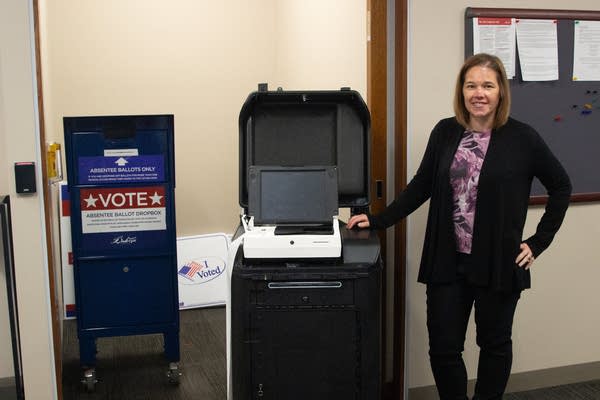
A woman stands next to a voting machine.
Michelle Blue, the director of elections for Dakota County, presents an absentee ballot box and a brand-new tabulator machine for counting votes at the Dakota County Administration Center June 8.
Cait Kelly | MPR News

What is an election judge and can I be one?

Election judges are volunteers or temporary paid employees who are required to oversee certain aspects of elections to make sure the law is being followed. Election judges are party balanced to make sure election oversight is fair.

“Our elections would not work without them,” Blue said. “Please come see the process up close and personal for yourself.”

To be an election judge you must be eligible to vote in Minnesota and must be able to read, write and speak English.




Source link

Leave a Reply

Subscribe to Our Newsletter

Get our latest articles delivered straight to your inbox. No spam, we promise.

Recent Reviews


Cisco’s Top Five Beaters

1. Expensive Solution

Cisco products necessitate a high level of operational overhead and a large number of licences. Cisco requires license to administer their APs with any of their controllers, and in some situations, licences for specific functions. As a result, wireless solution ASPs have been around 20-30% more than a competitive Fortinet quote. Customers that simply compare pricing at the hardware level may experience sticker shock as a result of this. 

To gain in-depth knowledge with practical experience in Cisco, Then explore HKR’s  Cisco Data Virtualization Training

2. Bolt-On Security 

Cisco isn’t a security company, and the majority of their security offerings are acquired and “bolted on” to their core networking product. As a result, compared to the Fortinet solution, there is less protection and integration.

3. Increased Management Overhead 

Cisco does not provide an easy way to handle all of their solution’s components. While they’ve created Digital Network Architecture (DNA) to address this, it comes with higher expenditures and (at least for the time being) restricted support for the entire portfolio. The FortiGate UI from Fortinet manages all access layers as well as security in a single interface, resulting in a faster ramp time and lower TCO.

4. Limited Flexibility in deployment 

While Cisco does provide a cloud controller via Meraki as well as standalone administration, users must decide which option is best for them up front and are then locked into that decision. Moving to or from their cloud architecture later on is expensive, as it necessitates the creation of all new AP SKUs. Fortinet has a series of universal access points that may be utilised with any of our management systems. A customer who decides to switch management choices incurs no additional cost or inconvenience because there is no need for a licence or reconfiguration. 

5. Location Analytics Are Not Available For Free

Customers do not have access to a free tier of Cisco’s location analytics product. This hinders the majority of customers from seeing the benefit that location analytics may provide.

To gain in-depth knowledge with practical experience in Cisco DCIT, Then explore HKR’s  DCIT Training !

Fortinet Training

  • Master Your Craft
  • Lifetime LMS & Faculty Access
  • 24/7 online expert support
  • Real-world & Project Based Learning

Why Fortinet? 

1. Fortinet Secure Unified Access 

The Secure Unified Access Solution was created by Fortinet to address security protection against data breaches and cybersecurity threats at the access layer.

To gain in-depth knowledge with practical experience in Fortinet, Then explore HKR’s Fortinet Certification Course!

2. Fortinet Security Fabric 

The Security Fabric from Fortinet is a comprehensive solution that includes:

  • Protection and visibility throughout the digital assault surface. In multi-cloud setups, siloed apps make it much more difficult to respond to attacks. Across all devices and applications, the Security Fabric provides real-time visibility.
  • Advanced threat detection and response are integrated. The Security Fabric improves communication between all of the company’s security systems, reducing detection and remediation times.
  • Through a single console, operations and analytics may be automated. Firms must detect attacks faster in the face of today’s complex threats. You can coordinate automatic reactions and cleanup to threats discovered anywhere across your extended network using the Security Fabric.
3. Secure Solutions In A Wide Range: 

Universal APs: This set of access points is compatible with any management system.

  1. FortiGate Integrated Wireless: FortiGate provides a comprehensive solution that includes security and wireless LAN administration.
  2. Cloud Managed: Using the Fortinet cloud, you can manage your wireless network from anywhere.
  3. Dedicated Controller Wireless: With various deployment choices and unique RF capabilities, a wireless network solution using a dedicated WLAN controller is possible.

Join our CLICA Training today and enhance your skills to new heights!

The Priorities Of Cisco’s Target Account (Who They Target) 

Cisco’s wireless LAN strategy targets both large and small businesses, as well as service providers, horizontally. They have the best success selling to accounts that aren’t price sensitive and are open to Cisco’s one-stop shop concept. Be aware that yoU may be dealing with many Cisco product portfolios rather than simply one. Meraki, SMB solutions, Mobility Express with embedded controller features, or the corporate solution with a real or virtual WLC are all options. Each has its own set of features and pricing range.

To gain in-depth knowledge with practical experience in Cisco, Then explore HKR’s  Cisco ENAUI TRAINING

Going On The Offensive Against Cisco Setbacks

To cope with the increased bandwidth and features, Cisco had to discard the access points’ IOS® code, which necessitated extensive rewriting and stabilisation work. In all modes, including FlexConnect and Mobility Express, it still has a large number of unfixed problems and lacks feature parity. The next generation of controllers will also be built on entirely new code (APIC-EM and elastic controllers), which will take years to perfect. Customers are well aware of this and are cautious of it.

  1. Cisco Weakness: For protection against developing threats, Cisco security for access incorporates a number of different products or solutions, including Stealthwatch, TrustSec, ISE, and Talos.
    How to Attack It: Position Fortinet Secure WLAN as a top-of-the-line wireless solution incorporated into a world-class security fabric.
  2. Cisco Weakness: Branching is not supported by Cisco Aironet. Meraki’s solution is positioned for small to medium branch sites. Meraki’s cloud solution is based on a subscription model, which means that if your subscription isn’t renewed, your devices will stop working.
    How to Attack It: Customers should be aware that Cisco and Meraki offer two separate product sets with non-unified management.
  3. Cisco Weakness: Customers must choose a management topology up front, which limits flexibility in Cisco architecture. Obtaining a complete feature set for guest management necessitates Cisco infrastructure, which may necessitate significant CAPEX investments or costly updates.
    How to Attack It: In the access, control, policy, and application levels, emphasise the versatility of Fortinet’s portfolio.

To gain in-depth knowledge with practical experience in Cisco PRNE, Then explore HKR’s  Cisco PRNE Training

Feature Comparison Defending Against Cisco Sales Tactics

  • What They Will Do: Make the claim that Fortinet’s technology is proprietary, expensive to implement, and difficult to manage.
    How to Respond: The Wi-Fi Alliance has verified all Fortinet infrastructure products as meeting industry standards. Fortinet APs support all common enterprise settings. Our Virtual Cell technique is a non-disruptive approach (Cisco doesn’t provide this service) that does not add to the complexity of management.
  • What They Will Do: Position security as a key attribute and differentiator of Cisco’s WLAN solution. 
    How to Respond: Only Fortinet offers enterprise-grade encryption and authentication, per-user and per-application security rules, VPN for remote offices, threat and rogue detection and mitigation, and wireless intrusion detection.
  • What They Will Do: Full-fledged network access control with posture assessment is pushed, including the ability to refuse access depending on device attributes.
    How to Respond: NAC posture evaluation is a more complex variant of NAC that most customers will find difficult to implement, and adoption rates are low since ISE is time-consuming and costly. Cisco understands that the majority of clients demand simple guest access and BYOD onboarding, which FortiNAC provides with complete third-party support, including Cisco.
  • What They Will Do: Declare that they have the most comprehensive wireless portfolio available for any wireless application.
    How to Respond: Without the requirement for distinct SKUs for cloud vs. standalone management, Fortinet’s portfolio supports the same number of use cases. FortiPresence now has a lot more features than CMX, and virtual wireless LAN controllers and the cloud are now a reality at Fortinet.

Wish to make a career in the world of Cisco ACI? Start with Cisco ACI Online Training!

HKR Trainings Logo

Subscribe to our YouTube channel to get new updates..!

Comparison Of Features: 

  • Wi-Fi infrastructure is provided by both Fortinet and Cisco for multivendor client environments.
  • FortiNAC ensures BYOD security with no bloatware connectivity solution, competitively priced, marketproven. E.g., endpoint policy enforcement, MDM, NAC, multiple subscription licenses. The BYOD security will be Cumbersome and ISE is expensive for Cisco.
  • Co-channel interference is managed through wireless virtualization, and channel layering is supported, allowing for higher client capacity that is supported in Fortinet but not in Cisco.
  • Options for a virtualized controller and management suite (private cloud solutions) are offered by both Fortinet and Cisco.
  • Fortinet and Cisco both provide ultra-high density designs with a 160 MHz channel.
  • The Fortinet ARRP and Cisco  RRM supports RF management.
  • Fortinet FortiWLM supports proactive network health visibility, analytics, and synthetic testing for onsite and remote wireless service assurance and Cisco is developing it as the future scope based on cloud.
  • Improved analytics and location, social Wi-Fi integration are offered in Fortinet FortiPresence and Cisco CMX.
  • Spectrum intelligence with visibility of Wi-Fi and non-Wi-Fi interferers are provided by both Fortinet and Cisco.

Want to Become a Master in CISCO SSFIPS? Then visit HKR to Learn CISCO SSFIPS Training!

Fortinet Training

Weekday / Weekend Batches

Conclusion:

Through this blog, we have analysed Fortinet and Cisco through comparisons made on security, solutions, features, etc.


Source link