
Frustrated rural hospitals waiting on federal funding


Winona Health hospital entrance

Rural health care providers in Minnesota and across the country are bracing for heavy Medicaid funding cuts next year.

They're part of President Donald Trump’s tax breaks and spending cuts package known as the One Big Beautiful Bill Act he signed into law last year, and includes nearly $1 trillion in Medicaid spending cuts over 10 years. As it made its way through Congress, lawmakers worked to appease some congressional Republicans concerned about how cuts could disproportionately impact rural hospitals and health providers, which see a larger portion of Medicaid patients.

The Trump administration offered $50 billion in federal funding to states over the course of five years to “transform” the rural health care delivery ecosystem, referred to as the Rural Health Transformation Program. But, six months after those grants were supposed to roll out, rural health facilities in Minnesota are still waiting on the promised money.

Multiple rural hospitals told MPR News they’re frustrated with delays and the restrictions of the application. Some worried about applying at all because of the payment model and the burdensome application.

And they say the money, which comes with strict guardrails, won’t help where hospitals say they need it most: offsetting the impending Medicaid losses.

“It's sort of like they're in a boat that's full of water, and somebody throws them an oar, so they can row faster instead of throwing them a life preserver,” said Joe Schindler, vice president of finance policy at the Minnesota Hospital Association.

What’s Minnesota working with?

Minnesota received $193 million for the first fiscal year. The bulk of that — 70 percent — is set aside for rural hospitals and must be spent by September 2027.

According to an analysis by national health policy group KFF, Minnesota received less than many states when adjusted for population at about $114 for each of the state’s 1.6 million rural residents.

Ten states received less than $100 per rural resident. Texas came in at the bottom with $66 per rural resident. Eight states were awarded more than $500 per rural resident, including Rhode Island, which is taking home more than $6,000 per rural resident.

How these allocation decisions were made is unclear, but Diane Rydrych, Minnesota Department of Health health policy director, said she’s happy with the funds awarded to the state by the Centers for Medicare & Medicaid Services.

“There was certainly a lot of speculation, and just a lot of wondering ahead of time about how CMS would approach this,” Rydrych said. “We tried to just be optimistic and open-minded about where we would end up in Minnesota, and not sort of succumb to any preconceived notions about where we would land. There's not necessarily a pattern, red or blue, large or small, more or less rural in that sense, in terms of how states ended up.”

Applicants could request items that fell within categories outlined by the state health department and CMS, like community based preventative care, chronic disease management, bringing health care services close to home, investing in technology and creating regional care models to improve whole person care.

The Minnesota Hospital Association said the bulk of requests revolved around technology. For example, Madelia Health, a small critical access system in southern Minnesota, said it requested funds for technology to improve chronic care management and improve telehealth options for patients as well as AI assistance that providers could use to streamline note taking and hospitals could use to code bills quicker.

An aggressive timeline still yields delays

Minnesota received word of its grant amount in December, but Zora Radosevich, director of the Office of Rural & Primary Care at Minnesota Department of Health, said it took the next four months to settle on the final budget with CMS. Hospitals were required to apply for funding by late May.

Radosevich said her experience working with CMS has been positive and productive. The state health department has been trying to balance speed with the due diligence and careful review that’s required.

But, rural health providers are frustrated. Six months into the program, none of them have seen a penny. The health department said they don’t know when the approval process will conclude.

“This all took way more time than we expected, given what was talked about back at the end of last year, [when] the federal government said, ‘Hey, we're going to send this money after the first of the year, and you should have your money in hand fairly quickly after that,’” Schindler said. “That was not the case.”

A burdensome application process

While the rural facilities said they’re grateful for any funding, the application was no easy feat. For some it was a barrier.

Rural health care facilities had about a month to put together the applications. That meant consulting subject matter experts, coordinating with vendors to see who could work within the upcoming budget cycle and sorting through staff — already stretched thin — to figure out who can take on the task of writing, managing and implementing the grant. Since the grant is so restrictive, it was also often too convoluted to figure out which requests qualified.

Lisa Bjerga, president and CEO of Lakewood Health System about an hour north of St. Cloud, said she heard from some peer hospitals during the application process that they planned to skip it all together.

“Hospitals are just saying we can't do it,” Bjerga said. “‘We don't have a grant writer, we don't have the resources to do this, it's too complex,’ and so they're just not applying.”

An aerial photo of a hospital
An aerial photo of Lakewood Health System in Staples, Minn.
Courtesy of University of Minnesota/Lakewood Health System

The payment model offered its own challenges. Applicants awarded funds are required to front the costs and await reimbursement.

Rydrych of the state health department said this is Minnesota’s standard grant policy and helps ensure fraud prevention, but acknowledged it can be a barrier for financially strapped hospitals.

That’s true for Madelia Health. President and CEO Dave Walz said the health care system has been on a line of credit with a local bank for more than two years. Making payroll is a constant stress. Paying for grant funds and awaiting reimbursement feels almost impossible.

“If you don't have additional funds to spend, how are we supposed to utilize this program?” Walz said.

The health department said it's offered more frequent invoicing to support hospitals like Madelia, but Rydrych said she’s not sure when it will be able to even start the reimbursement process.

A political concession

The Rural Health Transformation grant program is not meant to fund basic operations or uncompensated care, but to sponsor innovations that help deliver care more effectively in rural areas. A CMS spokesperson described it to MPR News as “catalytic, forward-looking funding to help states and providers transition to more sustainable models of care.”

Rural health care providers told MPR News their biggest frustration is the Trump administration developed the grant to pass the tax and spending cuts. But, grant restrictions forbid grantees from spending where they need it most.

The Minnesota Hospital Association estimates Minnesota will miss out on more than $2 billion in federal health care funding just in the first fiscal year alone, 2028, under Trump’s bill. It also estimates around 140,000 Minnesotans will lose Medicaid eligibility and another 60,000 will likely drop their Affordable Care Act health insurance because of rising costs. That means more uncompensated care, emergency room visits and requests for hospital financial assistance.

“It's not going to do anything to help with the Medicaid situation that's coming down the pike,” said Rachelle Schultz, president and CEO of Winona Health in southeast Minnesota. “It doesn’t even come close.”

And Bjerga of Lakewood Health System said the mandate seems to ignore the dire realities rural health facilities face.

“They're saying, ‘Oh, here's some free money we gave you for transformation, but yet we took away way more than that,’” Bjerga said. “It's really hard to be in a space of transformation when we're in survival mode.”




Source link

Leave a Reply

Subscribe to Our Newsletter

Get our latest articles delivered straight to your inbox. No spam, we promise.

Recent Reviews


The McLaughlin Group

There was a sketch on Saturday Night Live where Dana Carvey played news talk show host John McLaughlin.

The recurring gag was that McLaughlin would ask the guests a serious political question, each would give a thoughtful answer, and McLaughlin would shout “WRONG!”

I think about that a lot when I’m doing deposition preparation with clients in trade secrets lawsuits.

Let’s go over some common ways defendants in trade secrets lawsuits go wrong in their depositions. We’ll use our old hypothetical friend Dawn Davis as an example

1. Are the things defined as “confidential information” or “trade secrets” in the agreement actually confidential or secret?

Like most employment agreements, Dawn’s agreement with Paula Payne Windows includes a confidentiality agreement.

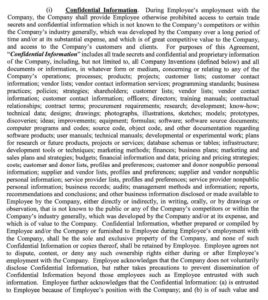
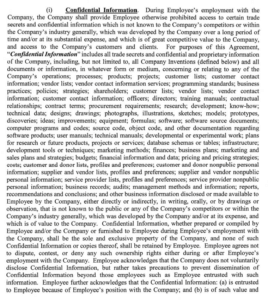
The definition of “confidential information” looks something like this:

The deposition questions about it go something like this:

Q: Can you take a look at the definition of the company’s “confidential information and trade secrets” in your agreement? Do you see that? 

A: Yes.

Q: You signed this agreement, right?

A: Yes, I signed it.

Q: So you agree that the things listed in this definition are the company’s confidential information, right?

A: Right.

WRONG!

What a difference a single letter can make.

If the question was “you agreed that the things listed in the definition are the company’s confidential information,” then yes would be an acceptable answer. That’s because generally, if you sign an agreement, you agreed to what’s in it.

But just because you signed the agreement doesn’t mean you now agree with every statement in the agreement.

See the distinction?

Yes, you may have agreed to what’s in the agreement by signing it, but just because the agreement says something is true doesn’t make it true.

Especially when it comes to a definition of “confidential information” or “trade secrets.”

The problem with this definition—and most definitions of confidential information in such agreements—is that it is both too vague and too broad.

These are slightly different things.

The definition is vague, or “indefinite,” because it is not clear what is included and what is not. For example, the definition refers to the company’s “processes” and “policies.” Which processes and policies? All of them, or just the “confidential” ones? And which ones are confidential?

Let’s say Paula Payne Windows has a process for prospecting for new customers: search on the internet for the kind of companies that buy windows, find the contact information for the person there responsible for buying windows, cold call that person, then make a note in the company’s CRM system to follow up later.

That’s a process, but is it a confidential process? Of course not. Everybody has a process like this. It’s no secret.

Is that process included in the contract’s definition of “confidential information”? It’s hard to say.

But you could read the definition literally to mean that all of the company’s processes are included in the definition of confidential information. And that brings up the second problem: the definition is overbroad.

The definition is overbroad because on its face it includes things that are not confidential.

An agreement that defines all of the company’s information as confidential would be unreasonable and unenforceable. It would be a de facto non-compete.

When you understand these two problems, you can answer deposition questions more accurately.

Q: So you agree that the things listed in this definition are the company’s confidential information, right?  

A: Not necessarily.

Q: Why not?

A: Well, first, I’m not even sure what this definition means. And second, it has things in it that are obviously not confidential information.

Q: Like what?

A: Like “processes” and “policies.” If that means all of the company’s processes and policies, then it includes things that are obviously not a secret. 

This answer won’t make the questioning lawyer happy, but you’re not there to make friends.

2. Is a customer list a trade secret?

Suppose when Dawn Davis left Paula Payne Windows, she took an Excel spreadsheet showing all her sales from the previous year, including the names of the customers. Dawn says she needed the list because the company owed her commissions, but Paula Payne Windows says the spreadsheet is a confidential customer list.

So the deposition questioning goes like this:

Q: You’re not a lawyer, are you?

 A: No.

 Q: Ok, I’m not asking for a legal opinion or anything, but do you see this definition of “trade secrets” from the Texas Uniform Trade Secrets Act?

A: Yes.

Q: The definition includes “list of actual or potential customers,” right?

A: Yes, I see that.  

Q: [in the most casual tone possible] Ok, so you understand a customer list is a trade secret, right?”

A: Yes, I understand that.

WRONG!

Perhaps we can forgive Dawn for making this mistake. I have seen licensed lawyers make this very argument to judges. “Your Honor, the definition of trade secrets in TUTSA specifically includes customer lists, so my client’s customer list is a trade secret.”

But the argument is wrong, for two reasons.

First, if you look at the whole definition of a trade secret, there’s a very important word: “if.”

A customer list is included in the list of types of things that can be a trade secret, if the rest of the elements of the definition are met (like “independent economic value”).

The first problem with the deposition question was that it ignored this important “if.”

The second problem with the argument is that it just defies common sense.

Think about it. Suppose Dawn’s spreadsheet lists just five customers, who happen to be the biggest homebuilders in her sales territory. There’s no way that’s a trade secret. All the competitors in that area know who those customers are.

If you want to know more, I cover this issue in more detail at my blog post When Is a Customer List a Trade Secret. I even cite court cases. But you get the idea.

Now that Dawn is armed with the knowledge that a customer list isn’t automatically a trade secret, let’s give her another crack at the deposition question:

Q: Ok, so you understand a customer list is a trade secret, right?”

A: No.  

Q: But it says that right there in the definition, doesn’t it? 

A: It says customer list, but there’s more to the definition.

Q: So you don’t think your customer list is a trade secret? 

A: No. Everybody in our industry knows who those customers are.

Now that we’ve avoided that confusion, let’s look at another category of information that can be a trade secret but isn’t necessarily a trade secret: prices.

3. Are the company’s prices trade secrets?

After customer lists, the next most common type of alleged “trade secret” is prices. I cover this at my blog post The Price Undercutting Theory in Trade Secrets Litigation.

Here’s how the lawyer for Paula Payne Windows might try to set it up in Dawn’s deposition:

Q: Are you working for Real Cheap Windows now?

A: Yes.

Q: Let’s say a competitor calls you up and asks you for the prices you’re charging customers this week, would you tell him?

A: Uh . . . I don’t think that has ever happened.

Q: But if it did, would you tell them?

A: I mean, I don’t think so.

Q: Why not?

A: Well it’s none of their business.

Q: And if they knew your prices they could offer the same customers lower prices, right?

A: That could happen.

Q: Can your competitors just do a Google search and find your prices?

A: No.  

Q: Right, so the prices your company charges its customers are confidential, right?

A: Yeah, I guess so.

WRONG!  

Don’t let this happen in your deposition

Everything leading up to the last question is fine, but are the prices really a secret?

Nine times out of ten, the answer will be no, at least in my experience and opinion.

That’s because in the vast majority of cases, there’s nothing to stop the customers from telling one competitor what another competitor is charging.

In fact, in many industries, it’s common for customers to do so. “Hey, Fred, Bubba’s Oilfield Supply says it can get me those frac valves for five thousand apiece this week, can you beat that?”

Unless the company has a nondisclosure agreement with the customer that says the customer must keep the company’s prices confidential, I don’t see how the company can genuinely claim the prices are a secret, or that it took the required “reasonable measures” to keep the prices secret.

Keep in mind, this is just my opinion. But it is usually correct.

Knowing that, here’s a better way for Dawn to answer deposition questions about prices:

Q: So the prices your company charges its customers are confidential, right?  

A: No.

Q: They’re not confidential? Are you saying you would just give them out to your competitors?

A: I didn’t say that.

Q: Well, if the prices aren’t confidential, why wouldn’t you share them?

A: They can easily go and ask my customer for the prices, and I can’t stop the customer from telling them. But that doesn’t mean it’s my job to help them.

So, those prices on the spreadsheet Dawn took from Paula Payne Windows, maybe they’re not so secret.

That, of course, does not mean it was a good idea for Dawn to take the spreadsheet.

4. What does the forensics show?

It’s a bad idea for departing employees to take or keep any company documents.

With the exception of their agreements with the company, which I think are generally fair game for an employee to keep. But generally, don’t take company documents when you leave!

There are multiple reasons for this, but maybe the most important one is that whatever documents the employee takes, those will be the documents the company claims contain its alleged “trade secrets” in the subsequent trade secrets lawsuit. I call this Wolfe’s First Law of Trade Secrets Litigation.

Here’s how it might go down in Dawn’s case:

Q: When you were working for Paula Payne Windows, did they provide a computer?

A: Yeah, I had a computer at the office.

Q: Did you ever use USB drives?

A: You mean like a thumb drive?  

Q: Yes. 

A: Sure, we used those all the time, like if I needed to take documents with me on a customer visit.

Q: Let me show you Plaintiff’s Exhibit 13 to your deposition. That’s a report our forensic expert prepared. Do you see that?

A: Yes.

Q: Do you see line 7 on page 2 that shows on April 7, 2023, the day after you gave notice, you plugged a Seagate thumb drive into your computer at work and copied 12 sales reports to it?  

A: Yes.

WRONG!

Dawn doesn’t have any personal knowledge of the forensic report or how it was prepared. And her recollection is probably not that specific. How can she be sure?

Here’s a better way for Dawn to answer:

Q: Do you see line 7 on page 2 that shows you copied 12 files on to a thumb drive?

A: I didn’t prepare this report.  

Q: Ok, but you see where it says that, right?

A: I see that the report says that.

Q: Well, are you denying that you copied 12 files on to that thumb drive on April 7, 2023?

A: I’m not denying there were times when I put files on a thumb drive, but I can’t remember if I copied those specific files on that specific date.  

Q: Ok, but you can’t rule it out?

A: I can’t rule it in or out. I just don’t remember.

Sticking to what you personally know is good deposition advice generally, but especially when it comes to computer forensics in a trade secrets lawsuit.

Let me stress: I am not saying Dawn should pretend like she doesn’t know or doesn’t remember if she does remember. Every witness should tell the truth. If Dawn clearly remembers, “yes, I copied 12 files on to a thumb drive on April 7, 2023,” then she should say so.

But it’s rare that the witness will remember that specifically.

In most cases, a witness in a deposition is not going to remember every little thing she did on a computer years earlier, before any lawsuit was filed. She certainly won’t remember things like the serial number of the USB drive.

And that brings up the final common deposition mistake to avoid in a trade secrets lawsuit.

5. Undermining your credibility by overstating your case

Maintaining your credibility is critically important in any lawsuit.

And if you’re a former employee defendant in a trade secrets lawsuit, it is even more important than usual. Right off the bat your credibility is under attack because you did something your former employer portrays as sneaky and underhanded. “Theft!” they will cry.

And you should expect the plaintiff’s lawyer will go into the deposition ready to set you up. It might go like this:

Q: Can you take a look at page 27 of the Paula Payne Windows Employee Handbook?

A: Ok, yes, I’m there.

Q: It says “Employees must take care not to disseminate company documents outside the company, such as sending them to personal email addresses.” Did I read that correctly?

A: Nobody ever paid attention to that.

Q: Ok, but that was the company’s stated policy, correct?

A: Yeah, I guess.

Q: Ok, so you knew it was against company policy to email yourself company documents, right?

A: Right.

Q: Did you ever do that?

A: Absolutely not. I never emailed myself company documents.

WRONG!

The answer is wrong because you already know what’s coming next: Impeachment.

The lawyer for Paula Payne Windows will show Dawn a copy of an email from her company email account to her personal Gmail account attaching a proposal to a customer.

“Oh, I forgot about that!” Dawn will say. “I was going to meet with a customer out of the office the next day, and I needed to be able to print out the proposal at home.”

A legitimate explanation, if true. But the damage will already be done.

So for questions like this, it’s important to be cautious and not overstate your case.

In this example, there are basically three possibilities:

  1. Dawn remembers emailing herself the proposal, or at least remembers emailing herself generally.
  2. Dawn has no recollection of emailing herself company documents, but knows it’s possible she did.
  3. Dawn knows for a fact she never emailed company documents to herself.

If 1 is true, then Dawn should say so.

If 2 is true, then Dawn should say something like “I don’t have a specific memory of doing that.” Then she’s leaving room for the possibility that it happened.

If 3 is true, then Dawn could say she never emailed herself company documents, but even then, she should proceed with caution.

You see, memory is a funny thing. Every litigator has experienced a client who was 100% sure of some fact or sequence of events, and then the documents show her memory is just flat wrong.

So even if Dawn is absolutely sure, it’s still a good idea to say something like “I don’t think I ever did that.”

You don’t need to overstate the good facts that are on your side.

On a scale of 1 to 14, 1 being lowest degree of likelihood, 14 being absolute metaphysical certitude, what are the chances you’ll make a mistake?

Go ahead, say your answer.

WRONG!

_______________________

Zach Wolfe (zach@zachwolfelaw.com) is a Texas trial lawyer who handles non-compete and trade secret litigation at Zach Wolfe Law Firm (zachwolfelaw.com). Thomson Reuters has named him a Texas Super Lawyer® for Business Litigation every year since 2020.

These are his opinions, not the opinions of his firm or clients, so don’t cite part of this post against him in an actual case. Every case is different, so don’t rely on this post as legal advice for your case.


Source link