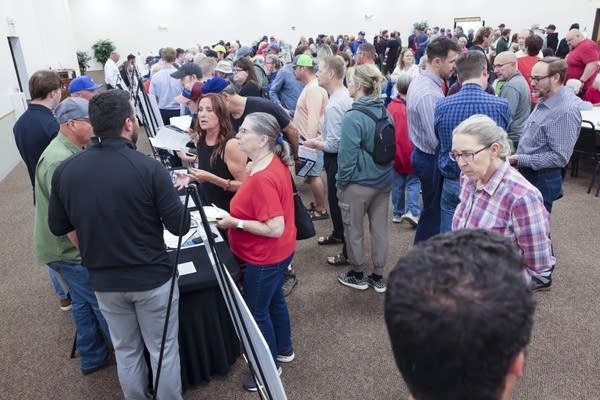
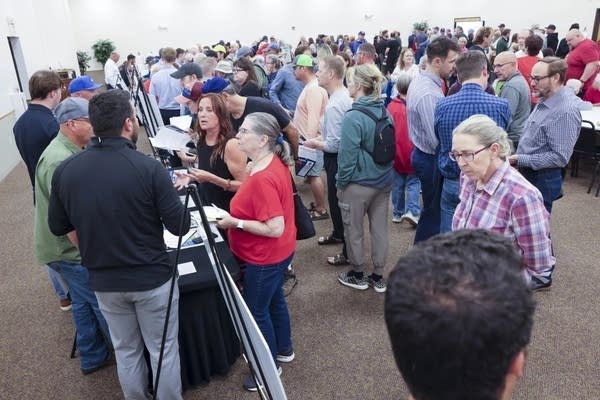
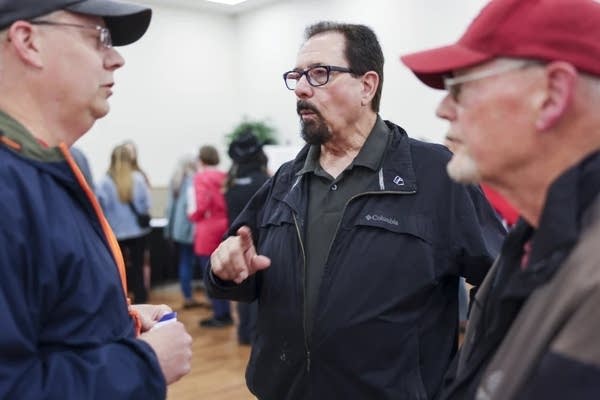
Hundreds of people crammed into an open house hosted by Google Wednesday night in Hermantown, where the tech giant attempted to assuage community concerns and answer questions about the proposed large-scale data center it’s seeking to build just outside Duluth.
People lined up to ask questions of representatives of Google and others involved in the project, including the construction firm Mortenson and Minnesota Power. They milled about at stations that displayed information on a host of issues, ranging from energy and water use, to noise and light pollution to the project’s economic impacts.
There wasn’t a formal presentation by Google, or an opportunity for members of the public to comment. Rather Google billed the event as an informal chance for people to speak directly with and ask questions of project leaders and other experts.
“We're at a phase in the project where we have enough answers to many of the questions that the community is asking,” said Tyler Huebner, Google’s manager of energy market development for the central U.S.
“We certainly understand the concerns about transparency, and this open house hopefully is a start at rebuilding that trust in the community.”

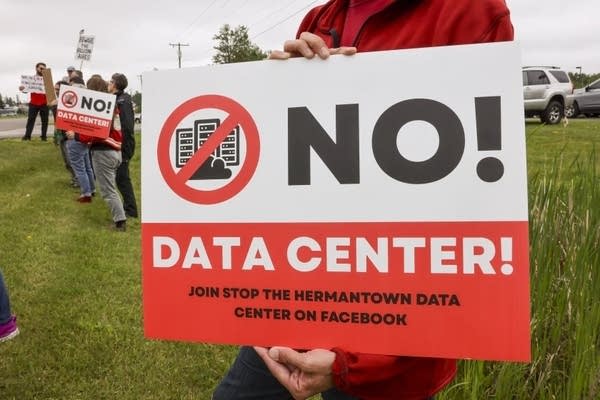
The proposed data center in Hermantown has generated intense public scrutiny and pushback since details began to emerge late last year. For months, rumors had swirled about a massive development proposal in a rural corner of the city. But the project was shrouded in secrecy.
Emails and other internal documents revealed that city officials had been engaged in discussions for over a year with project developers about the proposal, dubbed “Project Loon,” before the city and Google released details to the public. Several Hermantown and St. Louis County officials signed non-disclosure agreements, or NDAs, which prohibited them from discussing details with area residents.
The open house was held after residents came out in droves last month to oppose the massive proposed data center at a recent Hermantown city council meeting, where members voted to delay a decision on providing substantial tax breaks for the project.
Resentment over what many view as a lack of transparency still lingered among several attendees of the open house.
“The information was helpful, and I appreciate the efforts that Google is making to try to address the concerns,” said Hermantown resident Bret Reuter as he was leaving the event. “But I don't know that I'm walking out of here feeling reassured.”
Reuter is especially worried about the immense amount of electricity that data centers require, and that the Hermantown project could cause electric rates to rise down the road. He believes Google should pledge to pay for any increase in rates.
“I think that there's probably some creative things that big companies like Google can do to gain the trust of people that are concerned,” Reuter added.
Google is trying to make the case that it does data centers differently than the handful of other huge tech companies scrambling to build hyperscale data centers around the country to provide the computer muscle needed to power the growth of artificial intelligence and cloud computing.
Huebner says the Hermantown facility is needed to serve Google’s growth, as more and more people use Google Maps, Gmail, YouTube, and other apps and services, including rapidly developing AI platforms.
For the Hermantown facility, Google has reached an agreement with Duluth-based utility Minnesota Power to build 700 megawatts of new clean energy sources to provide electricity for the massive development, including 300 megawatts of wind energy and 400 megawatts of battery storage capability.
The company has said Minnesota’s law requiring utilities to produce 100 percent of their electricity from carbon-free sources by 2040 played a role in its decision to build data centers in Hermantown and Pine Island, Minn., near Rochester.
Google also says it leads the industry in conserving water at its data centers. The company is looking at two options to cool the Hermantown facility– air cooling and a closed-loop design that recirculates water– both of which require minimal amounts of water. The trade off, however, is that these cooling methods require more electricity.
“We're a very strong corporate actor,” said Google’s Huebner. “We want to build this in a responsible way and operate it in a responsible way that we think can provide a lot of benefits to Hermantown and northern Minnesota for years and decades to come.”
Google has pledged to spend about $130 million to extend utilities and infrastructure to the proposed site. In exchange, Hermantown has reached a tentative agreement to offer Google a property tax break of up to $80 million, pending city council approval.
The company has also agreed to pay the city and school district about $45 million over the next few decades, in addition to tens of millions more in tax revenue the project would generate over its lifetime.
“I think there's a lot of opportunity here from an economic impact perspective,” said Brad Orn, a Duluth resident and Hermantown business owner who attended the open house.
“There's a whole area of Hermantown that could get developed because of this that wouldn't normally otherwise get developed. So I think that needs to be looked at.”
Orn, who’s a board member for the Hermantown Chamber of Commerce, acknowledged the issue is touchy. He said everyone in the community is on edge about it. He believes there’s a “silent majority” that supports the proposed data center.
But for many in Hermantown, there’s not much Google can say that would change their minds about the project.
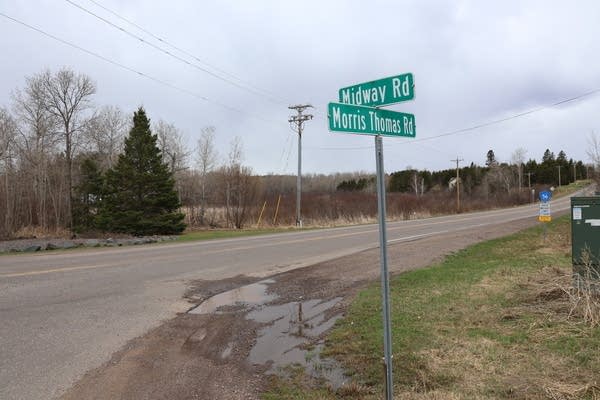
Hermantown resident John Nordin lives just across the road from the proposed data center, where six generations of his family have lived. Google plans to build four enormous buildings in stages on the 280-acre site to house the computer equipment, each about the size of five football fields and up to 50 feet high. The first phase would cost about $650 million to build, with the total investment nearing $2 billion.
His son Mike Nordin grew up on the property hunting and fishing and now lives in Duluth. He said he received only “boilerplate” answers to his questions at the open house that glossed over legitimate community concerns.
“We asked a guy if he'd live across from something like this, and he hesitated. People don't want to live across from something like this, nor should it be forced upon people,” Mike Nordin said.
“The reality is it's damaging and it's hurtful to a rural area,” he added. “Not everything can be developed in this world, and that is an area that shouldn't be developed.”
The Hermantown city council approved a zoning change last October to allow the data center to be built at its proposed location next to a Minnesota Power electric substation.
But it tabled a vote last month on the proposed tax abatement package. The council is expected to take up a revised environmental study of the proposal sometime after Labor day, before it reconsiders the tax package.
Meanwhile, a citizen group that formed last year to fight the proposed data center has filed two lawsuits to try to block it, including one that argues the environmental review of the proposal has been insufficient.
“I wish we could have more information out to the public on the specifics of the project,” said Hermantown Mayor Wayne Boucher, who attended the open house but stressed that the city didn’t play a role in organizing it.
“This is all their deal. We're glad that they're doing it. I wish it could have been done a little sooner,” he said.
Boucher said many of his constituents still have unanswered questions about the project, himself included. But he declined to detail them, saying only they are concerns he has learned from listening to people.
“I don't know where it goes from here, but I think it's a good start,” Boucher added. “I hope we can just keep doing this as civilly as possible. Sometimes there's been a tendency for people to lose control a little bit.”